Heritage · Museum
Guggenheim Museum Bilbao: The Building That Remade a City
The Guggenheim Museum Bilbao opened in 1997 on a derelict stretch of Bilbao's waterfront and became the most argued-over museum of its generation. Frank Gehry's titanium building is credited with transforming a fading industrial city, a claim the article weighs alongside what the museum actually holds.Written to last.
By Confinity Heritage Editorial · 2026-08-23 · 7-minute readQuiet tools, kept out of the way.
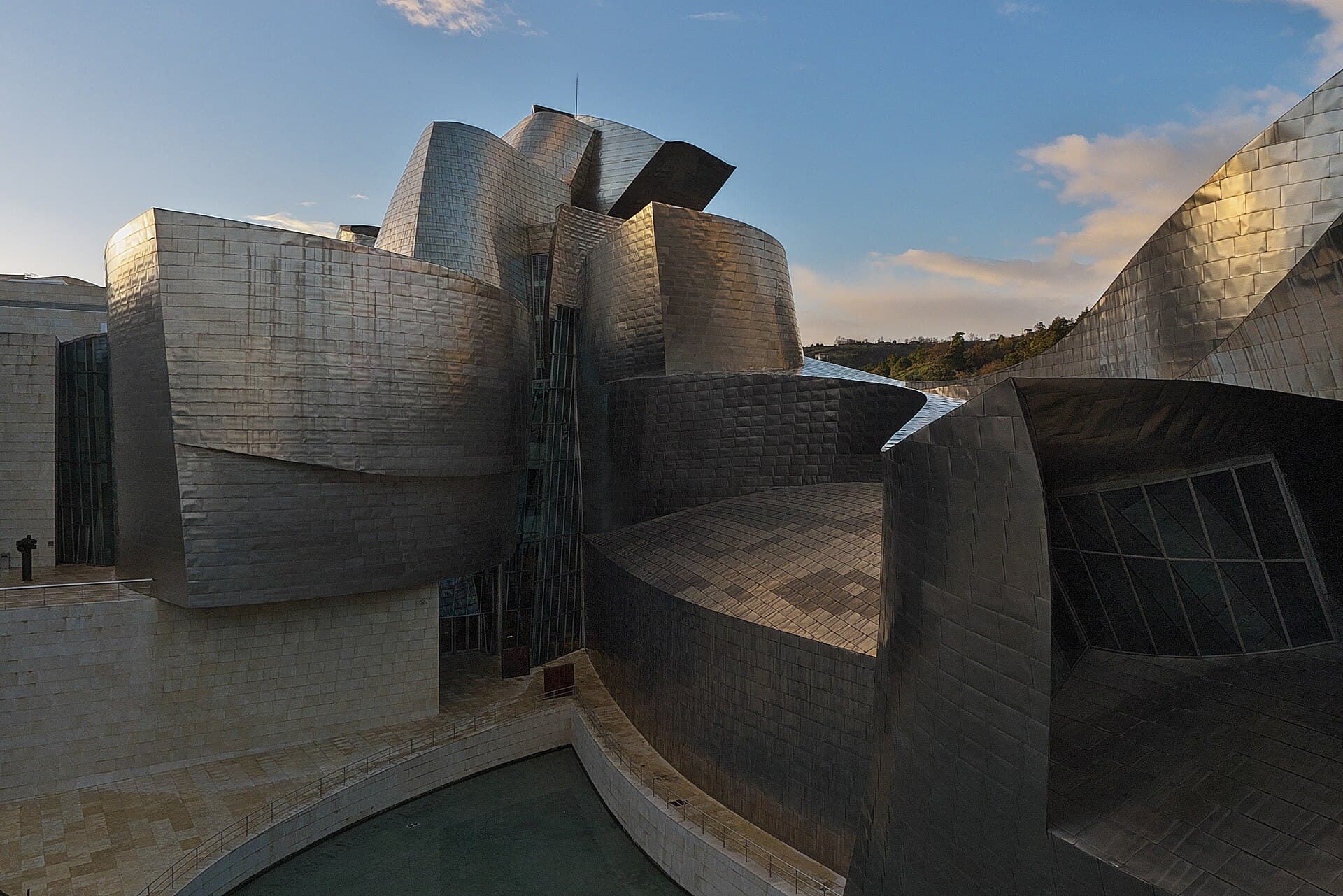
Most museums are remembered for what they hold. The Guggenheim Museum Bilbao is remembered for what it did to its city. When it opened in October 1997, its swirling titanium mass stood on a waterfront that had recently been shipyards and mud, in a city much of Spain had written off. Within a year more than a million people had come to see it, and "the Bilbao effect" had entered the vocabulary of every mayor with a struggling downtown. The art inside is serious, but the museum's central exhibit has always been itself: the most famous claimed proof that architecture can turn a city's story around. This article covers the gamble that produced it, the building Frank Gehry made, the collection it houses, the debate it started, and what a visit involves.
To understand the risk, it helps to picture Bilbao in the late 1980s. The city had been the industrial engine of the Basque Country for a century, built on iron ore, steel mills and shipbuilding along the Nervión river. By the 1980s that economy had collapsed. The shipyards and blast furnaces were closing or gone, regional unemployment ran above twenty percent, the Nervión was one of the most polluted waterways in Spain, and the armed Basque separatist group ETA was still killing. Bilbao was a city nobody visited on purpose.
The Basque regional government decided to spend its way out, and it decided to do so partly through culture. In New York, the Solomon R. Guggenheim Foundation, under its expansionist director Thomas Krens, was looking for partners willing to pay for the Guggenheim name, collection and management expertise. The two sides struck a deal in 1991 that had no real precedent: the Basque administrations would pay for everything, including construction of around $89 million, a $20 million fee to the foundation, and a fund of roughly $50 million for new acquisitions, a public commitment that ran well past $100 million in total. In exchange, Bilbao got a franchise of one of the most famous museum brands in the world, and access to a collection it could never have assembled on its own. Critics called it a colossal waste of Basque money on an American label; the government called it an investment in a different future.
An invited competition in 1991 asked three architects for a design, and the Californian Frank Gehry won it. Construction began in 1994 on the Abandoibarra waterfront, the derelict heart of the old port. The opening on 18 October 1997, attended by King Juan Carlos I, was shadowed by the old Bilbao the museum was built to escape: five days earlier, ETA members posing as gardeners had tried to plant grenades in flower pots outside the entrance, and shot dead a young Basque police officer, José María Aguirre, when he confronted them. The museum opened anyway, and the crowds came immediately.
The museum was designed for large-scale postwar and contemporary art, and its programme has stayed true to that. The vast, irregular galleries suit work that ordinary museums cannot physically hold, and the collection, shared between Bilbao's own acquisitions and loans from the wider Guggenheim network, leans toward artists who work at the scale of rooms rather than walls.
The anchor is Richard Serra's The Matter of Time, installed permanently in 2005 in the building's longest gallery, the 130-metre hall known informally as the Fish Gallery. Eight enormous sculptures in weathering steel, torqued ellipses and spirals with walls that lean and curve overhead, turn walking into the medium: the work happens in your body as much as your eyes. Serra and Gehry circled each other warily for years over whose work was serving whose, which is itself a fair summary of the museum's central tension.
Outside, two sculptures have become the museum's public face. Jeff Koons's Puppy, a twelve-metre West Highland terrier carpeted in living flowers, sits on the city side of the entrance and has become Bilbao's unofficial mascot, replanted with fresh flowers twice a year. On the river side stands Louise Bourgeois's Maman, a nine-metre bronze spider on delicate legs, guarding her marble eggs above the walkway. Inside, the collection includes major works by Anselm Kiefer, Eduardo Chillida, Jenny Holzer and Yves Klein, alongside a rotating programme of large temporary exhibitions that has ranged from Rothko and Hockney to shows of Basque and Spanish art.
Gehry's brief was, in the words the Basque negotiators used, to produce for Bilbao what the Sydney Opera House had done for Sydney. What he delivered is a building of about 24,000 square metres, with 11,000 square metres of exhibition space in nineteen galleries, wrapped in some 33,000 paper-thin titanium panels that shift from silver to gold to grey as the Atlantic light changes. The forms are usually read as a ship, or a fish, or both: Gehry had long been obsessed with fish as a form, and the building's curved metallic volumes bend along the Nervión like something surfacing from it, sliding under the adjacent La Salve bridge and rising into a tower on the far side. The street facades, by contrast, are relatively sober limestone and glass, scaled to the nineteenth-century city behind them. A fifty-metre atrium, taller than the rotunda of the original Guggenheim Museum in New York, twists upward at the centre, with walkways and glass lifts feeding the galleries.
A detail worth noting, because it is the part of the story architects still cite: none of it should have been buildable at the price. Gehry's office adapted CATIA, an aerospace modelling programme developed for fighter jets, to translate the curved physical models directly into fabrication data, so that every uniquely shaped panel and steel member could be cut by machine rather than priced as bespoke craftsmanship. The result was that one of the most formally extravagant buildings of the century came in on schedule and close to its budget, a fact that did as much as the titanium to change what clients believed possible. Philip Johnson, the elder statesman of American architecture, stood in the atrium and called it "the greatest building of our time," and the phrase has been attached to it ever since.
The numbers became a legend in urban policy. The museum drew 1.36 million visitors in its first year and has averaged around a million a year since, in a city of about 350,000. Visitor spending was estimated to have generated enough tax revenue to repay the construction cost within a few years. Bilbao's self-image changed at least as much as its economy: a city known for rust and violence became shorthand for reinvention, and delegations from post-industrial cities everywhere arrived to study how it was done.
The caution belongs alongside the legend. Scholars of the "Bilbao effect" point out that the museum rode a much broader renewal the Basque authorities were funding at the same time: a new metro with stations by Norman Foster, opened in 1995, the cleanup of the Nervión, a new airport terminal, and the replanning of the Abandoibarra docklands. The museum was the flag on that effort, not the effort itself. And the effect has proved stubbornly hard to export: dozens of cities commissioned spectacular buildings by famous architects in the decades that followed, and almost none saw anything like Bilbao's transformation. The lesson was less "build an icon" than "plan a whole city's recovery and give it an icon."
The franchise model drew its own fight. Critics coined the term "McGuggenheim" for what they saw as a museum chain selling its brand to the highest bidder, and Basque artists and intellectuals protested that public money was importing New York's collection and priorities instead of supporting Basque culture. The museum's answer has come through its programming: sustained exhibitions and acquisitions of Basque and Spanish artists, Chillida and Oteiza among them, a Basque-led board, and a staff and identity that are emphatically local. The argument has never fully ended, but the museum is now defended most loudly by the city that once doubted it.
What the Guggenheim Bilbao preserves is partly a collection and mostly a turning point. The Serra hall, the Koons terrier and the Kiefer canvases matter, but the building itself is the primary artefact: the built record of the moment a diminished city decided its future was worth a reckless-looking bet, and of the moment computing changed what architecture could afford to build. Bilbao before 1997 survives now mainly in photographs of cranes and slag; the museum is the hinge between that city and the present one, and locals date things to before and after it. Few buildings anywhere carry a city's memory of its own reinvention so visibly on their skin.
The museum stands at Abandoibarra Etorbidea 2, on the south bank of the Nervión, a short walk from the Moyúa metro station and the Guggenheim tram stop. It is generally open Tuesday to Sunday from 10:00 to 19:00, closed most Mondays outside the summer season, when it opens daily. Standard adult admission is around 18 euros, with reductions for students and seniors and free entry for children; tickets include an audio guide, and current prices and opening days are listed on the official site.
Allow two to three hours. The Serra installation rewards slow, repeated walking, and the exterior deserves a full circuit: cross the La Salve bridge to watch the titanium change colour over the water, ideally in late afternoon light. Puppy is on the city side, Maman on the river side, and both are free to anyone walking past, which is a fair summary of the museum's relationship with its city.
History and founding
The exhibits
The building and design
Cultural significance
What it preserves
Visiting
References and resources
- Guggenheim Museum Bilbao, official site
- Guggenheim Museum Bilbao: The building
- Guggenheim Museum Bilbao: The Matter of Time
- Guggenheim Museum Bilbao: Puppy
- Guggenheim Museum Bilbao: Plan your visit
- Encyclopaedia Britannica: Guggenheim Museum Bilbao
- Encyclopaedia Britannica: Frank Gehry
- Wikipedia: Guggenheim Museum Bilbao