Heritage · Museum
The Guggenheim Museum (New York): History and Visitor Guide
The Solomon R. Guggenheim Museum in New York shows modern art inside Frank Lloyd Wright's 1959 spiral rotunda on Fifth Avenue's Museum Mile.Written to last.
By Confinity Heritage Editorial · Updated 2026-07-31 · 7-minute readQuiet tools, kept out of the way.
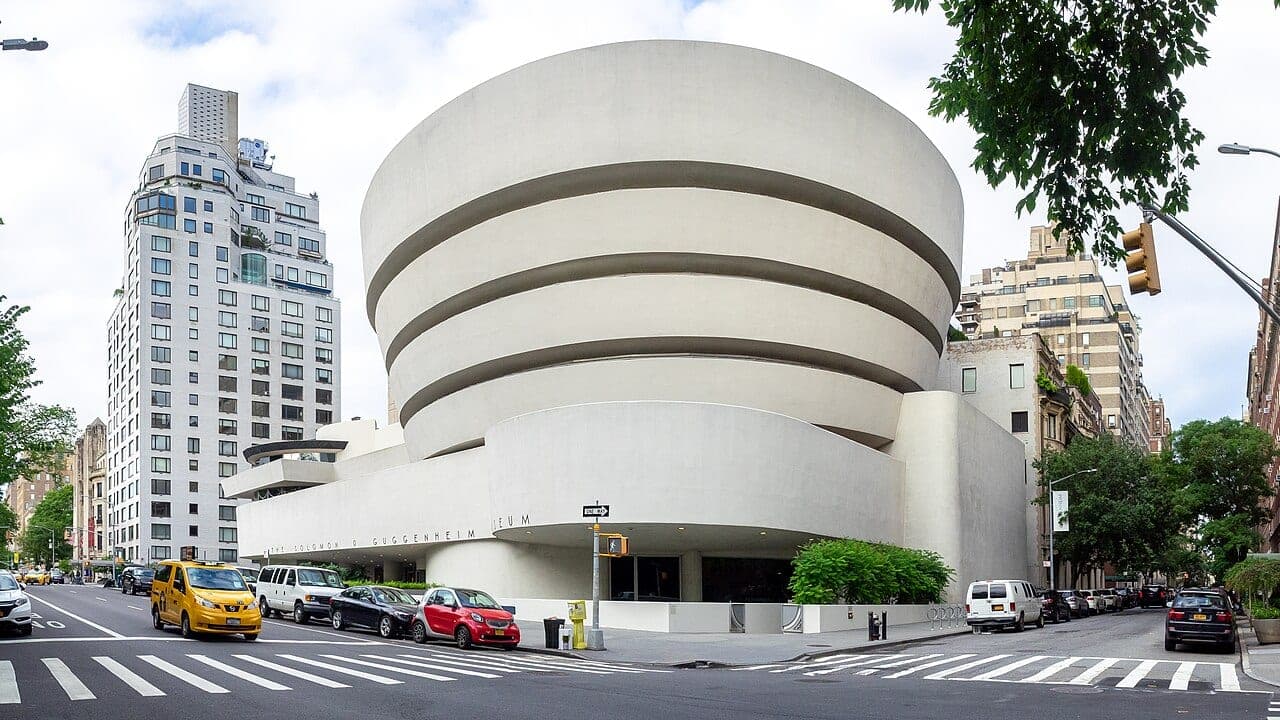
The Solomon R. Guggenheim Museum, known to most New Yorkers simply as the Guggenheim, is a museum of modern and contemporary art on upper Fifth Avenue in Manhattan. Its home is one of the most recognizable buildings in the United States: a white spiral of reinforced concrete designed by Frank Lloyd Wright and opened in 1959. The museum grew from the collection of the mining magnate Solomon R. Guggenheim, and it now anchors an international network of Guggenheim institutions that reaches from New York to Bilbao and Venice.
Solomon R. Guggenheim, heir to a family fortune built in mining and smelting, began buying Old Master paintings in the 1890s. His collecting changed direction in 1926, when he met the German-born artist and adviser Hilla Rebay, who introduced him to the European avant-garde and to what she called non-objective art, painting freed from any depiction of the visible world. Guided by Rebay, Guggenheim gathered works by Wassily Kandinsky, Rudolf Bauer, and other abstract painters, and in 1939 he opened the Museum of Non-Objective Painting in rented Manhattan quarters, with Rebay as its first director. The institution took its present name in 1952, three years after Guggenheim's death in 1949.
By then a permanent building was already being designed. In June 1943 Rebay and Guggenheim commissioned Wright, then in his mid-seventies, to design it; it would be the only museum he ever built. Wright worked on the project for the rest of his life, producing hundreds of sketches and several sets of drawings across roughly fifteen years. A Fifth Avenue site at 89th Street, overlooking Central Park, was secured in 1944, and ground was broken in 1956. Wright died in April 1959, about six months before the building he had fought so long to realize opened to the public on October 21, 1959. Later work enlarged and repaired it: a ten-story annex designed by Gwathmey Siegel & Associates was added in 1992, and a thorough restoration of the exterior and structure followed in 2005–2008. In 2019 the museum was inscribed on the UNESCO World Heritage List as one of eight buildings in "The 20th-Century Architecture of Frank Lloyd Wright."
Wright rejected the conventional museum plan of connected rectangular rooms. In its place he wound a single continuous ramp, a helix roughly a quarter of a mile long, around a top-lit central void crowned by a domed skylight. The idea was that a visitor would ride an elevator to the top and then walk gently down the spiral, viewing the art in one unbroken sequence. The gallery walls curve and tilt slightly outward, following the shape of the building rather than standing straight.
 One continuous ramp under a glass dome. Wright intended visitors to take the lift up and walk down, and for years the museum ran it the other way. Photograph by Stevenuccia, CC BY-SA 3.0, via Wikimedia Commons.
That radical form drew objections before the doors even opened. In 1956 a group of artists signed a letter protesting that the sloping floor and curved, tilted walls would be hostile to paintings meant to hang flat in even light. Curators have argued about the point ever since, and the museum has learned to work with the ramp rather than against it. Whatever the practical difficulties, the rotunda has become a work of art in its own right, and the slow descent through it is inseparable from a visit.
The Guggenheim's holdings began with the abstract pictures Rebay and Guggenheim assembled, and Kandinsky remains a particular strength; the museum owns one of the deepest collections of his work anywhere. Around that core the collection widened through a series of major acquisitions. In 1948 it absorbed the estate of the dealer Karl Nierendorf, adding paintings by Paul Klee and others. The bequest of Justin K. Thannhauser, whose family had run galleries in Munich and beyond, brought Impressionist and Post-Impressionist masterworks by Paul Cézanne, Edgar Degas, Édouard Manet, and Vincent van Gogh, along with more than thirty pieces by Pablo Picasso.
The New York building is also the head of a family of institutions run by the Solomon R. Guggenheim Foundation. The Peggy Guggenheim Collection in Venice, built on the holdings of Solomon's niece, joined the foundation after her death, and the Guggenheim Museum Bilbao, designed by Frank Gehry, opened in 1997 and helped remake a Spanish industrial city into a cultural destination.
Few buildings have shaped the popular image of the modern art museum as strongly as this one. Its coiled white silhouette appears in films, advertisements, and countless photographs, and it helped fix the idea that a museum could be as much a landmark as the art it holds. Inside, the ramp gives the institution an unusual way to stage exhibitions, letting a single artist's career or a themed survey unfold along one continuous path. That reputation carried outward with the foundation's Bilbao branch, whose success gave rise to the phrase "the Bilbao effect" for a signature building used to revive a city.
The museum sits at 1071 Fifth Avenue, at the corner of 89th Street on the Upper East Side, along the stretch of Fifth Avenue known as Museum Mile. The nearest subway stop is 86th Street on the 4, 5, and 6 lines, and several Fifth and Madison Avenue bus routes pass close by. The rotunda and its ramp are reached by elevator, so the full spiral can be seen without climbing stairs, and the museum publishes accessibility services for visitors with a range of needs. Special exhibitions fill the ramp and the adjoining tower galleries through much of the year, and current hours, admission, and timed tickets are listed on the museum's official site.
One continuous ramp under a glass dome. Wright intended visitors to take the lift up and walk down, and for years the museum ran it the other way. Photograph by Stevenuccia, CC BY-SA 3.0, via Wikimedia Commons.
That radical form drew objections before the doors even opened. In 1956 a group of artists signed a letter protesting that the sloping floor and curved, tilted walls would be hostile to paintings meant to hang flat in even light. Curators have argued about the point ever since, and the museum has learned to work with the ramp rather than against it. Whatever the practical difficulties, the rotunda has become a work of art in its own right, and the slow descent through it is inseparable from a visit.
The Guggenheim's holdings began with the abstract pictures Rebay and Guggenheim assembled, and Kandinsky remains a particular strength; the museum owns one of the deepest collections of his work anywhere. Around that core the collection widened through a series of major acquisitions. In 1948 it absorbed the estate of the dealer Karl Nierendorf, adding paintings by Paul Klee and others. The bequest of Justin K. Thannhauser, whose family had run galleries in Munich and beyond, brought Impressionist and Post-Impressionist masterworks by Paul Cézanne, Edgar Degas, Édouard Manet, and Vincent van Gogh, along with more than thirty pieces by Pablo Picasso.
The New York building is also the head of a family of institutions run by the Solomon R. Guggenheim Foundation. The Peggy Guggenheim Collection in Venice, built on the holdings of Solomon's niece, joined the foundation after her death, and the Guggenheim Museum Bilbao, designed by Frank Gehry, opened in 1997 and helped remake a Spanish industrial city into a cultural destination.
Few buildings have shaped the popular image of the modern art museum as strongly as this one. Its coiled white silhouette appears in films, advertisements, and countless photographs, and it helped fix the idea that a museum could be as much a landmark as the art it holds. Inside, the ramp gives the institution an unusual way to stage exhibitions, letting a single artist's career or a themed survey unfold along one continuous path. That reputation carried outward with the foundation's Bilbao branch, whose success gave rise to the phrase "the Bilbao effect" for a signature building used to revive a city.
The museum sits at 1071 Fifth Avenue, at the corner of 89th Street on the Upper East Side, along the stretch of Fifth Avenue known as Museum Mile. The nearest subway stop is 86th Street on the 4, 5, and 6 lines, and several Fifth and Madison Avenue bus routes pass close by. The rotunda and its ramp are reached by elevator, so the full spiral can be seen without climbing stairs, and the museum publishes accessibility services for visitors with a range of needs. Special exhibitions fill the ramp and the adjoining tower galleries through much of the year, and current hours, admission, and timed tickets are listed on the museum's official site.
History
The building
The collection
Cultural role
Visiting
References and resources
- Solomon R. Guggenheim Museum on Wikipedia, a detailed history of the museum, building, and collection
- Encyclopaedia Britannica: Solomon R. Guggenheim Museum, an overview of the institution and its architecture
- Guggenheim, the museum's official site for visiting and exhibitions
- Van Gogh to Picasso: The Thannhauser Legacy, on the Thannhauser bequest of Impressionist and modern works
- The Guggenheim Museums and the Art of This Century, on the foundation's network and the 1997 Bilbao opening