Heritage · Museum
The Egyptian Museum, Cairo: History and Visitor Guide
Opened in 1902 on Cairo's Tahrir Square, the Egyptian Museum holds pharaonic antiquities, with major holdings moving to the Grand Egyptian Museum.Written to last.
By Confinity Heritage Editorial · Updated 2026-07-31 · 7-minute readQuiet tools, kept out of the way.
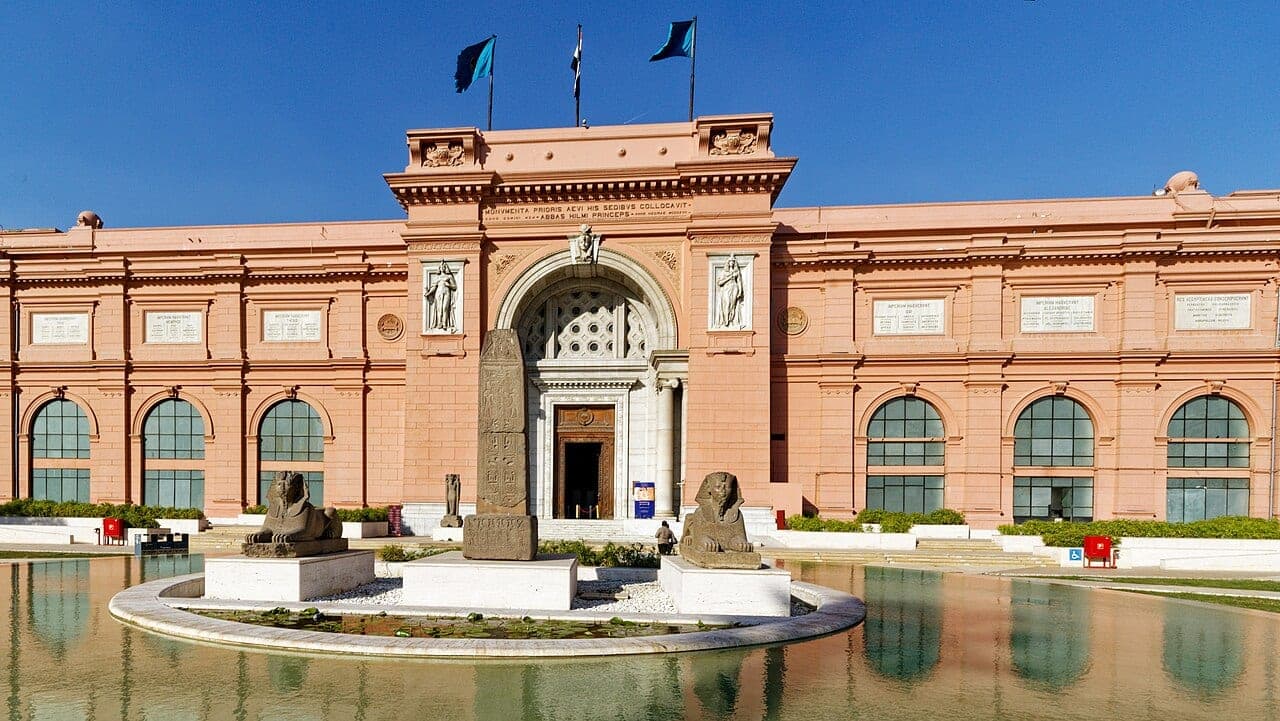
For more than a century the Egyptian Museum on Tahrir Square was the first place most visitors met the civilisation of the pharaohs. Opened in 1902 in a salmon-pink neoclassical building at the centre of Cairo, it drew the finest antiquities recovered along the Nile into a single national collection, and for generations it was the largest assembly of pharaonic art anywhere (Wikipedia).
Its holdings run to more than 170,000 objects, from Predynastic pottery to Roman-era portraits, though the museum has been known above all for one find: the near-complete tomb goods of Tutankhamun, uncovered in 1922 (Wikipedia).
That primacy is now shifting. Much of the collection, the Tutankhamun material chief among it, has been moving to the far larger Grand Egyptian Museum near the Giza pyramids, a transfer carried out in stages through the mid-2020s and reported as culminating in late 2025 (The Art Newspaper). The Tahrir museum remains open, and its place within Egypt's museum landscape is being redefined rather than closed.
The museum's origins lie with the French Egyptologist Auguste Mariette, who in 1858 was appointed to lead the newly created Egyptian Antiquities Service and founded a national collection to keep excavated material in the country (Britannica). Mariette housed the antiquities in a former warehouse at Bulaq, on the Nile north of central Cairo. A flood in 1878 damaged the building and its contents and strengthened the case for a permanent, purpose-built home (Wikipedia).
After Mariette's death in 1881 his successor, Gaston Maspero, carried the effort forward. The collection was moved for a time to a former royal palace at Giza before a permanent site was settled in central Cairo. The foundation stone of the Tahrir Square building was laid on 1 April 1897, and the museum was inaugurated on 15 November 1902 in the presence of Khedive Abbas II Hilmi (Wikipedia).
The building was the work of the French architect Marcel Dourgnon, who won an international competition for the design. His neoclassical scheme, with a domed entrance hall and long skylit galleries, is often described as the first purpose-built museum in the region (Wikipedia). Over the following century the collection grew steadily through excavation, so much so that objects filled the galleries, the basement and the courtyard, and overcrowding became the museum's defining practical problem.
At its height the museum held the largest collection of pharaonic antiquities in the world, more than 170,000 registered objects spanning some three thousand years (Wikipedia). Its best-known holding was the burial assemblage of Tutankhamun, the boy king whose almost intact tomb Howard Carter reached in the Valley of the Kings in 1922. The find yielded more than 5,000 items, among them the nested gold coffins and the celebrated gold funerary mask, and for decades these filled the museum's upper floor (Egyptian Streets).
 The Tahrir Square building opened in 1902 and was purpose-built for the collection, which outgrew it within a generation. Photograph by Ovedc, CC BY-SA 4.0, via Wikimedia Commons.
The galleries also held masterpieces of the Old Kingdom, including the seated diorite statue of King Khafre, the painted limestone figures of Prince Rahotep and his wife Nofret, and the slate Narmer Palette, one of the earliest historical documents from Egypt. A separate hall long displayed the royal mummies of the New Kingdom, the preserved bodies of pharaohs such as Ramesses II and Thutmose III.
Much of this signature material is what has moved. The Tutankhamun treasures have been transferred to the Grand Egyptian Museum to be shown together for the first time, while the royal mummies departed in 2021 for a dedicated hall elsewhere in Cairo, described below (The Art Newspaper). The Tahrir museum retains a very large quantity of statuary, coffins, papyri and everyday objects.
The Grand Egyptian Museum, or GEM, was built on a site near the Giza plateau, within sight of the pyramids, to give Egypt a single very large museum able to show its antiquities in modern conditions (Egyptian Streets). Planned since the early 2000s, it opened in phases rather than all at once. A partial opening admitted visitors to a first group of galleries from late 2024, and reporting described a full official inauguration, including the complete Tutankhamun galleries, at the start of November 2025 (The Art Newspaper; Egyptian Streets).
Because the project ran years behind its original schedule and opened in stages, dates and the exact scope of what has transferred are best treated with some caution and read against current reporting. What is clear is the intent: the GEM is designed to be the primary home for Egypt's flagship pharaonic collections, and the Tahrir museum's holdings have been redistributed accordingly rather than the older museum being emptied outright.
For more than a hundred years the Egyptian Museum served as the guardian of pharaonic heritage, the institution that kept the material record of ancient Egypt within the country and put it before scholars and the public. Its collection shaped how Egyptology developed and how the wider world pictures ancient Egypt.
That role was on public view in April 2021, when 22 royal mummies were carried in a televised procession from Tahrir Square to the National Museum of Egyptian Civilization in the Fustat district, an event staged as the Pharaohs' Golden Parade (Wikipedia). The eighteen kings and four queens travelled in sequence through the city in specially built vehicles, a ceremony that doubled as a statement of national custodianship over the ancient past.
The Egyptian Museum sits on the northern side of Tahrir Square in central Cairo, one of the city's most central spots (Britannica). It is within walking distance of the Nile corniche and close to Sadat station on the Cairo metro, and it remains open to visitors.
Because holdings have been moving to the Grand Egyptian Museum and to other sites, the specific objects on show at Tahrir have been changing, so anyone hoping to see a particular piece should check the current arrangement before travelling. Opening hours, ticketing and gallery layout are best confirmed through official channels close to a visit.
The Tahrir Square building opened in 1902 and was purpose-built for the collection, which outgrew it within a generation. Photograph by Ovedc, CC BY-SA 4.0, via Wikimedia Commons.
The galleries also held masterpieces of the Old Kingdom, including the seated diorite statue of King Khafre, the painted limestone figures of Prince Rahotep and his wife Nofret, and the slate Narmer Palette, one of the earliest historical documents from Egypt. A separate hall long displayed the royal mummies of the New Kingdom, the preserved bodies of pharaohs such as Ramesses II and Thutmose III.
Much of this signature material is what has moved. The Tutankhamun treasures have been transferred to the Grand Egyptian Museum to be shown together for the first time, while the royal mummies departed in 2021 for a dedicated hall elsewhere in Cairo, described below (The Art Newspaper). The Tahrir museum retains a very large quantity of statuary, coffins, papyri and everyday objects.
The Grand Egyptian Museum, or GEM, was built on a site near the Giza plateau, within sight of the pyramids, to give Egypt a single very large museum able to show its antiquities in modern conditions (Egyptian Streets). Planned since the early 2000s, it opened in phases rather than all at once. A partial opening admitted visitors to a first group of galleries from late 2024, and reporting described a full official inauguration, including the complete Tutankhamun galleries, at the start of November 2025 (The Art Newspaper; Egyptian Streets).
Because the project ran years behind its original schedule and opened in stages, dates and the exact scope of what has transferred are best treated with some caution and read against current reporting. What is clear is the intent: the GEM is designed to be the primary home for Egypt's flagship pharaonic collections, and the Tahrir museum's holdings have been redistributed accordingly rather than the older museum being emptied outright.
For more than a hundred years the Egyptian Museum served as the guardian of pharaonic heritage, the institution that kept the material record of ancient Egypt within the country and put it before scholars and the public. Its collection shaped how Egyptology developed and how the wider world pictures ancient Egypt.
That role was on public view in April 2021, when 22 royal mummies were carried in a televised procession from Tahrir Square to the National Museum of Egyptian Civilization in the Fustat district, an event staged as the Pharaohs' Golden Parade (Wikipedia). The eighteen kings and four queens travelled in sequence through the city in specially built vehicles, a ceremony that doubled as a statement of national custodianship over the ancient past.
The Egyptian Museum sits on the northern side of Tahrir Square in central Cairo, one of the city's most central spots (Britannica). It is within walking distance of the Nile corniche and close to Sadat station on the Cairo metro, and it remains open to visitors.
Because holdings have been moving to the Grand Egyptian Museum and to other sites, the specific objects on show at Tahrir have been changing, so anyone hoping to see a particular piece should check the current arrangement before travelling. Opening hours, ticketing and gallery layout are best confirmed through official channels close to a visit.
History
The collection
The Grand Egyptian Museum
Cultural role
Visiting
References and resources
- Encyclopaedia Britannica: Egyptian Museum: overview of the museum's founding, the Bulaq origins and the Tahrir building.
- Wikipedia: Egyptian Museum: history, the 1902 opening, collection size, and the 2021 royal-mummy move.
- The Art Newspaper: Tutankhamun set to debut at the Grand Egyptian Museum: reporting on the delayed GEM opening and the Tutankhamun transfer.
- Egyptian Streets: Everything you need to know about the Grand Egyptian Museum opening: the phased opening, gallery figures and the Tutankhamun collection.