Heritage · Museum
The National Palace Museum: The Imperial Collection That Crossed a Continent
The National Palace Museum in Taipei holds around 700,000 objects from the Chinese imperial collection, moved across wartime China in thousands of crates before crossing to Taiwan in 1948 and 1949. Explore its history, the Jadeite Cabbage and Maogong ding, and visitor information.Written to last.
By Confinity Heritage Editorial · 2026-08-23 · 7-minute readQuiet tools, kept out of the way.
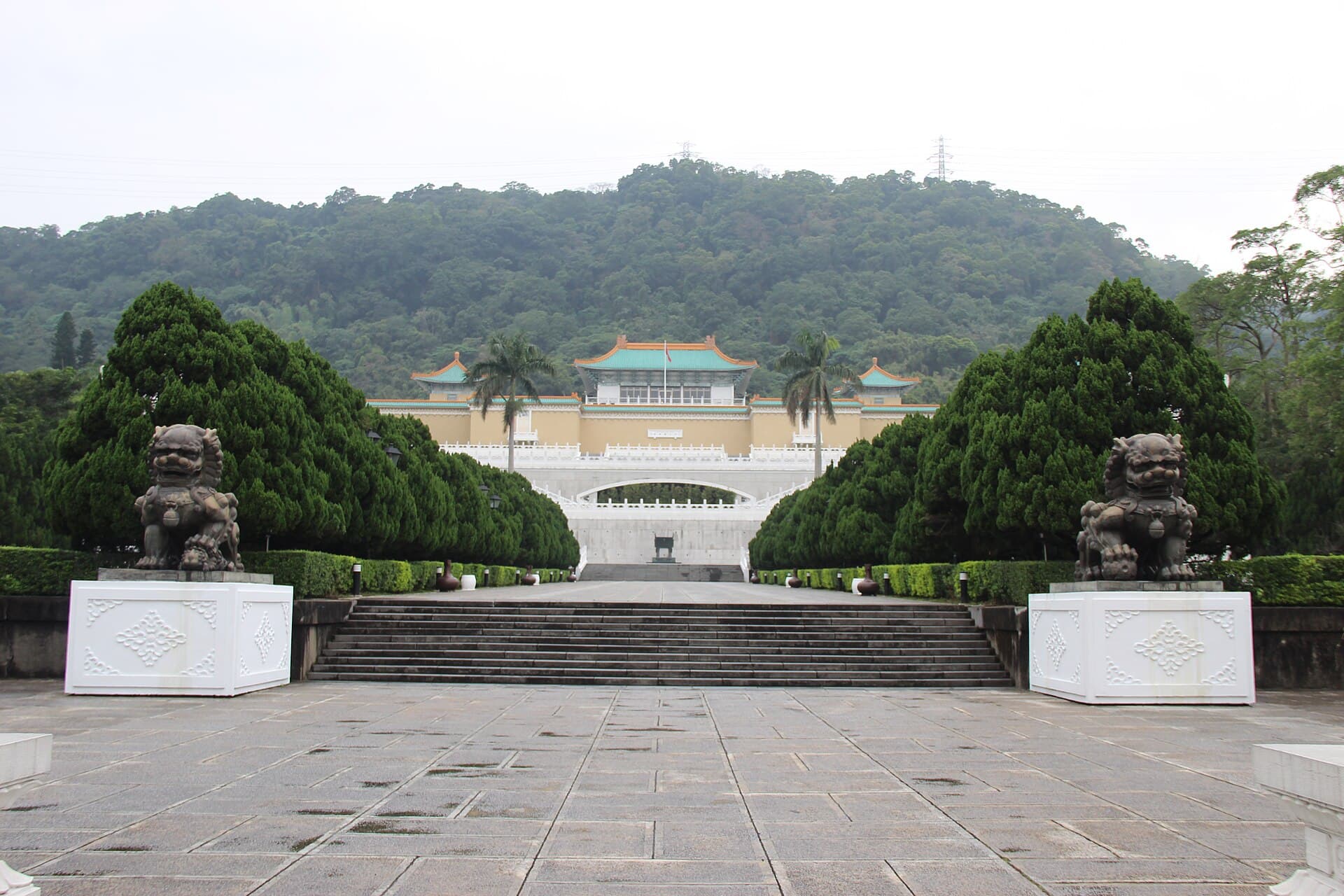
Most museum collections stay put. The one held by the National Palace Museum in Taipei spent a decade and a half in wooden crates, moving across China by rail, truck, river boat and, on the worst mountain roads, on the backs of porters. It sheltered in warehouses, temples and caves while a world war burned through the country around it, and it reached its present home in Taiwan only after a civil war had redrawn the map behind it. The museum at Waishuangxi, on the northern edge of Taipei, holds around 700,000 objects from the Chinese imperial collection: bronzes, porcelain, jades, paintings, calligraphy, rare books and court archives accumulated by emperors over almost a thousand years. This article covers how the collection survived its journey, what it contains, and what it means for one heritage to live in two museums separated by a strait.
The collection began as the private property of emperors. Song, Yuan, Ming and Qing rulers gathered paintings, calligraphy, ritual bronzes and fine ceramics into the palace holdings, and by the eighteenth century the Qianlong Emperor, an obsessive collector, had built one of the greatest accumulations of art any individual has ever controlled. It sat in the Forbidden City in Beijing, sealed off from public view. That changed after the fall of the Qing dynasty. The last emperor, Puyi, remained in the inner court until a warlord government expelled him in November 1924. A committee inventoried what he left behind, and on 10 October 1925 the palace opened as the Palace Museum, turning the emperors' private hoard into a public inheritance.
The public phase lasted barely eight years before the crates came out. Japan seized Manchuria in 1931, and as its forces pressed toward Beijing the staff made a decision many at the time condemned as defeatist: the collection would be evacuated south. Beginning in February 1933, the finest objects were packed into wooden crates, padded with cotton and paper by staff who tested their methods by packing porcelain and dropping the crates to see what survived. Together with objects from other institutions, nearly 20,000 crates travelled by rail to Shanghai, and in 1936 to a purpose-built storehouse in Nanjing.
Full-scale war arrived the following year, and the collection scattered again in three great streams: south and west through Changsha to caves near Anshun in Guizhou; by boat up the Yangtze through Chongqing to Leshan in Sichuan; and north over the Qinling mountains by rail and truck to Emei, also in Sichuan. Crates were hauled out of buildings days before they were bombed, ferried across rivers ahead of advancing armies, and kept for years in temples and mountain caves by small teams of curators who moved their families with the objects. When the crates were reassembled in Nanjing in 1947, the staff could report something close to a miracle of logistics: across fourteen years and thousands of kilometres of a country at war, almost nothing had been lost or broken. It stands among the greatest evacuation feats in the history of museums.
The final leg was the shortest and the most consequential. As the civil war between the Nationalist government and the Communists turned decisively in 1948, the government ordered a selection of the evacuated treasures shipped to Taiwan. Between December 1948 and February 1949, three vessels carried 2,972 crates across the strait, roughly a fifth of the crates evacuated from Beijing but containing much of the finest material: the best paintings and calligraphy, the rarest porcelains, the great bronzes, and a vast body of imperial archives and rare books. The crates were stored first in a sugar mill and then, from 1950, in tunnels and warehouses at Beigou in central Taiwan. The permanent museum at Waishuangxi in Taipei opened on 12 November 1965, and the collection, enlarged by later purchases and donations, has grown to its present figure of around 700,000 objects.
The museum's holdings run from Neolithic jades to Qing court documents, and only a small share can be on display at once. Among the bronzes, the anchor is the Maogong ding, a Western Zhou ritual cauldron from around the ninth century BCE whose interior carries an inscription of about 500 characters, among the longest known on any ancient Chinese bronze. It is displayed as both an object and a document, a piece of political writing cast in metal nearly three thousand years ago.
The ceramics collection is one of the strongest anywhere. Its rarest holdings are the Ru ware vessels of the Northern Song dynasty, glazed in a famously soft blue-green. Ru ware was made for the court for only a couple of decades around 1100, and fewer than a hundred pieces are known to survive worldwide; the museum's group is the largest held by any single institution. Around these sit deep holdings of Song, Yuan, Ming and Qing porcelain.
Painting and calligraphy form the most fragile part of the collection, and the museum treats them accordingly. Masterworks on silk and paper rotate on and off display for conservation, with the most delicate pieces shown briefly and then rested for years, so that seeing a particular famous scroll can mean planning a visit around its rare appearances. The imperial archives and rare books, hundreds of thousands of items by count, serve researchers more than casual visitors and preserve the administrative memory of the Qing court in remarkable depth.
Then there are the icons. The Jadeite Cabbage, a Qing-era carving that turns a flawed piece of half-white, half-green jadeite into a cabbage with two insects hidden in its leaves, and the Meat-Shaped Stone, banded jasper worked and dyed to resemble a slice of braised pork belly, draw the longest queues in the building. Neither is the most important object the museum owns, but both show the playfulness inside a collection that can otherwise feel imposingly canonical.
The main building at Waishuangxi was designed in a Chinese palace style, with green-tiled roofs, cream walls and a grand staircase climbing the hillside, deliberately echoing the architecture of the palace the collection came from. Opened in 1965 and enlarged several times since, it backs onto the mountain itself, where tunnels bored into the rock provided secure storage in a form the collection's guardians understood well by then. The setting does quiet work: a collection formed inside walled courts in Beijing is shown inside a building that recalls them, half a continent away.
In December 2015 the museum opened its Southern Branch in Taibao, Chiayi County, in Taiwan's southwest. Conceived as a museum of Asian art and culture, with a sweeping modern building set in parkland, it places the Chinese collection in a wider frame of Buddhist art, textiles, tea culture and ceramics from across Asia, and carries the museum's audience beyond the capital.
The museum's deepest significance lies in a plain historical fact: one imperial collection now lives in two museums. The Palace Museum in Beijing kept the majority of the objects and the buildings of the Forbidden City itself; the National Palace Museum in Taipei holds the portion selected and shipped in 1948 and 1949. Each institution descends from the museum founded in 1925, and each holds masterpieces the other does not. The two have at times cooperated as scholarly institutions, most visibly in 2009, when the Beijing museum lent objects to a joint exhibition in Taipei on the Yongzheng Emperor. Loans in the other direction have not happened, because unresolved questions about the collection's ownership mean the Taipei museum will not send objects anywhere that does not guarantee, in law, their return. The situation is stated here as it stands; the arguments over it belong to the politics of the strait, not to the objects.
For visitors, the museum is the most complete surviving window into Chinese court art, and for Taiwan it is the island's most visited museum. Its Open Data platform releases tens of thousands of high-resolution images of collection objects for free public use, a generous policy that lets the emperors' private hoard circulate more widely than any emperor could have imagined.
What the museum preserves, beyond the objects themselves, is proof of what deliberate care can do. Every crate that reached Taipei intact did so because specific people packed it well, moved it in time, and stayed with it through years of war, often at real personal cost. The collection is a record of a thousand years of Chinese art, but its survival is a record of the twentieth century: convoys over mountain roads, caves in Guizhou fitted out as treasure stores, curators raising children beside the crates they guarded. Museums usually preserve memory; this one is also a memory of preservation, and the story of the journey has become part of what every object in the building means.
The main museum stands at Waishuangxi in Taipei's Shilin District, reachable by bus from Shilin metro station. It is generally open Tuesday to Sunday from 09:00 to 17:00 and closed on Mondays; current hours, ticketing and closure days are listed on the official site. The Southern Branch in Chiayi County keeps its own schedule and ticketing.
Allow at least half a day for the main building. The galleries reward slow attention, and the most famous small objects draw queues at peak times, so early arrival helps. Check the exhibition calendar before travelling: because the great scrolls rotate for conservation, what is on the walls changes through the year, and a particular masterpiece may be resting in the mountain rather than hanging in the gallery.