Heritage · Museum
Art Institute of Chicago: History, Collection & Icons
The Art Institute of Chicago opened in its Beaux-Arts home during the 1893 World's Columbian Exposition and grew into one of the oldest and largest art museums in the United States. Behind the bronze lions on Michigan Avenue it holds Seurat's A Sunday on La Grande Jatte, Grant Wood's American Gothic, and Edward Hopper's Nighthawks.Written to last.
By Confinity Heritage Editorial · Updated 2026-07-31 · 7-minute readQuiet tools, kept out of the way.
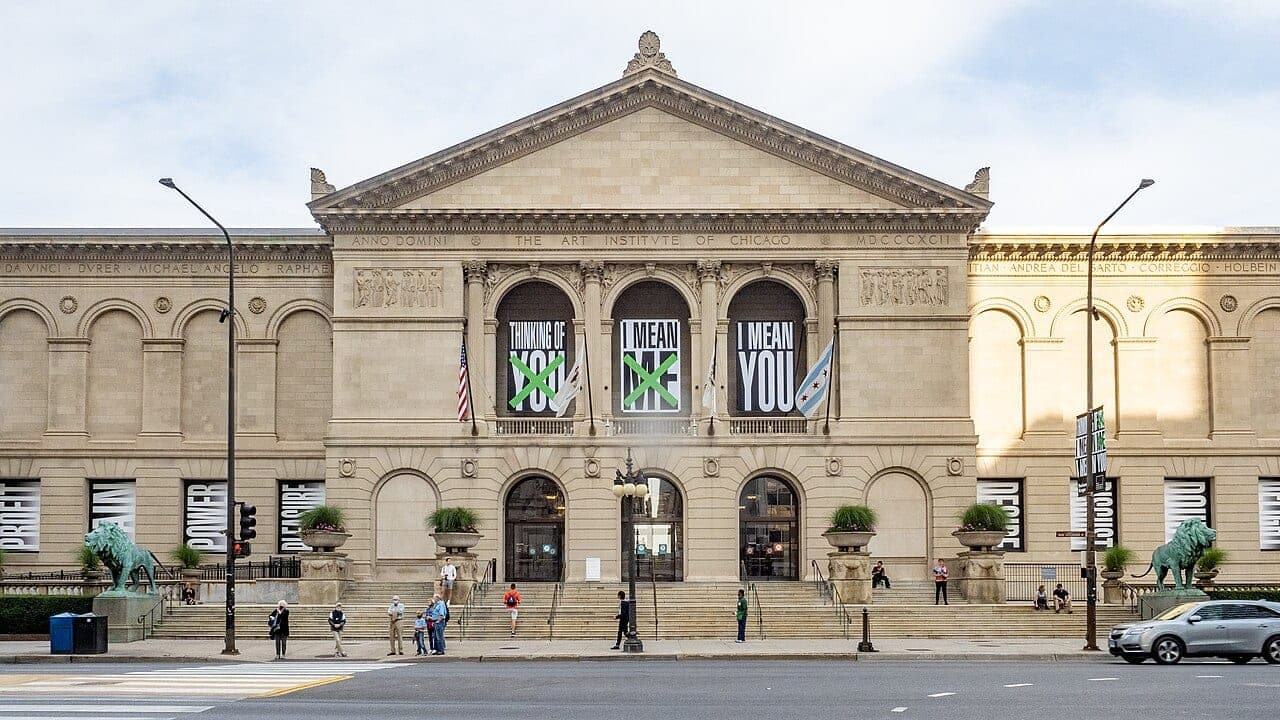
The Art Institute of Chicago sits at 111 South Michigan Avenue, on the eastern edge of the Loop where the city meets the green stretch of Grant Park and, more recently, Millennium Park. It is one of the oldest and largest art museums in the United States, and after its most recent expansion it became the second-largest art museum in the country after the Metropolitan Museum of Art in New York. Behind a limestone Beaux-Arts front guarded by two bronze lions, it holds roughly 300,000 works across eleven curatorial departments, reaching from ancient bronzes and Japanese prints to photography made in living memory.
What draws most visitors, though, is a run of paintings that have passed well beyond the art world into common memory. The museum owns one of the finest collections of Impressionist and Post-Impressionist art outside France, anchored by Georges Seurat's "A Sunday on La Grande Jatte" and Gustave Caillebotte's "Paris Street; Rainy Day." It is also the home of two of the most recognizable American pictures ever painted, Grant Wood's "American Gothic" and Edward Hopper's "Nighthawks." Woven through the same walls is a teaching mission as old as the collection itself, carried by the affiliated School of the Art Institute of Chicago, which shares the institution's founding and much of its history.
The museum grew out of an earlier artists' cooperative, the Chicago Academy of Design, established in 1866. After that body fell into financial trouble, a group of businessmen reorganized it, and in 1879 it was incorporated as the Chicago Academy of Fine Arts, a combined school and exhibition society. In 1882 the young institution took the name it still carries, the Art Institute of Chicago, and elected the banker and philanthropist Charles L. Hutchinson as its president. Hutchinson led the museum for more than four decades, until 1924, and his gifts and persuasion did much to build both the collection and the endowment.
The early Art Institute had ambition well ahead of its holdings. It rented quarters, mounted loan exhibitions, and taught students, all while its trustees looked for a permanent home worthy of a city rebuilding itself after the fire of 1871. That home arrived by way of a world's fair, and it fixed the museum's address and character for good.
The strength that first made the museum's reputation is European painting of the later nineteenth century. Its Impressionist and Post-Impressionist rooms hold more than thirty works by Claude Monet, among them several of his "Haystacks" and views of water lilies, along with pictures by Pierre-Auguste Renoir, Edgar Degas, and Camille Pissarro. Its single most famous canvas is Seurat's "A Sunday on La Grande Jatte," painted between 1884 and 1886 and built entirely from small dots of color in the technique that came to be called pointillism. Nearby hangs Caillebotte's "Paris Street; Rainy Day" of 1877, a wide, cool view of a Paris intersection under grey skies, and Vincent van Gogh's self-portrait of 1887.
The American galleries carry the two paintings most visitors come to find. Grant Wood's "American Gothic," showing a stern farmer with a pitchfork beside a woman before a white farmhouse, won a prize at the museum in 1930 and was bought that same year; it has since become one of the most parodied images in the country. Edward Hopper's "Nighthawks," his 1942 nightscape of figures in an all-night diner, was purchased by the museum for 3,000 dollars within months of being finished. The collection reaches far beyond these highlights, into Pablo Picasso's "The Old Guitarist" of his Blue Period, medieval and Renaissance European art, arms and armor, Japanese woodblock prints, textiles, architecture and design, and a deep holding of photography. Taken together the eleven departments hold something close to 300,000 objects, an encyclopedic span rather than a single specialty.
The museum's home is a direct legacy of the World's Columbian Exposition of 1893, the fair that filled Chicago's lakefront that summer. The Beaux-Arts structure on Michigan Avenue was designed by the Boston firm of Shepley, Rutan and Coolidge and was built to serve during the fair as the World's Congress Auxiliary Building, hosting the scholarly and civic congresses held alongside the exhibition. When the fair closed, the building passed to the museum, which moved into it on October 31, 1893, and it has remained the institution's core ever since.
 The Michigan Avenue building was put up for the 1893 World's Columbian Exposition and handed to the museum afterwards. The two lions arrived the following year and have never been named. Photograph by Diego Delso, CC BY-SA 3.0, via Wikimedia Commons.
The two bronze lions that flank the main steps arrived the following year. Modeled by the sculptor Edward Kemeys and unveiled in May 1894, each cast weighs more than two tons. Kemeys gave them distinct attitudes rather than a matched pair: the south lion is described as standing in an attitude of defiance, the north lion as on the prowl. The pair have become an unofficial emblem of the city, dressed in team colors when a Chicago club reaches a championship and photographed by generations of visitors.
For more than a century the museum grew by adding wings around and behind that original block, spreading east over the railroad tracks toward the lake. The largest single addition came in 2009, when the Modern Wing designed by Renzo Piano opened on May 16. The Italian architect, a Pritzker Prize winner, added about 264,000 square feet of galleries, an education center, and a restaurant, in the largest expansion in the museum's history and the result of a 385 million dollar campaign. Piano crowned it with a broad flat sunshade he called a "flying carpet," designed to filter northern daylight into the top-floor galleries of modern and contemporary art. From the wing's upper level, the Nichols Bridgeway, a slender pedestrian span also by Piano, arcs across Monroe Street to connect the museum directly with Millennium Park.
The Art Institute is unusual among American museums in remaining bound to a degree-granting art school. The School of the Art Institute of Chicago, known as SAIC, is legally part of the same institution, making it one of the few places in the country where a major museum and a major art school share one organization. Its faculty and alumni thread through American art: Georgia O'Keeffe studied there in 1905 and 1906, and Grant Wood, painter of the museum's own "American Gothic," trained there as well. Students move constantly between the classroom and galleries that hold originals by the artists they study, an arrangement the museum treats as central to what it is.
The building and its pictures have also lodged themselves in popular culture. Seurat's "A Sunday on La Grande Jatte" inspired Stephen Sondheim and James Lapine's 1984 musical "Sunday in the Park with George," which imagines the painter at work. Two years later the museum supplied one of the most fondly remembered sequences in John Hughes's 1986 film "Ferris Bueller's Day Off," in which the truant teenagers wander its galleries and one of them stares into the dots of the Seurat until the crowd dissolves. For many Americans the film was a first sight of the museum, and its rooms have kept that hold on the imagination since.
The Art Institute stands at 111 South Michigan Avenue, a short walk from the Loop's elevated train stations and from Millennium Park, whose reflective "Cloud Gate" sculpture sits just across the street. The lions mark the historic Michigan Avenue entrance, while a second, step-free entrance serves visitors from the Modern Wing side on Monroe Street. General admission is ticketed, with the standard adult rate for non-Illinois residents set around 32 dollars and lower prices for Illinois and Chicago residents, seniors, students, and teenagers; children fourteen and under enter free, and Illinois residents have access to designated free days.
The museum is generally open daily, with shorter hours on some days and extended Thursday evenings, and it is closed on a small number of holidays; checking the current schedule before a visit is wise, as hours and prices are periodically revised. The galleries are wheelchair accessible, and the museum offers cafés, a members' lounge, and one of the better museum shops in the city. Because the collection is so large, most visitors do better to pick a few departments, the Impressionists, the American icons, and the Modern Wing among them, than to try to see everything in a single day.
The Michigan Avenue building was put up for the 1893 World's Columbian Exposition and handed to the museum afterwards. The two lions arrived the following year and have never been named. Photograph by Diego Delso, CC BY-SA 3.0, via Wikimedia Commons.
The two bronze lions that flank the main steps arrived the following year. Modeled by the sculptor Edward Kemeys and unveiled in May 1894, each cast weighs more than two tons. Kemeys gave them distinct attitudes rather than a matched pair: the south lion is described as standing in an attitude of defiance, the north lion as on the prowl. The pair have become an unofficial emblem of the city, dressed in team colors when a Chicago club reaches a championship and photographed by generations of visitors.
For more than a century the museum grew by adding wings around and behind that original block, spreading east over the railroad tracks toward the lake. The largest single addition came in 2009, when the Modern Wing designed by Renzo Piano opened on May 16. The Italian architect, a Pritzker Prize winner, added about 264,000 square feet of galleries, an education center, and a restaurant, in the largest expansion in the museum's history and the result of a 385 million dollar campaign. Piano crowned it with a broad flat sunshade he called a "flying carpet," designed to filter northern daylight into the top-floor galleries of modern and contemporary art. From the wing's upper level, the Nichols Bridgeway, a slender pedestrian span also by Piano, arcs across Monroe Street to connect the museum directly with Millennium Park.
The Art Institute is unusual among American museums in remaining bound to a degree-granting art school. The School of the Art Institute of Chicago, known as SAIC, is legally part of the same institution, making it one of the few places in the country where a major museum and a major art school share one organization. Its faculty and alumni thread through American art: Georgia O'Keeffe studied there in 1905 and 1906, and Grant Wood, painter of the museum's own "American Gothic," trained there as well. Students move constantly between the classroom and galleries that hold originals by the artists they study, an arrangement the museum treats as central to what it is.
The building and its pictures have also lodged themselves in popular culture. Seurat's "A Sunday on La Grande Jatte" inspired Stephen Sondheim and James Lapine's 1984 musical "Sunday in the Park with George," which imagines the painter at work. Two years later the museum supplied one of the most fondly remembered sequences in John Hughes's 1986 film "Ferris Bueller's Day Off," in which the truant teenagers wander its galleries and one of them stares into the dots of the Seurat until the crowd dissolves. For many Americans the film was a first sight of the museum, and its rooms have kept that hold on the imagination since.
The Art Institute stands at 111 South Michigan Avenue, a short walk from the Loop's elevated train stations and from Millennium Park, whose reflective "Cloud Gate" sculpture sits just across the street. The lions mark the historic Michigan Avenue entrance, while a second, step-free entrance serves visitors from the Modern Wing side on Monroe Street. General admission is ticketed, with the standard adult rate for non-Illinois residents set around 32 dollars and lower prices for Illinois and Chicago residents, seniors, students, and teenagers; children fourteen and under enter free, and Illinois residents have access to designated free days.
The museum is generally open daily, with shorter hours on some days and extended Thursday evenings, and it is closed on a small number of holidays; checking the current schedule before a visit is wise, as hours and prices are periodically revised. The galleries are wheelchair accessible, and the museum offers cafés, a members' lounge, and one of the better museum shops in the city. Because the collection is so large, most visitors do better to pick a few departments, the Impressionists, the American icons, and the Modern Wing among them, than to try to see everything in a single day.
History and founding
The collection
The building
Cultural significance
Visiting
References and resources
- History of the Art Institute of Chicago, the museum's official account of its founding and building
- Plan your visit, current hours, admission, and directions from the museum
- Art Institute of Chicago on Wikipedia, with departmental detail and citations
- Art Institute of Chicago at Encyclopaedia Britannica
- Modern Wing on Wikipedia, on Renzo Piano's 2009 expansion
- School of the Art Institute of Chicago, the affiliated art school