Heritage · Landmark
The Western Wall: the stones that held the Temple Mount
The Western Wall is a surviving retaining wall of the vast platform Herod the Great raised around Jerusalem's Temple Mount, begun about 19 BC. Judaism reveres it as the closest accessible point to the site of the ancient Temple's Holy of Holies; Islamic tradition knows it as the al-Buraq Wall, part of the western edge of the Haram al-Sharif.Written to last.
By Confinity Heritage Editorial · 2026-08-23 · 7-minute readQuiet tools, kept out of the way.
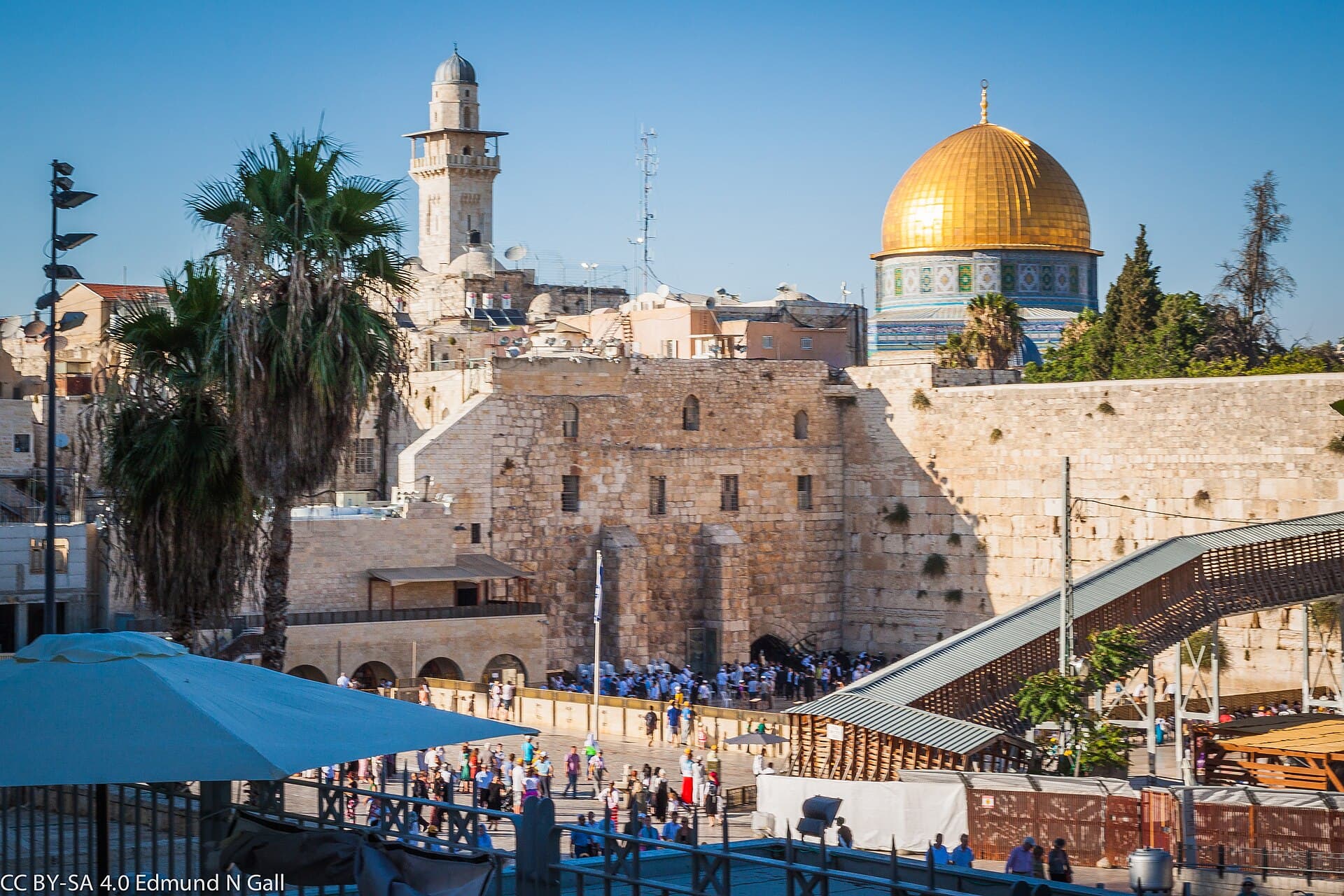
A wall of pale golden limestone runs along the western flank of the raised esplanade at the heart of Jerusalem's Old City, in territory administered by Israel since 1967. Most of its 488 metres lie hidden, built over by the houses of the Old City or buried beneath centuries of risen street level. A stretch of about 57 metres stands open to a broad plaza, and it is this section the world knows as the Western Wall. Jews call it HaKotel, simply "the Wall." In Islamic tradition it is the al-Buraq Wall. Millions come each year to pray, to celebrate, or only to stand and look at stones that have been in place for two thousand years.
The wall means different things to different communities, and it stands inside one of the longest running religious and territorial disputes on earth. Judaism reveres it as the closest accessible point to the site of the ancient Temple, destroyed in 70 AD. Islamic tradition honours it as the place where the Prophet Muhammad tethered his mount on the Night Journey, and as part of the western boundary of the Haram al-Sharif, the Noble Sanctuary. This article describes the wall's fabric and history, and states each tradition's connection to the place as that tradition holds it, without taking a position on questions of sovereignty or access.
A visitor could be forgiven for assuming that the Western Wall is a remnant of the Temple building itself. It is not. In about 19 BC Herod the Great, the Roman client king of Judea, began the most ambitious construction project of his reign: rebuilding the Second Temple and roughly doubling the esplanade on which it stood. To do this his engineers wrapped the natural hill in four enormous retaining walls, filled the space behind them with vaults and earth, and created an artificial platform of some fourteen hectares, among the largest sacred precincts of the ancient world. The Temple stood on top of that platform. The Western Wall is the western of the four retaining walls, the masonry that held the mountain up rather than the sanctuary that stood upon it.
Even the dating carries a surprise. Excavations near the wall's southern end uncovered coins struck around 17 AD sealed beneath the wall's foundation courses, evidence that construction continued for decades after Herod's death in 4 BC. Josephus records that work on the wider complex was completed only in the 60s AD, a few years before Roman legions destroyed the Temple in 70 AD. The platform the wall retains has carried other sanctuaries since; today it holds the Dome of the Rock and Al-Aqsa Mosque.
The wall is a document that can be read from bottom to top. The lower courses at the prayer plaza are Herodian ashlar: immense blocks of meleke limestone, dressed with the signature of Herod's masons, a finely cut flat border framing a slightly raised central boss. The blocks were laid dry, without mortar, each course set back a few centimetres from the one below so that the whole face leans imperceptibly inward for stability. Seven of these courses stand visible above the plaza pavement, with a further seventeen buried beneath it, resting on bedrock.
The most extraordinary single block lies out of sight, inside the tunnel that follows the wall's buried length. The Western Stone is about 13.6 metres long and 3.3 metres high, with an estimated weight in excess of 500 tonnes, which places it among the heaviest objects ever lifted into position by pre-industrial builders. How Herod's engineers moved it remains a subject of study rather than certainty.
Above the great Herodian courses the masonry changes twice. A band of large but plainer stones was added during later repairs in the Roman and early Islamic centuries, and the small stones of the uppermost courses date from Ottoman times, with the final rows added in the nineteenth century. Nothing about the wall is a single moment; it is layers of maintenance across two millennia.
When the Roman army under Titus burned the Temple in 70 AD, the retaining walls of the platform largely survived. Over the centuries that followed, as Jews were at various periods barred from the city or from the platform itself, the exposed western retaining wall became the focus of prayer and pilgrimage: the nearest place to the site of the Holy of Holies, the Temple's innermost sanctuary, that a Jew could reach. A rabbinic tradition holds that the divine presence, the Shekhinah, never departed from the Western Wall. Travellers' accounts attest Jewish prayer at the wall through the medieval period, and under Ottoman rule from the sixteenth century the narrow alley at its foot became the established place of devotion, with tradition crediting Sultan Suleiman with formally recognising the practice.
European visitors who watched worshippers mourning the Temple's destruction coined the name "Wailing Wall." The term was an outsider's description, and it is now generally avoided; Jewish usage has always been simply the Kotel. Prayer at the wall also reflects a rule as much as a longing: many observant Jews refrain from walking on the platform above, out of concern for treading unknowingly on the site of the Holy of Holies, so the wall below remains the boundary of approach. Visitors of every background join a further custom, writing prayers on slips of paper, called kvitlach, and pressing them into the crevices between the stones.
In Islamic tradition the same masonry belongs to the story of the Isra, the Night Journey. The Quran's opening verse of Sura 17 speaks of the Prophet Muhammad's journey by night from the sacred mosque to the farthest mosque, al-masjid al-aqsa, which Islamic tradition identifies with the sanctuary in Jerusalem. Tradition holds that the Prophet rode a winged steed named al-Buraq and, on arriving, tethered it beside the sanctuary's wall; the association gives the Western Wall its Arabic name, Ha'it al-Buraq, the Buraq Wall. The wall is understood in this tradition not as a separate monument but as part of the fabric of the Haram al-Sharif itself, the western edge of a sanctuary often described as the third holiest in Islam.
For most of the Islamic centuries the wall and the quarter beside it were held as waqf, religious endowment property. Tensions over arrangements at the wall contributed to deadly violence across Palestine in 1929, after which an international commission appointed under the League of Nations concluded in 1930 that the wall was Muslim waqf property while affirming the established Jewish right of access for devotion. Both communities' attachments were thus a matter of formal record long before the present political order.
The open plaza where crowds now gather is younger than most of its visitors. From the twelfth century, when an endowment attributed to a son of Saladin settled North African Muslims there, the Moroccan Quarter stood directly against the wall, and worshippers reached the stones through an alley barely four metres wide. In June 1967, days after Israeli forces captured the Old City in the Six-Day War, the quarter was demolished on the orders of the city's authorities to open space before the wall. More than a hundred houses were levelled and around 650 residents were displaced, events that remain a grievance in Palestinian and Moroccan memory. The cleared ground became the present Western Wall Plaza, which can hold tens of thousands of people.
The plaza functions as an open-air synagogue under the administration of the Western Wall Heritage Foundation and the Rabbi of the Western Wall, with separate men's and women's prayer sections in the Orthodox manner. It is also a national stage: boys and girls mark bar and bat mitzvahs there, army units hold swearing-in ceremonies, and state memorial days open beside the stones. South of the main plaza, at the foot of the ruined spring of Robinson's Arch, a platform known as Ezrat Yisrael hosts egalitarian prayer, where men and women worship together. Its status has been contested for years; a 2016 government plan to formalise and expand the space was suspended in 2017, and the arrangements for non-Orthodox prayer remain a live public debate.
The wall can also be followed underground. The Western Wall Tunnel, excavated in stages since the late 1960s and open to guided visitors, runs along the buried northern continuation of the wall for hundreds of metres, past the Western Stone, Herodian street paving, and the point calculated to stand closest to the site of the Holy of Holies, where a small synagogue now operates. The tunnel's northern exit, opened in 1996, set off deadly unrest at the time, a reminder that every metre of this masonry carries political weight as well as archaeological interest.
Twice a year, before Passover and before Rosh Hashanah, attendants working under the supervision of the Rabbi of the Western Wall draw the accumulated slips of paper from the crevices with wooden sticks, so that no hand rummages through another person's prayer. The notes are not read and not thrown away. Following the custom that applies to sacred writing, they are gathered into sacks and buried on the Mount of Olives, across the valley to the east. It is hard to think of a better image of what this wall has become. A retaining wall built to hold up a platform ended as a keeper of words: pleas, thanks, names of the sick and the remembered, pressed into stone joints by people of every nation and quietly given a burial rather than a bin. The stones were engineered to bear weight. For two thousand years, that is what they have done.