Heritage · Landmark
Westminster Abbey: coronation church and national memory hall
Every English and British coronation since 1066 has taken place in Westminster Abbey, and beneath its floor lie kings, poets, scientists, and one soldier whose name nobody knows. Over a thousand years, a royal church became the place where a whole nation keeps its dead.Written to last.
By Confinity Heritage Editorial · 2026-08-23 · 7-minute readQuiet tools, kept out of the way.
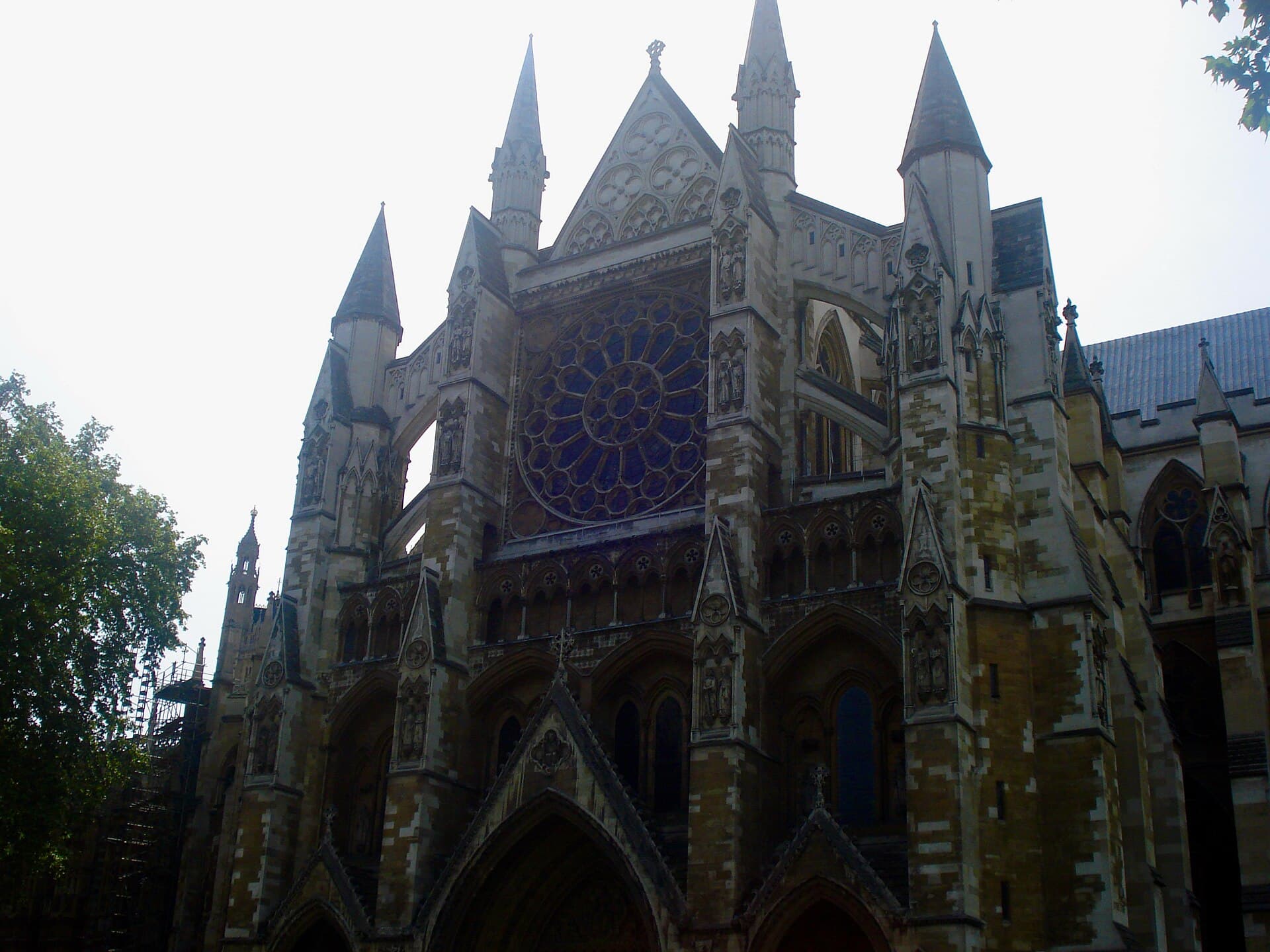
On low ground beside the Thames, on what was once a marshy islet called Thorney, stands the church that has organised the public memory of England for close to a thousand years. Westminster Abbey, formally the Collegiate Church of St Peter in Westminster, faces the Palace of Westminster in the heart of London, capital of the United Kingdom. Since 1066 every English and later British monarch has been crowned within its walls, and beneath its floor lie, or are commemorated, more than 3,300 people: kings and queens, poets, scientists, and one soldier whose name nobody knows. In 1987 UNESCO inscribed the abbey, together with the Palace of Westminster and St Margaret's Church, on the World Heritage List.
The building a visitor enters today is the work of two kings separated by nearly two centuries, finished by later hands over five hundred years more. Edward the Confessor raised the first great church on the site and lived just long enough to see it consecrated. Henry III pulled most of it down from 1245 to build the soaring Gothic church that stands now. The result is less a single monument than a continuous act of building and burying, in which each age has added its dead to the last and then handed the fabric on.
Edward the Confessor, the last great king of the Anglo-Saxon line, refounded a Benedictine monastery at Westminster and poured a large share of his wealth into a vast new church for it, the first in England built in the Romanesque manner of Normandy. It was consecrated on 28 December 1065, but the king was too ill to attend. He died in the first days of January 1066 and was buried before the high altar, and the Bayeux Tapestry shows his new church as the backdrop to the events that ended his dynasty.
Nearly two centuries later Henry III, who venerated Edward as a saint, began demolishing the Confessor's church in 1245 to raise something grander over his grave. His master mason, Henry of Reyns, drew on the French cathedrals of Reims and Amiens and gave the new church the highest Gothic vault in England, nearly 31 metres. Money ran out with the nave half finished, and rebuilding resumed only in 1376 under the architect Henry Yevele, who kept faithfully to the thirteenth-century design; the western towers were completed in 1745, to designs by Nicholas Hawksmoor. The monastery was dissolved by Henry VIII in 1540, and in 1560 Elizabeth I refounded the church as a Royal Peculiar, answerable to the sovereign alone, which it remains.
William the Conqueror had himself crowned in the abbey on Christmas Day 1066, months after Hastings, choosing the Confessor's church to declare himself heir of the old royal line. Every monarch of England, and later of Britain, has been crowned there since, except Edward V and Edward VIII, who reigned too briefly to be crowned at all. The coronation of Charles III on 6 May 2023 was the fortieth held in the church. For centuries the ritual began across the city: monarchs kept the eve of the coronation at the Tower of London and processed through the streets to Westminster the next morning.
At the centre of the rite stands a battered oak chair. Edward I commissioned the Coronation Chair around 1300 to enclose the Stone of Scone, the sandstone block on which Scottish kings had been made, which he had carried south in 1296. Almost every monarch since has been crowned seated upon it. The stone was returned to Scotland in 1996 on the understanding that it travels back to the abbey for each coronation, as it did in 2023.
Henry III's rebuilding had a second purpose: a worthy setting for Edward the Confessor's body. In October 1269 the king carried the saint's coffin on his own shoulders to a new shrine behind the high altar, where it still lies, the only major shrine in England to keep its saint through the Reformation. Around it the medieval kings gathered in death: Henry III himself, Edward I, Edward III, Richard II, and Henry V.
The dynasty that followed built its own mausoleum. Henry VII began his Lady Chapel at the abbey's east end in 1503, and its fan vault, dissolving into carved stone pendants, made it famous across Europe as a wonder of late Gothic building. The king and his queen, Elizabeth of York, lie there in a gilt-bronze tomb by the Florentine sculptor Pietro Torrigiano, one of the first Renaissance works in England. In the chapel's north aisle, James I buried Elizabeth I in 1606 in a single tomb above her half-sister Mary I, with a Latin inscription that reads in translation: partners both in throne and grave, here rest we two sisters, Elizabeth and Mary, in the hope of one resurrection. In 1612 the same king brought the body of his mother, Mary Queen of Scots, from Peterborough Cathedral, twenty-five years after her execution, and gave her a south-aisle tomb grander than Elizabeth's own, so the two rivals who never met in life now face each other across the chapel.
Geoffrey Chaucer was buried in the abbey's south transept in 1400, not because he wrote The Canterbury Tales but because he had served the crown as Clerk of the King's Works and lived out his last months as a tenant in the abbey's garden. The literature came later. In 1556 the scholar Nicholas Brigham gave Chaucer a finer tomb, and in 1599 Edmund Spenser was buried close by, fellow poets reportedly casting elegies and the pens that wrote them into his grave. From that pairing grew Poets' Corner, the closest thing the English language has to a pantheon.
Ben Jonson, Dryden, and Samuel Johnson followed. Charles Dickens was buried there in 1870, in a private early-morning service that honoured his dislike of pomp. Thomas Hardy's ashes were interred in 1928, though his heart was buried separately in his native Dorset. Around the graves crowd memorials to writers buried elsewhere: Shakespeare received his monument in 1740, more than a century after his death in Stratford, and Jane Austen and the Brontë sisters are remembered in stone here while lying in other ground.
The abbey buries its scientists with the same ceremony as its kings. Isaac Newton was buried in the nave in 1727 beneath a monument showing him reclining among his instruments, an honour that astonished Voltaire, who noted that England buried a mathematician like a beloved king. In 1882 Charles Darwin was buried a few feet from Newton, after a campaign in Parliament and the press insisted the abbey was the only fitting place.
In June 2018 the ashes of Stephen Hawking were interred between the graves of those two men, the abbey placing him in that company deliberately. His memorial stone carries his equation for the temperature of black holes. Between Newton's monument and Hawking's stone runs three centuries of a single tradition: the nation reserving this floor for those who changed what humans know.
On 11 November 1920, two years to the day after the Armistice, the body of an unidentified British soldier, brought from the battlefields of France and Flanders, was buried at the west end of the nave in soil carried over with him. The grave of the Unknown Warrior was capped the following year with a slab of black Belgian marble declaring that they buried him among the kings because he had done good toward God and toward his house. It is the one grave in the abbey on which no one may step; even coronation and funeral processions divide around it. The idea it began travelled the world within a few years, a story told in this library's page on the Tomb of the Unknown Soldier.
The grave gathered its own customs almost at once. In 1923 Lady Elizabeth Bowes-Lyon, marrying the future George VI, laid her bouquet on the slab in memory of a brother killed in the war, and every royal bride since has had her bouquet laid there, even when the wedding took place elsewhere. The abbey has hosted sixteen royal weddings in all, from Henry I in 1100 through Princess Elizabeth and Philip Mountbatten in 1947 to Prince William and Catherine Middleton in 2011, each procession stepping carefully around the Warrior's grave.
George II, buried in 1760, was the last monarch laid to rest in the abbey; the Hanoverians and their successors chose St George's Chapel at Windsor instead, and the abbey's role quietly changed. Freed from serving as the royal burial ground, it became something rarer: the place where the nation at large is remembered, with more than 3,300 burials and memorials ranging from prime ministers and abolitionists to musicians and engineers.
Since June 2018 visitors can see that long accumulation from above. The Queen's Diamond Jubilee Galleries occupy the medieval triforium, sixteen metres over the nave floor, reached by the first major addition to the church since Hawksmoor's towers. Among the exhibits are the funeral effigies once carried at royal burials: carved wooden heads of medieval kings, including Edward III's with its mouth drawn down by the stroke that killed him, and later wax figures of Charles II and Lord Nelson, the latter set up to tempt sightseers away from Nelson's tomb at St Paul's. The abbey keeps even the props of its old funerals.
One building has run a nation's remembrance for a thousand years. The walls that saw a dying king buried in January 1066 saw his successors crowned, then buried, then joined by the poets who gave the country its voice, the scientists who redrew its universe, and a nameless soldier standing for a million dead. None of it was planned. It happened because generation after generation decided that this floor, already crowded, was still the right place to set down what must not be forgotten. Westminster Abbey is what a nation's memory looks like when it is kept in one room: layered, contested, tender in places, and still open, with space somehow always found for one name more.
A church built twice
The coronation church
A mausoleum of kings and rival queens
Poets' Corner
Newton, Darwin, and a handful of ashes
The grave no one may walk on
From royal graveyard to memory hall
A millennium of keeping
References and resources
- Westminster Abbey (official site). "History," "Coronations," and commemorations pages. westminster-abbey.org.
- UNESCO World Heritage Centre. "Palace of Westminster and Westminster Abbey including Saint Margaret's Church." World Heritage List, property no. 426, inscribed 1987. whc.unesco.org/en/list/426.
- Encyclopaedia Britannica. "Westminster Abbey." britannica.com/topic/Westminster-Abbey.
- Wikipedia. "Westminster Abbey," "Coronation Chair," "Poets' Corner," "Henry VII Chapel," and "The Unknown Warrior." Retrieved 2026.
- Westminster Abbey. "The Queen's Diamond Jubilee Galleries." westminster-abbey.org.