Heritage · Landmark
Fatehpur Sikri: the capital Akbar built and left
A whole Mughal capital stands on a sandstone ridge west of Agra, its mint, its records office, its baths and its stables still in the positions the emperor's builders gave them. The court moved in around 1571 and moved out in 1585, and almost nothing was raised over it afterwards.Written to last.
By Confinity Heritage Editorial · 2026-08-25 · 7-minute readQuiet tools, kept out of the way.
Fatehpur Sikri sits on a sandstone ridge in Agra District, in the north of India, roughly 37 kilometres west of Agra. The Mughal emperor Akbar made it his capital and had the first phase constructed between 1571 and 1573: palaces, offices, stables, baths and one of the largest mosques in the subcontinent, almost all of it red sandstone quarried from the ridge it stands on. The court left in 1585. Very little was built there afterwards, so the plan a visitor walks through is close to the plan that was finished.
Akbar reached his late twenties without a surviving heir. Sikri was not empty ground: an Archaeological Survey of India excavation in 1999 and 2000 turned up Jain sculpture and temple foundations a thousand years older than Akbar. What drew him was a person. Shaikh Salim Chishti, a Sufi of the Chishti order who lived from 1478 to 1572, kept a cavern on the ridge, and Akbar came to ask him to pray for a son. A son was born at Sikri in 1569 and named Salim after the saint. He became the emperor Jahangir.
Akbar began a religious compound that year, and after the boy's second birthday he started a walled city and an imperial palace. Abul Fazl gave the reasoning in the Akbarnama: his sons had been born at Sikri, the spirit of Shaikh Salim had taken possession of the place, and the emperor wished to give outward splendour to a spot that already held spiritual grandeur. Building a capital at a working khanqah lent Akbar a legitimacy the Chishtis could confer and he could not manufacture. The name Fatehpur, city of victory, followed the Gujarat campaign of 1572 and 1573.
The ridge runs about three kilometres. A wall some six kilometres long, pierced by nine gates, closed the city on three sides; a dammed lake closed the fourth. Inside, the plan was rectangular and gridded, with drainage laid in from the start. The building is red sandstone throughout, with very little marble, and the vocabulary is mixed: Timurid massing, Persian forms, decorative habits from Gujarat, and the domestic architecture of Hindu and Muslim India set side by side without much anxiety about which was which.
Two buildings show how far that mixing went. The Panch Mahal is five open storeys of columns, each tier smaller than the one beneath, 176 columns in all, finished with a single domed chhatri; UNESCO reads it as disposed asymmetrically on the pattern of a Persian badgir, or wind catcher. The Diwan-i-Khas is a plain square box with four chhatris on the roof, and inside it is one pillar: square at the base, octagonal above, banded with geometric and floral carving, opening at the top into thirty-six serpentine brackets that carry a circular platform. Four narrow stone walkways run from that platform to the corners of the upper gallery.
The Jama Masjid was among the first things built on the summit; its epigraph gives AH 979, that is 1571 or 1572, as the date of completion. It follows Indian practice: iwans around a central courtyard, a row of chhatris above the sanctuary.
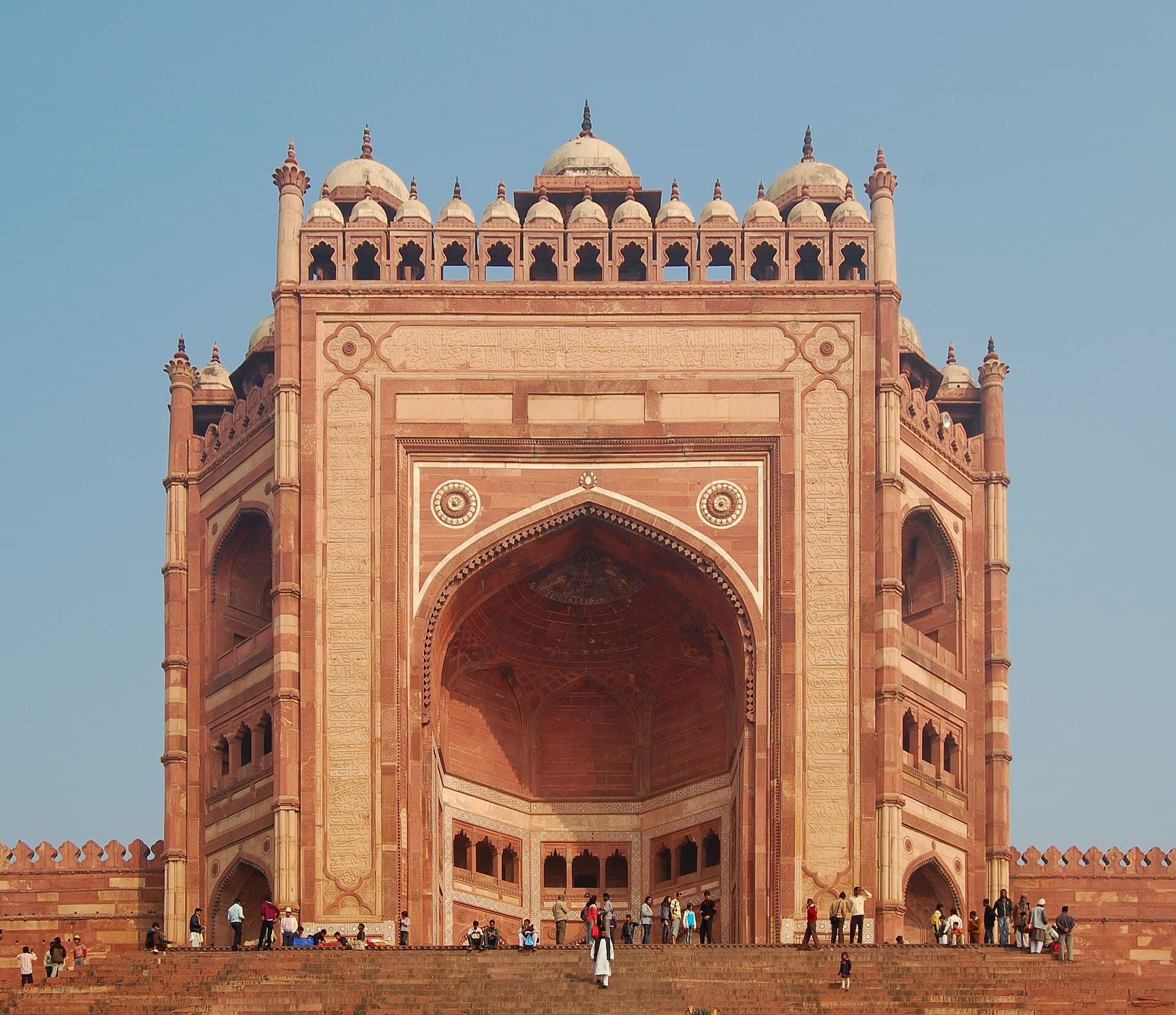
The Buland Darwaza was added to the mosque's south wall about five years later as a victory arch for Gujarat. UNESCO records it as completed in 1575 and 40 metres high; other accounts date the start to 1573 and give a total height of some 54 metres from ground level, counting the flight of forty-two steps that does most of the work of making it enormous. Locals call its central opening the Horseshoe Gate, for the shoes nailed to the wooden doors for luck.
Inside the mosque courtyard stands the tomb of Salim Chishti, built in 1580 and 1581 and embellished again under Jahangir in 1606. It is white marble where everything around it is red: a single storey around a square chamber, the grave beneath a wooden canopy encrusted with mother-of-pearl, a passage for circumambulation, and jali screens cut so finely that the light comes through them in geometric patterns. The design owes a good deal to the Gujarat Sultanate mausolea of the previous century, another thing the Gujarat campaign brought home.
The Ibadat Khana, the house of worship, was begun in 1575 and finished the following year. Discussions ran there on Thursday evenings, sometimes through the night. It started as a Sunni assembly, widened into a pan-Muslim one, and from 1578 opened to Hindus, Jains, Zoroastrians, Christians and men who professed no faith. Three Jesuits from Goa reached the city on 28 February 1580, Rodolfo Acquaviva, Antonio Monserrate and Francis Henriques, and stayed three years before concluding that Akbar would not convert.
What came out of those evenings is easy to overstate. In 1582 Akbar articulated what later writers call the Din-i-Ilahi; Abul Fazl and his contemporaries called it Tawhid-i-Ilahi, oneness of the divine. It had no scripture and no priesthood, and historians have identified only eighteen or nineteen adherents, all of them courtiers. Some scholars argue that treating it as a founded religion is a misreading produced by later British translations of Abul Fazl, and that the durable thing was sulh-i-kul, universal peace: appointment on merit rather than creed. Where it physically stood is also unresolved. In the early 1980s K. K. Muhammed, working under R. C. Gaur of Aligarh Muslim University, excavated a mound between the Jama Masjid and the Jodha Bai palace and matched it to a painting made in Akbar's lifetime; Syed Ali Nadeem Rezavi argues for the Daftarkhana instead. Guides on the site tend to point at the pillar in the Diwan-i-Khas.
In 1585 Akbar marched for the Punjab after the death of his half-brother Mirza Muhammad Hakim, and the capital went to Lahore. He returned once, briefly, in 1601. UNESCO records that the city then remained an area for temporary visits by the Mughal emperors. William Finch passed through in November 1610 and found it lying like a waste desert.
Most accounts say the water failed. The explanation is contested, and the disagreement is worth setting out rather than resolving. The charge first appears under Jahangir, who wrote in 1619 that Fathpur had little water and that the water it had was bad. Rezavi points out that no source from the years when the city was the capital says anything of the kind: not the official chronicles, not Badauni, not the private letters of residents. The evidence runs the other way. Babur had camped at Sikri in 1527 because the well watered ground for a large army was there. In 1580 the Jesuit Francis Henriques wrote that a perennial lake had been led in a year earlier and watered the elephants, horses, cattle and the whole population. A survey of the walled city finds at least thirteen stepwells and eight tanks besides. One water crisis is on record and it is the opposite of a drought: in 1584 a side of the Hauz-i Shirin gave way, and the flood carried off houses below and killed the emperor's leopard keeper.
The competing explanation is strategic. Abul Fazl sets out Akbar's own programme for the north west: give peace to Afghanistan, clear Swat and Bajaur of rebellion, uproot the Raushaniyya, seize Kashmir, bring Sindh into the empire. That work wanted Lahore, and when it was done a court facing a Deccan campaign and a rebellious son preferred the walls of Agra Fort. A third reading, from J. F. Richards, ties the move to Akbar's religious trajectory: he had made pilgrimages to Chishti shrines for years, and in 1585 they stopped.
The city did not empty overnight either. The mint stopped striking gold in 1580 or 1581 and silver and copper the year after. Akbar's mother stayed on after the court had gone, and by the 1610s the town carried a working bazaar, an indigo trade and Persian carpet weavers, none of which is possible without water. What ended in 1585 was the capital, not the place.
Over the archway of the Buland Darwaza, in Persian, is an inscription that names Jesus. The usual English rendering opens: "The world is a bridge, pass over it, but build no houses on it." It goes on: the world endures but an hour, and the hour should be spent in prayer, because the rest is unseen.
The attribution is not a Christian import, nor the work of the Jesuits, who arrived five years after the gate was finished. The saying is an agraphon, one with no place in the canonical gospels, and it had circulated in Arabic and Persian devotional writing for centuries before Akbar was born. Al-Ghazali gives it as a saying of Jesus, Abu Talib al-Makki attributes it instead to Muhammad, and the New Testament scholar Joachim Jeremias suggested that some version of it lies behind the otherwise cryptic instruction in the Gospel of Thomas to be passers-by. Tarif Khalidi's collection of the sayings and stories of Jesus in Islamic literature runs to roughly three hundred items, and this is one of them. Its presence on a Mughal victory arch is ordinary devotional culture, not a curiosity.
The city below it was finished, occupied for fourteen years, and left.
Because so little was built over it, Fatehpur Sikri preserves the working plan of a Mughal court in a way no other site does: administrative block, royal apartments, mint, records office, workshops, treasury, baths, stables and caravanserai still in their original relations to one another, which lets archaeologists reconstruct the hierarchy of a sixteenth century household from the ground itself. UNESCO's authenticity statement records repairs from the British period onward, carried out without changing the original structures. Mining is banned within ten kilometres, and the site falls inside the Taj Trapezium Zone, the pollution control area established by India's Supreme Court in December 1996 that also covers the Taj Mahal and Agra Fort.
The palace complex is ticketed and run by the Archaeological Survey of India, but the mosque courtyard is not a ruin. The tomb of Salim Chishti is a working shrine, and pilgrims, many of them women hoping for a child, still tie threads to the marble screens and come back to untie them when the wish is granted. The saint who promised Akbar a son is still being asked for the same thing.
Two capitals emptied in different ways: Ani, on the Turkish side of a closed border, went out slowly, through sieges, earthquakes and trade routes that moved, and left ruins; Fatehpur Sikri went out in a single season by one man's decision, and left a city.
The saint on the ridge
Red sandstone and a borrowed grammar
The mosque, the gate, and the tomb
The house of worship
Fourteen years, and then the court left
The world is a bridge
What is left, and who still comes
References and resources
- UNESCO World Heritage Centre. "Fatehpur Sikri." World Heritage List no. 255, inscribed 1986 under criteria (ii), (iii) and (iv). whc.unesco.org/en/list/255.
- Wikipedia. "Fatehpur Sikri," "Buland Darwaza," "Tomb of Salim Chishti," "Ibadat Khana," "Din-i Ilahi," "Salim Chishti." Retrieved 2026.
- Syed Ali Nadeem Rezavi. "Demystifying the Popular Myths Around the Building and Abandonment of Fathpur Sikri." ASHA: Blast From The Past, 23 April 2019.
- Manya Rathore. "Ibadat Khana." World History Encyclopedia, 29 April 2020.
- BYU Studies. "The Noncanonical Sayings of Jesus." byustudies.byu.edu.
- Tarif Khalidi, editor and translator. The Muslim Jesus: Sayings and Stories in Islamic Literature. Harvard University Press.
- Abul Fazl. The Akbarnama. Translated by H. Beveridge. Asiatic Society, Calcutta.