Heritage · Landmark
Vatican City: History, Attractions & Visitor Guide
Vatican City is the smallest sovereign state on earth, forty-four hectares inside Rome, created by the Lateran Treaty on 11 February 1929.Written to last.
By Confinity Heritage Editorial · Updated 2026-07-20 · 7-minute readQuiet tools, kept out of the way.
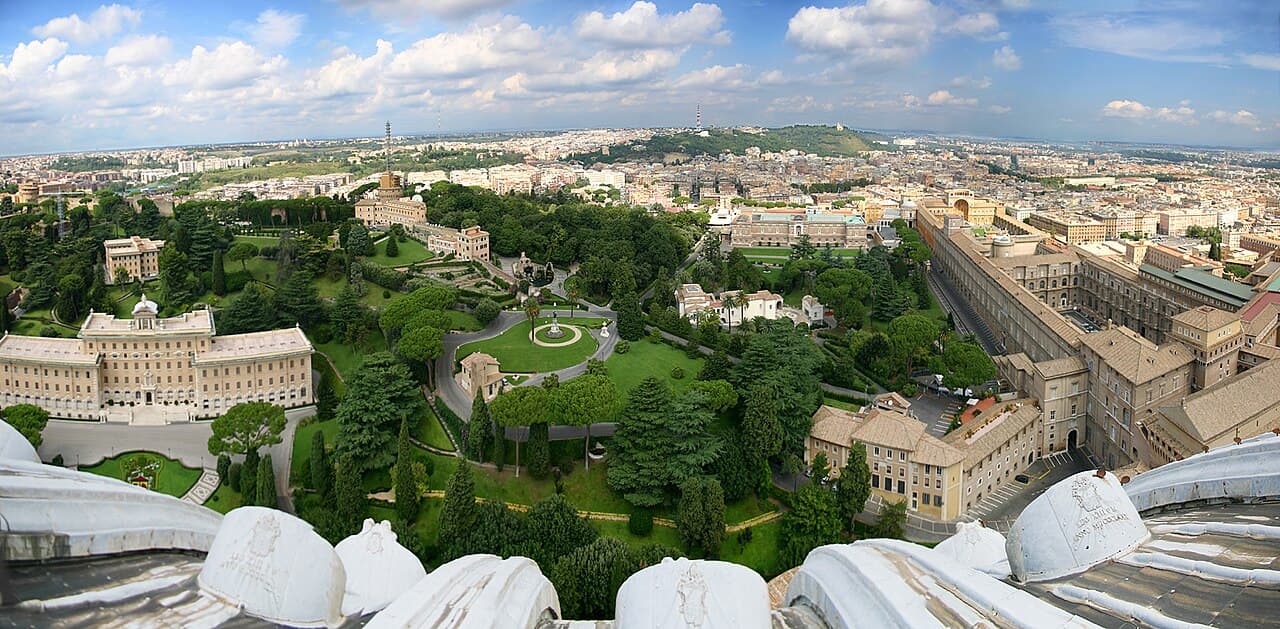
Vatican City is the smallest sovereign state in the world, a walled enclave of about 44 hectares (109 acres) set entirely within the city of Rome. It was created on 11 February 1929 by the Lateran Treaty between the Holy See and the Kingdom of Italy, and it serves as the seat of the Holy See, the central government of the Roman Catholic Church, and the residence of the pope. Fewer than a thousand people hold Vatican citizenship, yet the territory carries a weight out of all proportion to its size: it contains St Peter's Basilica and its square, the Apostolic Palace, extensive gardens, and one of the most concentrated collections of Renaissance and Baroque art anywhere. In 1984 the entire city was inscribed on the UNESCO World Heritage List, the only case of a whole independent country being listed as a single property.
The ground beneath Vatican City was a burial area on the right bank of the Tiber in Roman times, outside the ancient city walls. Christian tradition holds that the apostle Saint Peter was martyred nearby during the reign of the emperor Nero, around 64 AD, and buried on the Vatican hill. In the 4th century the emperor Constantine raised a large basilica over the site venerated as Peter's grave, the church now known as Old St Peter's. That building anchored the area as a place of pilgrimage for more than a thousand years and drew the papal court to settle around it.
For most of the Middle Ages and the early modern period the popes were not only spiritual leaders but also temporal rulers of the Papal States, a band of territories across central Italy governed from Rome. Defensive walls followed. After Saracen raiders sacked the shrine of St Peter in 846, Pope Leo IV enclosed the Vatican hill with fortifications between about 848 and 852, creating what became known as the Leonine City. Later popes, among them Paul III, Pius IV, and Urban VIII, extended and strengthened the walls, several stretches of which still mark the modern border.
The temporal power ended in the 19th century. During Italian unification, troops of the new Kingdom of Italy captured Rome in 1870 and annexed the last of the Papal States. The popes refused to accept the loss and withdrew inside the Vatican, describing themselves as prisoners rather than recognise the Italian claim to the city. This standoff, known as the Roman Question, lasted almost sixty years. It was resolved on 11 February 1929, when Cardinal Secretary of State Pietro Gasparri and the Italian prime minister Benito Mussolini signed the Lateran Treaty on behalf of Pope Pius XI and King Victor Emmanuel III. Italy recognised the full sovereignty of the Holy See over the newly defined Vatican City State, and the Holy See recognised the Kingdom of Italy with Rome as its capital. The agreement took legal effect on 7 June 1929, and a new state, the smallest in the world, came into being.
The present St Peter's Basilica replaced the crumbling Constantinian church. Pope Julius II decided to rebuild it entirely, and the foundation stone was laid on 18 April 1506 to a plan by Donato Bramante. The project consumed the careers of successive architects across 120 years. Raphael and Antonio da Sangallo the Younger took the design in different directions before Michelangelo took charge in 1547 and returned it to Bramante's idea of a great central dome. Michelangelo did not live to see it finished; the dome was completed to his designs by Giacomo della Porta and Domenico Fontana in 1590. Carlo Maderno then lengthened the nave and built the travertine facade, and the basilica was consecrated on 18 November 1626 by Pope Urban VIII.
 Bernini described the colonnades as the arms of the church reaching out to embrace the world. Stand on either of the two marked stones and the four rows of columns line up as one. Photograph by Lars Curfs, CC BY-SA 3.0, via Wikimedia Commons.
The result is one of the largest churches ever built. The interior runs to roughly 220 metres (about 730 feet) in length, and Michelangelo's dome rises about 136 metres to the top of the cross, which makes it the tallest dome in the world by that measure. Markers set into the nave floor record how far short the great churches of other cities fall against St Peter's length. Directly below the central papal altar, marked by a sunken shrine called the Confessio, lies the space venerated as the tomb of St Peter; archaeological excavations in the Vatican necropolis during the 1940s and 1950s explored the burials beneath the church. Inside the basilica are works such as Michelangelo's Pietà and the bronze baldachin over the high altar by Gian Lorenzo Bernini.
The scale of the project also left a mark on European history. Rebuilding on this scale was enormously expensive, and to help pay for it the papacy expanded the sale of indulgences, grants of remission from the penalties of sin offered in return for donations. The aggressive marketing of a St Peter's indulgence in the German lands was the immediate provocation for Martin Luther's Ninety-five Theses of 1517, the document usually taken to mark the start of the Protestant Reformation. In that sense the church meant to crown the unity of Western Christianity became entangled with its greatest division.
In front of the basilica, Bernini shaped the open space that has become the public face of the Vatican. St Peter's Square was built between 1656 and 1667 for Pope Alexander VII. Its central ellipse, the piazza obliqua, is framed by two curving colonnades of 284 columns and 88 pilasters set in four rows of the Tuscan order, crowned by 140 statues of saints. Bernini described the sweeping arms as the embrace of the Church reaching out to the faithful, and the design lets very large crowds see the pope when he appears. At the centre stands an ancient Egyptian obelisk, brought to Rome in the 1st century and moved to its present position in 1586 under Pope Sixtus V in a famous feat of engineering by Domenico Fontana. Together, the basilica and its square form the single most recognised icon of sacred architecture cited in the UNESCO listing.
It helps to separate two things that are easy to confuse. The Holy See is the central governing institution of the Roman Catholic Church, the jurisdiction of the pope as bishop of Rome; it is the entity that conducts diplomacy, sends and receives ambassadors, and holds a permanent observer seat at the United Nations. Vatican City State is the physical territory created in 1929 to give the Holy See a sovereign base independent of any other country. The pope is the head of both, and he holds full legislative, executive, and judicial authority over the state, which makes Vatican City one of the few absolute elective monarchies in the world.
Day-to-day government is delegated. Legislative power is exercised in the pope's name by the Pontifical Commission for Vatican City State, while administration runs through a Governorate headed by a president. The state has its own flag, anthem, postal service, pharmacy, small railway station, and euro coinage minted under agreement with the European Union. Security inside the walls has been the responsibility of the Pontifical Swiss Guard since Pope Julius II first recruited the corps in 1506; its members still wear the distinctive striped Renaissance uniform.
For so small a place, Vatican City runs a surprising number of institutions. Vatican Radio was built by the wireless pioneer Guglielmo Marconi and inaugurated by Pope Pius XI on 12 February 1931; it now broadcasts in dozens of languages. The daily newspaper L'Osservatore Romano has appeared since the 19th century, and Vatican stamps and coins are collected worldwide. Citizenship is unusual in that it is granted for the duration of an official role rather than by birth, so the population is made up largely of clergy, Swiss Guards, and their families, and it falls when postings end. The state has no military of its own beyond the Guard, and it stayed formally neutral through the Second World War under Pope Pius XII while Rome around it was occupied.
Much of the territory is not built up at all. The Vatican Gardens cover roughly 23 hectares, about half the state, and have been laid out and replanted since the Renaissance and Baroque periods with lawns, fountains, and woodland. The Apostolic Palace, the official papal residence next to the basilica, is a vast complex of chapels, offices, and galleries that also houses the Vatican Apostolic Library. Alongside these sits the network of galleries known as the Vatican Museums, home to the Sistine Chapel and the Raphael Rooms; those collections are covered on their own page rather than here. Beyond the walls, the Lateran Treaty also granted the Holy See extraterritorial control over several properties elsewhere in Rome and the papal estate at Castel Gandolfo.
The whole of Vatican City was inscribed on the UNESCO World Heritage List in 1984 under four cultural criteria. The listing praises the state as a unique masterpiece of artistic creation that has exerted a deep influence on the development of art since the 16th century, singling out the basilica of St Peter together with the Sistine Chapel, the Raphael Rooms, and the other decorated interiors. Because the property boundary follows the state border, Vatican City is both the smallest World Heritage site and the only one that coincides with an entire sovereign country.
Conserving that heritage is a continuous task carried out by the Vatican's own restoration workshops and scientific laboratories. The most publicised campaign was the cleaning of Michelangelo's frescoes in the Sistine Chapel, completed over roughly fourteen years and unveiled in the 1990s, which stripped centuries of soot and overpainting to reveal far brighter colour than most viewers had ever seen. Work of this kind is not without controversy, and conservators balance the desire to clean against the risk of removing original material. The pressures are ongoing: heavy visitor numbers raise heat and humidity around fragile surfaces, and air pollution drifting from the surrounding city weathers stone and pigment. The Vatican has responded with climate control in the most sensitive rooms, careful management of the gardens, and investment in energy measures such as solar panels on some roofs.
Vatican City sits on the west bank of the Tiber and is reached most easily from the Ottaviano-San Pietro or Cipro stops on Line A of the Rome Metro, or on foot from the historic centre across the river. There are no passport checks at the open border with Italy.
St Peter's Square is a public space, open at all hours. St Peter's Basilica is free to enter and generally opens in the early morning and closes in the evening, with hours varying by season and by the calendar of services; a modest fee applies to climb the dome, which rewards the effort with a view over the square, the gardens, and the rooftops of Rome. Visitors pass through airport-style security, and a dress code is enforced throughout the basilica and the museums: shoulders and knees must be covered. Crowds are heaviest in the middle of the day and around papal events, so early morning tends to be calmer.
Seeing the pope is possible on a set rhythm. He gives a general audience in the square on most Wednesdays, weather and travel permitting, and leads the Angelus prayer at midday on Sundays from a window of the Apostolic Palace; free tickets are needed for the Wednesday audience but not for the Sunday Angelus. The square is also the setting for the great set pieces of the church calendar, from canonisations to the Urbi et Orbi blessing given at Christmas and Easter. In a Jubilee or Holy Year, held about every 25 years, the pope opens the Holy Door of St Peter's, and pilgrims pass through it before it is sealed again at the year's end. The Vatican Gardens can be visited only on booked guided tours rather than wandered freely. The Vatican Museums and the Sistine Chapel have a separate ticketed entrance on the Viale Vaticano and their own opening times; plan those through their dedicated page. Nearby, Castel Sant'Angelo, the papal fortress that began as the mausoleum of the emperor Hadrian, makes a natural companion visit a short walk along the river.
Bernini described the colonnades as the arms of the church reaching out to embrace the world. Stand on either of the two marked stones and the four rows of columns line up as one. Photograph by Lars Curfs, CC BY-SA 3.0, via Wikimedia Commons.
The result is one of the largest churches ever built. The interior runs to roughly 220 metres (about 730 feet) in length, and Michelangelo's dome rises about 136 metres to the top of the cross, which makes it the tallest dome in the world by that measure. Markers set into the nave floor record how far short the great churches of other cities fall against St Peter's length. Directly below the central papal altar, marked by a sunken shrine called the Confessio, lies the space venerated as the tomb of St Peter; archaeological excavations in the Vatican necropolis during the 1940s and 1950s explored the burials beneath the church. Inside the basilica are works such as Michelangelo's Pietà and the bronze baldachin over the high altar by Gian Lorenzo Bernini.
The scale of the project also left a mark on European history. Rebuilding on this scale was enormously expensive, and to help pay for it the papacy expanded the sale of indulgences, grants of remission from the penalties of sin offered in return for donations. The aggressive marketing of a St Peter's indulgence in the German lands was the immediate provocation for Martin Luther's Ninety-five Theses of 1517, the document usually taken to mark the start of the Protestant Reformation. In that sense the church meant to crown the unity of Western Christianity became entangled with its greatest division.
In front of the basilica, Bernini shaped the open space that has become the public face of the Vatican. St Peter's Square was built between 1656 and 1667 for Pope Alexander VII. Its central ellipse, the piazza obliqua, is framed by two curving colonnades of 284 columns and 88 pilasters set in four rows of the Tuscan order, crowned by 140 statues of saints. Bernini described the sweeping arms as the embrace of the Church reaching out to the faithful, and the design lets very large crowds see the pope when he appears. At the centre stands an ancient Egyptian obelisk, brought to Rome in the 1st century and moved to its present position in 1586 under Pope Sixtus V in a famous feat of engineering by Domenico Fontana. Together, the basilica and its square form the single most recognised icon of sacred architecture cited in the UNESCO listing.
It helps to separate two things that are easy to confuse. The Holy See is the central governing institution of the Roman Catholic Church, the jurisdiction of the pope as bishop of Rome; it is the entity that conducts diplomacy, sends and receives ambassadors, and holds a permanent observer seat at the United Nations. Vatican City State is the physical territory created in 1929 to give the Holy See a sovereign base independent of any other country. The pope is the head of both, and he holds full legislative, executive, and judicial authority over the state, which makes Vatican City one of the few absolute elective monarchies in the world.
Day-to-day government is delegated. Legislative power is exercised in the pope's name by the Pontifical Commission for Vatican City State, while administration runs through a Governorate headed by a president. The state has its own flag, anthem, postal service, pharmacy, small railway station, and euro coinage minted under agreement with the European Union. Security inside the walls has been the responsibility of the Pontifical Swiss Guard since Pope Julius II first recruited the corps in 1506; its members still wear the distinctive striped Renaissance uniform.
For so small a place, Vatican City runs a surprising number of institutions. Vatican Radio was built by the wireless pioneer Guglielmo Marconi and inaugurated by Pope Pius XI on 12 February 1931; it now broadcasts in dozens of languages. The daily newspaper L'Osservatore Romano has appeared since the 19th century, and Vatican stamps and coins are collected worldwide. Citizenship is unusual in that it is granted for the duration of an official role rather than by birth, so the population is made up largely of clergy, Swiss Guards, and their families, and it falls when postings end. The state has no military of its own beyond the Guard, and it stayed formally neutral through the Second World War under Pope Pius XII while Rome around it was occupied.
Much of the territory is not built up at all. The Vatican Gardens cover roughly 23 hectares, about half the state, and have been laid out and replanted since the Renaissance and Baroque periods with lawns, fountains, and woodland. The Apostolic Palace, the official papal residence next to the basilica, is a vast complex of chapels, offices, and galleries that also houses the Vatican Apostolic Library. Alongside these sits the network of galleries known as the Vatican Museums, home to the Sistine Chapel and the Raphael Rooms; those collections are covered on their own page rather than here. Beyond the walls, the Lateran Treaty also granted the Holy See extraterritorial control over several properties elsewhere in Rome and the papal estate at Castel Gandolfo.
The whole of Vatican City was inscribed on the UNESCO World Heritage List in 1984 under four cultural criteria. The listing praises the state as a unique masterpiece of artistic creation that has exerted a deep influence on the development of art since the 16th century, singling out the basilica of St Peter together with the Sistine Chapel, the Raphael Rooms, and the other decorated interiors. Because the property boundary follows the state border, Vatican City is both the smallest World Heritage site and the only one that coincides with an entire sovereign country.
Conserving that heritage is a continuous task carried out by the Vatican's own restoration workshops and scientific laboratories. The most publicised campaign was the cleaning of Michelangelo's frescoes in the Sistine Chapel, completed over roughly fourteen years and unveiled in the 1990s, which stripped centuries of soot and overpainting to reveal far brighter colour than most viewers had ever seen. Work of this kind is not without controversy, and conservators balance the desire to clean against the risk of removing original material. The pressures are ongoing: heavy visitor numbers raise heat and humidity around fragile surfaces, and air pollution drifting from the surrounding city weathers stone and pigment. The Vatican has responded with climate control in the most sensitive rooms, careful management of the gardens, and investment in energy measures such as solar panels on some roofs.
Vatican City sits on the west bank of the Tiber and is reached most easily from the Ottaviano-San Pietro or Cipro stops on Line A of the Rome Metro, or on foot from the historic centre across the river. There are no passport checks at the open border with Italy.
St Peter's Square is a public space, open at all hours. St Peter's Basilica is free to enter and generally opens in the early morning and closes in the evening, with hours varying by season and by the calendar of services; a modest fee applies to climb the dome, which rewards the effort with a view over the square, the gardens, and the rooftops of Rome. Visitors pass through airport-style security, and a dress code is enforced throughout the basilica and the museums: shoulders and knees must be covered. Crowds are heaviest in the middle of the day and around papal events, so early morning tends to be calmer.
Seeing the pope is possible on a set rhythm. He gives a general audience in the square on most Wednesdays, weather and travel permitting, and leads the Angelus prayer at midday on Sundays from a window of the Apostolic Palace; free tickets are needed for the Wednesday audience but not for the Sunday Angelus. The square is also the setting for the great set pieces of the church calendar, from canonisations to the Urbi et Orbi blessing given at Christmas and Easter. In a Jubilee or Holy Year, held about every 25 years, the pope opens the Holy Door of St Peter's, and pilgrims pass through it before it is sealed again at the year's end. The Vatican Gardens can be visited only on booked guided tours rather than wandered freely. The Vatican Museums and the Sistine Chapel have a separate ticketed entrance on the Viale Vaticano and their own opening times; plan those through their dedicated page. Nearby, Castel Sant'Angelo, the papal fortress that began as the mausoleum of the emperor Hadrian, makes a natural companion visit a short walk along the river.
History
St Peter's Basilica and Square
The state and the Holy See
Preservation
Visiting
References and resources
- UNESCO World Heritage Centre, Vatican City (property 286)
- Encyclopaedia Britannica: Vatican City
- Wikipedia: Vatican City
- Wikipedia: St Peter's Basilica
- Wikipedia: St Peter's Square
- Wikipedia: Lateran Treaty
- The Holy See (official site)
- St Peter's Basilica (official site)
- Vatican Museums (official site)