Heritage · Landmark
The Sydney Opera House: History, Architecture and Visitor Guide
The Sydney Opera House, opened in 1973 on Sydney Harbour, is Jorn Utzon's shell-roofed masterpiece and a UNESCO World Heritage Site listed in 2007.Written to last.
By Confinity Heritage Editorial · Updated 2026-07-31 · 7-minute readQuiet tools, kept out of the way.
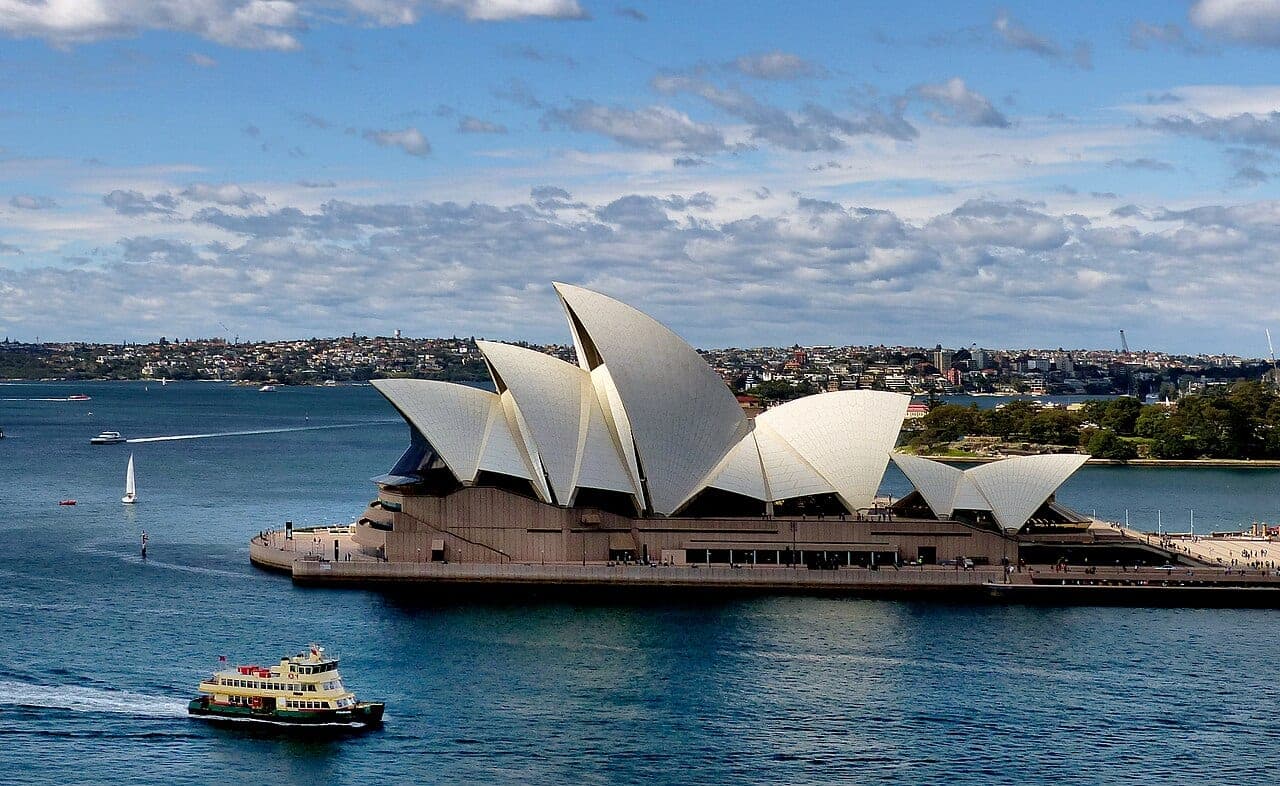
Few modern buildings are as instantly recognisable as the Sydney Opera House. Set on Bennelong Point, a finger of land reaching into Sydney Harbour, its cluster of white shell roofs has become the emblem of a city and, for many, of Australia itself. Designed by the Danish architect Jorn Utzon and opened in 1973, it is one of the defining works of twentieth-century architecture and a rare example of a public building whose form was genuinely new when it appeared (Britannica).
The building is both an artistic landmark and a working performing-arts centre. Beneath the sails sit several concert halls and theatres that host around 1,800 performances a year, while the site draws well over ten million visitors annually (Wikipedia). In 2007 UNESCO added it to the World Heritage List under criterion (i), recognising it as a masterpiece of human creative genius and a daring experiment that influenced the architecture of the late twentieth century (UNESCO).
The story begins with a competition. In the mid-1950s the government of New South Wales invited designs for an opera house on Bennelong Point, and in 1957 an international jury chose the entry of Jorn Utzon, then a little-known architect who had never built anything on this scale (Britannica). His drawings proposed a series of soaring shells rising from a broad platform, a shape he later linked to natural forms such as bird wings, clouds and shells (UNESCO).
Turning that vision into a structure proved far harder than anyone expected. The curved roofs could not be built from the freehand shapes of the original sketches, and Utzon worked for years with the engineering firm Ove Arup and Partners to find a buildable geometry. The breakthrough came around 1961, when the team realised that every shell could be cut from the surface of a single sphere, so that all the ribs shared the same curvature and could be cast from common moulds (Wikipedia). The roofs were finally assembled from 2,194 precast concrete sections and clad in more than a million ceramic tiles (Wikipedia).
Construction ran long and far over budget. An early estimate of around AUD 7 million and a completion date in the early 1960s gave way to a final cost of about AUD 102 million and an opening a decade behind schedule (Wikipedia). As costs climbed the politics soured. After a change of state government in 1965, the new works minister, Davis Hughes, clashed with Utzon over payments and design control, and in February 1966 the architect resigned and left Australia, with the interiors completed by a team led by Peter Hall (Wikipedia; Britannica). Queen Elizabeth II formally opened the finished building on 20 October 1973 (Britannica).
Utzon never saw the completed work in person, but the rift eventually healed. In 1999 he was re-engaged as a design consultant, and he set out a body of design principles to guide future changes so that the building could evolve without losing its character (Sydney Opera House). A reception room he redesigned reopened in 2004 and was renamed the Utzon Room in his honour (Sydney Opera House). He died in 2008, reconciled with the building he had shaped but never returned to visit (Wikipedia).
The design divides sharply into two parts: a heavy platform and the light roofs above it. The podium is a broad terraced base that lifts visitors above the water and conceals the mechanical spaces and access below. From it rise the shells, a set of gleaming vaults that reach about 67 metres at their highest point over a site roughly 183 metres long and 120 metres wide (Wikipedia). The shells are faced in Swedish-made tiles in two finishes, glossy and matte, so that the surface shifts between bright white and softer cream as the light and weather change (Wikipedia).
 The shells were unbuildable as first drawn. The solution was to make every one of them a section of the surface of a single sphere, so the same curve could be cast again and again. Photograph by Dietmar Rabich, CC BY-SA 4.0, via Wikimedia Commons.
Inside, the sails shelter a group of performance spaces. The largest is the Concert Hall, seating roughly 2,600 and home to a grand pipe organ. Alongside it sit the Joan Sutherland Theatre, used for opera and ballet, together with the Drama Theatre, the Playhouse and a smaller Studio (Wikipedia). Foyers of glass face the harbour, so that audiences look out over the water between acts.
The Opera House quickly became a national symbol and a fixture of Sydney life. It is the home of Opera Australia, the Sydney Symphony Orchestra and other resident companies, and its stages carry everything from classical concerts to contemporary music, theatre and public talks (Sydney Opera House). Its silhouette appears on stamps, in film and on the harbour every New Year, when fireworks frame the sails for a global audience. Few works of architecture have travelled so far as a shorthand for the country that built them.
The Opera House sits at Bennelong Point, a short walk from Circular Quay, which links the city's train, bus and ferry networks and makes public transport the easiest way to arrive. Guided tours run through the day and take visitors behind the scenes into the halls and foyers, while performance tickets are sold separately through the resident companies and the box office (Sydney Opera House). The building offers step-free routes, accessible seating and assisted-listening systems, and current times, prices and access details are published on the official website (Sydney Opera House).
Keeping a building of this age and fame in working order is a continuing task. Since 2013 the site has been through a long programme of upgrades, sometimes called the Decade of Renewal, worth close to AUD 300 million, which has renewed ageing stage machinery, improved access and opened new public areas (Sydney Opera House). The centrepiece was a major overhaul of the Concert Hall, which closed for renovation and reopened in 2022 with improved acoustics and safety, ahead of the building's fiftieth anniversary in 2023 (Sydney Opera House). The work is guided by Utzon's own principles, so that each change is measured against the original intent rather than made for its own sake.
The shells were unbuildable as first drawn. The solution was to make every one of them a section of the surface of a single sphere, so the same curve could be cast again and again. Photograph by Dietmar Rabich, CC BY-SA 4.0, via Wikimedia Commons.
Inside, the sails shelter a group of performance spaces. The largest is the Concert Hall, seating roughly 2,600 and home to a grand pipe organ. Alongside it sit the Joan Sutherland Theatre, used for opera and ballet, together with the Drama Theatre, the Playhouse and a smaller Studio (Wikipedia). Foyers of glass face the harbour, so that audiences look out over the water between acts.
The Opera House quickly became a national symbol and a fixture of Sydney life. It is the home of Opera Australia, the Sydney Symphony Orchestra and other resident companies, and its stages carry everything from classical concerts to contemporary music, theatre and public talks (Sydney Opera House). Its silhouette appears on stamps, in film and on the harbour every New Year, when fireworks frame the sails for a global audience. Few works of architecture have travelled so far as a shorthand for the country that built them.
The Opera House sits at Bennelong Point, a short walk from Circular Quay, which links the city's train, bus and ferry networks and makes public transport the easiest way to arrive. Guided tours run through the day and take visitors behind the scenes into the halls and foyers, while performance tickets are sold separately through the resident companies and the box office (Sydney Opera House). The building offers step-free routes, accessible seating and assisted-listening systems, and current times, prices and access details are published on the official website (Sydney Opera House).
Keeping a building of this age and fame in working order is a continuing task. Since 2013 the site has been through a long programme of upgrades, sometimes called the Decade of Renewal, worth close to AUD 300 million, which has renewed ageing stage machinery, improved access and opened new public areas (Sydney Opera House). The centrepiece was a major overhaul of the Concert Hall, which closed for renovation and reopened in 2022 with improved acoustics and safety, ahead of the building's fiftieth anniversary in 2023 (Sydney Opera House). The work is guided by Utzon's own principles, so that each change is measured against the original intent rather than made for its own sake.
History
Architecture
Cultural role
Visiting
Preservation
References and resources
- UNESCO World Heritage Centre: Sydney Opera House: inscription in 2007 under criterion (i), design origins and outstanding universal value.
- Encyclopaedia Britannica: Sydney Opera House: Utzon's competition win, the 1966 resignation and the 1973 opening.
- Sydney Opera House (official): resident companies, tours, access, Utzon's reconciliation and the renewal works.
- Wikipedia: Sydney Opera House: engineering of the shells, cost figures, dimensions and interior venues.