Heritage · Landmark
Teotihuacan: the place where the gods were made
Centuries before the Aztecs, an unknown people raised one of the largest cities on earth in the Valley of Mexico, then abandoned it and left even their name behind. The Aztecs who later walked the ruins called it Teotihuacan, the place where the gods were made.Written to last.
By Confinity Heritage Editorial · Updated 2026-07-31 · 7-minute readQuiet tools, kept out of the way.
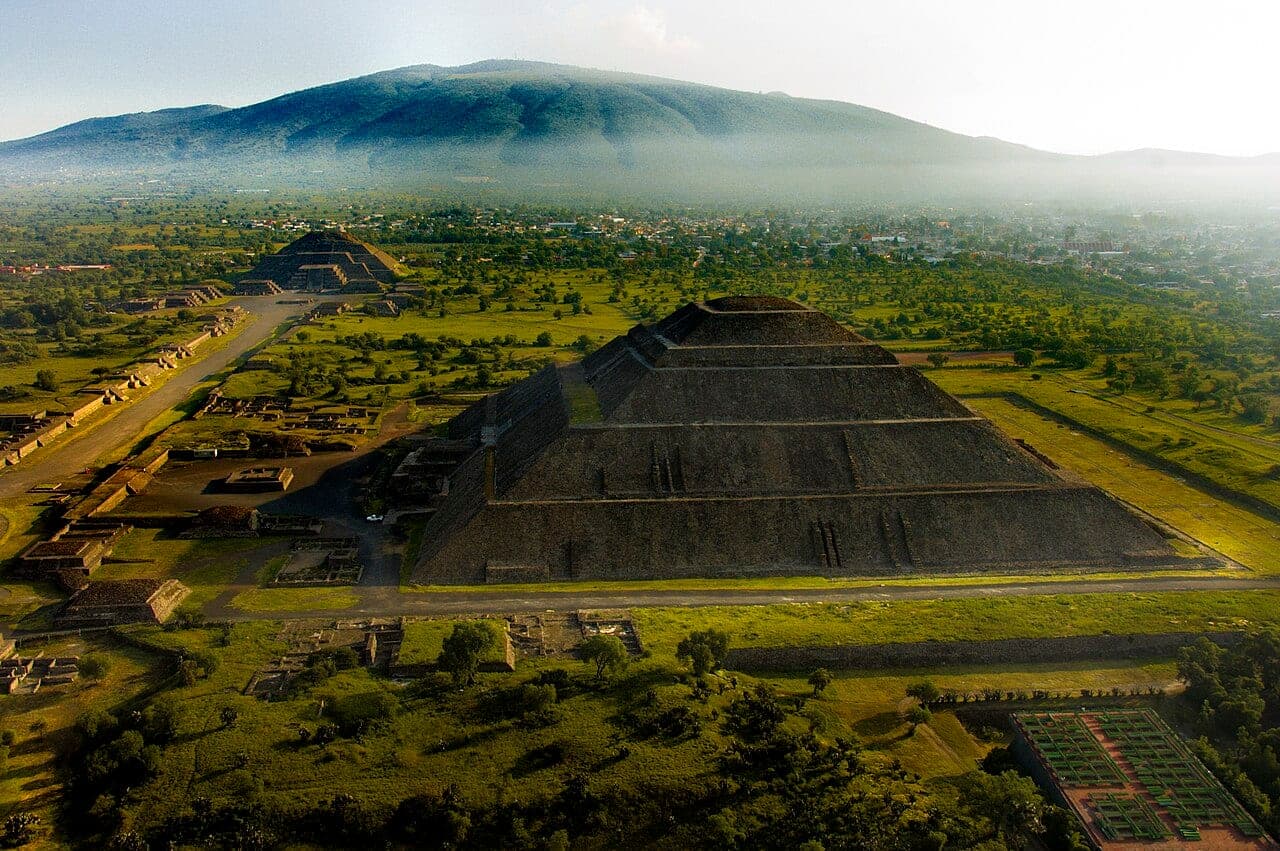
When the Aztecs came upon Teotihuacan, the city had already lain in ruins for centuries. They walked its broad central avenue, climbed its enormous pyramids, and found no one who could tell them who had built any of it. So they supplied the meaning themselves. In their language, Nahuatl, they named the place Teotihuacan, commonly rendered as the place where the gods were made, and they told a story in which the sun and moon of the present age were born there in fire.
That is the first strange fact about Teotihuacan: the name the world uses was given by a people who arrived roughly nine hundred years after the city fell, and who knew its builders only as ancestors and gods. The people who actually raised it left no readable name for themselves or their language. What they left instead was one of the largest cities on earth in its day, laid out with a geometry so deliberate its plan still governs how visitors move through it. The memory of Teotihuacan survived. The memory of the Teotihuacanos, the men and women who made it, very nearly did not.
Teotihuacan lies about 50 kilometres (30 miles) northeast of modern Mexico City, in a side valley of the wider Basin of Mexico. Settlement began around 100 BCE, and over the following centuries it grew rapidly, drawing in people from an emptying countryside. At its height, in the period from roughly 100 to 550 CE, it covered around 20 square kilometres and held somewhere between 100,000 and 200,000 people. Around 500 CE it was among the largest cities anywhere on the planet.
More remarkable than its size is who lived there. Teotihuacan was emphatically multi-ethnic. Archaeologists have identified whole neighbourhoods of migrants: a Zapotec quarter, sometimes called the Oaxaca barrio, whose residents kept their home region's burial customs and pottery for generations; a district with strong ties to the Gulf Coast; and material links to the Maya lands far to the south. People came, it seems, to a city that had room for them, drawn by its workshops and its gods. Much of its wealth rested on obsidian, the volcanic glass worked into blades and traded across Mesoamerica, and on the craft economy that grew around that trade. The whole settlement was laid out on a grid oriented slightly east of north, an orientation repeated in almost every wall and street, as though the entire city were a single act of planning.
The spine of the city is the Avenue of the Dead, a ceremonial boulevard about 40 metres wide running for some 4 kilometres between the great monuments. The name is another Aztec invention: the newcomers assumed the mounds lining the avenue were the tombs of kings. They were not, but the name stuck.
 The avenue runs for over two kilometres and is set about fifteen degrees east of north, an orientation the whole city was laid out to follow. Photograph by Polimerek, CC BY-SA 3.0, via Wikimedia Commons.
At the avenue's northern end rises the Pyramid of the Moon, set against the mountain of Cerro Gordo so that its silhouette echoes the peak behind it. Larger still is the Pyramid of the Sun, one of the biggest structures of the ancient Americas: about 65 metres high and, by volume, the third largest pyramid in the world. It was raised over a natural cave and tunnel the builders seem to have revered as a sacred point of origin, a mouth into the earth.
Near the southern end, inside a sunken enclosure the Aztecs called the Ciudadela, sits the Temple of the Feathered Serpent, dedicated to the deity later known as Quetzalcoatl. Built around 150 to 200 CE, its facade carries rows of carved serpent heads emerging from stone ruffs of feathers, alternating with a second headdress form, their eyes once set with obsidian so the whole surface glittered. Beneath it, excavators found the darker side of that grandeur: dedicatory burials of more than two hundred people, perhaps as many as 260, many with their hands bound behind them and dressed as warriors, laid in rows at the corners and centre of the pyramid as sacrifices meant to consecrate it.
Away from the monuments, Teotihuacan was a city of homes. Between 1962 and 1970 the archaeologist René Millon and his team mapped it in full and counted more than two thousand residential compounds. These were not huts but substantial single-storey blocks, each walled on the outside and organised within around open courtyards, housing several families together. Some were grand and some plain, sorted by rank and origin, a mosaic of neighbourhoods.
The finest compounds were painted. Teotihuacano murals survive at sites such as Tepantitla, where a famous scene shows a watery paradise of the rain god, tiny human figures swimming and playing among streams and mountains. Processions of elaborately dressed priests, jaguars, and a central figure often identified as the Great Goddess of Teotihuacan, a deity of water and creation, recur across the walls. The art is confident and highly stylised, yet it lacks something every other Mesoamerican power put front and centre: a ruler.
Not one mural, carving or monument yet found names or portrays a single king. Archaeologists have turned up no royal tombs proclaiming a dynasty and no king-lists, and nothing resembling the boastful inscriptions of conquest that the Maya carved. This absence has led many scholars to suspect that Teotihuacan was governed collectively, perhaps by councils of noble houses rather than one supreme lord. Even the language of the city is unknown. Nahua, Totonac, Otomí and other tongues have all been proposed, but no writing system has been securely read, and the everyday speech of a metropolis of two hundred thousand people has been lost entirely.
Sometime around 550 CE, the heart of Teotihuacan burned. The destruction was not random: it fell most heavily on the temples, palaces and civic buildings along the Avenue of the Dead, while ordinary neighbourhoods were largely spared. That pattern has convinced many researchers that the collapse came from within, an uprising or the tearing apart of a ruling order, rather than a foreign army, though drought and the harsh climate downturn recorded across the globe in 535 to 536 CE may have sharpened the crisis. The population thinned over the following two centuries, and by around 750 CE the great city was effectively abandoned.
It did not vanish, though. The ruins were too vast to ignore, and to the peoples who later filled the Valley of Mexico they became holy ground. When the Aztecs, the Mexica, rose to power centuries afterward, they treated Teotihuacan as the birthplace of the present age. In their telling, the gods had gathered in the darkness there, and two of them, the humble Nanahuatzin and the proud Tecuciztecatl, had thrown themselves into a fire to become the sun and the moon, setting the fifth and current world in motion. Aztec rulers made pilgrimages to the site, dug into its monuments, and carried away offerings. It was they who named the pyramids of the Sun and the Moon and the Avenue of the Dead. The city that had forgotten its own name was remembered as the place where time itself began.
Modern study of Teotihuacan began in earnest in the early twentieth century. Leopoldo Batres cleared and heavily restored the Pyramid of the Sun between 1905 and 1910, in time for the centenary of Mexican independence, though his rough methods have been criticised ever since. More careful work followed with Manuel Gamio's interdisciplinary survey of 1917 to 1922, and later Millon's mapping project, which revealed the order of the whole city.
The most dramatic discovery is recent. In 2003, after heavy rain opened a sinkhole near the Temple of the Feathered Serpent, the archaeologist Sergio Gómez Chávez found the entrance to a tunnel running deep beneath the pyramid. Excavated between 2009 and 2015, and sealed shut around 1,800 years ago, it yielded tens of thousands of ritual objects: jade, shell, obsidian, spheres coated in glittering pyrite, greenstone statues, and pools of liquid mercury. At the tunnel's end lay chambers arranged as a miniature landscape of mountains and pools, an underworld modelled underground. The find suggests the passage was a symbolic place of creation and rulership at the very core of the city.
Teotihuacan was inscribed as a UNESCO World Heritage Site in 1987 and is now cared for by Mexico's National Institute of Anthropology and History, INAH. It draws well over a million visitors a year, and that popularity, along with urban growth pressing at its edges, is the main threat conservators watch. The ground still holds far more than has been dug: much of the city remains unexcavated beneath its fields.
Teotihuacan is, in the end, a lesson about what memory can and cannot save. The stone survived. The plan survived. The gods, borrowed and renamed by later peoples, survived. What did not survive was the human particular: the name of the city in its own language, the identities of the people who governed it, the words a mother used to name her child in its painted courtyards. A metropolis of two hundred thousand souls became, to everyone who came after, an anonymous work of the gods.
The Aztecs did a generous thing when they stood in those ruins and gave them meaning rather than letting them fall silent. But naming a place after gods is also an admission that its people are gone beyond recovery. The pull of Teotihuacan is exactly this ache: so much was kept, and the one thing that mattered most, the names of the living, was lost. Confinity exists for the opposite outcome: a life, a face, a voice, a story kept while it can still be attached to the person who lived it, so that those who come later inherit not an anonymous monument but a remembered human being.
The avenue runs for over two kilometres and is set about fifteen degrees east of north, an orientation the whole city was laid out to follow. Photograph by Polimerek, CC BY-SA 3.0, via Wikimedia Commons.
At the avenue's northern end rises the Pyramid of the Moon, set against the mountain of Cerro Gordo so that its silhouette echoes the peak behind it. Larger still is the Pyramid of the Sun, one of the biggest structures of the ancient Americas: about 65 metres high and, by volume, the third largest pyramid in the world. It was raised over a natural cave and tunnel the builders seem to have revered as a sacred point of origin, a mouth into the earth.
Near the southern end, inside a sunken enclosure the Aztecs called the Ciudadela, sits the Temple of the Feathered Serpent, dedicated to the deity later known as Quetzalcoatl. Built around 150 to 200 CE, its facade carries rows of carved serpent heads emerging from stone ruffs of feathers, alternating with a second headdress form, their eyes once set with obsidian so the whole surface glittered. Beneath it, excavators found the darker side of that grandeur: dedicatory burials of more than two hundred people, perhaps as many as 260, many with their hands bound behind them and dressed as warriors, laid in rows at the corners and centre of the pyramid as sacrifices meant to consecrate it.
Away from the monuments, Teotihuacan was a city of homes. Between 1962 and 1970 the archaeologist René Millon and his team mapped it in full and counted more than two thousand residential compounds. These were not huts but substantial single-storey blocks, each walled on the outside and organised within around open courtyards, housing several families together. Some were grand and some plain, sorted by rank and origin, a mosaic of neighbourhoods.
The finest compounds were painted. Teotihuacano murals survive at sites such as Tepantitla, where a famous scene shows a watery paradise of the rain god, tiny human figures swimming and playing among streams and mountains. Processions of elaborately dressed priests, jaguars, and a central figure often identified as the Great Goddess of Teotihuacan, a deity of water and creation, recur across the walls. The art is confident and highly stylised, yet it lacks something every other Mesoamerican power put front and centre: a ruler.
Not one mural, carving or monument yet found names or portrays a single king. Archaeologists have turned up no royal tombs proclaiming a dynasty and no king-lists, and nothing resembling the boastful inscriptions of conquest that the Maya carved. This absence has led many scholars to suspect that Teotihuacan was governed collectively, perhaps by councils of noble houses rather than one supreme lord. Even the language of the city is unknown. Nahua, Totonac, Otomí and other tongues have all been proposed, but no writing system has been securely read, and the everyday speech of a metropolis of two hundred thousand people has been lost entirely.
Sometime around 550 CE, the heart of Teotihuacan burned. The destruction was not random: it fell most heavily on the temples, palaces and civic buildings along the Avenue of the Dead, while ordinary neighbourhoods were largely spared. That pattern has convinced many researchers that the collapse came from within, an uprising or the tearing apart of a ruling order, rather than a foreign army, though drought and the harsh climate downturn recorded across the globe in 535 to 536 CE may have sharpened the crisis. The population thinned over the following two centuries, and by around 750 CE the great city was effectively abandoned.
It did not vanish, though. The ruins were too vast to ignore, and to the peoples who later filled the Valley of Mexico they became holy ground. When the Aztecs, the Mexica, rose to power centuries afterward, they treated Teotihuacan as the birthplace of the present age. In their telling, the gods had gathered in the darkness there, and two of them, the humble Nanahuatzin and the proud Tecuciztecatl, had thrown themselves into a fire to become the sun and the moon, setting the fifth and current world in motion. Aztec rulers made pilgrimages to the site, dug into its monuments, and carried away offerings. It was they who named the pyramids of the Sun and the Moon and the Avenue of the Dead. The city that had forgotten its own name was remembered as the place where time itself began.
Modern study of Teotihuacan began in earnest in the early twentieth century. Leopoldo Batres cleared and heavily restored the Pyramid of the Sun between 1905 and 1910, in time for the centenary of Mexican independence, though his rough methods have been criticised ever since. More careful work followed with Manuel Gamio's interdisciplinary survey of 1917 to 1922, and later Millon's mapping project, which revealed the order of the whole city.
The most dramatic discovery is recent. In 2003, after heavy rain opened a sinkhole near the Temple of the Feathered Serpent, the archaeologist Sergio Gómez Chávez found the entrance to a tunnel running deep beneath the pyramid. Excavated between 2009 and 2015, and sealed shut around 1,800 years ago, it yielded tens of thousands of ritual objects: jade, shell, obsidian, spheres coated in glittering pyrite, greenstone statues, and pools of liquid mercury. At the tunnel's end lay chambers arranged as a miniature landscape of mountains and pools, an underworld modelled underground. The find suggests the passage was a symbolic place of creation and rulership at the very core of the city.
Teotihuacan was inscribed as a UNESCO World Heritage Site in 1987 and is now cared for by Mexico's National Institute of Anthropology and History, INAH. It draws well over a million visitors a year, and that popularity, along with urban growth pressing at its edges, is the main threat conservators watch. The ground still holds far more than has been dug: much of the city remains unexcavated beneath its fields.
Teotihuacan is, in the end, a lesson about what memory can and cannot save. The stone survived. The plan survived. The gods, borrowed and renamed by later peoples, survived. What did not survive was the human particular: the name of the city in its own language, the identities of the people who governed it, the words a mother used to name her child in its painted courtyards. A metropolis of two hundred thousand souls became, to everyone who came after, an anonymous work of the gods.
The Aztecs did a generous thing when they stood in those ruins and gave them meaning rather than letting them fall silent. But naming a place after gods is also an admission that its people are gone beyond recovery. The pull of Teotihuacan is exactly this ache: so much was kept, and the one thing that mattered most, the names of the living, was lost. Confinity exists for the opposite outcome: a life, a face, a voice, a story kept while it can still be attached to the person who lived it, so that those who come later inherit not an anonymous monument but a remembered human being.
A city rising in the Valley of Mexico
The Avenue of the Dead and its pyramids
Apartments, murals, and rulers without faces
The fire and the reverence that followed
Digging into the mountain
A place made for remembering
References and resources
- UNESCO World Heritage Centre: Pre-Hispanic City of Teotihuacan
- Encyclopaedia Britannica: Teotihuacan
- Wikipedia: Teotihuacan
- Wikipedia: Temple of the Feathered Serpent, Teotihuacan
- INAH (Instituto Nacional de Antropologia e Historia): Zona Arqueologica de Teotihuacan
- Smithsonian Magazine: Liquid mercury found under a Mexican pyramid could lead to a king's tomb
- The Archaeologist: The Temple of the Feathered Serpent, ritual sacrifice in Teotihuacan