Heritage · Country
Guatemala Culture and Heritage
The Maya raised Tikal and El Mirador in Guatemala's northern forests, and their descendants still weave, pray and remember across the highlands today. This is a guide to the country's layered inheritance, from the Popol Vuh and colonial Antigua to the giant kites that carry messages to the dead.Written to last.
By Confinity Heritage Editorial · Updated 2026-07-31 · 8-minute readQuiet tools, kept out of the way.
On the first of November each year, the wind above the highland cemeteries of Sumpango and Santiago Sacatepéquez fills with colour. Families raise barriletes gigantes, giant kites of tissue paper stretched over bamboo frames, some twenty metres across, and send them up to carry messages to the dead and to keep unquiet spirits away. It is one of the oldest ways Guatemala holds the living and the departed in conversation, in a country where remembrance is folded into daily life.
Guatemala is the heartland of the Maya. Its northern forests hold Tikal and El Mirador, among the greatest cities of the ancient Americas, while its highlands are home to millions of Maya people who still speak their own languages, weave their own dress and keep the sacred K'iche' book, the Popol Vuh. Layered over that inheritance are three centuries of Spanish rule, whose Baroque capital at Antigua survives as ruins and cobbled streets, and the sober memory of a long internal war.
Guatemala sits at the northern edge of Central America, bordered by Mexico, Belize, Honduras and El Salvador, with coasts on both the Pacific and the Caribbean. Its centre is a spine of volcanic highlands, part of the Sierra Madre, studded with more than thirty volcanoes; Volcán Tajumulco, at 4,220 metres, is the highest point in Central America, and the crater lake of Atitlán is ringed by three cones. Northward the land falls away into the limestone lowlands and rainforest of the Petén, where the ancient Maya built their forest cities.
With around eighteen million people, Guatemala is the most populous country in Central America, and a large share of its population, roughly two in five, is Indigenous, overwhelmingly Maya. The capital is Guatemala City, and the national bird and the currency both carry the name of the quetzal, the long-tailed forest bird the Maya prized above gold. Its heritage is marked by living continuity: the descendants of the temple-builders still farm the same valleys, speak related languages and keep many of the same festivals.
Guatemala City. Founded in 1776 as Nueva Guatemala de la Asunción after earthquakes forced the abandonment of the old capital, the city is now the largest in Central America, home to several million people across its metropolitan region. It holds the country's national institutions, among them the Museo Nacional de Arqueología y Etnología, whose Maya stelae, jade and ceramics are the finest in the country, and the Popol Vuh Museum. Set on a highland plateau in an active seismic zone, it was itself badly shaken in the earthquakes of 1917 and 1918.
 Antigua was abandoned as capital after the earthquakes of 1773, and the ruins were left standing where they fell. Photograph by MongeNajera, CC BY-SA 3.0, via Wikimedia Commons.
Antigua Guatemala. The colonial capital, founded in 1543 as Santiago de los Caballeros, was for two centuries the political and religious centre of Spanish Central America. Repeatedly damaged by earthquakes and largely wrecked in 1773, it was left behind when the capital moved, and its Baroque churches, convents and palaces survive as ruins along cobbled streets beneath the Agua volcano. Inscribed by UNESCO in 1979, it is renowned for its Holy Week processions.
Quetzaltenango. Known to its Maya inhabitants as Xela, from the K'iche' Xelajuj Noj, Quetzaltenango is the country's second city and the hub of the western highlands. A centre of K'iche' and Mam culture and of highland weaving, it grew wealthy on coffee and keeps the neoclassical civic architecture built during that boom, along with its markets and language schools.
Chichicastenango. A K'iche' town in the Quiché highlands, almost entirely Indigenous, Chichicastenango holds one of the largest markets in the country. Its church of Santo Tomás, raised around 1545 on the platform of a Maya temple, is approached by twenty steps still used by Maya day-keepers for prayer and offerings of incense and candles. It was here, in the early eighteenth century, that the priest Francisco Ximénez copied and translated the Popol Vuh.
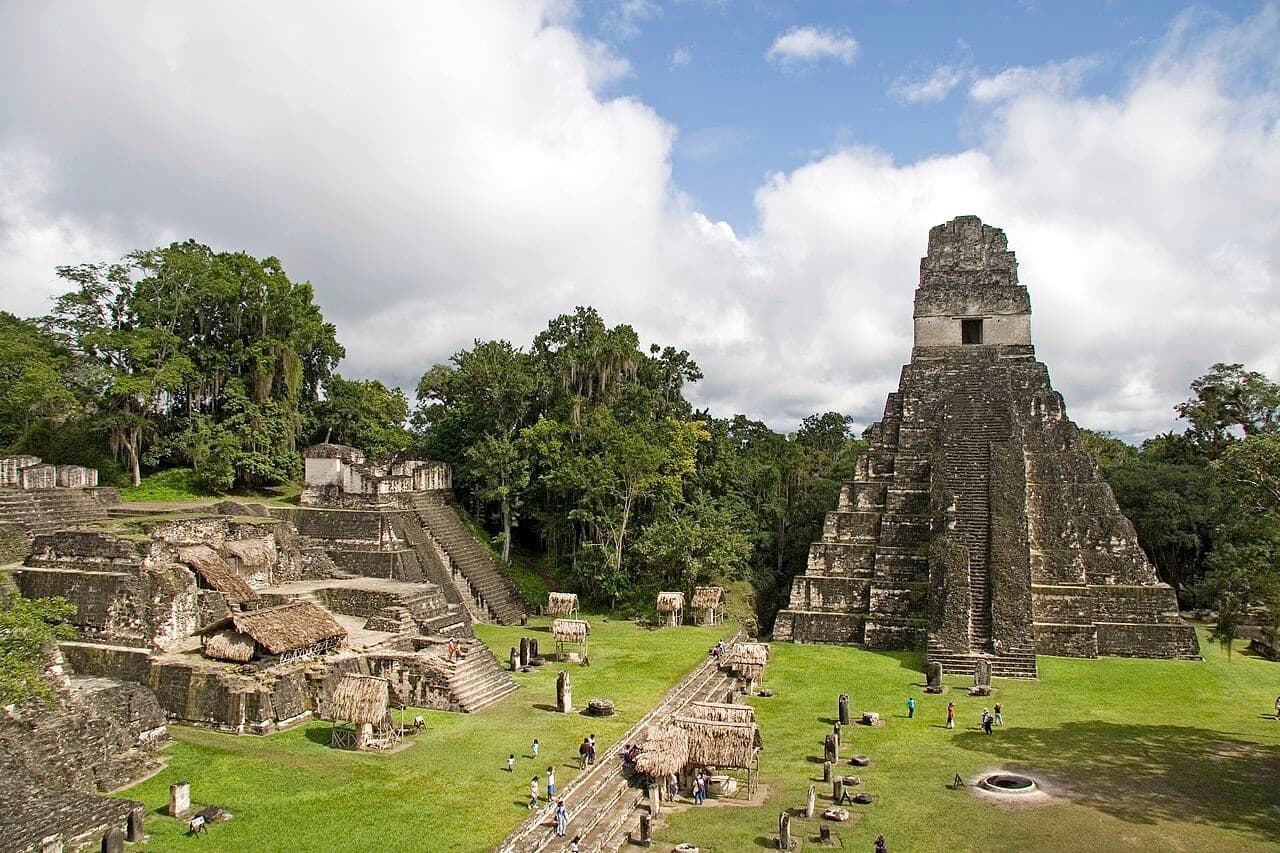
Guatemala holds some of the earliest and greatest achievements of Maya civilisation. In the Preclassic period, from around the sixth century BCE, the city of El Mirador rose in the Petén forest, its pyramid La Danta among the largest structures by volume ever built in the ancient world, and the Mirador basin a probable cradle of Maya statehood. During the Classic period, from roughly 250 to 900 CE, Tikal became the dominant power of the southern lowlands; at its height between 600 and 800 CE its centre drew on a population in the tens of thousands, its temple-pyramids rising above the canopy and aligned to the movements of the sun. To the east, at Quirigua in the Motagua valley, the ruler K'ak' Tiliw Chan Yopaat won independence from Copán in 738 CE and raised the tallest carved stelae in the Maya world, some more than ten metres high. Yaxha was among the other important centres.
Antigua was abandoned as capital after the earthquakes of 1773, and the ruins were left standing where they fell. Photograph by MongeNajera, CC BY-SA 3.0, via Wikimedia Commons.
Antigua Guatemala. The colonial capital, founded in 1543 as Santiago de los Caballeros, was for two centuries the political and religious centre of Spanish Central America. Repeatedly damaged by earthquakes and largely wrecked in 1773, it was left behind when the capital moved, and its Baroque churches, convents and palaces survive as ruins along cobbled streets beneath the Agua volcano. Inscribed by UNESCO in 1979, it is renowned for its Holy Week processions.
Quetzaltenango. Known to its Maya inhabitants as Xela, from the K'iche' Xelajuj Noj, Quetzaltenango is the country's second city and the hub of the western highlands. A centre of K'iche' and Mam culture and of highland weaving, it grew wealthy on coffee and keeps the neoclassical civic architecture built during that boom, along with its markets and language schools.
Chichicastenango. A K'iche' town in the Quiché highlands, almost entirely Indigenous, Chichicastenango holds one of the largest markets in the country. Its church of Santo Tomás, raised around 1545 on the platform of a Maya temple, is approached by twenty steps still used by Maya day-keepers for prayer and offerings of incense and candles. It was here, in the early eighteenth century, that the priest Francisco Ximénez copied and translated the Popol Vuh.
Guatemala holds some of the earliest and greatest achievements of Maya civilisation. In the Preclassic period, from around the sixth century BCE, the city of El Mirador rose in the Petén forest, its pyramid La Danta among the largest structures by volume ever built in the ancient world, and the Mirador basin a probable cradle of Maya statehood. During the Classic period, from roughly 250 to 900 CE, Tikal became the dominant power of the southern lowlands; at its height between 600 and 800 CE its centre drew on a population in the tens of thousands, its temple-pyramids rising above the canopy and aligned to the movements of the sun. To the east, at Quirigua in the Motagua valley, the ruler K'ak' Tiliw Chan Yopaat won independence from Copán in 738 CE and raised the tallest carved stelae in the Maya world, some more than ten metres high. Yaxha was among the other important centres.
 Tikal, a Maya city of tens of thousands that was abandoned by the tenth century and swallowed by forest. Photograph by amslerPIX, CC BY 2.0, via Wikimedia Commons.
After the Classic lowland cities declined, power passed in the Postclassic period to highland kingdoms such as that of the K'iche', centred on Q'umarkaj. It was members of the K'iche' nobility who, in the mid-sixteenth century, set down the Popol Vuh, the account of creation, the deeds of the Hero Twins and the royal lineages, preserving their sacred history in writing under colonial rule.
The Spanish arrived in 1524 under Pedro de Alvarado, who defeated the K'iche' in the western highlands, in battles later linked in tradition to the Maya lord Tecún Umán. Colonial Santiago, today's Antigua, became the seat of a captaincy-general that governed much of Central America, and its churches and convents were rebuilt repeatedly against the region's earthquakes until the disaster of 1773 forced the capital's move in 1776. Guatemala won independence from Spain in 1821, passed through brief union with Mexico and then the United Provinces of Central America, and became a separate republic in the 1840s.
The twentieth century brought reformist governments in the 1940s and early 1950s, a coup in 1954 that ended them, and, from 1960 to 1996, an internal armed conflict between the state and leftist insurgents. The war fell heaviest on the rural Maya highlands, above all during the counter-insurgency of the early 1980s. The peace accords of December 1996 established a United Nations-sponsored truth commission, the Commission for Historical Clarification, whose 1999 report, Guatemala: Memory of Silence, found that more than 200,000 people had been killed or forcibly disappeared, that the large majority of the victims were unarmed Maya civilians, and that acts of genocide had been committed against specific Maya communities. Those findings are now part of national memory, marked in exhumations, memorials and annual commemorations.
The name Guatemala comes from the Nahuatl Quauhtemallan, meaning roughly "place of many trees", a word carried into Central America by the Nahua-speaking allies of the Spanish and adapted into Spanish. Spanish is the country's official and most widely spoken language, but it shares the ground with a great family of Indigenous tongues. The Academy of Mayan Languages of Guatemala recognises twenty-two distinct Mayan languages, among them K'iche', Q'eqchi', Kaqchikel and Mam, which together have millions of speakers; alongside them stand Xinca, an Indigenous language unrelated to the Maya family, and Garífuna, spoken by the Afro-Indigenous communities of the Caribbean coast. Each carries its own body of naming, storytelling and calendrical knowledge, and their survival, uneven across regions and generations, is a central question of Guatemalan heritage today.
Nowhere is Maya identity more visible than in traje, the traditional dress woven and worn across the highlands. Women's huipiles, blouses woven on the backstrap loom in patterns of birds, flowers, mountains and cosmic symbols, identify at a glance the community a wearer comes from, each town keeping its own colours and designs; the loom itself reaches back thousands of years. Markets such as Chichicastenango's gather this work from surrounding villages.
Music runs just as deep. The marimba, a wooden xylophone-like instrument with roots often traced to Africa and the colonial period, was named the national instrument in 1978 and is played at festivals, weddings and funerals alike. In the colonial highlands, Holy Week, Semana Santa, brings its own art: in Antigua above all, families lay alfombras, carpets of dyed sawdust, flowers and pine needles, across the streets for the Good Friday processions to pass over and scatter within hours. Guatemalan cooking rests on the ancient triad of maize, beans and squash, and reaches its heights in slow dishes such as pepián and the Q'eqchi' turkey stew kaq'ik.
Most Guatemalans are Christian, with a Roman Catholic majority and a fast-growing evangelical and Pentecostal minority. Yet across the Maya highlands, Catholic practice has long been braided together with older Maya spirituality. The ajq'ijab', or day-keepers, still reckon the 260-day ritual calendar and lead ceremonies of prayer, incense and candle, sometimes on the very steps of colonial churches, as at Santo Tomás in Chichicastenango, where offerings are made before and around the Christian altar.
The most singular figure of this blended devotion is Maximón, also called San Simón, a folk saint most closely associated with Santiago Atitlán on Lake Atitlán. Represented as a seated figure in a hat and layers of scarves, offered cigars, candles and aguardiente, and kept each year in the house of a different confraternity, Maximón is petitioned for favours that fall outside the reach of the official saints. He embodies a spirituality that has held Maya and Catholic elements together in a single living practice.
Guatemalan remembrance reaches its fullest expression at the turn of October into November, when All Saints' Day and the Day of the Dead bring families to the cemeteries. Graves are cleaned, repainted and heaped with flowers, and families gather among the tombs to eat and to remember. The dish of the season is fiambre, an elaborate cold salad of dozens of ingredients in a vinegar dressing, prepared once a year and, by tradition, shared in the presence of the dead.
Above the cemeteries of Sumpango and Santiago Sacatepéquez fly the barriletes gigantes, the giant kites for which Guatemala is known. Built by community teams from bamboo and layers of coloured tissue paper cut into intricate designs, the largest many metres across, the kites are raised on the first of November to carry messages to the departed and, by their sound and movement, to turn away restless spirits. The custom draws on beliefs that reach back to before the Spanish arrival, and it remains, above all, a family and community act of memory.
Everyday mourning keeps both Catholic and Maya forms: the wake and rosary, novena prayers after a death, burial in family plots and return visits on anniversaries, alongside offerings shaped by community tradition. Guatemala also carries a heavier duty of remembrance. The victims of the internal war are commemorated in memorials, in the work of forensic teams who exhume clandestine graves so that families can identify and rebury their dead, and in annual acts held so that, in the country's own words, the past is not forgotten.
The most important genealogical archive in Guatemala was found by accident in 2005, in a rat-infested building nobody had opened for years.
Investigators looking into a munitions complaint came across the records of the National Police: around eighty million pages, roughly eight thousand linear metres, covering the force from the late nineteenth century to its dissolution in 1997. Inside were the arrest records, surveillance files and operational reports of the counterinsurgency period, including the abductions and disappearances of the thirty-six-year civil war. For families who had spent decades being told nothing, the archive contained the date a relative was picked up and sometimes the name of the officer who did it. It has been used in prosecutions and it remains under threat of neglect.
The ordinary record is old. Catholic parish registers survive from the sixteenth century, and Guatemala's are among the earliest in the Americas; many highland parishes kept separate books for Spanish and Indigenous parishioners, which means Maya families can often be traced in the colonial record. Civil registration dates from the later nineteenth century and is now administered by RENAP.
The Archivo General de Centro América in Guatemala City holds the colonial series for the whole of Spanish Central America, not just Guatemala, so families from El Salvador, Honduras, Nicaragua and Costa Rica have colonial records there too.
For the Maya communities destroyed between 1981 and 1983, the record is the exhumations, and the forensic teams are still working.
Guatemala holds three UNESCO World Heritage sites, and all three speak to the country's layered past. Tikal National Park, inscribed in 1979, is a mixed site recognised for both its Maya monuments and the surrounding rainforest, and was among the country's first protected areas. Antigua Guatemala, also inscribed in 1979, preserves the Baroque colonial capital and the ruins left by its earthquakes. The Archaeological Park and Ruins of Quirigua, inscribed in 1981, safeguards the great carved stelae and zoomorphic sculptures of the Motagua valley.
Responsibility for the ancient sites rests chiefly with the state through the Institute of Anthropology and History, working with national parks authorities and international research projects. The challenges are real: the vast forest city of El Mirador remains remote and vulnerable, and the looting of Maya artefacts has long drawn conservation and repatriation efforts. Sustained work at Tikal, Quirigua and the highland colonial towns keeps the monuments standing and studied.
Guatemala's most portable treasure has become one of its most digitally accessible. The eighteenth-century manuscript in which Francisco Ximénez recorded the Popol Vuh in parallel K'iche' and Spanish, held today by the Newberry Library in Chicago, has been digitised and placed online, so that the oldest surviving text of the Maya creation account can be read page by page from anywhere. Scholarly translations circulate freely through Mesoamerican research archives, and cultural platforms have published online exhibitions of Tikal, Antigua and highland weaving. Digital documentation projects have also produced detailed three-dimensional records of Maya monuments, including the carved stelae of Quirigua, supporting both research and conservation.
Guatemala has given the world two Nobel laureates, and both are bound up with the country's Maya inheritance and its memory. The writer Miguel Ángel Asturias received the Nobel Prize in Literature in 1967 for work rooted in the traditions of Latin America's Indigenous peoples; his novels, among them El Señor Presidente and Hombres de maíz, drew on Maya myth and the politics of his homeland. In 1992 the K'iche' activist Rigoberta Menchú received the Nobel Peace Prize for her work on Indigenous rights and reconciliation, becoming an international voice for the Maya communities most affected by the war. A younger generation of Guatemalan filmmakers has since carried Maya languages and stories to festivals abroad, while marimba, weaving and the country's festivals continue to shape its image beyond its borders.
The Popol Vuh reaches a global public. The digitisation of the Ximénez manuscript and the wide circulation of modern translations have turned a once-fragile colonial document into a shared inheritance, readable by Maya communities and scholars worldwide.
Forensic teams return the disappeared to their families. Guatemalan forensic anthropologists have exhumed and identified victims of the internal war from clandestine graves, allowing families to recover, name and rebury their dead, a quiet and sustained act of national repair.
The marimba as a symbol of resilience. Once suppressed and played in secret, the marimba survived to become the national instrument and a symbol of the shared African, Maya and Ladino roots of Guatemalan culture.
Living Maya heritage endures. The continued use of twenty-two Mayan languages, the daily wearing of traje and the annual raising of the giant kites show a heritage that remains the practice of living communities rather than a museum piece.
Tikal, a Maya city of tens of thousands that was abandoned by the tenth century and swallowed by forest. Photograph by amslerPIX, CC BY 2.0, via Wikimedia Commons.
After the Classic lowland cities declined, power passed in the Postclassic period to highland kingdoms such as that of the K'iche', centred on Q'umarkaj. It was members of the K'iche' nobility who, in the mid-sixteenth century, set down the Popol Vuh, the account of creation, the deeds of the Hero Twins and the royal lineages, preserving their sacred history in writing under colonial rule.
The Spanish arrived in 1524 under Pedro de Alvarado, who defeated the K'iche' in the western highlands, in battles later linked in tradition to the Maya lord Tecún Umán. Colonial Santiago, today's Antigua, became the seat of a captaincy-general that governed much of Central America, and its churches and convents were rebuilt repeatedly against the region's earthquakes until the disaster of 1773 forced the capital's move in 1776. Guatemala won independence from Spain in 1821, passed through brief union with Mexico and then the United Provinces of Central America, and became a separate republic in the 1840s.
The twentieth century brought reformist governments in the 1940s and early 1950s, a coup in 1954 that ended them, and, from 1960 to 1996, an internal armed conflict between the state and leftist insurgents. The war fell heaviest on the rural Maya highlands, above all during the counter-insurgency of the early 1980s. The peace accords of December 1996 established a United Nations-sponsored truth commission, the Commission for Historical Clarification, whose 1999 report, Guatemala: Memory of Silence, found that more than 200,000 people had been killed or forcibly disappeared, that the large majority of the victims were unarmed Maya civilians, and that acts of genocide had been committed against specific Maya communities. Those findings are now part of national memory, marked in exhumations, memorials and annual commemorations.
The name Guatemala comes from the Nahuatl Quauhtemallan, meaning roughly "place of many trees", a word carried into Central America by the Nahua-speaking allies of the Spanish and adapted into Spanish. Spanish is the country's official and most widely spoken language, but it shares the ground with a great family of Indigenous tongues. The Academy of Mayan Languages of Guatemala recognises twenty-two distinct Mayan languages, among them K'iche', Q'eqchi', Kaqchikel and Mam, which together have millions of speakers; alongside them stand Xinca, an Indigenous language unrelated to the Maya family, and Garífuna, spoken by the Afro-Indigenous communities of the Caribbean coast. Each carries its own body of naming, storytelling and calendrical knowledge, and their survival, uneven across regions and generations, is a central question of Guatemalan heritage today.
Nowhere is Maya identity more visible than in traje, the traditional dress woven and worn across the highlands. Women's huipiles, blouses woven on the backstrap loom in patterns of birds, flowers, mountains and cosmic symbols, identify at a glance the community a wearer comes from, each town keeping its own colours and designs; the loom itself reaches back thousands of years. Markets such as Chichicastenango's gather this work from surrounding villages.
Music runs just as deep. The marimba, a wooden xylophone-like instrument with roots often traced to Africa and the colonial period, was named the national instrument in 1978 and is played at festivals, weddings and funerals alike. In the colonial highlands, Holy Week, Semana Santa, brings its own art: in Antigua above all, families lay alfombras, carpets of dyed sawdust, flowers and pine needles, across the streets for the Good Friday processions to pass over and scatter within hours. Guatemalan cooking rests on the ancient triad of maize, beans and squash, and reaches its heights in slow dishes such as pepián and the Q'eqchi' turkey stew kaq'ik.
Most Guatemalans are Christian, with a Roman Catholic majority and a fast-growing evangelical and Pentecostal minority. Yet across the Maya highlands, Catholic practice has long been braided together with older Maya spirituality. The ajq'ijab', or day-keepers, still reckon the 260-day ritual calendar and lead ceremonies of prayer, incense and candle, sometimes on the very steps of colonial churches, as at Santo Tomás in Chichicastenango, where offerings are made before and around the Christian altar.
The most singular figure of this blended devotion is Maximón, also called San Simón, a folk saint most closely associated with Santiago Atitlán on Lake Atitlán. Represented as a seated figure in a hat and layers of scarves, offered cigars, candles and aguardiente, and kept each year in the house of a different confraternity, Maximón is petitioned for favours that fall outside the reach of the official saints. He embodies a spirituality that has held Maya and Catholic elements together in a single living practice.
Guatemalan remembrance reaches its fullest expression at the turn of October into November, when All Saints' Day and the Day of the Dead bring families to the cemeteries. Graves are cleaned, repainted and heaped with flowers, and families gather among the tombs to eat and to remember. The dish of the season is fiambre, an elaborate cold salad of dozens of ingredients in a vinegar dressing, prepared once a year and, by tradition, shared in the presence of the dead.
Above the cemeteries of Sumpango and Santiago Sacatepéquez fly the barriletes gigantes, the giant kites for which Guatemala is known. Built by community teams from bamboo and layers of coloured tissue paper cut into intricate designs, the largest many metres across, the kites are raised on the first of November to carry messages to the departed and, by their sound and movement, to turn away restless spirits. The custom draws on beliefs that reach back to before the Spanish arrival, and it remains, above all, a family and community act of memory.
Everyday mourning keeps both Catholic and Maya forms: the wake and rosary, novena prayers after a death, burial in family plots and return visits on anniversaries, alongside offerings shaped by community tradition. Guatemala also carries a heavier duty of remembrance. The victims of the internal war are commemorated in memorials, in the work of forensic teams who exhume clandestine graves so that families can identify and rebury their dead, and in annual acts held so that, in the country's own words, the past is not forgotten.
The most important genealogical archive in Guatemala was found by accident in 2005, in a rat-infested building nobody had opened for years.
Investigators looking into a munitions complaint came across the records of the National Police: around eighty million pages, roughly eight thousand linear metres, covering the force from the late nineteenth century to its dissolution in 1997. Inside were the arrest records, surveillance files and operational reports of the counterinsurgency period, including the abductions and disappearances of the thirty-six-year civil war. For families who had spent decades being told nothing, the archive contained the date a relative was picked up and sometimes the name of the officer who did it. It has been used in prosecutions and it remains under threat of neglect.
The ordinary record is old. Catholic parish registers survive from the sixteenth century, and Guatemala's are among the earliest in the Americas; many highland parishes kept separate books for Spanish and Indigenous parishioners, which means Maya families can often be traced in the colonial record. Civil registration dates from the later nineteenth century and is now administered by RENAP.
The Archivo General de Centro América in Guatemala City holds the colonial series for the whole of Spanish Central America, not just Guatemala, so families from El Salvador, Honduras, Nicaragua and Costa Rica have colonial records there too.
For the Maya communities destroyed between 1981 and 1983, the record is the exhumations, and the forensic teams are still working.
Guatemala holds three UNESCO World Heritage sites, and all three speak to the country's layered past. Tikal National Park, inscribed in 1979, is a mixed site recognised for both its Maya monuments and the surrounding rainforest, and was among the country's first protected areas. Antigua Guatemala, also inscribed in 1979, preserves the Baroque colonial capital and the ruins left by its earthquakes. The Archaeological Park and Ruins of Quirigua, inscribed in 1981, safeguards the great carved stelae and zoomorphic sculptures of the Motagua valley.
Responsibility for the ancient sites rests chiefly with the state through the Institute of Anthropology and History, working with national parks authorities and international research projects. The challenges are real: the vast forest city of El Mirador remains remote and vulnerable, and the looting of Maya artefacts has long drawn conservation and repatriation efforts. Sustained work at Tikal, Quirigua and the highland colonial towns keeps the monuments standing and studied.
Guatemala's most portable treasure has become one of its most digitally accessible. The eighteenth-century manuscript in which Francisco Ximénez recorded the Popol Vuh in parallel K'iche' and Spanish, held today by the Newberry Library in Chicago, has been digitised and placed online, so that the oldest surviving text of the Maya creation account can be read page by page from anywhere. Scholarly translations circulate freely through Mesoamerican research archives, and cultural platforms have published online exhibitions of Tikal, Antigua and highland weaving. Digital documentation projects have also produced detailed three-dimensional records of Maya monuments, including the carved stelae of Quirigua, supporting both research and conservation.
Guatemala has given the world two Nobel laureates, and both are bound up with the country's Maya inheritance and its memory. The writer Miguel Ángel Asturias received the Nobel Prize in Literature in 1967 for work rooted in the traditions of Latin America's Indigenous peoples; his novels, among them El Señor Presidente and Hombres de maíz, drew on Maya myth and the politics of his homeland. In 1992 the K'iche' activist Rigoberta Menchú received the Nobel Peace Prize for her work on Indigenous rights and reconciliation, becoming an international voice for the Maya communities most affected by the war. A younger generation of Guatemalan filmmakers has since carried Maya languages and stories to festivals abroad, while marimba, weaving and the country's festivals continue to shape its image beyond its borders.
The Popol Vuh reaches a global public. The digitisation of the Ximénez manuscript and the wide circulation of modern translations have turned a once-fragile colonial document into a shared inheritance, readable by Maya communities and scholars worldwide.
Forensic teams return the disappeared to their families. Guatemalan forensic anthropologists have exhumed and identified victims of the internal war from clandestine graves, allowing families to recover, name and rebury their dead, a quiet and sustained act of national repair.
The marimba as a symbol of resilience. Once suppressed and played in secret, the marimba survived to become the national instrument and a symbol of the shared African, Maya and Ladino roots of Guatemalan culture.
Living Maya heritage endures. The continued use of twenty-two Mayan languages, the daily wearing of traje and the annual raising of the giant kites show a heritage that remains the practice of living communities rather than a museum piece.
National Overview
Notable Cities
Historical Foundations
Linguistic and Etymological Roots
Cultural Identity
Religion and Spirituality
Remembrance and Mourning Traditions
Tracing a Family in Guatemala
Heritage Preservation Efforts
Digital Heritage
Contemporary Cultural Influences
Success Stories
References and resources
- UNESCO World Heritage Centre: Tikal National Park. The mixed cultural and natural site inscribed in 1979.
- UNESCO World Heritage Centre: Antigua Guatemala. The colonial capital and its earthquake ruins.
- UNESCO World Heritage Centre: Archaeological Park and Ruins of Quirigua. The great Maya stelae of the Motagua valley.
- UNESCO World Heritage Centre: Guatemala. The state-party page listing the country's inscriptions.
- Encyclopaedia Britannica: Guatemala. Geography, history and society.
- Encyclopaedia Britannica: Popol Vuh. The K'iche' Maya creation account and its transmission.
- Historical Clarification Commission (CEH), Guatemala: Memory of Silence. The truth commission and its findings on the internal armed conflict.
- The Nobel Prize, Rigoberta Menchú Tum, Peace 1992. The Maya activist and laureate.
- Academia de Lenguas Mayas de Guatemala. The body recognising the country's Mayan languages.
- Newberry Library: Popol Vuh. The Ximénez manuscript, its digitisation and study.