Heritage · Landmark
The Temple of Literature: Hanoi's eighty-two stelae
Founded in 1070 as a temple to Confucius and joined six years later by an academy that trained the men who governed the country, Van Mieu keeps five walled courtyards in the middle of Hanoi. In the third of them stand eighty-two stone tablets, each on the back of a carved tortoise, each cut with the names and home villages of scholars who passed the royal examinations across more than three centuries.Written to last.
By Confinity Heritage Editorial · 2026-08-25 · 7-minute readQuiet tools, kept out of the way.
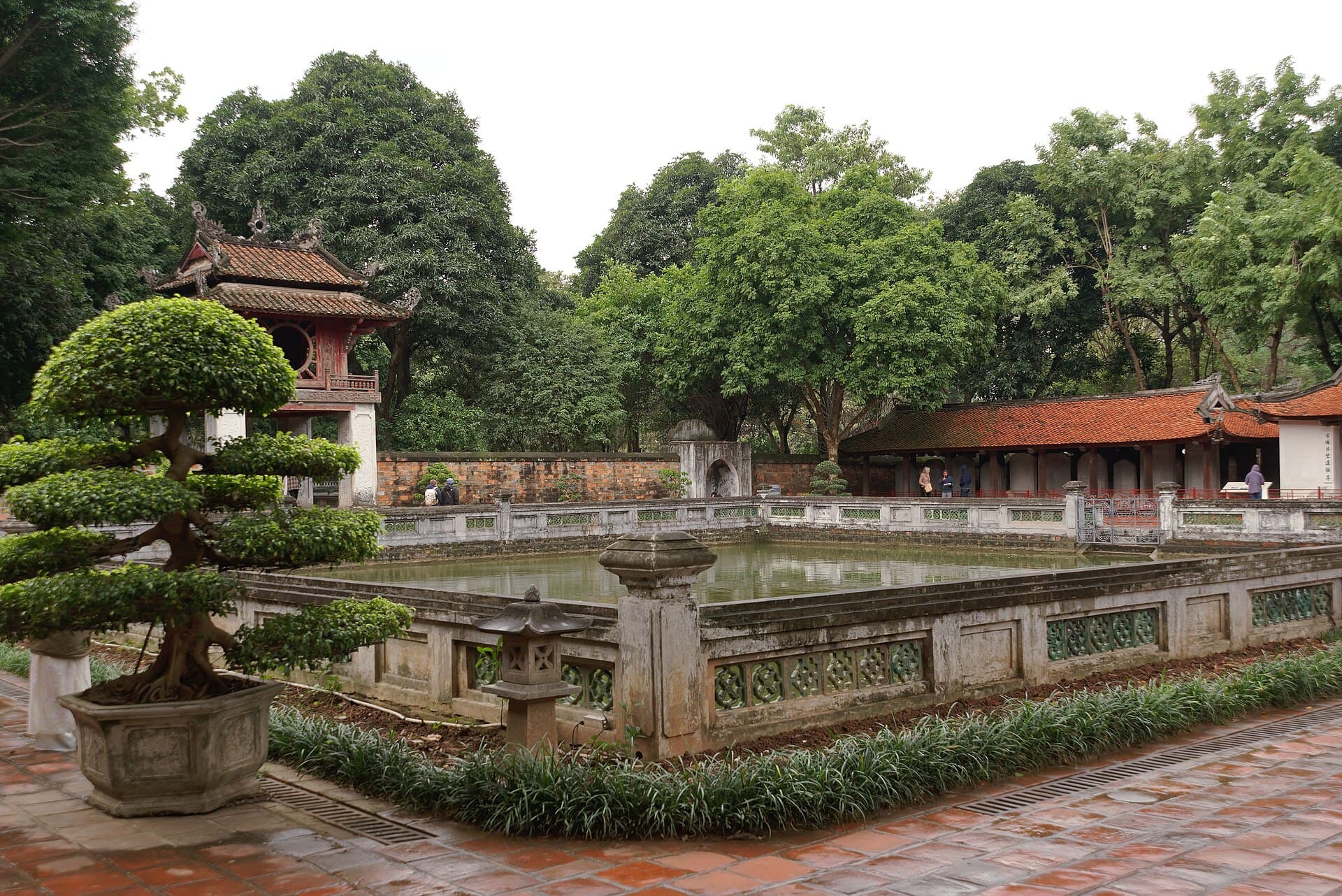
South of the old imperial citadel of Thang Long, in the middle of modern Hanoi, Vietnam, a long brick wall encloses five courtyards laid end to end. This is Van Mieu, the Temple of Literature, founded in 1070 under the Ly emperor Ly Thanh Tong as a temple to Confucius, his four closest disciples and the Duke of Zhou. The chronicles add that seventy-two further Confucian scholars were painted on its walls and that the crown princes studied there. Six years later, in 1076, his son Ly Nhan Tong established the Quoc Tu Giam, the Imperial Academy, on the same ground, and it taught there until 1779.
That academy is usually called Vietnam's first national university. The phrase compresses seven centuries of shifting institutions into one modern word, but the substance holds: this was where the state formed the men who would run it. And in the third courtyard, ranked in two files beside a square pool, stand eighty-two stone tablets on the backs of eighty-two stone tortoises. They carry names. UNESCO placed them on the Memory of the World international register in 2011, which makes the tablets, rather than the buildings that shelter them, the internationally listed heritage on this site.
The layout follows the great Confucian temple at Qufu in Shandong, and the precinct covers more than 54,000 square metres including the Van lake in front and the Giam park behind. The academy that grew inside it began as a school for the royal house. Under the Tran dynasty it was enlarged and renamed, first Quoc Tu Vien and then Quoc Hoc Vien, and the intake widened from princes to the sons of officials and then to students from across the country, most of whom arrived having already passed the provincial examination at home.
What they studied was fixed and enormous: the Four Books, the Five Classics, Chinese history and the composition of regulated verse, held in memory and reproduced under examination conditions. Students lived on site in dormitories built in ranks of twenty-five rooms. In 1802 the Nguyen dynasty founded its capital at Hue and set up a new imperial academy there. The Hanoi school lost its rank and dwindled into a district school, leaving the temple holding the record of what had happened in it.
A visitor enters through the Great Portico, past four tall pillars and two small stelae ordering horsemen to dismount. Three paths run the length of the site: the central one for the monarch, the left for civil mandarins, the right for military ones. The first two courtyards are quiet ground, planted with old trees and topiary cut into the shapes of the twelve zodiac animals.
The second courtyard is closed at its northern end by the Khue Van Cac, a small pavilion raised on four whitewashed stone pillars with a red-painted upper storey, four circular windows and a bronze bell inside. It was built in 1805 by Nguyen Van Thanh, the governor-general of Bac Thanh, and named for Khue, the constellation held to govern literature, so that the round windows read as a star throwing light. The pavilion is the youngest famous thing on the site and has become the most recognisable: it appears on the back of the 100,000 dong banknote, and in 2012 the National Assembly named it the symbol of Hanoi in the Law on the Capital.
Through the pavilion lies the third courtyard and the Thien Quang well, a square pool of still water whose name means heavenly light, with the stelae ranked in two open halls on either side. Beyond the Dai Thanh gate, the fourth courtyard is the ceremonial heart: the House of Ceremonies, the sanctuary where Confucius and his four disciples are worshipped, and altars to Chu Van An, the rector remembered as the model Vietnamese teacher. The fifth courtyard is the ground of the academy itself.
In 1484 the emperor Le Thanh Tong ordered the first tablets cut, reaching backwards to record examinations already decades old. The Nham Tuat examination of 1442, which produced thirty-three graduates, got its stele forty-two years after the candidates sat it. Carving continued in irregular campaigns for almost three hundred years, the largest of them in 1653, when twenty-five tablets went up at once for examinations held between 1554 and 1653, and the last stones were finished in 1780.
Eighty-two survive. Accounts of how many were raised in all differ, with 116 the figure most often repeated, so roughly a third of the record has been lost to war, weather and the simple attrition of three centuries. The surviving stones record eighty-two examinations held between 1442 and 1779, eighty-one under the Le dynasty and one under the Mac, and they carry the names and birthplaces of 1,307 graduates, though published counts vary between sources.
Each tablet follows a form. A preamble praises the monarch, sets out the reason the examination was held and names the officials who ran it. Then comes the list: every successful candidate, his rank in the order of merit, and the village and district he came from. The tortoise beneath is not decoration. It is one of the four holy creatures of Vietnamese tradition alongside the dragon, the unicorn and the phoenix, standing for longevity and wisdom, which is to say for the durability of what is written on its back. The tortoises change shape across the centuries, and specialists sort the stelae into three design groups by period, so that the pedestals themselves date the stones.
The tablets were inscribed on UNESCO's regional Memory of the World register for Asia and the Pacific in March 2010 and on the international register in May 2011. Thirty-two more stelae were later raised at the imperial academy in Hue, continuing the practice until 1919.
The Confucian examination system in Vietnam ran from 1075 to 1919, one of the longest such traditions anywhere, and it outlasted the Chinese system that had inspired it. Candidates climbed three tiers: the provincial examination, the metropolitan examination, then the court examination held before the monarch, which set the final order of merit.
What made it remarkable was who could enter. There was no requirement of birth or property. A boy from a rice village with a teacher, a borrowed set of the classics and the memory to hold them could sit the provincial papers alongside the son of a minister, and if he passed all three tiers he became a mandarin, with office, exemptions and standing that reached back to his family. Success was rare enough that one laureate could lift a whole village for a generation.
And the reward at the summit was not only a post. It was the stone. Office could be lost, land could be seized, a family's money could go in one bad decade. The tablet in the third courtyard could not be undone: the name, the rank and the home village cut into stone in the capital, standing in the temple of the national cult, where anyone who came to study or to worship would walk past it. That is what the stelae are for. They are a public memory system, built on the understanding that the surest reward you can give a man is to write him down somewhere permanent and put him where he will be read.
The system ended under French rule. Examinations were suspended and wound down through the 1910s, and the last metropolitan examination was held at Hue in 1919. A thousand-year machine for turning memorised classics into public office stopped, and the stones in Hanoi became the only part of it still standing.
Vietnamese students have long come to Van Mieu before examinations to ask for luck, and the custom was to rub the head of a stone tortoise on the way past. Thousands of hands over decades did what centuries of monsoon had not: the stone went glossy, then soft, then began to lose its detail. The tablets are now railed off to stop the practice, and visitors read them from behind a barrier.
The tension is worth naming. A monument raised so that names would outlast the men who earned them was being erased, slowly and affectionately, by people who wanted a share of its luck. The fence protects the record from the very belief that keeps the site alive.
The temple has not passed through the twentieth century untouched. It was registered as a monument historique under the French protectorate in 1906, and restoration campaigns ran in 1920 and 1947 under the French School of the Far East. Between 1945 and 1954 parts of the precinct were demolished to enlarge the Saint Paul Hospital, overwhelmed in wartime. In 1946, in the First Indochina War, the fifth courtyard and its Thai Hoc buildings, the academy proper, were destroyed.
That courtyard stood empty for half a century, and was rebuilt in 2000 on the original ground, with a front hall for ceremonies and a rear hall holding a statue of Chu Van An below a shrine to the three monarchs most bound to the site. In May 2012 the Prime Minister recognised the whole of Van Mieu - Quoc Tu Giam as a Special National Monument, the highest domestic grade of protection. It is not, and has never been, a UNESCO World Heritage Site: Vietnam's World Heritage properties lie elsewhere, at Ha Long Bay, the imperial city of Hue and Hoi An. What is internationally listed here is documentary, the eighty-two tablets and the record they carry.
The site is still doing the work it was built for. In the days before Tet, calligraphers set up outside the wall and write wishes in chu Han on red paper to carry home or hang up, the old script surviving as a New Year practice rather than as a bureaucracy. In May and June the courtyards fill with graduating students in ao dai and academic gowns being photographed at the Van Mieu gate, and before national examinations candidates and their families come again.
None of them are chasing a mandarinate. But the instinct is continuous with the one the stelae were cut to serve: the wish to have an achievement witnessed, fixed and kept where other people will see it. The men on those tablets asked for something modest and enormous at once, that a stranger five centuries later should be able to read their name and know which village had produced them. Eighty-two stones, and 1,307 names, and the tortoises still holding them up. It worked.
A temple to Confucius, a school for princes
Five courtyards, walking north
Eighty-two stones on the backs of tortoises
What the examinations were for
The heads worn smooth
Hospital wards, artillery, and a rebuilt academy
Red paper, graduation gowns, and a name that lasts
References and resources
- UNESCO Memory of the World. "Stone Stele Records of Royal Examinations of the Le and Mac Dynasties (1442-1779)." International Register, inscribed 2011. unesco.org/en/memory-world.
- Van Mieu - Quoc Tu Giam. Official site of the monument, Hanoi. vanmieu.gov.vn/en.
- Wikipedia. "Temple of Literature, Hanoi," "Stone stele records of imperial examinations of the Le and Mac dynasties," and "Confucian court examination system in Vietnam." Retrieved 2026.
- VietnamPlus. "Van Mieu steles listed in UNESCO World Memory Programme." en.vietnamplus.vn.
- VietnamNet. "Khue Van Cac chosen as Hanoi's symbol." vietnamnet.vn.
- Vietnam.vn. "Special National Monument of Van Mieu - Quoc Tu Giam," on Decision 548/QD-TTg of 12 May 2012. vietnam.vn.
- Tran-ham-Tan. "Etude sur le Van-mieu de Ha-noi." Bulletin de l'Ecole francaise d'Extreme-Orient, vol. 45 (1951), pp. 89-118.