Heritage · Landmark
Golden Temple (Harmandir Sahib): History, Significance & Visiting
The Golden Temple, or Harmandir Sahib, is the holiest gurdwara of Sikhism, a gold-sheathed sanctum set in the middle of a sacred pool in Amritsar. This guide covers its history from Guru Arjan to the events of 1984, its architecture, the langar that feeds tens of thousands daily, and how to visit with respect.Written to last.
By Confinity Heritage Editorial · Updated 2026-07-31 · 7-minute readQuiet tools, kept out of the way.
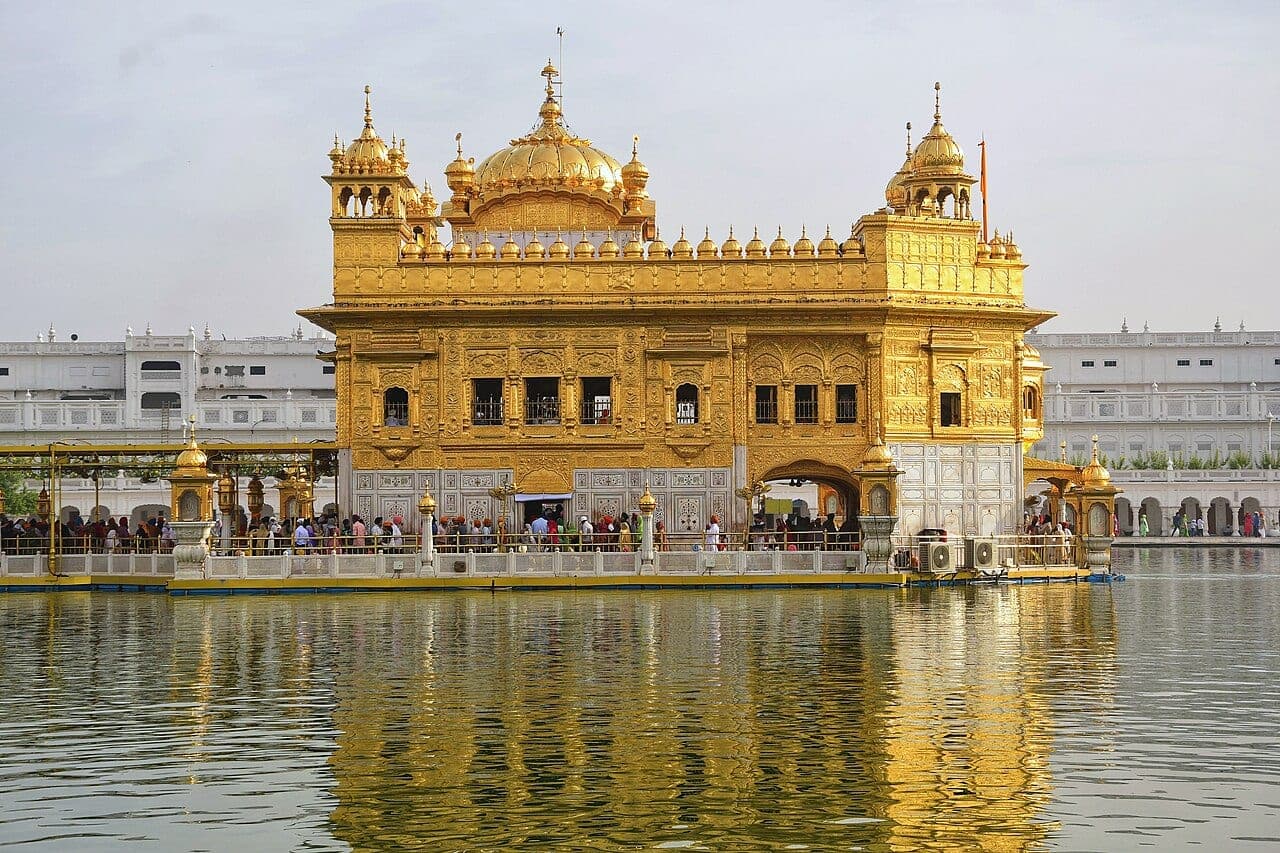
In the centre of a large square pool in Amritsar, Punjab, a low gilded shrine sits at the end of a marble causeway, its reflection doubling in the still water around it. This is the Harmandir Sahib, also called Sri Harmandir Sahib and Sri Darbar Sahib, and known in English as the Golden Temple: the holiest gurdwara of Sikhism and the spiritual heart of the faith. Pilgrims arrive at every hour to walk the marble path around the water, to bathe in it, and to cross the bridge into the sanctum, where the Sikh scripture is read and sung without pause.
The pool gives the city its name. Amrit means the water of immortality, or nectar, and sar a pool, so Amritsar is the pool of nectar, and the sheet of water enclosing the shrine is the Amrit Sarovar. Almost everything about the building states a single idea in stone and gold: that the divine is open to all. The sanctum has four doors, one to each direction, so that people of every caste, creed, and origin may enter from any side, and beside it the community kitchen, or langar, serves a free meal to everyone who comes, often described as the world's largest free community kitchen.
The site began as water before it was architecture. Guru Ram Das, the fourth of the ten Sikh Gurus, founded the settlement that grew into Amritsar in the 1570s and had the sacred pool excavated, a work completed around 1577. The town was first known as Ramdaspur, after him.
His son and successor, Guru Arjan, the fifth Guru, built the temple in the middle of the pool. Construction began in 1581, and the brick shrine was completed in 1589. Arjan set the building lower than the ground around it and gave it entrances on all four sides, a deliberate reversal of the usual temple form, so that worshippers step down to reach it and no direction, and no people, is privileged over another. A long-standing Sikh tradition holds that the foundation stone was laid by the Muslim Sufi saint Mian Mir, a friend of the Guru, a story often repeated as an emblem of the shrine's openness, though its historical detail is debated. In 1604 Guru Arjan installed the Adi Granth, the first compiled volume of Sikh scripture, which he had assembled, and appointed Baba Buddha as its first custodian, or granthi. That act made the building the home of the Sikh word.
Facing the shrine across an open courtyard, Guru Hargobind, the sixth Guru, raised the Akal Takht, the "throne of the timeless one," completed in the early seventeenth century as the seat of the community's temporal authority. Together the two structures express the Sikh balance of spiritual and worldly life. Through the eighteenth century the complex was attacked and desecrated several times during Afghan invasions of Punjab, and it was rebuilt each time by the Sikhs, a repeated cycle of destruction and restoration that shaped its later form.
The building acquired its famous surface under Maharaja Ranjit Singh, founder of the Sikh Empire, who took Amritsar in 1802. He funded a renovation in marble and copper from around 1809 and, over the following decades, had the upper storeys overlaid with gold leaf, the work that gave the shrine its English name. The gilded copper, marble inlay, and frescoes added under his patronage largely define the appearance visitors see today.
In June 1984 the complex was the site of one of the most painful episodes in modern Sikh history. According to accounts of the period, armed militants led by Jarnail Singh Bhindranwale had occupied and fortified parts of the complex, including the Akal Takht. Between 1 and 8 June, on the orders of Prime Minister Indira Gandhi, the Indian Army carried out a military operation, code-named Operation Blue Star, to remove them. In the fighting the Akal Takht was heavily damaged and many people died, among them soldiers, militants, and civilian pilgrims who were present in the complex; casualty figures remain disputed, with official government counts substantially lower than several independent estimates. The Harmandir Sahib itself survived, though it was struck by gunfire. The events, and the deaths of pilgrims caught in them, remain a deeply painful memory for many Sikhs. Later in 1984 Indira Gandhi was assassinated by two of her Sikh bodyguards, an act widely reported as a reaction to the operation. The government rebuilt the damaged Akal Takht soon afterward, but the Sikh community, objecting to a state-built reconstruction, later took it down and rebuilt it themselves through voluntary service.
The Harmandir Sahib is a compact two-storey structure that appears to float in the centre of the Amrit Sarovar. A single marble causeway, sometimes called the Guru's Bridge, links it to the surrounding walkway through an arched gateway, the Darshani Deori; the slow approach along the water is part of the experience the design intends. The plan of the shrine draws together forms from more than one tradition. Its low proportions and inlaid marble recall Rajput and wider Indian building, while the arches, the floral pietra dura inlay, and the domed silhouette owe much to Mughal and Islamic craft, all of it turned to a distinctly Sikh purpose.
 The shrine sits below the level of the surrounding walkway and is entered by descending, and it opens on all four sides. Both are deliberate. Photograph by Bernard Gagnon, CC BY-SA 4.0, via Wikimedia Commons.
Above the marble lower level, the upper storeys and the shallow dome are sheathed in gilded copper, the dome shaped like an inverted lotus and crowned by a finial. Inside and out, the surfaces carry embossed metalwork, mirror inlay, and painted floral designs. The four doors remain the building's central statement: one opening in each direction, a built declaration that the shrine is open to all people and all faiths, without the single guarded entrance of a fortress or an exclusive sanctuary.
Across the water the Akal Takht rises higher than the shrine, its several storeys and white facade marking it as the place of decision and authority, in deliberate contrast to the low, gold sanctum given over to worship. The two buildings, reflected together in the sarovar and ringed by the marble walkway, the clock tower, and the surrounding shrines and quarters, form a single composition meant to be walked slowly and seen from every side.
At the heart of the shrine is the Guru Granth Sahib, the Sikh scripture that Sikhs regard as the living and eternal Guru. Each day the volume is carried in procession into the sanctum and, at night, returned to its resting place; within, ragis sing kirtan, the hymns of the Gurus set to music, in a recitation that continues through the hours the shrine is open. On special occasions an akhand path, an unbroken reading of the entire scripture, may be held. To sit within earshot of that singing, out over the water, is for many pilgrims the purpose of the whole journey.
The langar expresses the faith's teaching on equality as plainly as the four doors do. Anyone, of any religion, caste, gender, or income, may sit on the floor in long rows, the pangat, and share the same simple vegetarian meal, prepared and served by volunteers performing seva, or selfless service. The kitchen at the Golden Temple runs around the clock, serving tens of thousands of people on an ordinary day and past a hundred thousand on festivals, sustained by donations and volunteer labour and managed by the Shiromani Gurdwara Parbandhak Committee. Sitting together as equals to eat is itself the lesson: the Gurus used the shared meal to reject the divisions of caste.
As the holiest gurdwara, the Harmandir Sahib is the goal of pilgrimage for Sikhs worldwide, and it draws very large numbers of visitors of every background throughout the year, with the greatest crowds gathering on Sikh festivals and the anniversaries of the Gurus. For many who come, the visit joins private devotion to a shared act of belonging that reaches across the global Sikh community.
The complex is maintained by the Shiromani Gurdwara Parbandhak Committee, the elected body that manages Sikh shrines in the region, and much of its upkeep is carried out through kar seva, voluntary restoration work offered as a religious duty. Periodically the sarovar is drained and its silt removed by lines of volunteers, and the gold and marble surfaces are cleaned and, where needed, re-gilded. The gilding itself has been renewed over time, most extensively in a major refurbishment in the late twentieth century.
The shrine was added to India's tentative list for UNESCO World Heritage status in 2004. Formal inscription has not followed, and the proposal has met reservation from within the Sikh community, where some fear that international designation could reduce the community's own control over its holiest site. Day-to-day pressure on the fabric comes from the sheer volume of visitors and from urban air pollution in the surrounding city, which the managing committee and its conservators work to counter.
The Golden Temple is open to visitors of every faith, and there is no charge to enter. All who come are asked to observe the same customs expected of worshippers. The head must be covered by everyone, women and men alike, and scarves are available near the entrance for those without one; shoes are removed and left at the free shoe stands, and everyone washes their feet in the shallow channel before stepping onto the marble walkway. Tobacco, alcohol, and meat are not permitted anywhere within the complex.
Visitors are asked to move quietly and respectfully around the walkway, to dress modestly, and to keep in mind that this is an active place of worship rather than a sight to be toured. Photography is generally allowed on the outer walkway but restricted inside the sanctum, and it is courteous to avoid interrupting those at prayer or bathing. Many visitors join the queue across the causeway to enter the shrine and take part in the langar, where guests are welcome to eat and, if they wish, to help with the cooking or washing as a form of service. The shrine keeps long hours, from early morning until late at night, and it is often calmest in the very early morning, when the marble is cool and the first hymns carry across the water.
The shrine sits below the level of the surrounding walkway and is entered by descending, and it opens on all four sides. Both are deliberate. Photograph by Bernard Gagnon, CC BY-SA 4.0, via Wikimedia Commons.
Above the marble lower level, the upper storeys and the shallow dome are sheathed in gilded copper, the dome shaped like an inverted lotus and crowned by a finial. Inside and out, the surfaces carry embossed metalwork, mirror inlay, and painted floral designs. The four doors remain the building's central statement: one opening in each direction, a built declaration that the shrine is open to all people and all faiths, without the single guarded entrance of a fortress or an exclusive sanctuary.
Across the water the Akal Takht rises higher than the shrine, its several storeys and white facade marking it as the place of decision and authority, in deliberate contrast to the low, gold sanctum given over to worship. The two buildings, reflected together in the sarovar and ringed by the marble walkway, the clock tower, and the surrounding shrines and quarters, form a single composition meant to be walked slowly and seen from every side.
At the heart of the shrine is the Guru Granth Sahib, the Sikh scripture that Sikhs regard as the living and eternal Guru. Each day the volume is carried in procession into the sanctum and, at night, returned to its resting place; within, ragis sing kirtan, the hymns of the Gurus set to music, in a recitation that continues through the hours the shrine is open. On special occasions an akhand path, an unbroken reading of the entire scripture, may be held. To sit within earshot of that singing, out over the water, is for many pilgrims the purpose of the whole journey.
The langar expresses the faith's teaching on equality as plainly as the four doors do. Anyone, of any religion, caste, gender, or income, may sit on the floor in long rows, the pangat, and share the same simple vegetarian meal, prepared and served by volunteers performing seva, or selfless service. The kitchen at the Golden Temple runs around the clock, serving tens of thousands of people on an ordinary day and past a hundred thousand on festivals, sustained by donations and volunteer labour and managed by the Shiromani Gurdwara Parbandhak Committee. Sitting together as equals to eat is itself the lesson: the Gurus used the shared meal to reject the divisions of caste.
As the holiest gurdwara, the Harmandir Sahib is the goal of pilgrimage for Sikhs worldwide, and it draws very large numbers of visitors of every background throughout the year, with the greatest crowds gathering on Sikh festivals and the anniversaries of the Gurus. For many who come, the visit joins private devotion to a shared act of belonging that reaches across the global Sikh community.
The complex is maintained by the Shiromani Gurdwara Parbandhak Committee, the elected body that manages Sikh shrines in the region, and much of its upkeep is carried out through kar seva, voluntary restoration work offered as a religious duty. Periodically the sarovar is drained and its silt removed by lines of volunteers, and the gold and marble surfaces are cleaned and, where needed, re-gilded. The gilding itself has been renewed over time, most extensively in a major refurbishment in the late twentieth century.
The shrine was added to India's tentative list for UNESCO World Heritage status in 2004. Formal inscription has not followed, and the proposal has met reservation from within the Sikh community, where some fear that international designation could reduce the community's own control over its holiest site. Day-to-day pressure on the fabric comes from the sheer volume of visitors and from urban air pollution in the surrounding city, which the managing committee and its conservators work to counter.
The Golden Temple is open to visitors of every faith, and there is no charge to enter. All who come are asked to observe the same customs expected of worshippers. The head must be covered by everyone, women and men alike, and scarves are available near the entrance for those without one; shoes are removed and left at the free shoe stands, and everyone washes their feet in the shallow channel before stepping onto the marble walkway. Tobacco, alcohol, and meat are not permitted anywhere within the complex.
Visitors are asked to move quietly and respectfully around the walkway, to dress modestly, and to keep in mind that this is an active place of worship rather than a sight to be toured. Photography is generally allowed on the outer walkway but restricted inside the sanctum, and it is courteous to avoid interrupting those at prayer or bathing. Many visitors join the queue across the causeway to enter the shrine and take part in the langar, where guests are welcome to eat and, if they wish, to help with the cooking or washing as a form of service. The shrine keeps long hours, from early morning until late at night, and it is often calmest in the very early morning, when the marble is cool and the first hymns carry across the water.
History
Architecture and design
Religious and cultural significance
Preservation
Visiting
References and resources
- Encyclopaedia Britannica: Golden Temple: overview of the shrine's founding, history, and gilding.
- Encyclopaedia Britannica: Operation Blue Star: account of the 1984 events and the disputed casualty figures.
- Golden Temple Amritsar (official): the langar: the community kitchen, its scale, and the practice of seva.
- Golden Temple Amritsar (official): significance: the meaning of the four doors and the shrine's openness.
- Shiromani Gurdwara Parbandhak Committee (SGPC): the body that manages the shrine and Sikh gurdwaras in the region.
- UNESCO World Heritage tentative list: Sri Harimandir Sahib: the 2004 tentative-list entry for the complex.
- Wikipedia: Golden Temple: detailed history, architecture, and references for further reading.