Heritage · Landmark
Uluru: the rock that keeps its own law
A sandstone monolith rises 348 metres from the desert plain of central Australia, changing colour with every hour of light. To its traditional owners, the Anangu, every fold and waterhole records ancestral events under Tjukurpa, a body of law and memory that decides who may know what, and some of it is deliberately not for outsiders.Written to last.
By Confinity Heritage Editorial · 2026-08-23 · 7-minute readQuiet tools, kept out of the way.
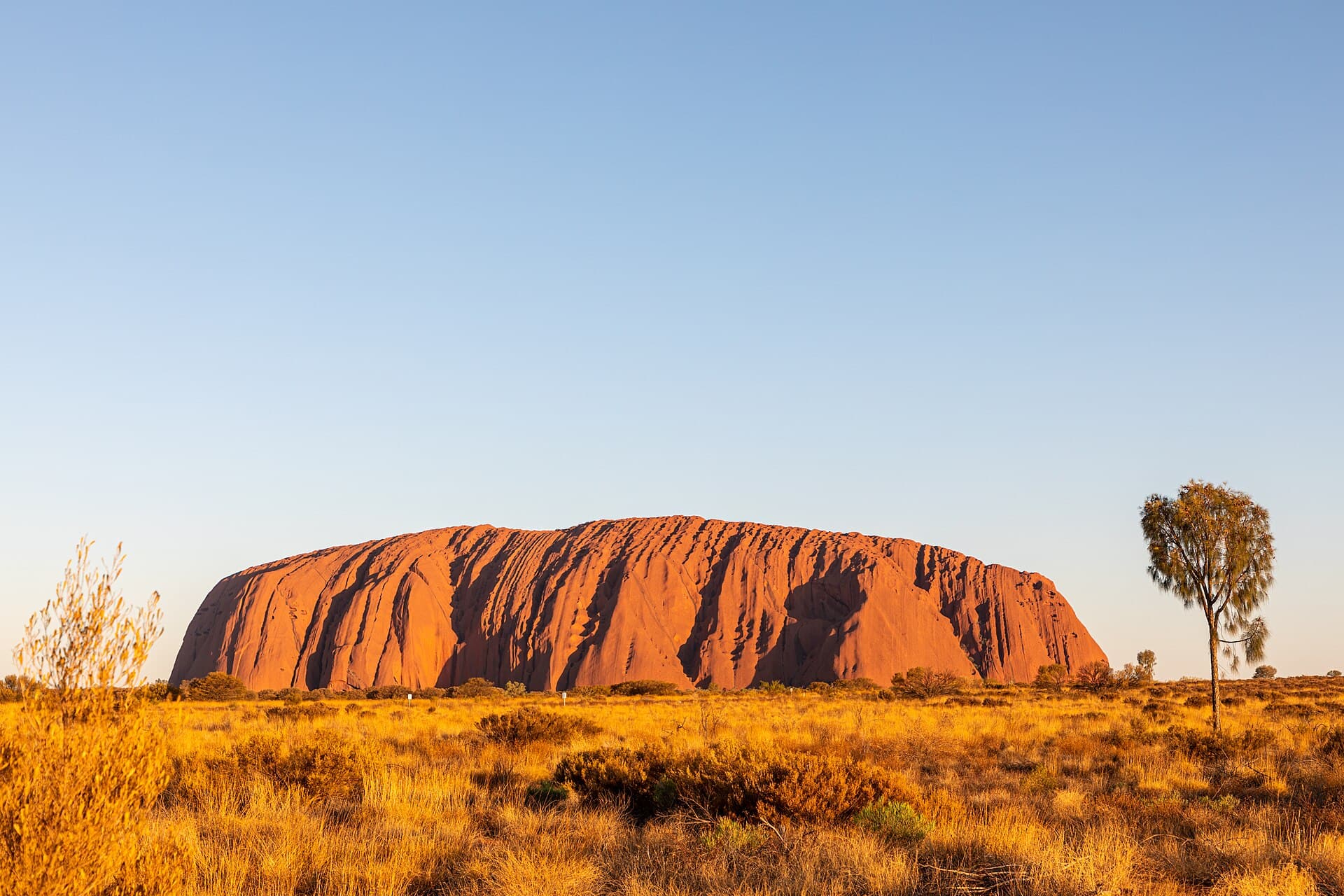
Near the centre of Australia, where the Northern Territory's desert plain runs flat to the horizon in every direction, a single mass of sandstone rises about 348 metres into the air and takes roughly 9.4 kilometres to walk around. Uluru is often called the world's most famous monolith, and the word undersells it: the visible rock is only the exposed shoulder of a formation that continues far beneath the plain, so that most of the mountain is underground. What a visitor sees change colour through the day, from ochre to burnt orange to a deep ember red at dawn and dusk, is a thin rusted skin of iron minerals over grey stone, lit by a desert atmosphere that behaves like a slow fire.
The rock has two names and two kinds of fame. To much of the twentieth-century world it was Ayers Rock, a geological curiosity at the heart of an empty continent, something to be photographed and climbed. To the Anangu, the Western Desert people who are its traditional owners, it has always been Uluru, a proper name with no translation, and it is not empty at all. Under Tjukurpa, the Anangu framework of law, story, and creation, the rock's caves, waterholes, and scars record the deeds of ancestral beings, and responsibility for that record passes down family lines to the present day. The modern history of Uluru is the story of those two understandings meeting, colliding, and slowly, over a century and a half, being put back in the right order.
Geologists read Uluru as an inselberg, an island mountain left standing while the country around it wore away. Its stone is arkose, a coarse sandstone rich in feldspar, laid down as sediment around 550 million years ago and later compressed and tilted until the original horizontal layers stand nearly on end. That tilting is why the surface reads as long parallel ridges running up the flanks, and why rain, when it comes, pours off in silver threads that have carved chutes and plunge pools. The formation extends well below the surrounding plain, with the buried portion generally put at several kilometres.
About 30 kilometres to the west stand the 36 dome formations of Kata Tjuta, once labelled the Olgas, which share the park and the Tjukurpa. Together they anchor Uluru-Kata Tjuta National Park, 1,326 square kilometres of dune country, desert oak, and spinifex.
The Anangu, speakers of Pitjantjatjara and Yankunytjatjara, belong to the cultural world of the Western Desert, one of the oldest continuous cultural traditions known anywhere. Archaeology puts human presence in the region at tens of thousands of years; the Anangu themselves say they have been there since the world took its present form. For all that time Uluru was not scenery but infrastructure: its shaded caves were camps and classrooms, its waterholes, above all Mutitjulu near the eastern base, were reliable water in a dry country, and its surface was a teaching text. Children learned the law by walking the base with their elders, matching each feature to the events it records.
That way of living was disrupted, not ended, by the twentieth century. Pastoralism, missions, and then mass tourism pushed Anangu to the margins of their own country, and by the 1950s a motel and airstrip had been built close against the rock itself. The families never left, and the knowledge never stopped being taught.
Tjukurpa is usually translated as the creation period or, loosely, the Dreaming, but Anangu use it to mean something wider: law, religion, moral system, and the record of how the world came to be, held in one framework. In the Tjukurpa, ancestral beings travelled the land, and their actions made its features. At Uluru, publicly shared accounts tell of beings such as Kuniya, the woma python woman, and Liru, the poisonous snake, whose confrontation is written into the rock near Mutitjulu Waterhole, and Mala, the rufous hare-wallaby people, whose story shapes sites on the northwestern face. The rock is, in a literal sense that the Anangu insist on, evidence of these events: each cave, stain, and fissure is the mark an action left.
What outsiders most need to understand about Tjukurpa is that it has rules of access. Knowledge is graded by seniority, gender, and ceremonial standing, and transmitted through song, ceremony, and art rather than writing. Some stories may be told to anyone; others belong only to initiated men or only to senior women, and telling them wrongly is a serious breach of law. This is why several sites around the base are signposted against photography: a published image could carry a sacred site to people who are not entitled to see it, including Anangu of the wrong knowledge status. It is tempting to read such restrictions as secrecy, but they are closer to an archive with access controls. The memory is kept, carefully and completely; it is simply not all kept for us.
The first European to reach the rock was the surveyor William Gosse, who arrived in July 1873 and named it Ayers Rock after Sir Henry Ayers, then chief secretary of South Australia, a man who never saw it. For the next century maps, postcards, and school books carried the name of a colonial politician, while the name Uluru survived where it had always lived, in Anangu speech.
Officialdom caught up slowly. In 1993 the Northern Territory adopted a dual name, Ayers Rock / Uluru, the first formal recognition that the older name had standing. In 2002 the order was reversed, and the place has been officially Uluru / Ayers Rock ever since, with the park itself renamed Uluru-Kata Tjuta National Park in 1993. The sequence of names is a small, readable history of who was assumed to own the story.
On 26 October 1985, at a ceremony at the base of the rock, the Governor-General of Australia handed the title deeds of the park to the Anangu traditional owners. The Handback, as it is remembered, followed a decade of Aboriginal land rights campaigning and made the arrangement that still governs the park: the Anangu hold freehold title and lease the land back to the national parks service, now Parks Australia, for 99 years, and a board of management with an Anangu majority directs the park jointly with government staff. Anangu call the working principle tjungu, together. Rangers learn Tjukurpa alongside ecology; traditional burning and hunting continue.
The world's recognition followed in two steps. UNESCO inscribed the park on the World Heritage List in 1987 for its natural values, the geology and the desert ecosystems. In 1994 the listing was expanded to include its cultural values as a living cultural landscape, making it one of the first properties anywhere recognised in this mixed way, an acknowledgement that the rock's meaning is not a relic but a working system maintained by its owners.
For decades the standard tourist act at Uluru was to climb it, hauling up a chain bolted to the steep western face in the 1960s. The route crosses the path of the Mala ancestors and is of deep ceremonial significance, and the Anangu had asked visitors not to climb for as long as anyone had thought to ask them. The park's signs put it plainly: this is our home; under our law we are responsible for you here; please don't climb. Anangu called climbers minga, ants, for the look of the long single-file line on the rock. More than thirty people died on the climb, and each death grieved the traditional owners, who felt responsible for visitors on their land.
In November 2017 the board of management voted unanimously to close the climb permanently, setting the date for 26 October 2019, the 34th anniversary of Handback. The final climbers came down on 25 October; the next day the chain was removed. The closure was contested loudly beforehand and accepted quickly afterwards; visitor numbers did not collapse as critics predicted. The request had been on the signs for decades. What changed in 2019 was that it was finally honoured.
The park the climb left behind is built around looking rather than conquering. Most visitors now come for first light, gathering at the Talinguru Nyakunytjaku viewing area to watch the rock move through its colours at sunrise, or walk the full base track, which passes waterholes, rock art, and the sites where photography is asked to stop. Since 2016 the artist Bruce Munro's Field of Light installation, tens of thousands of slender lit stems spread across a valley within sight of the rock, has given the desert night its own quiet spectacle, developed with the traditional owners' consent.
The Cultural Centre near the base, opened in 1995 on the tenth anniversary of Handback, is where the Anangu present Tjukurpa on their own terms: what may be shared is shared generously, in exhibits, art, and language, and what may not be shared is named as such. Visitors are told, in effect, that they are being trusted with part of a record, and that the rest is in good hands.
Most heritage writing assumes that remembering means publishing: that a place is saved when its story is written down, translated, and made available to everyone. Uluru holds a different model. Its memory is complete, tended, and tens of thousands of years deep, and part of it is deliberately withheld, not because it is forgotten but because its keepers decide who is ready to receive it. The Handback returned the land; the closure of the climb returned the right to say how it is treated; the photography signs assert the right to say what is seen. Together they make Uluru a standing lesson in a kind of respect the modern world finds difficult: that some memory is not public property, and that honouring it means accepting the parts you will never be told. The rock keeps its own law. Visitors are welcome at the base of it.
A mountain mostly below the ground
The oldest owners
Tjukurpa: the law that keeps the story
Two names for one place
Handback and joint management
The end of the climb
Dawn at Uluru now
Memory you are not entitled to read
References and resources
- UNESCO World Heritage Centre. "Uluru-Kata Tjuta National Park." World Heritage List, property no. 447, inscribed 1987, cultural values added 1994. whc.unesco.org/en/list/447.
- Parks Australia. "Uluru-Kata Tjuta National Park," including the pages on Anangu culture, Tjukurpa, park history, and the closure of the climb. parksaustralia.gov.au/uluru.
- Encyclopaedia Britannica. "Uluru/Ayers Rock." britannica.com/place/Uluru-Ayers-Rock.
- Director of National Parks. "Uluru-Kata Tjuta National Park Management Plan." Australian Government.
- Wikipedia. "Uluru" and "Uluru-Kata Tjuta National Park." Retrieved 2026.