Heritage · Landmark
The Statue of Liberty: History, Facts and Visitor Guide
A colossal copper statue in New York Harbor, designed by Bartholdi with an internal frame by Gustave Eiffel and given by France, dedicated in 1886.Written to last.
By Confinity Heritage Editorial · Updated 2026-07-31 · 7-minute readQuiet tools, kept out of the way.
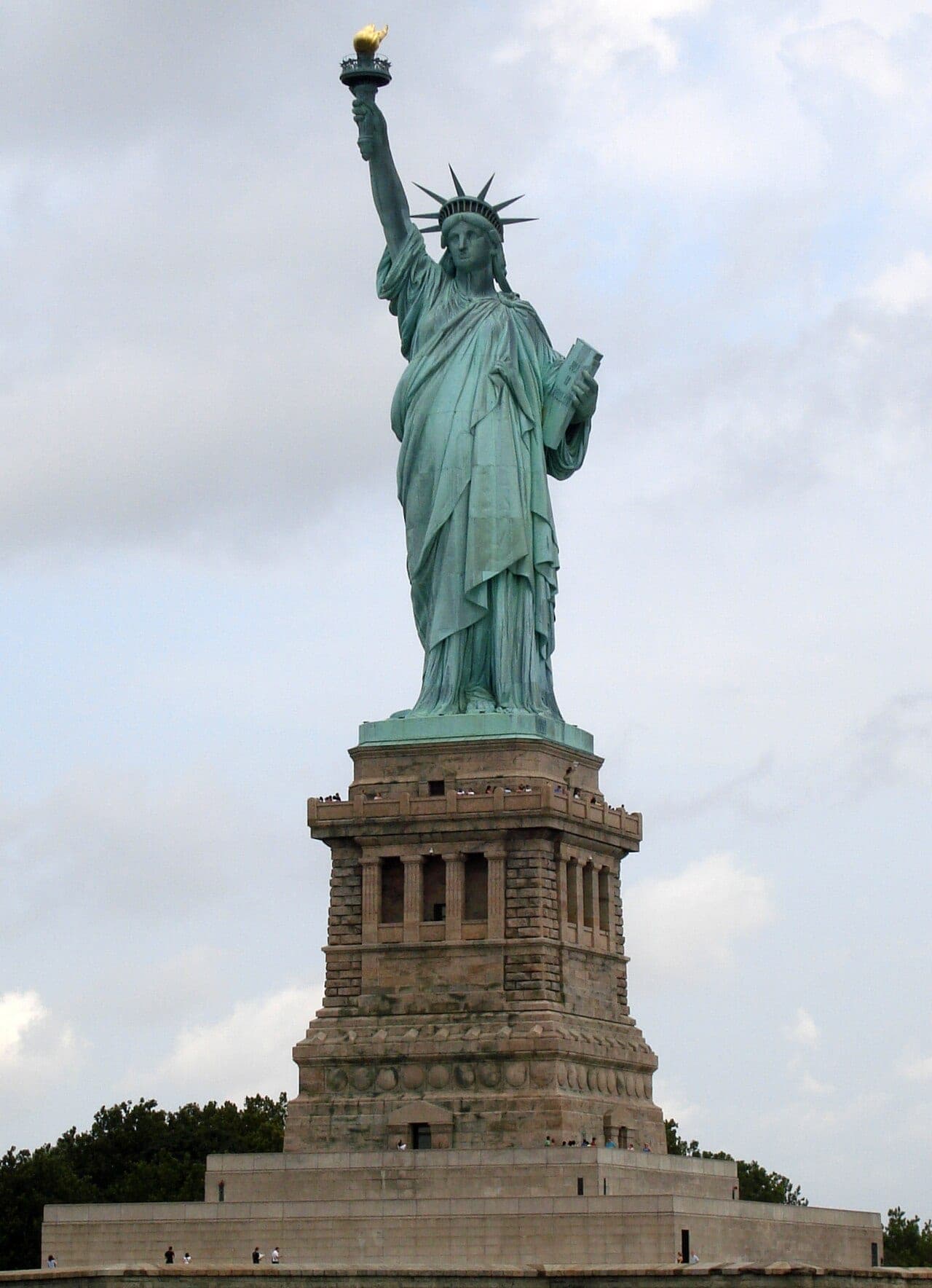
The Statue of Liberty rises from Liberty Island in New York Harbor, a copper figure of a robed woman holding a torch above her head and a tablet cradled in her left arm. Its formal name is Liberty Enlightening the World. The statue was a gift from the people of France to the people of the United States, designed by the French sculptor Frédéric-Auguste Bartholdi with an internal supporting structure engineered by Gustave Eiffel, and dedicated on 28 October 1886. Over the following century its meaning shifted from a monument to republican friendship toward a broader symbol of immigration and refuge, a change owed largely to a single sonnet. UNESCO added it to the World Heritage List in 1984.
The idea is usually traced to Édouard de Laboulaye, a French jurist and admirer of the American republic, who is said to have proposed a monument to liberty and Franco-American friendship around 1865. Bartholdi developed the concept into a design over the following decade. The two nations divided the labour: France would fund and build the statue itself, while the United States would provide the site and pay for the pedestal.
The French sum came from public subscription, raising roughly 2.25 million francs, about $250,000. American fundraising for the pedestal lagged until the publisher Joseph Pulitzer used his newspaper, the New York World, to coax small donors into giving; his 1885 campaign drew more than 120,000 contributions and raised over $100,000. The architect Richard Morris Hunt designed the granite-clad concrete pedestal, set within the star-shaped walls of Fort Wood on what was then Bedloe's Island.
The statue was completed in Paris in 1884, then disassembled into some 350 pieces packed in 214 crates and shipped across the Atlantic. Reassembled on its finished pedestal, it was dedicated on 28 October 1886 before President Grover Cleveland and a harbor crowded with ships.
Bartholdi built the figure from thin copper sheets, about 3/32 of an inch (2.4 mm) thick, hammered into shape by the repoussé technique over wooden forms. The skin, roughly 31 tons of copper, hangs from an internal iron framework engineered by Gustave Eiffel after the death in 1879 of the project's first engineer, Eugène Viollet-le-Duc. Eiffel's solution, worked out with Maurice Koechlin, used a central iron pylon and a flexible system of straps so the copper skin could expand, contract, and sway in the wind without cracking. The framework weighs about 125 tons.
 The copper skin is about 2.4 millimetres thick, roughly two coins, hung on an iron frame Gustave Eiffel designed to let it flex in the wind. Photograph by William Warby, CC BY 2.0, via Wikimedia Commons.
From the base of the statue to the tip of the torch measures 151 feet 1 inch (46 m); from heel to the top of the head is 111 feet 1 inch; and from the ground to the torch, counting pedestal and foundation, the whole reaches 305 feet 1 inch (93 m). The crown bears seven rays, often read as light reaching the seven seas and continents, and the tablet is inscribed JULY IV MDCCLXXVI, the date of American independence. The uplifted torch, the source of the light in the statue's name, was Bartholdi's focal point.
The statue's association with immigration was not part of Bartholdi's original brief; it grew after the fact. Emma Lazarus wrote her sonnet "The New Colossus" in 1883 to help raise money for the pedestal, recasting the figure as a "Mother of Exiles" who calls, "Give me your tired, your poor, your huddled masses yearning to breathe free." The poem was little noticed at first, and only in 1903, years after Lazarus had died, was it cast on a bronze plaque and mounted inside the pedestal.
When the federal immigration station on nearby Ellis Island opened in 1892 and processed some 12 million arrivals before closing in 1954, the statue became the first American sight many immigrants saw. That welcome, rather than the founding theme of Franco-American liberty, is what most visitors now bring to it. Historians point to the tension between the poem's openness and the restrictive immigration laws passed in the same period. The broken chains and shackle at Liberty's feet, largely hidden by her robe, also tie the monument to the abolition of slavery that Laboulaye and Bartholdi supported.
The statue is administered by the National Park Service, which runs it together with Ellis Island as the Statue of Liberty National Monument. Official ferries depart from Battery Park in Manhattan and Liberty State Park in New Jersey, and there is no other public access to the island. A ferry ticket includes grounds access, while pedestal and crown visits require separate timed reservations; crown tickets are limited and often booked far ahead. The climb to the crown runs 354 steps and has no elevator. The Statue of Liberty Museum, opened on the island in 2019, displays the original 1886 torch. Hours and reservation rules change, so check the Park Service site before travelling.
By the early 1980s the statue needed serious repair. Corrosion had attacked the iron framework where it met the copper skin, and the torch, altered in 1916, leaked. In 1982 President Ronald Reagan asked Lee Iacocca to lead a private Statue of Liberty and Ellis Island Foundation, which raised the funds for a full restoration. French and American teams replaced the corroded iron ribs with stainless steel, repaired the copper, and installed a new torch covered in gold leaf, lit from the outside as Bartholdi had intended. The original torch was removed and later placed in the museum. The statue reopened during the Liberty Weekend festivities of July 3–6, 1986, in time for its centennial.
The copper skin is about 2.4 millimetres thick, roughly two coins, hung on an iron frame Gustave Eiffel designed to let it flex in the wind. Photograph by William Warby, CC BY 2.0, via Wikimedia Commons.
From the base of the statue to the tip of the torch measures 151 feet 1 inch (46 m); from heel to the top of the head is 111 feet 1 inch; and from the ground to the torch, counting pedestal and foundation, the whole reaches 305 feet 1 inch (93 m). The crown bears seven rays, often read as light reaching the seven seas and continents, and the tablet is inscribed JULY IV MDCCLXXVI, the date of American independence. The uplifted torch, the source of the light in the statue's name, was Bartholdi's focal point.
The statue's association with immigration was not part of Bartholdi's original brief; it grew after the fact. Emma Lazarus wrote her sonnet "The New Colossus" in 1883 to help raise money for the pedestal, recasting the figure as a "Mother of Exiles" who calls, "Give me your tired, your poor, your huddled masses yearning to breathe free." The poem was little noticed at first, and only in 1903, years after Lazarus had died, was it cast on a bronze plaque and mounted inside the pedestal.
When the federal immigration station on nearby Ellis Island opened in 1892 and processed some 12 million arrivals before closing in 1954, the statue became the first American sight many immigrants saw. That welcome, rather than the founding theme of Franco-American liberty, is what most visitors now bring to it. Historians point to the tension between the poem's openness and the restrictive immigration laws passed in the same period. The broken chains and shackle at Liberty's feet, largely hidden by her robe, also tie the monument to the abolition of slavery that Laboulaye and Bartholdi supported.
The statue is administered by the National Park Service, which runs it together with Ellis Island as the Statue of Liberty National Monument. Official ferries depart from Battery Park in Manhattan and Liberty State Park in New Jersey, and there is no other public access to the island. A ferry ticket includes grounds access, while pedestal and crown visits require separate timed reservations; crown tickets are limited and often booked far ahead. The climb to the crown runs 354 steps and has no elevator. The Statue of Liberty Museum, opened on the island in 2019, displays the original 1886 torch. Hours and reservation rules change, so check the Park Service site before travelling.
By the early 1980s the statue needed serious repair. Corrosion had attacked the iron framework where it met the copper skin, and the torch, altered in 1916, leaked. In 1982 President Ronald Reagan asked Lee Iacocca to lead a private Statue of Liberty and Ellis Island Foundation, which raised the funds for a full restoration. French and American teams replaced the corroded iron ribs with stainless steel, repaired the copper, and installed a new torch covered in gold leaf, lit from the outside as Bartholdi had intended. The original torch was removed and later placed in the museum. The statue reopened during the Liberty Weekend festivities of July 3–6, 1986, in time for its centennial.
History
Design and construction
Cultural role
Visiting
Preservation
References and resources
- UNESCO World Heritage Centre: Statue of Liberty: the 1984 inscription record.
- Encyclopaedia Britannica: Statue of Liberty: origin, construction, and restoration.
- US National Park Service: Statue of Liberty National Monument: official history and visitor information.
- National Park Service: Statue statistics: verified dimensions and weights.
- Wikipedia: Statue of Liberty: history, engineering, and sources.
- Wikipedia: The New Colossus: the Lazarus sonnet and its 1903 plaque.
- Wikipedia: Ellis Island: the immigration station, 1892 to 1954.