Heritage · Landmark
The Vijećnica: the library Sarajevo lost in a night
A banded hall of ochre and red stone on the Miljacka, built in the 1890s as the city hall of Austro-Hungarian Sarajevo and given over in 1949 to the National and University Library of Bosnia and Herzegovina. On the night of 25 August 1992 gunners in the hills fired incendiary shells into it, and the written record of a country burned while citizens passed books out of the flames hand to hand.Written to last.
By Confinity Heritage Editorial · 2026-08-25 · 7-minute readQuiet tools, kept out of the way.
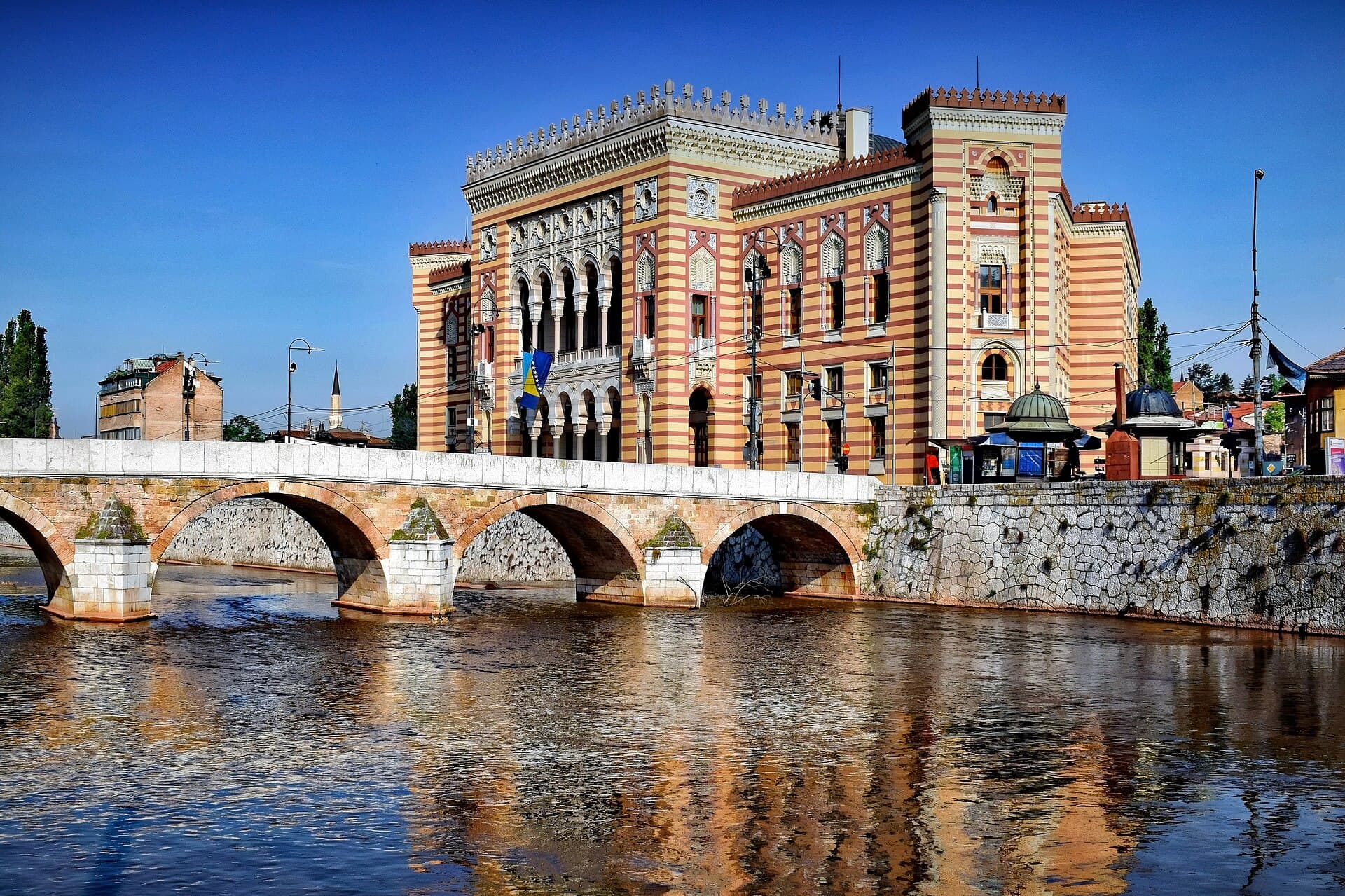
On the bank of the Miljacka, where the river leaves the old Ottoman bazaar quarter of Sarajevo in Bosnia and Herzegovina, stands a hall of ochre and red stone, its walls laid in horizontal bands, its arches cusped, its plan wedged into the angle of the riverbank. Inside, a central atrium rises through three storeys of arcades to a stained-glass ceiling. Sarajevans call the building the Vijećnica, the council chamber. It was raised as the city hall of Austro-Hungarian Sarajevo and opened in 1896, and in 1949 it was handed to the National and University Library of Bosnia and Herzegovina.
For forty-three years the building the empire had put up to administer the city held the country's written record instead. On the night of 25 August 1992, four months into the siege of Sarajevo, gunners in the hills above the valley fired incendiary shells into it, and it burned. Mostar's Stari Most fell fifteen months later and became the war's most reproduced image of cultural destruction, filmed as it dropped into the Neretva and afterwards dredged out of it. What burned in Sarajevo could not be recovered from a riverbed.
The design passed through three sets of hands in five years, and the argument between them is still legible in the elevation. The Czech architect Karel Pařík drew the first project in 1891. Béni Kállay, the Austro-Hungarian joint finance minister who governed Bosnia, raised objections that Pařík would not accept, and the commission was taken from him and handed on.
Alexander Wittek carried it through 1892 and 1893. He kept most of Pařík's layout and conceded Kállay's demand for an additional storey to make the hall more imposing. Wittek gave the Vijećnica its face. He travelled to Cairo to study Mamluk architecture at first hand, and the striped masonry, the cusped arcades and the honeycomb vaulting descend from those journeys rather than from anything standing in Bosnia at the time. He never saw it finished. Diagnosed with a paralytic mental disorder in 1893, he died in Graz in 1894, and the sources disagree over whether the cause was tuberculosis or his own hand. The working drawings for the facades and the ornament, dated 1894 and 1895, are signed by Ćiril M. Iveković, who completed the project with only small changes.
Building work ran from 1892 to 1894 at a cost of 984,000 crowns, with a further 32,000 for fittings, and the hall was formally opened on 20 April 1896. Its most consequential day as a city hall came eighteen years later. Archduke Franz Ferdinand and his wife Sophie attended a reception there on the morning of 28 June 1914, after the first attempt on his life had failed, and were shot near the Latin Bridge minutes after leaving. In 1949 the building was given to the National and University Library, founded four years earlier.
By August 1992 Sarajevo had been encircled for four months. On the night of 25 August, Army of Republika Srpska positions on the surrounding heights fired on the Vijećnica. The bibliographer András Riedlmayer, who gathered witness statements on the attack from Harvard's Fine Arts Library, recorded that the building was struck with phosphorus incendiary rounds, which ignite on contact with air, and that he held video evidence of soldiers firing on the firemen and their hoses as they tried to reach the blaze. The library's own account puts the fire at fourteen hours; burnt paper fell over the city for days afterwards.
While it burned, library staff and ordinary Sarajevans formed a human chain and passed books out of the building by hand, under sniper fire, into the street. They saved a small fraction of what was inside. One of them was Aida Buturović, born in 1959, a librarian who had read literature and philosophy at the Faculty of Philosophy in Sarajevo. She was thirty-two. Walking home from the rescue along Titova street, between the Presidency and Marijin Dvor, she was hit in the neck by shrapnel from a shell, and her family found her body at the morgue days later. The library counts four of its staff killed during the war: Buturović, Adela Leota, Ante-Slavko Kovačić and Mirko Azinović. In the ruins that autumn the cellist Vedran Smailović sat among the rubble and played, and the photograph became one of the images by which the siege is remembered.
No inventory survived the fire, so every figure for the loss is a reconstruction, and the published numbers differ. Riedlmayer's survey put the pre-war holdings at 1.5 million volumes, including more than 155,000 rare books and manuscripts, the national archives of Bosnia and Herzegovina, the legal deposit copies of everything published in the country, and the research collections of the University of Sarajevo. On that reckoning, ninety percent of the volumes were destroyed. The library's own director, Ismet Ovčina, has spoken of more than two million library units lost and put the destruction at eighty percent of the stock. The commemorative plaque on the building says over two million books, periodicals and documents. Accounts that follow the manuscripts specifically tend to cite around 700 manuscripts and incunabula, a figure far below Riedlmayer's count of rare items and evidently measuring something narrower.
Where the ranges agree matters more than where they part. The manuscript and rare book collections were largely gone. So was the national serial archive: the deposit run of Bosnian newspapers, journals and pamphlets reaching back to the cultural revival of the mid-nineteenth century, much of it held in single copies and nowhere else in the world. Alongside it went maps, sheet music, posters, photographs and the accumulated printed record of Catholic, Orthodox, Muslim and Jewish life in Bosnia, the kind of local material that no other library had reason to duplicate.
Three months before the Vijećnica burned, the Oriental Institute in Sarajevo was destroyed by fire, taking 5,263 bound manuscript codices and more than 200,000 Ottoman-era documents. A pattern of that kind is what the specialists who examined the war point to. Riedlmayer, who spent years documenting the destruction of Bosnian libraries and archives and published his findings in the Middle East Studies Association Bulletin in 1995, described the burning of the Vijećnica as the largest deliberate act of book burning in recorded history, and argued that the significance of the collection lay in what it demonstrated: that the region's communities had a documented common past. His colleague Jeffrey Spurr called it a cultural crime without parallel since the Second World War.
The legal record is thinner, and the SENSE Transitional Justice Centre, which built its archive out of the evidence of the International Criminal Tribunal for the former Yugoslavia, sets that out plainly. The first indictment against Radovan Karadžić and Ratko Mladić charged the intentional and wanton destruction of religious and cultural buildings, libraries among them, and the burning of the Vijećnica was discussed at the confirmation hearing in July 1996. It was later dropped from the schedule of incidents in the amended indictments on which the trials proceeded. Nobody has been convicted for the destruction of the library, a point the institution itself makes at every anniversary.
Recovery began almost at once and has never been finished. Riedlmayer and Spurr set up a project at Harvard to trace microfilm: short of money, the library had traded film with institutions abroad, so copies of some of its manuscripts existed in other countries, and roughly thirty cabinets of foreign microfilm burned in Sarajevo, implying a comparable quantity of Bosnian film sitting in foreign collections. Some 30,000 newly published books were shipped to Sarajevo by academic presses and donors, and libraries in Slovenia, the United States and elsewhere sent replacements. In the decades since, the National and University Library has digitised what survived, published collections online and contributed to Europeana, and it lends charred fragments to exhibitions abroad, among them the House of European History in Brussels.
None of that restores the archive. Donated books replace printed editions that other libraries also hold. They cannot replace a manuscript that existed in one copy, or the only surviving run of a Sarajevo newspaper from the 1880s. Between the fire and the present the library moved its premises six times, and it has still not gone back to the Vijećnica. It works today from the University of Sarajevo campus, rebuilding a collection whose irreplaceable core is gone.
The shell of the building survived, held up by the firefighters and staff who fought the blaze, and reconstruction ran in four stages from 1996 to 2013, funded by Austria, the European Commission, the city of Barcelona and the European Union's pre-accession instrument, at an estimated 25 million convertible marks. The Vijećnica reopened on 9 May 2014 with the Sarajevo Philharmonic and Vedran Smailović playing in the restored atrium, and opened to the general public that July. It is now the seat of the mayor of Sarajevo and the city council, and it holds concerts, exhibitions and state receptions.
Beside the entrance is a plaque erected by Sarajevo Canton and recorded by the canton's Institute for the Protection of Cultural, Historical and Natural Heritage. It names those it holds responsible for the fire, gives the date and the scale of the loss, and closes with an instruction: "Do not forget, remember and warn!" Visitors read it, then photograph the stained-glass ceiling above. The ceiling is new, the stone is cleaned, the arcades are as Wittek drew them. The building is the part of this story that could be put back.
Three architects and a building nobody agreed on
The night of 25 to 26 August 1992
What burned, and the figures that do not agree
The case that this was not collateral damage
What came back, and what could not
The rebuilt hall and the words on its wall
References and resources
- Vijećnica (official site of Sarajevo City Hall). "Construction of City Hall Sarajevo." vijecnica.ba/en.
- Riedlmayer, András. "Erasing the Past: The Destruction of Libraries and Archives in Bosnia-Herzegovina." Middle East Studies Association Bulletin, vol. 29, no. 1, July 1995, pp. 7-11.
- Johnson, David P., Jr. "Scholars Help Bosnia Rebuild Destroyed Libraries." Washington Report on Middle East Affairs, December 1998, pp. 64-65. wrmea.org.
- SENSE Transitional Justice Centre. "Targeting History and Memory: the ICTY and the investigation, reconstruction and prosecution of crimes against cultural and religious heritage." heritage.sensecentar.org.
- Conference of European National Librarians. "The National and University Library of Bosnia and Herzegovina commemorated 33 years since the shelling and destruction of Vijećnica." cenl.org.
- University of Sarajevo. "The National and University Library of Bosnia and Herzegovina marked the 27th anniversary of the destruction of the City Hall." unsa.ba.
- Kultura sjećanja (Centre for Nonviolent Action). "Sarajevo, memorial plaque on the Vijećnica building," recorded by the Cantonal Institute for the Protection of Cultural, Historical and Natural Heritage of Sarajevo. kulturasjecanja.org.
- Balkan Insight. "Sarajevo Reopens Iconic War-Damaged City Hall," 12 May 2014, and "Sarajevo's Restored City Hall Opens its Doors," 17 July 2014. balkaninsight.com.
- Wikipedia. "Vijećnica," "National and University Library of Bosnia and Herzegovina," "Karel Pařík" and "Alexander Wittek." Retrieved 2026.