Heritage · Landmark
Stari Most: the bridge Mostar is named for
A single arc of pale limestone has crossed the Neretva at Mostar since 1566, so central to the city that Mostar takes its name from the keepers of the bridge. Destroyed by shellfire in November 1993, it was rebuilt with Ottoman methods and reopened in 2004, and it now stands as both a monument to reconciliation and a measure of how far reconciliation still has to go.Written to last.
By Confinity Heritage Editorial · 2026-08-23 · 7-minute readQuiet tools, kept out of the way.
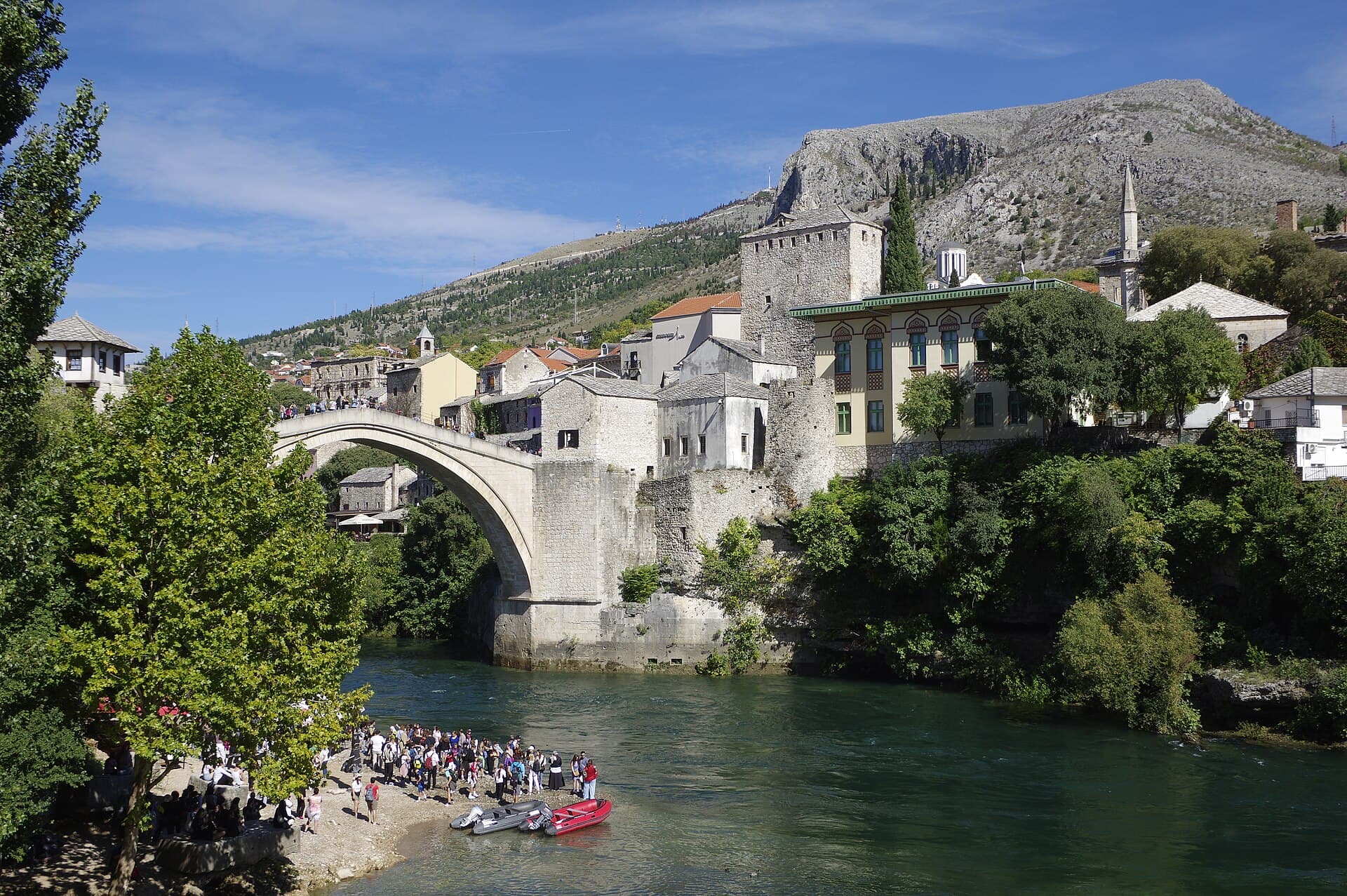
In the old town of Mostar, in Bosnia and Herzegovina, a single arc of pale stone rises over the green water of the Neretva. Stari Most, the Old Bridge, springs from a cliff on one bank to a cliff on the other in one unbroken curve, hump-backed and steep enough that its walkway is ribbed with stone risers to give feet a purchase. Two fortified towers, the Halebija and the Tara, stand guard at either end. The bridge a visitor crosses today was finished in 2004, a faithful twin of the one finished in 1566, and the distance between those two dates holds most of what the monument means.
Few structures are so completely identified with their city. Mostar takes its name from the mostari, the bridge-keepers who watched over the crossing, so that the town is, literally, the place of the bridge. For four and a quarter centuries the arch carried traders, pilgrims, armies, and generations of young men who proved themselves by diving from its parapet. Then, on a November morning in 1993, it was deliberately destroyed, and its fall became one of the defining images of the wars that broke Yugoslavia apart. Its reconstruction, completed with Ottoman methods and local stone, was inscribed by UNESCO in 2005 as a symbol of reconciliation and coexistence. The bridge now carries that hope as surely as it once carried mule trains, and the city around it shows how heavy the load still is.
By the middle of the sixteenth century Mostar was a growing Ottoman trading town, and the crossing at its heart was a wooden suspension bridge that swayed so badly that travellers crossed it in fear. The town petitioned for something better, and the order came from the top of the empire: Suleiman the Magnificent commissioned a permanent stone bridge, and the work fell to Mimar Hayruddin, a pupil of the great imperial architect Mimar Sinan. Construction ran through the late 1550s and into the 1560s, and the bridge was completed in 1566, its cost met from the imperial treasury.
The commission was a gamble as much as an honour. A single-span stone arch of this size had little precedent in the region, and failure under a sultan's commission carried consequences an architect did not need spelled out. A local legend preserves the stakes: on the day the wooden scaffolding was to be struck, Hayruddin is said to have prepared for his own funeral, convinced the arch would come down with the falsework. It did not. The story cannot be verified, but the fact that Mostar told it for four centuries says something true about the bridge: everyone who looked at it understood that it should not have been possible.
The engineering deserved the legend. The arch spans about 29 metres in a single leap and stands roughly 24 metres above the summer level of the Neretva, with no pier in the riverbed to help it. It was built from tenelija, a local limestone quarried near the city, light in colour and light in weight, easy to cut when fresh and hardening with exposure. The blocks were fastened with iron cramps set in lead, in the Ottoman manner, and the arch was given a subtle rise that distributes its load into the cliffs on either side.
How it stands has been studied ever since. The seventeenth-century Ottoman traveller Evliya Celebi, who saw it in 1664, wrote that he had crossed sixteen countries and never seen such a high bridge, thrown from rock to rock as high as the sky. Later engineers took the question up in earnest: the geometry of the arch, the behaviour of the stone, and the hidden details of its construction have been the subject of technical analyses spanning centuries, and the reconstruction of the early 2000s turned the whole bridge into an open research problem, since rebuilding it required understanding, stone by stone, what Hayruddin's builders had done. The answer, broadly, is that the bridge is a masterpiece of economy: a thin arch of light stone, perfectly shaped, asked to do one thing and doing it for 427 years.
The bridge made the city in more than name. Mostar grew up around the crossing as a market town where the routes from the Adriatic coast met the roads into the Balkan interior, and the old bazaar quarter, the Kujundziluk, still climbs the eastern bank in a jumble of cobbles and workshops. Mosques, churches, and later a synagogue rose within a few minutes' walk of the arch, and Ottoman, Mediterranean, and Austro-Hungarian layers accumulated around it. The mostari kept the bridge; the bridge, in a real sense, kept the town, giving it its livelihood, its silhouette, and its name.
It also gave Mostar a rite of passage. Young men have been diving from the parapet into the cold river below since at least the seventeenth century, a drop of over twenty metres that demands training, nerve, and respect for the water. The tradition became an institution: a local diving club keeps the practice alive and trains newcomers, and an annual summer competition has been organised in its modern form since 1968, with roots reaching back generations earlier. For a Mostar boy, the first dive from the bridge has long marked a threshold. The divers, standing on the parapet in wet trunks collecting coins from tourists before the plunge, are as much a part of the monument as its stone.
The war reached Mostar in 1992, and by 1993 the city had become a front line in the conflict between Bosnian Croat and Bosniak forces. The old town on the east bank was besieged and shelled for months. On 8 November 1993, tank fire from Croat HVO forces struck the bridge repeatedly through the day; on the morning of 9 November 1993 the arch collapsed into the Neretva. The bridge had stood for 427 years. It had no strategic value remotely proportionate to what it meant, and the footage of the old stone folding into the river travelled around the world and became an emblem of the deliberate destruction of culture in that war.
The destruction was later examined at the International Criminal Tribunal for the former Yugoslavia, where the shelling of the bridge formed part of the case against senior HVO political and military leaders in the Prlic and others proceedings, and where those leaders were convicted of crimes committed in the campaign in which the bridge was destroyed. In Mostar the loss was felt as something closer to a death in the family, and when the fighting ended, army divers began the slow work of dredging the sunken tenelija blocks out of the riverbed, laying the drowned stones out on the bank like recovered remains.
The decision to rebuild came quickly; the rebuilding itself took nearly a decade. Under the coordination of UNESCO and with financing led by the World Bank, joined by a coalition of donor countries and heritage organisations, the project set itself an unusual discipline: the bridge would be rebuilt as it had been built, using Ottoman-era construction techniques and technologies, not merely restored in outline. Tenelija was cut from local quarries, blocks were shaped by hand, and iron cramps sealed with lead joined them as in 1566. The stones recovered from the river were studied, and though most were too damaged by fire, blast, and water to bear load again, some found a place in the reconstruction.
The new arch was completed and the bridge reopened on 23 July 2004, in a ceremony watched across the region. The following year, UNESCO inscribed the Old Bridge and its surrounding quarter on the World Heritage List, and the inscription is unusual in its candour: it honours the reconstruction itself, describing the renewed bridge and old town as a symbol of reconciliation, international cooperation, and the coexistence of diverse communities. A rebuilt monument was recognised not despite being rebuilt but because of it.
The bridge was rebuilt faster than the trust. Mostar today remains largely two parallel cities: a mainly Croat west bank and a mainly Bosniak east bank, with separate schools, separate utilities in some sectors, separate football clubs, and a shared city government that has often struggled to function. Children on either side can grow up crossing the bridge for ice cream and tourists without ever attending a class together. None of this needs embellishment; residents of Mostar describe it plainly themselves. The arch joins the banks. Joining the banks was always the easy part to see and the hard part to mean.
Near the bridge a stone bears a short carved instruction: Don't forget '93. It faces the crowds of visitors photographing the divers, and it does what plaques rarely manage, which is to say only what is needed. The bridge is whole; the sentence is there so that its wholeness never becomes a way of pretending nothing happened.
Stari Most is the clearest test case in Europe of what reconstruction can and cannot restore. The arch that stands today is the original's twin in span, stone, and method, raised by hands trained to work as Hayruddin's masons worked, and it carries the same divers over the same river. That is an extraordinary act of collective memory, a city and an international community agreeing that the shape of a thing can be brought back if enough people insist. But the reconstruction was never presented as an undoing, and the city has been careful not to let it become one. The fall of the bridge is remembered on purpose, in the carved stone by the parapet and in the footage that still circulates every November. And the reconciliation the new arch was raised to stand for remains unfinished work on both banks beneath it. The bridge keeps what stone can keep: the form, the crossing, the name of the city. The rest it can only stand for, patiently, until the people on either side decide to carry their half.
The sultan's commission
A single arc of tenelija
The city of the bridge-keepers
The ninth of November 1993
Rebuilding, stone by stone
The divided city around the reconciled bridge
What a rebuilt bridge can keep
References and resources
- UNESCO World Heritage Centre. "Old Bridge Area of the Old City of Mostar." World Heritage List, property no. 946, inscribed 2005. whc.unesco.org/en/list/946.
- Encyclopaedia Britannica. "Stari Most." britannica.com/topic/Stari-Most.
- Wikipedia. "Stari Most" and "Mostar." Retrieved 2026.
- International Criminal Tribunal for the former Yugoslavia. Prlic et al. (IT-04-74) case information sheet. icty.org/en/case/prlic.
- UNESCO. Records of the reconstruction of the Old Bridge of Mostar and the reopening ceremony of 23 July 2004.