Heritage · Landmark
The Great Mosque of Djenné: the building the town remakes
Every year, before the rains come, the whole town of Djenné climbs the largest mud building on earth and coats it in fresh banco by hand, finishing in a single day. The bundles of palm timber that give the mosque its bristling silhouette are there so that they can: permanent scaffolding for a building that survives by being remade.Written to last.
By Confinity Heritage Editorial · 2026-08-25 · 7-minute readQuiet tools, kept out of the way.
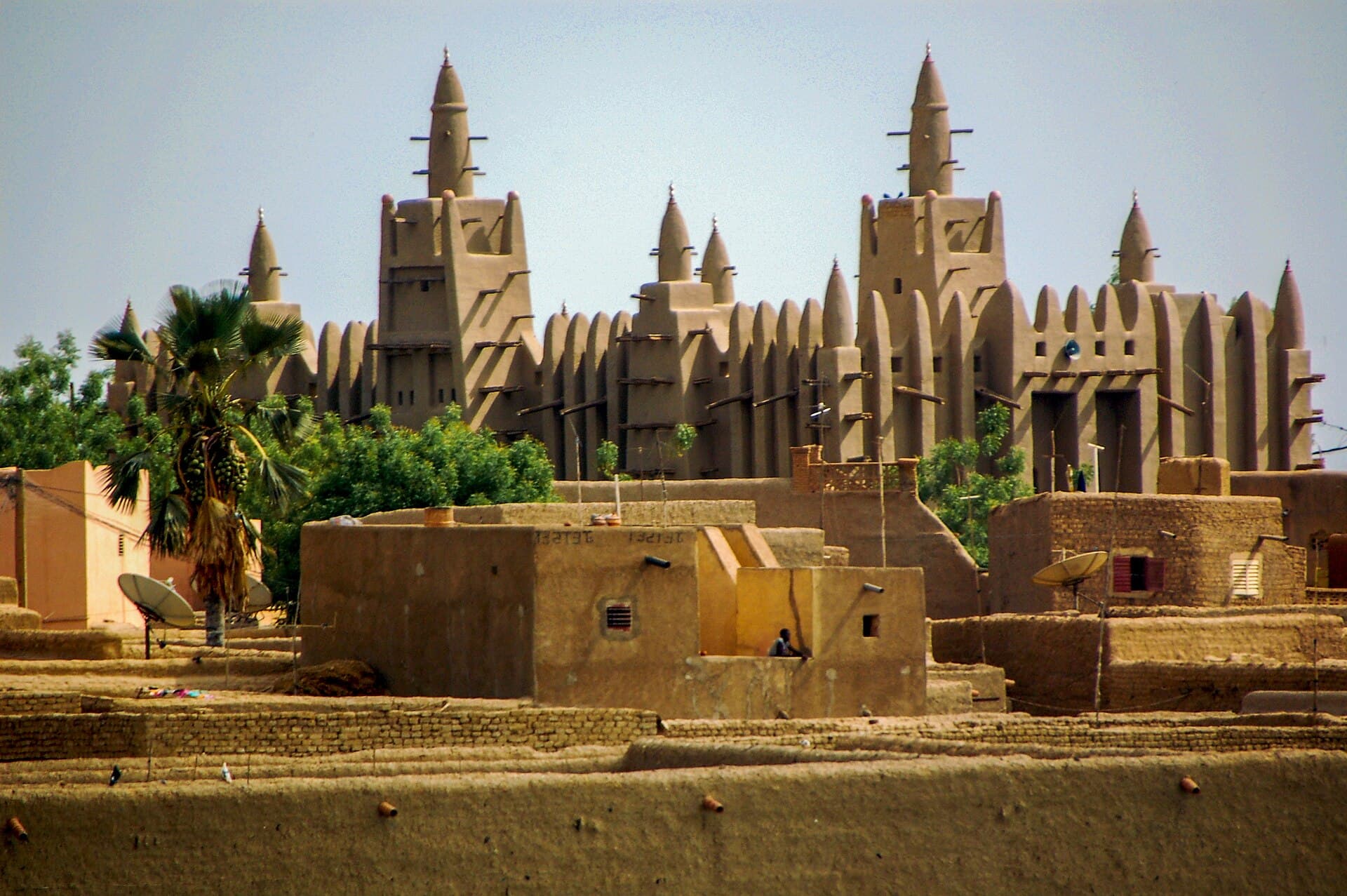
The Great Mosque of Djenné stands on a raised earthen platform above the market square of a town in the inland delta of the Niger, in central Mali. It is made of sun-dried mud: mud bricks, mud mortar, a smooth outer render, with bundles of palm timber pushed through the walls so that they bristle from the surface. It is the largest mud-brick building in the world, and the structure standing today was raised in 1906 and 1907 on the site of a much older mosque. Since 1988 it has sat inside the UNESCO World Heritage property "Old Towns of Djenné", which joins the surviving fabric of the town to four archaeological sites nearby.
The building is held up by a habit: once a year the town coats the whole exterior in fresh mud by hand, and the timbers projecting from the walls are the ladder they climb to do it.
Nobody knows when the first mosque was built at Djenné; suggested dates run from about 1200 to 1330. The earliest written account is the Tarikh al-Sudan, compiled by Abd al-Sadi in the mid-seventeenth century from oral tradition already centuries old: a ruler named Kunburu became a Muslim, pulled down his palace and gave the site over to a mosque, and his successors added the towers and the wall.
The record then goes quiet for two hundred years. When René Caillié reached Djenné in 1828 he found the mosque ruined and given over to nesting swallows, the townspeople praying in a courtyard outside to escape the smell. The Fulani ruler Seku Amadu, who had taken the town a decade earlier, let it decay further and put up a plain low replacement to the east between 1834 and 1836. By the time Félix Dubois arrived in the 1890s the ruin was in use as a cemetery, and the plan he published in 1897 was his own reconstruction. The earlier structure is understood at second hand: a late chronicle, a few European accounts of its collapse, and photographs of what was left.
In 1906 the town arranged for the old mosque to be rebuilt on its own footprint. The work was completed in 1907 under the mason Ismaila Traoré, head of Djenné's guild, using forced labour; UNESCO dates the reconstruction to 1906 and 1907. Photographs from the period suggest at least some outer walls follow the ruin beneath. The plainly new idea was the symmetrical row of three box-like towers in the east wall, now the most recognisable roofline in West Africa and the emblem on the coat of arms of Mali.
Dubois came back in 1910 and hated it, assuming the French administration had designed it and saying so in print, in language about hedgehogs and church organs that has followed the mosque ever since. Later scholarship went the other way: Jean-Louis Bourgeois argued that French involvement extended at most to some internal arches, that the guild built it by its own methods, and that the design is "basically African."
The walls are laid in sun-baked earth bricks called ferey, bedded in a mortar of sand and earth, then rendered with banco, a clay plaster that gives the building its poured, hand-modelled look. Set into the render, in level rows, are bundles of rodier palm sticks called toron, which project about 60 centimetres from the surface. They are ornament, they are structure, and above all they are permanent scaffolding.
The mosque sits on a platform roughly 75 metres square, lifted three metres above the marketplace, clear of the Bani in flood. The prayer wall faces east over the market, a metre thick and stiffened by eighteen buttresses, each capped with a cone finial topped by an ostrich egg; the central tower rises 16 metres. Inside, the roof is carried on nine pierced walls that resolve into a forest of ninety squat pillars; the courtyard to the west has galleries on three sides, the western one reserved for women. The manner is Sudano-Sahelian, the tradition that also produced the earthen mosques of Timbuktu far downriver.
 Bundles of rodier palm set into the wall: decoration, and the ladder the town climbs each year. Photograph by upyernoz, CC BY 2.0, via Wikimedia Commons.
Once a year, in the weeks before the rains, Djenné replasters the entire mosque by hand and finishes in a day. The crépissage is at once a maintenance operation and the largest festival in the town's calendar.
Preparation begins weeks ahead. Clay is brought in by truck and donkey cart, broken up, mixed with water and rice husks, and left to steep in pits and pools by the riverbank. The husks bind the render against cracking. The mud has to be stirred while it cures, a job that tends to fall to small boys who tread and play in it. In 2018 the batch soaked for twenty days.
On the morning, the masons' guild takes charge. UNESCO records the transmission of Djenné's building knowledge as the responsibility of the barey, the masons' corporation, passed from one generation to the next; the guild assigns the walls and judges the result. Young men climb the toron and palm-wood ladders with baskets of wet banco on their heads and smear it over the face of the building with their hands. Women and girls carry water up from the river, to the pits beforehand and to the men on the walls during. Each quarter of the town is given a stretch of mosque, and the day runs as a race: a first dash to deliver the opening load, then a contest between quarters to finish first, with a cash prize. Griots sing, and elders who have done it many times sit in a place of honour in the market square and watch.
Set beside almost every other building on this shelf, the mosque inverts the problem. There is very little original fabric here to conserve. The bricks are earth and the render is earth, and every wet season takes some of both away. What has been continuous since 1907 is the practice rather than the material: knowing how to mix banco, carry it, and lay it on a curved wall so that it sheds water, held by a guild, taught by apprenticeship, rehearsed in public once a year. The maintenance is the monument. If the town stopped for a few seasons there would be nothing left to restore, because the first thing lost would be the surface that was going to be replaced anyway, and then the wall behind it.
Three kilometres away lies Djenné-Djenno, "ancient Djenné," one of the four archaeological sites in the World Heritage listing along with Hambarkétolo, Kaniana and Tonomba. It is an occupation mound up to six metres deep, covering 33 hectares and ringed by sixty-nine smaller mounds, excavated by Roderick and Susan McIntosh from 1977 and again in 1981 and the 1990s.
What they found rewrote the chronology of West African urbanism. The site was settled around 250 BC and abandoned around AD 1400, and holds some of the earliest iron working and the earliest domesticated African rice found in the region. By about AD 800 it and its neighbours may have held ten to twenty-seven thousand people, behind a mud-brick wall 3.7 metres thick at the base and nearly two kilometres round, of the same cylindrical bricks Djenné masons still make. Until those excavations the standing assumption was that towns, long-distance trade and specialised crafts reached West Africa with Arab merchants in the seventh and eighth centuries. Djenné-Djenno was a city a thousand years earlier, and its power appears to have been spread among corporate groups on separate mounds, each with its own crafts, rather than concentrated in a ruling class.
By the 2000s the 1907 structure was in trouble: the annual coats of banco had added weight year on year, and the timber armature inside the walls was decaying. Restoration financed by the Aga Khan Trust for Culture began in January 2009, carried out with the town's masons, stripping away accumulated plaster to consolidate the structure beneath. In early November exceptional rain fell on Djenné, and on the fifth the upper part of the south tower of the east façade collapsed, sending several tonnes of mud onto the terrace and throwing four masons off the scaffolding, all of them lightly injured. The work carried on.
The objections were about method: the restoration stripped much of the mud from the surface and suspended the annual remudding while it went on, and masons said afterwards that the returned surfaces were too flat and sharply cut, the hand-modelled quality gone. One master mason put it as a matter of nationality: they had done it in a European way. There had been trouble before: on 20 January 2006 a team inspecting the roof under the same programme was seen hacking at it, and the town erupted, ransacking the Cultural Mission and the mayor's house. One man died.
That dispute is the argument of this page in reverse: a logic of arresting decay, applied to a building whose logic is renewal, pausing for several years the event through which renewal is taught.
Djenné lies in the Mopti region of central Mali, which since the mid-2010s has been among the most dangerous parts of the country. The conflict that began in the north in 2012 moved south into the delta, and jihadist groups, principally the Macina katiba under JNIM, are active in the countryside around the town. On 13 July 2016, at its session in Istanbul, the World Heritage Committee added Old Towns of Djenné to the List of World Heritage in Danger, citing insecurity that was blocking measures against decaying building materials, uncontrolled urbanisation and erosion at the archaeological sites. It has stayed there since.
Tourism, which helped pay for the upkeep of Djenné's traditional houses, has all but vanished, and attacks have come close: in March 2018 armed men on motorbikes destroyed a nearly finished dam site outside the town. That year the town council discussed calling off the crépissage and went ahead anyway, reasoning that postponing would look like a concession. It was nearly cancelled again in 2022, ran in March 2023, and in May 2024 thousands replastered it once more, the head of Djenné's cultural mission saying the work had to continue whatever the cost.
A stone ruin can survive neglect for a century and still be worth conserving. A building that depends on several thousand people assembling on one morning is only ever as safe as the gathering.
Bundles of rodier palm set into the wall: decoration, and the ladder the town climbs each year. Photograph by upyernoz, CC BY 2.0, via Wikimedia Commons.
Once a year, in the weeks before the rains, Djenné replasters the entire mosque by hand and finishes in a day. The crépissage is at once a maintenance operation and the largest festival in the town's calendar.
Preparation begins weeks ahead. Clay is brought in by truck and donkey cart, broken up, mixed with water and rice husks, and left to steep in pits and pools by the riverbank. The husks bind the render against cracking. The mud has to be stirred while it cures, a job that tends to fall to small boys who tread and play in it. In 2018 the batch soaked for twenty days.
On the morning, the masons' guild takes charge. UNESCO records the transmission of Djenné's building knowledge as the responsibility of the barey, the masons' corporation, passed from one generation to the next; the guild assigns the walls and judges the result. Young men climb the toron and palm-wood ladders with baskets of wet banco on their heads and smear it over the face of the building with their hands. Women and girls carry water up from the river, to the pits beforehand and to the men on the walls during. Each quarter of the town is given a stretch of mosque, and the day runs as a race: a first dash to deliver the opening load, then a contest between quarters to finish first, with a cash prize. Griots sing, and elders who have done it many times sit in a place of honour in the market square and watch.
Set beside almost every other building on this shelf, the mosque inverts the problem. There is very little original fabric here to conserve. The bricks are earth and the render is earth, and every wet season takes some of both away. What has been continuous since 1907 is the practice rather than the material: knowing how to mix banco, carry it, and lay it on a curved wall so that it sheds water, held by a guild, taught by apprenticeship, rehearsed in public once a year. The maintenance is the monument. If the town stopped for a few seasons there would be nothing left to restore, because the first thing lost would be the surface that was going to be replaced anyway, and then the wall behind it.
Three kilometres away lies Djenné-Djenno, "ancient Djenné," one of the four archaeological sites in the World Heritage listing along with Hambarkétolo, Kaniana and Tonomba. It is an occupation mound up to six metres deep, covering 33 hectares and ringed by sixty-nine smaller mounds, excavated by Roderick and Susan McIntosh from 1977 and again in 1981 and the 1990s.
What they found rewrote the chronology of West African urbanism. The site was settled around 250 BC and abandoned around AD 1400, and holds some of the earliest iron working and the earliest domesticated African rice found in the region. By about AD 800 it and its neighbours may have held ten to twenty-seven thousand people, behind a mud-brick wall 3.7 metres thick at the base and nearly two kilometres round, of the same cylindrical bricks Djenné masons still make. Until those excavations the standing assumption was that towns, long-distance trade and specialised crafts reached West Africa with Arab merchants in the seventh and eighth centuries. Djenné-Djenno was a city a thousand years earlier, and its power appears to have been spread among corporate groups on separate mounds, each with its own crafts, rather than concentrated in a ruling class.
By the 2000s the 1907 structure was in trouble: the annual coats of banco had added weight year on year, and the timber armature inside the walls was decaying. Restoration financed by the Aga Khan Trust for Culture began in January 2009, carried out with the town's masons, stripping away accumulated plaster to consolidate the structure beneath. In early November exceptional rain fell on Djenné, and on the fifth the upper part of the south tower of the east façade collapsed, sending several tonnes of mud onto the terrace and throwing four masons off the scaffolding, all of them lightly injured. The work carried on.
The objections were about method: the restoration stripped much of the mud from the surface and suspended the annual remudding while it went on, and masons said afterwards that the returned surfaces were too flat and sharply cut, the hand-modelled quality gone. One master mason put it as a matter of nationality: they had done it in a European way. There had been trouble before: on 20 January 2006 a team inspecting the roof under the same programme was seen hacking at it, and the town erupted, ransacking the Cultural Mission and the mayor's house. One man died.
That dispute is the argument of this page in reverse: a logic of arresting decay, applied to a building whose logic is renewal, pausing for several years the event through which renewal is taught.
Djenné lies in the Mopti region of central Mali, which since the mid-2010s has been among the most dangerous parts of the country. The conflict that began in the north in 2012 moved south into the delta, and jihadist groups, principally the Macina katiba under JNIM, are active in the countryside around the town. On 13 July 2016, at its session in Istanbul, the World Heritage Committee added Old Towns of Djenné to the List of World Heritage in Danger, citing insecurity that was blocking measures against decaying building materials, uncontrolled urbanisation and erosion at the archaeological sites. It has stayed there since.
Tourism, which helped pay for the upkeep of Djenné's traditional houses, has all but vanished, and attacks have come close: in March 2018 armed men on motorbikes destroyed a nearly finished dam site outside the town. That year the town council discussed calling off the crépissage and went ahead anyway, reasoning that postponing would look like a concession. It was nearly cancelled again in 2022, ran in March 2023, and in May 2024 thousands replastered it once more, the head of Djenné's cultural mission saying the work had to continue whatever the cost.
A stone ruin can survive neglect for a century and still be worth conserving. A building that depends on several thousand people assembling on one morning is only ever as safe as the gathering.
The mosque before this mosque
Ismaila Traoré and the rebuilding of 1907
Ferey, banco and the toron
The crépissage
Djenné-Djenno and the city before the city
The 2009 restoration and what the masons said
The Mopti region and the years of insecurity
References and resources
- UNESCO World Heritage Centre: Old Towns of Djenné, property no. 116, inscribed 1988, criteria (iii) and (iv), on the List of World Heritage in Danger since 2016.
- UNESCO World Heritage Centre: Restoration works continue despite violent storms at the Great Mosque of Djenné, 15 December 2009.
- UNESCO World Heritage Centre: Mali's Old Towns of Djenné on List of World Heritage in Danger, 13 July 2016.
- Wikipedia: Great Mosque of Djenné and Djenné-Djenno.
- Smithsonian Magazine: How the City of Mud Stays Standing, Meet the Masons of Djenné, Mali, Vicky Gan, 2013.
- Roads and Kingdoms: Militants threatened this town's tradition of repairing its iconic mosque, 2018.
- Africanews: Mali residents re-plaster the Great Mosque of Djenné to save heritage site, 13 May 2024.