Heritage · Landmark
Mount Fuji: Japan's sacred summit
A near-perfect volcanic cone rising alone above central Japan, worshipped for more than a thousand years and painted into the world's memory by Hokusai. Mount Fuji is at once a living volcano, a Shinto sanctuary and the country's clearest emblem of itself.Written to last.
By Confinity Heritage Editorial · Updated 2026-07-31 · 7-minute readQuiet tools, kept out of the way.
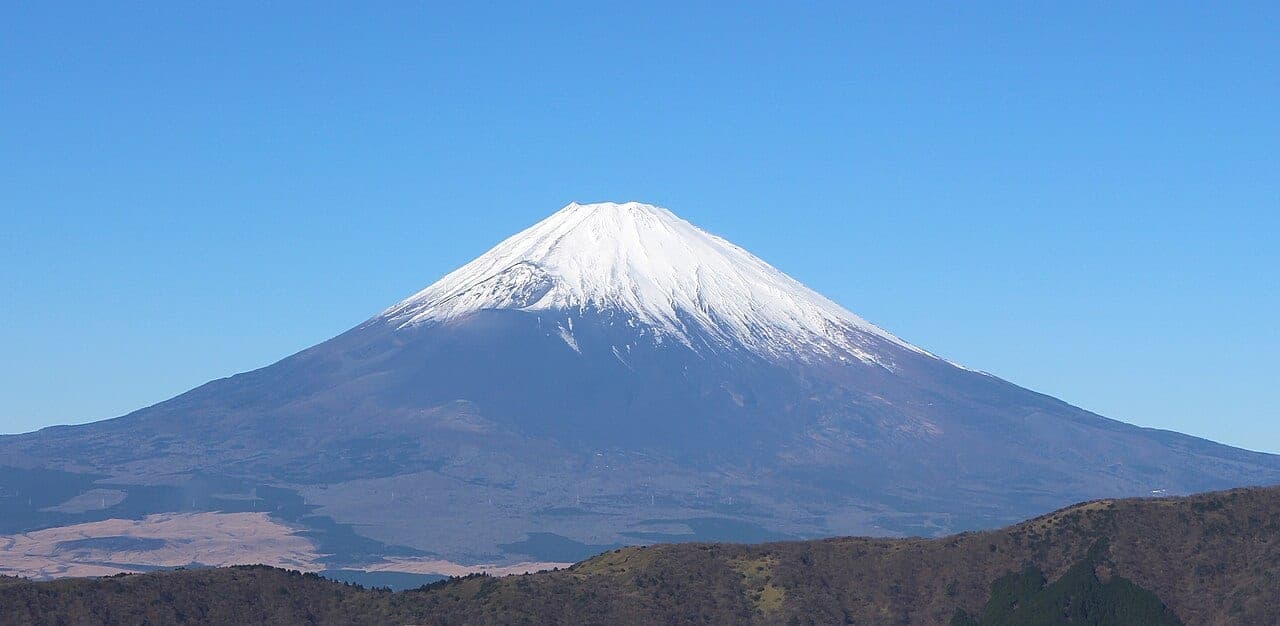
Mount Fuji rises alone. Where most great mountains crowd together in ranges, Fuji stands by itself above the plains of central Honshu, a near-perfect cone of dark rock and pale snow that can be seen on clear days from Tokyo, roughly 100 kilometres to the northeast. At 3,776 metres it is the highest point in Japan, straddling the border between Shizuoka and Yamanashi prefectures (Wikipedia). Its symmetry is so complete that for centuries it has served as the country's shorthand for itself: a single silhouette that means Japan.
Yet Fuji is far more than a shape on the horizon. It is an active volcano that last erupted in 1707, a sacred mountain climbed by pilgrims for more than a thousand years, and the most painted and photographed landform in Japanese art. When UNESCO added it to the World Heritage list in 2013, it did so not as a piece of nature but as a cultural site, honouring the mountain as both an object of worship and a source of artistic inspiration (UNESCO). Few places gather so much geology, faith and imagination into one form.
Fuji is geologically young and still alive. It is a stratovolcano, built layer upon layer from hardened lava, ash and rock, and it sits at a rare meeting point where three of the planet's tectonic plates converge, which helps explain both its height and its restlessness (National Geographic). The graceful cone visitors see today is only the most recent of several volcanoes stacked at the same spot. Beneath it lie the older masses geologists call Komitake and Old Fuji, and the smooth outer shell known as New Fuji began to form only around 10,000 years ago (Wikipedia). By the measure of the earth, the mountain is very new work.
The summit is crowned by a crater roughly 780 metres across and 240 metres deep, its rim broken into eight peaks that pilgrims once circled in a ritual walk (Wikipedia). Fuji's eruptions have reshaped the land around it more than once. A long outpouring of lava in 864–866 divided an older lake into the smaller waters now known as Motosu, Shoji and Saiko, part of the Fuji Five Lakes that ring the northern foot. The last eruption, the Hoei event, began on 16 December 1707 and continued into early 1708 (Wikipedia). It was a violent, explosive eruption that opened not at the summit but on the southeastern flank, raising the secondary crater of Hoeizan and dusting the streets of Edo, today's Tokyo, with ash a hundred kilometres away (National Geographic). Fuji has been quiet ever since, but it is classed as dormant rather than extinct, and its slopes are watched closely for any sign of return.
Long before anyone climbed it, Fuji was feared and revered as a home of fire. Early worshippers built shrines at its foot to calm the deity believed to send its eruptions, and over time that deity settled into the figure of Konohanasakuya-hime, the blossom princess of Shinto myth, enshrined as the guardian spirit of the mountain (Wikipedia). More than a thousand Sengen shrines dedicated to her stand across Japan. Two anchor the mountain itself: Fujisan Hongu Sengen Taisha at Fujinomiya on the southern side, and Kitaguchi Hongu Fuji Sengen near Fujiyoshida to the north, where the historic climbing path begins.
As the volcano quieted, worship shifted from watching the mountain to walking it. Ascetics of Shugendo, a mountain faith blending Shinto and Buddhism, treated the climb as spiritual training, and tradition credits the legendary holy man En no Gyoja with an early ascent in the seventh century (Wikipedia). By the Edo period this had grown into a popular devotion. Confraternities called Fujiko sent ordinary townspeople up the mountain, guided and housed by innkeeper-priests known as oshi, and those who could not make the journey built miniature Fuji mounds, or fujizuka, in their own neighbourhoods to climb in small. For most of this history the summit was forbidden to women, and the ban was not lifted until 1872 (Wikipedia). Pilgrims often purified themselves first at the Oshino Hakkai, eight clear ponds fed by snowmelt filtered slowly through the mountain's porous lava, which remain part of the World Heritage site today.
Fuji entered Japanese art almost as early as it entered Japanese faith. The Man'yoshu, the country's oldest surviving poetry anthology, praises the peak in verses attributed to the eighth-century poet Yamabe no Akahito, who described it soaring divine and lofty above the province of Suruga. The mountain also threads through the old tale of the bamboo cutter, in which an emperor's servants carry an elixir of immortality to the highest summit in the land.
 Seen from Lake Kawaguchi, one of the five lakes on the northern side, and one of the views Hokusai worked from. Photograph by Alpsdake, CC BY-SA 4.0, via Wikimedia Commons.
Its most far-reaching moment in art came much later. Between about 1830 and 1832 the printmaker Katsushika Hokusai produced Thirty-six Views of Mount Fuji, a series of landscapes in which the mountain appears from every distance and mood (Wikipedia). One of them, Under the Wave off Kanagawa, better known as the Great Wave, became perhaps the single most recognised image in all of Japanese art, its curling breaker framing a small, calm Fuji far behind (The Met). Hiroshige and countless others followed. Through these images the mountain became a national emblem, a role it still fills on everything from banknotes to the badges of local clubs.
For most of the year Fuji belongs to the snow and is left to climbers with serious mountaineering skill. The official climbing season is short, running roughly from early July to early September, when the upper slopes are clear and the mountain huts are open (Japan Guide). In those weeks hundreds of thousands of people make the ascent, many of them ordinary travellers rather than seasoned hikers.
Four routes lead to the top, each starting from a road-served waypoint known as a fifth station. The Yoshida Trail on the north side is the busiest and best equipped, lined with huts where climbers rest and eat. The Subashiri and Gotemba trails on the east are quieter and longer, Gotemba the most demanding of all, while the Fujinomiya Trail from the south is the shortest and steepest. Many climbers time their ascent to reach the rim before dawn for the goraiko, the sunrise seen from the summit, and some then walk the full circuit of the crater, a loop called the Ohachi-meguri that traces the ancient pilgrims' path around the eight peaks. The huts, booked out months ahead in peak season, let walkers break the climb overnight and adjust to the thin air above 3,000 metres.
Fuji's World Heritage status recognises exactly this long marriage of mountain and meaning. In June 2013 UNESCO inscribed it as Fujisan, sacred place and source of artistic inspiration, a cultural property gathering twenty-five component sites across more than 20,000 hectares, among them the summit, the Sengen shrines, the Oshino Hakkai springs and the surrounding lakes (UNESCO). Notably, it was listed as a cultural rather than a natural site: earlier attempts had faltered partly over litter and roadside development on the slopes, and it was the mountain's hold on the human imagination that carried the case.
Success brought its own problem. Crowds on the Yoshida Trail swelled to the point of danger, with queues on narrow ridges and a wave of poorly prepared visitors attempting to climb through the night without rest. In response the authorities introduced controls, and by the 2025 season all four trails required climbers to pay an entry fee of 4,000 yen, book online in advance and pass through a gate that closes overnight to discourage exhausting single-night dashes to the top (Time). A daily limit caps the number allowed onto the Yoshida route. The measures try to hold a difficult balance: keeping the mountain open to the many while protecting both the climbers and the fragile place they come to see.
What endures through all of this is the mountain's quiet authority over the country that lives in its sight. Commuters glance up from a Tokyo platform on a clear winter morning and find Fuji floating white on the horizon; travellers on the bullet train press to the window for the few seconds it fills the frame. The pilgrim's climb and the tourist's climb turn out to be the same walk up the same slope, and both carry something of the old sense that to stand on the summit is to stand at the meeting of earth and sky.
For an archive of memory, Fuji is a rare kind of subject: a single place that has held the attention of a whole culture for well over a thousand years and gathered around itself the poems, prayers, prints and footsteps of countless people who will never be named. Each of them saw more or less the same shape that rises today. The mountain outlasts them, and in outlasting them it keeps them, carrying forward the worship and the wonder of everyone who has ever looked up and measured their own small life against its unmoved summit.
Seen from Lake Kawaguchi, one of the five lakes on the northern side, and one of the views Hokusai worked from. Photograph by Alpsdake, CC BY-SA 4.0, via Wikimedia Commons.
Its most far-reaching moment in art came much later. Between about 1830 and 1832 the printmaker Katsushika Hokusai produced Thirty-six Views of Mount Fuji, a series of landscapes in which the mountain appears from every distance and mood (Wikipedia). One of them, Under the Wave off Kanagawa, better known as the Great Wave, became perhaps the single most recognised image in all of Japanese art, its curling breaker framing a small, calm Fuji far behind (The Met). Hiroshige and countless others followed. Through these images the mountain became a national emblem, a role it still fills on everything from banknotes to the badges of local clubs.
For most of the year Fuji belongs to the snow and is left to climbers with serious mountaineering skill. The official climbing season is short, running roughly from early July to early September, when the upper slopes are clear and the mountain huts are open (Japan Guide). In those weeks hundreds of thousands of people make the ascent, many of them ordinary travellers rather than seasoned hikers.
Four routes lead to the top, each starting from a road-served waypoint known as a fifth station. The Yoshida Trail on the north side is the busiest and best equipped, lined with huts where climbers rest and eat. The Subashiri and Gotemba trails on the east are quieter and longer, Gotemba the most demanding of all, while the Fujinomiya Trail from the south is the shortest and steepest. Many climbers time their ascent to reach the rim before dawn for the goraiko, the sunrise seen from the summit, and some then walk the full circuit of the crater, a loop called the Ohachi-meguri that traces the ancient pilgrims' path around the eight peaks. The huts, booked out months ahead in peak season, let walkers break the climb overnight and adjust to the thin air above 3,000 metres.
Fuji's World Heritage status recognises exactly this long marriage of mountain and meaning. In June 2013 UNESCO inscribed it as Fujisan, sacred place and source of artistic inspiration, a cultural property gathering twenty-five component sites across more than 20,000 hectares, among them the summit, the Sengen shrines, the Oshino Hakkai springs and the surrounding lakes (UNESCO). Notably, it was listed as a cultural rather than a natural site: earlier attempts had faltered partly over litter and roadside development on the slopes, and it was the mountain's hold on the human imagination that carried the case.
Success brought its own problem. Crowds on the Yoshida Trail swelled to the point of danger, with queues on narrow ridges and a wave of poorly prepared visitors attempting to climb through the night without rest. In response the authorities introduced controls, and by the 2025 season all four trails required climbers to pay an entry fee of 4,000 yen, book online in advance and pass through a gate that closes overnight to discourage exhausting single-night dashes to the top (Time). A daily limit caps the number allowed onto the Yoshida route. The measures try to hold a difficult balance: keeping the mountain open to the many while protecting both the climbers and the fragile place they come to see.
What endures through all of this is the mountain's quiet authority over the country that lives in its sight. Commuters glance up from a Tokyo platform on a clear winter morning and find Fuji floating white on the horizon; travellers on the bullet train press to the window for the few seconds it fills the frame. The pilgrim's climb and the tourist's climb turn out to be the same walk up the same slope, and both carry something of the old sense that to stand on the summit is to stand at the meeting of earth and sky.
For an archive of memory, Fuji is a rare kind of subject: a single place that has held the attention of a whole culture for well over a thousand years and gathered around itself the poems, prayers, prints and footsteps of countless people who will never be named. Each of them saw more or less the same shape that rises today. The mountain outlasts them, and in outlasting them it keeps them, carrying forward the worship and the wonder of everyone who has ever looked up and measured their own small life against its unmoved summit.
A young mountain still warm at its core
The god in the mountain
The most painted mountain in the world
The season of the open trail
A cultural site under strain
A mountain held in common
References and resources
- UNESCO World Heritage Centre: Fujisan, sacred place and source of artistic inspiration. https://whc.unesco.org/en/list/1418/
- Japan National Tourism Organization: Fujisan World Heritage. https://www.japan.travel/en/world-heritage/fujisan-sacred-place-and-source-of-artistic-inspiration/
- Wikipedia: Mount Fuji. https://en.wikipedia.org/wiki/Mount_Fuji
- Wikipedia: Hoei eruption. https://en.wikipedia.org/wiki/H%C5%8Dei_eruption
- National Geographic Education: Most Recent Eruption of Mount Fuji. https://education.nationalgeographic.org/resource/last-eruption-mount-fuji/
- Wikipedia: Thirty-six Views of Mount Fuji. https://en.wikipedia.org/wiki/Thirty-six_Views_of_Mount_Fuji
- The Metropolitan Museum of Art: Under the Wave off Kanagawa, the Great Wave. https://www.metmuseum.org/art/collection/search/45434
- Wikipedia: Konohanasakuya-hime. https://en.wikipedia.org/wiki/Konohanasakuya-hime
- Japan Guide: Climbing Mount Fuji. https://www.japan-guide.com/e/e6901.html
- Time: Japan's Mount Fuji Introduces Paid Reservations for Climbers. https://time.com/6978250/mount-fuji-yoshida-trail-reservation-fee-overtourism/