Heritage · Landmark
Mount Rushmore: History, Meaning & Contested Legacy
A granite sculpture of four US presidents carved into the Black Hills of South Dakota between 1927 and 1941. The same mountain is sacred to the Lakota Sioux, who call it the Six Grandfathers and still seek the return of the land it sits on.Written to last.
By Confinity Heritage Editorial · Updated 2026-07-31 · 7-minute readQuiet tools, kept out of the way.
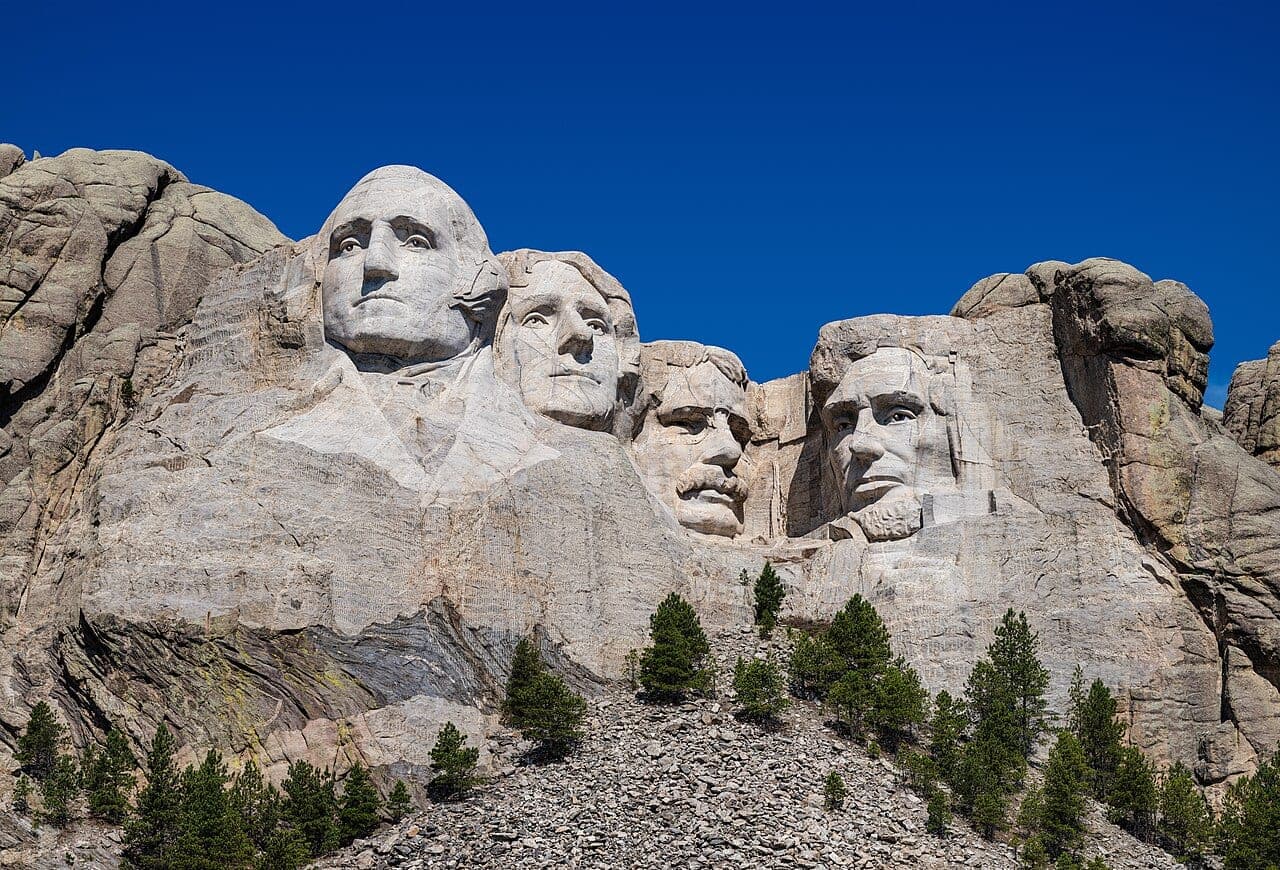
Mount Rushmore National Memorial is a granite sculpture in the Black Hills of South Dakota, showing the heads of four United States presidents: George Washington, Thomas Jefferson, Theodore Roosevelt, and Abraham Lincoln. Each face is about 60 feet tall. The work was carved between 1927 and 1941 under the direction of the sculptor Gutzon Borglum and completed by his son Lincoln Borglum after Gutzon's death in March 1941. The National Park Service, which administers the site, describes the four figures as chosen to represent the founding, growth, development, and preservation of the nation.
The memorial also sits on ground with a much older meaning. The Black Hills, known in Lakota as Pahá Sápa and He Sápa, are sacred to the Lakota Sioux and other Plains nations, and the mountain the sculpture occupies was called the Six Grandfathers, Tȟuŋkášila Šákpe, after the six sacred directions of Lakota belief. The Black Hills were guaranteed to the Sioux by the 1868 Treaty of Fort Laramie and then taken by the United States after gold was found there in 1874. An honest account of Mount Rushmore has to hold both histories at once: the memorial's intended tribute to national leaders, and the claim of the people for whom the mountain was holy long before it carried any president's face.
The Black Hills rise from the northern Great Plains as an isolated, forested range. For the Lakota, who reached the region in the eighteenth century, the hills were a place of prayer, hunting, and burial. The 1868 Treaty of Fort Laramie set aside the Great Sioux Reservation, including the Black Hills, for the "absolute and undisturbed use and occupation" of the Sioux. That guarantee held for only a few years. In 1874 an Army expedition led by Lieutenant Colonel George Armstrong Custer confirmed gold in the hills, and prospectors poured in. Rather than remove the trespassers, the federal government pressed the Sioux to sell; when they refused, Congress passed an 1877 act that seized the Black Hills, breaking the treaty.
The idea for a monumental carving came half a century later, from Doane Robinson, South Dakota's state historian, who in 1923 proposed cutting figures into the granite spires known as the Needles to draw tourists. Robinson first imagined regional heroes of the West, among them Lewis and Clark, the Oglala leader Red Cloud, Sacagawea, and Crazy Horse. He wrote to Gutzon Borglum, then at work on a Confederate memorial at Stone Mountain in Georgia, who agreed to take part but argued for subjects and a site of national scale.
Borglum judged the Needles too thin to hold a sculpture and chose Mount Rushmore instead, a broad granite face named for Charles Rushmore, a New York lawyer who had visited the area in the 1880s. Its coarse-grained stone caught good light and gave him room to work. Congress authorized the memorial in 1925, and carving began on 4 October 1927. Work continued, with frequent halts for weather and money, until 31 October 1941.
Funding was a constant problem. President Calvin Coolidge, vacationing in the Black Hills, endorsed the project, and the Mount Rushmore National Memorial Act of 1929 authorized federal matching funds. The final cost came to about $989,992, most of it federal money. Roughly 400 workers, many of them miners, drilled and blasted the rock; despite the danger, no one died during construction. Borglum also planned a Hall of Records, a vault to be cut into the canyon wall behind the heads to hold the nation's founding documents and an account of the carving. Work on the tunnel stopped in 1939 with only the entrance chamber roughed out, and the hall was never finished. In 1998 the Park Service placed a repository of records in a time capsule at its entrance.
Each of the four heads is about 60 feet (18 m) tall, proportioned to figures that would rise several hundred feet if carved in full. The faces were shaped first by drilling and controlled dynamite blasting, which removed most of the rough stone, then by a "honeycombing" method in which closely spaced holes let workers take off thin layers by hand, and finished with pneumatic tools that smoothed the surface. About 450,000 tons of rock were removed in all.
 Each head is about 18 metres from chin to crown. Around ninety per cent of the rock was removed with dynamite, and the finishing was done by hand. Photograph by Dean Franklin, CC BY 2.0, via Wikimedia Commons.
Borglum selected the four presidents to mark what he saw as key phases of the country's first 150 years. Washington represents the nation's founding; Jefferson its territorial growth, having overseen the Louisiana Purchase; Lincoln the preservation of the union through the Civil War and the ending of slavery; and Theodore Roosevelt its emergence as a modern industrial power and the building of the Panama Canal. Roosevelt was the most debated choice at the time. He had been a friend of Borglum, and his recent death led some to object that he did not yet belong beside the others. The arrangement of the heads also shifted during the work as the sculptors tested the stone and found which sections were sound.
The mountain is part of a large granite body in the Black Hills, sometimes called the Black Elk Peak granite after the range's highest point. Borglum valued the rock for being hard, close-grained, and slow to wear away; it erodes at roughly one inch every 10,000 years, which is why the faces have needed no recarving. The same durability made the carving slow and costly, since the granite resisted the tools as much as it resisted the weather.
For the Lakota, Mount Rushmore was carved on land the United States had taken in violation of a treaty, on a mountain they held sacred. The name Six Grandfathers comes from a vision of the Oglala holy man Black Elk, who described the six sacred directions of the world as grandfathers; the peak was renamed for Charles Rushmore only late in the nineteenth century. To many Lakota the sculpture reads less as a tribute than as a claim staked on stolen and holy ground, cut with the faces of leaders who presided over the loss of Native land.
The legal dispute over the Black Hills reached the Supreme Court in 1980. In United States v. Sioux Nation of Indians, decided on 30 June 1980 by a vote of 8 to 1 with Justice Rehnquist the sole dissenter, the Court held that the 1877 taking of the Black Hills had been an unlawful appropriation of property that required just compensation. The award set the 1877 value of the land at about $17.1 million and added roughly a century of interest, bringing the total to around $105 million. The Sioux declined to take the money, on the ground that accepting payment would extinguish their claim to the land itself, which they continue to seek to have returned. The award has remained in a federal account, where compound interest has since grown it past $1 billion, still unclaimed.
The memorial's principal sculptor carried a contested record of his own. Before Mount Rushmore, Borglum led the Confederate memorial at Stone Mountain, Georgia, a project backed and partly funded by the Ku Klux Klan during its 1920s revival. Borglum worked closely with Klan figures and sat on some of the organization's committees, and he held nativist and antisemitic views; historians differ on whether he ever held formal membership. He left Stone Mountain after a dispute in 1925, destroying his working models, and moved on to South Dakota.
About 17 miles away, a separate carving offers a direct response. In 1948 the Oglala Lakota chief Henry Standing Bear invited the sculptor Korczak Ziolkowski, who had briefly worked at Mount Rushmore, to carve a memorial to the Lakota leader Crazy Horse on Thunderhead Mountain. Standing Bear is often quoted as wanting to show that the Native peoples had great heroes too. The Crazy Horse Memorial, still unfinished and funded privately after its founders refused federal money, is planned to be far larger than the presidential heads, with the face already emerged from the rock.
The National Park Service is responsible for keeping the sculpture stable. The granite is durable, but thin cracks open along natural seams in the rock, and for decades crews sealed them with a mix of linseed oil and granite dust. Since the late 1990s the memorial has used a silicone-based sealant, and a network of small sensors tracks the cracks for movement across the seasons. In 2005 a specialist team cleaned the faces with pressurized water to remove lichen and grime. The monument has also been recorded in fine detail: a 2010 laser-scanning survey, carried out with Scottish and American partners, captured the entire sculpture in three dimensions as a reference against future damage or loss.
Mount Rushmore lies near Keystone, South Dakota, about 25 miles southwest of Rapid City, and is open year round. There is no entrance fee, though the Park Service charges for parking. From the entrance, the Avenue of Flags leads to the Grand View Terrace, where the four heads face the visitor directly, and to the museum in the Lincoln Borglum Visitor Center. The half-mile Presidential Trail brings people closer to the base of the cliff, and the sculptor's studio displays Borglum's tools and scale models. On summer evenings a lighting ceremony illuminates the faces. The memorial draws around two million visitors a year. The surrounding Black Hills hold other sites worth the trip, including Custer State Park, Wind Cave National Park, and the Crazy Horse Memorial.
Each head is about 18 metres from chin to crown. Around ninety per cent of the rock was removed with dynamite, and the finishing was done by hand. Photograph by Dean Franklin, CC BY 2.0, via Wikimedia Commons.
Borglum selected the four presidents to mark what he saw as key phases of the country's first 150 years. Washington represents the nation's founding; Jefferson its territorial growth, having overseen the Louisiana Purchase; Lincoln the preservation of the union through the Civil War and the ending of slavery; and Theodore Roosevelt its emergence as a modern industrial power and the building of the Panama Canal. Roosevelt was the most debated choice at the time. He had been a friend of Borglum, and his recent death led some to object that he did not yet belong beside the others. The arrangement of the heads also shifted during the work as the sculptors tested the stone and found which sections were sound.
The mountain is part of a large granite body in the Black Hills, sometimes called the Black Elk Peak granite after the range's highest point. Borglum valued the rock for being hard, close-grained, and slow to wear away; it erodes at roughly one inch every 10,000 years, which is why the faces have needed no recarving. The same durability made the carving slow and costly, since the granite resisted the tools as much as it resisted the weather.
For the Lakota, Mount Rushmore was carved on land the United States had taken in violation of a treaty, on a mountain they held sacred. The name Six Grandfathers comes from a vision of the Oglala holy man Black Elk, who described the six sacred directions of the world as grandfathers; the peak was renamed for Charles Rushmore only late in the nineteenth century. To many Lakota the sculpture reads less as a tribute than as a claim staked on stolen and holy ground, cut with the faces of leaders who presided over the loss of Native land.
The legal dispute over the Black Hills reached the Supreme Court in 1980. In United States v. Sioux Nation of Indians, decided on 30 June 1980 by a vote of 8 to 1 with Justice Rehnquist the sole dissenter, the Court held that the 1877 taking of the Black Hills had been an unlawful appropriation of property that required just compensation. The award set the 1877 value of the land at about $17.1 million and added roughly a century of interest, bringing the total to around $105 million. The Sioux declined to take the money, on the ground that accepting payment would extinguish their claim to the land itself, which they continue to seek to have returned. The award has remained in a federal account, where compound interest has since grown it past $1 billion, still unclaimed.
The memorial's principal sculptor carried a contested record of his own. Before Mount Rushmore, Borglum led the Confederate memorial at Stone Mountain, Georgia, a project backed and partly funded by the Ku Klux Klan during its 1920s revival. Borglum worked closely with Klan figures and sat on some of the organization's committees, and he held nativist and antisemitic views; historians differ on whether he ever held formal membership. He left Stone Mountain after a dispute in 1925, destroying his working models, and moved on to South Dakota.
About 17 miles away, a separate carving offers a direct response. In 1948 the Oglala Lakota chief Henry Standing Bear invited the sculptor Korczak Ziolkowski, who had briefly worked at Mount Rushmore, to carve a memorial to the Lakota leader Crazy Horse on Thunderhead Mountain. Standing Bear is often quoted as wanting to show that the Native peoples had great heroes too. The Crazy Horse Memorial, still unfinished and funded privately after its founders refused federal money, is planned to be far larger than the presidential heads, with the face already emerged from the rock.
The National Park Service is responsible for keeping the sculpture stable. The granite is durable, but thin cracks open along natural seams in the rock, and for decades crews sealed them with a mix of linseed oil and granite dust. Since the late 1990s the memorial has used a silicone-based sealant, and a network of small sensors tracks the cracks for movement across the seasons. In 2005 a specialist team cleaned the faces with pressurized water to remove lichen and grime. The monument has also been recorded in fine detail: a 2010 laser-scanning survey, carried out with Scottish and American partners, captured the entire sculpture in three dimensions as a reference against future damage or loss.
Mount Rushmore lies near Keystone, South Dakota, about 25 miles southwest of Rapid City, and is open year round. There is no entrance fee, though the Park Service charges for parking. From the entrance, the Avenue of Flags leads to the Grand View Terrace, where the four heads face the visitor directly, and to the museum in the Lincoln Borglum Visitor Center. The half-mile Presidential Trail brings people closer to the base of the cliff, and the sculptor's studio displays Borglum's tools and scale models. On summer evenings a lighting ceremony illuminates the faces. The memorial draws around two million visitors a year. The surrounding Black Hills hold other sites worth the trip, including Custer State Park, Wind Cave National Park, and the Crazy Horse Memorial.
History
The sculpture and the mountain
Contested legacy
Preservation
Visiting
References and resources
- US National Park Service: Mount Rushmore history and culture: official account of the carving, the four figures, and the site's meaning.
- Encyclopaedia Britannica: Mount Rushmore National Memorial: overview of Doane Robinson's idea, Borglum, and the construction.
- United States v. Sioux Nation of Indians, 448 U.S. 371 (1980): the Supreme Court ruling on the taking of the Black Hills and the compensation award.
- Crazy Horse Memorial (official site): the response carving begun in 1948 at the request of Chief Henry Standing Bear.
- Wikipedia: Mount Rushmore: consolidated history, dimensions, funding, and the Six Grandfathers name.
- Wikipedia: Treaty of Fort Laramie (1868): the treaty that guaranteed the Black Hills to the Sioux.