Heritage · Landmark
Ani: the ruined Armenian capital on a closed border
A walled city stands empty on a plateau in eastern Turkey, its cathedral roofless, its churches counted in the dozens where legend counted a thousand and one. The gorge below it carries an international border that has been shut since 1993, and the city can be seen from the far bank by people who cannot reach it.Written to last.
By Confinity Heritage Editorial · 2026-08-25 · 7-minute readQuiet tools, kept out of the way.
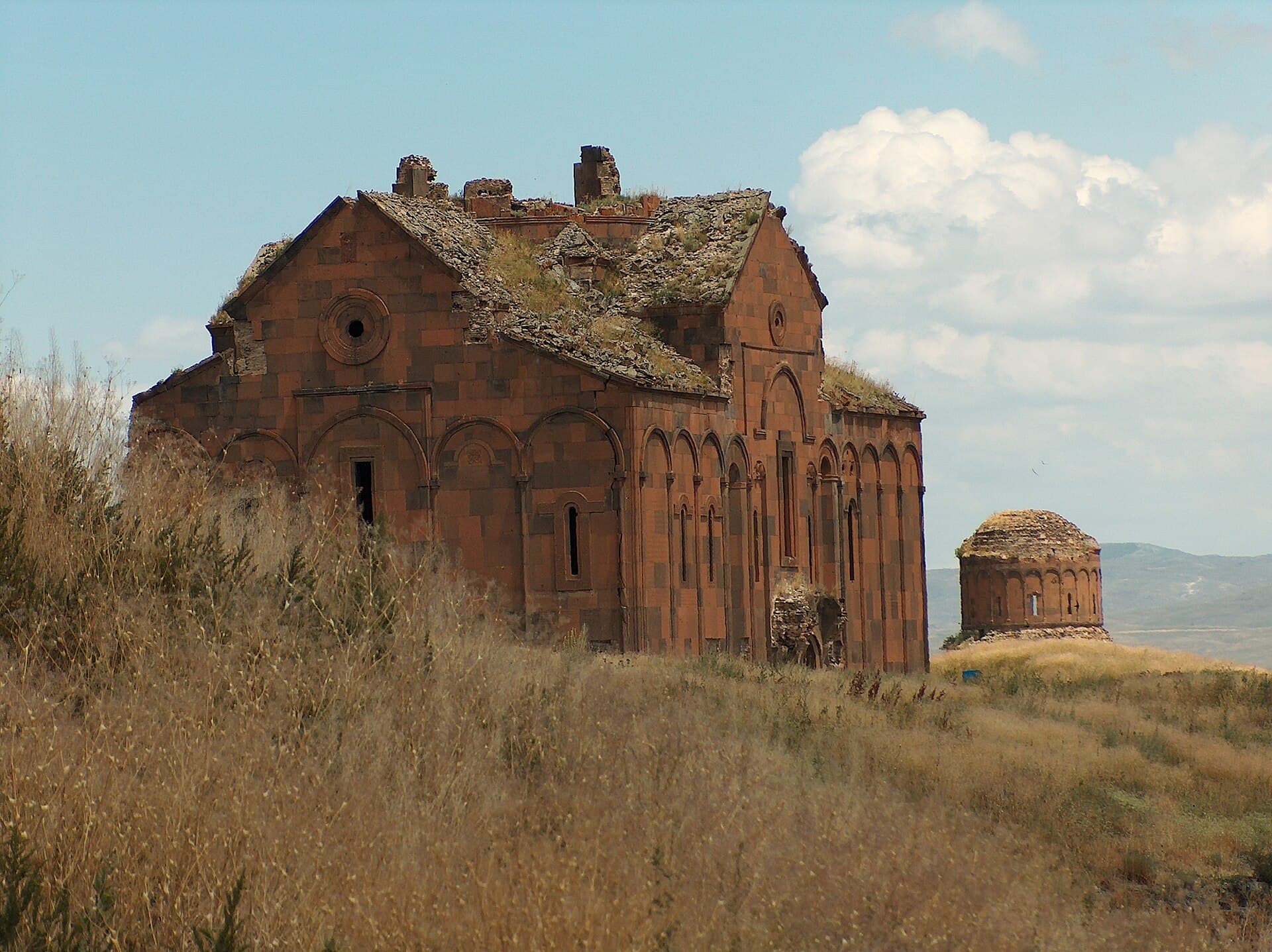
Ani stands on a triangular plateau in Kars province, in the far east of Turkey, where the Akhurian river has cut a ravine deep enough to serve as an international border. Nobody lives there. Grass runs up to the walls of a roofless cathedral and past the surviving half of a church whose eastern side fell in a storm in 1955. For most of a century after 961 this was the capital of Bagratid Armenia, a city the UNESCO citation records as growing wealthy on control of one branch of the Silk Roads.
Ani became something larger than the Kamsarakan hill fort of the chronicles in 961, when King Ashot III moved the Bagratuni capital there from Kars, and larger still under Smbat II, who built the walls. In 992 the Armenian Catholicosate moved its seat to Ani, making it the political and religious centre of the kingdom at once. Its peak came in the long reign of Gagik I, from 989 to 1020. Medieval writers put the population at around 100,000, a figure modern historians treat with caution given how little ground lies inside the walls.
The kingdom did not survive the century. Gagik's sons quarrelled over the succession, and in 1045 Ani passed to Byzantium after its last king was invited to Constantinople and detained there.
The epithet is medieval and it is not a census. BBC Travel, calling the nickname hyperbole, puts the archaeological evidence at at least forty churches, chapels and mausoleums, while tallies that separate out the rock-cut spaces reach fifty churches, thirty-three cave chapels and twenty further chapels. The figures differ over what is counted: whether a chapel cut into the gorge wall, or a mausoleum built against a church, is a church.
The plateau defended three sides by itself, leaving only the north open, and that is where the building went. Smbat II drew a double line of walls across it in the 980s, the inner line much the taller, studded with large semicircular towers set close together. Later rulers raised and thickened them, and Armenian inscriptions of the twelfth and thirteenth centuries record private citizens paying for towers of their own. Three gates pierced the northern wall: the Lion Gate, the Kars Gate, and the Dvin Gate, also called the Chequer Board Gate for the panel of red and black squares above its entrance.
Everything on the site is local volcanic tufa, soft enough to carve finely and hard enough to hold an edge, and it comes out of the ground in creamy yellow, rose red and near black. The masons cut it into large polished blocks, laid them with joints tight enough to read as one surface, and used the colour on purpose: banded courses, chequered panels, blind arcades of slender paired colonnettes running round a church like a ruled line.
The cathedral, Surp Asdvadzadzin, is the largest thing still standing at Ani. Work began in 989 under Smbat II, stopped when he died that year, and was completed under Queen Katranide, wife of his successor Gagik I, in 1001 or in 1010 depending on how the inscription on the north wall is read. It is a domed basilica, 34.3 metres long and 21.9 metres wide, once rising some 38 metres to the tip of its conical dome. The nave runs between freestanding clustered piers under pointed arches, features European builders would not use at scale for another two centuries, which is why the cathedral appears in arguments about the origins of Gothic.
Its architect has a second entry in the record, and it carries Ani a long way from Kars. In 989 an earthquake tore open the dome of Hagia Sophia in Constantinople. Byzantine officials summoned Trdat, chief architect to the Bagratid kings, to organise the repair; the rebuilt dome was finished by 994, and Trdat was back at Ani by 993 to resume his own. The Armenian historian Stepanos Taronetsi recorded that Greek builders had tried and failed before Trdat presented a plan and a model. Scholars differ on what the summons proves. Sirarpie Der Nersessian read it as sufficient indication of his renown, while Richard Krautheimer was cooler, suggesting Trdat "might have been summoned as a technician."
The Church of the Holy Redeemer was finished shortly after 1035 for Prince Ablgharib Pahlavid, to house a fragment of the True Cross. Its plan was unusual anywhere: nineteen sides externally, eight apses within, a tall drum carrying a central dome. It stood almost complete until 1955, when the whole eastern half collapsed in a storm, leaving a half cylinder of wall open to the weather. It stands today inside a cage of scaffolding.
The Church of Saint Gregory built by Tigran Honents, finished in 1215 under Zakarid rule, is the best preserved building on the site. Honents was a merchant, not a prince, which says something about where wealth had settled by then. Its exterior is dense with carving, real and imaginary animals filling the spandrels of a blind arcade that runs the whole way round. Inside are two fresco cycles, the life of Saint Gregory the Illuminator and the life of Christ, credited by scholars to Georgian artists; programmes on that scale are rare in Armenian churches.
Ani fell to a Seljuk army under Alp Arslan in 1064, after a siege of twenty-five days, and the population was massacred; the Turkish historian Sibt ibn al-Jawzi preserved an eyewitness description of streets impassable for bodies. The cathedral became a mosque, and Turkish sources still call it Fethiye Camii, the conquest mosque, for the Friday prayer the sultan held there.
Nothing about the next three centuries is simple. In 1072 the Seljuks sold Ani to the Shaddadids, a Muslim Kurdish dynasty who married into the Bagratuni nobility and largely left the Christian population alone. Georgian armies took the city five times between 1124 and 1209, and after 1201 the Zakarian princes governing for Queen Tamar presided over a real revival. The Seljuks of Rum raided in 1217 and 1220, the Mongols failed against the city in 1226 and succeeded in 1236, and the earthquake of 1319 brought down the cathedral's dome.
What finished Ani was slower. The trade routes moved. The Kara Koyunlu shifted their capital to Yerevan, the Catholicosate followed in 1441, and the Ottomans took the site in 1579. A small town lived on inside the walls into the mid-seventeenth century, and the last monks left around 1735, after which the plateau was empty. Earthquakes in 1832 and 1988 took more of what remained.
Ani lies about four hundred metres from the frontier. Turkey closed its land border with Armenia in 1993, over the conflict between Armenia and Turkey's ally Azerbaijan, and the two states have no formal relations. That closure sits on top of an older military geography: after Turkey joined NATO in 1952 the ruin became a Cold War front line, a permit from the Ministry of Culture was required to visit until 2004, and at one point in the 1980s photography there was banned outright. Reporting from the site in 2024, AFP wrote that Ani had for years been closed to tourists and reachable only with a military permit. That regime has gone. Visitors buy a ticket at the gate, and Hürriyet Daily News reported around 450,000 of them in 2025.
How Ani is described has moved more slowly than how it is reached. UNESCO inscribed the property in 2016 as the Archaeological Site of Ani, under cultural criteria (ii), (iii) and (iv). The citation calls it a capital of the medieval Armenian kingdom of the Bagratids and justifies criterion (iii) on the ground that Ani bears exceptional testimony to Armenian cultural and architectural development, naming the Ani school of Armenian religious architecture. Turkish accounts foreground other layers. Hürriyet Daily News presents the site as the first gateway of the Turks into Anatolia, and the governor of Kars told AFP in 2024 that this was land his ancestors had conquered. In July 2025 an Anadolu Agency report on the restoration used the cathedral's Seljuk name throughout, and Armenian outlets read that as an announcement of a mosque conversion; CivilNetCheck found no such claim in the Turkish coverage, but noted that it named Trdat while omitting that architect and cathedral alike were Armenian.
Restoration is contested in its own right. The World Monuments Fund listed Ani on its Watch in 1996, 1998 and 2000, and in 2011 began work on the cathedral and the Redeemer with the Turkish Ministry of Culture and the Istanbul organisation Anadolu Kültür. Gagik Gyurjyan of ICOMOS-Armenia said the ministry rejected a preliminary agreement to bring Armenian specialists in; Osman Kavala of Anadolu Kültür said the lack of formal relations had probably prevented it. The UNESCO assessment of authenticity is explicit that new fabric introduced during a number of restoration projects has cost the site original building material. Each side has also accused the other of damage: Armenian commentators call the Turkish record of neglect deliberate, while Turkish officials have blamed blasting at a quarry on the Armenian bank, reported to have stopped around 2009 after a complaint to ICOMOS.
This page adjudicates none of that, and takes no position on the wider dispute between the two countries, including the terminology used about the events of 1915. AFP, reporting from Ani, referred to the mass killing of Armenians in the Ottoman Empire during the First World War, which Turkey does not recognise as genocide; that is AFP's formulation rather than this page's. The geography can be stated plainly. From the Armenian bank the city is visible: an observation point near Haykadzor has an information panel and a poor view, and a border post at Kharkov a good view that needs clearance from Yerevan. Nobody standing at either can cross the gorge. The only road to the gate runs from Kars.
The Bagratid capital
A thousand and one churches, and the count that survives
The walls and the standard of the stone
Trdat, the cathedral, and the dome in Constantinople
The Redeemer and the frescoes of Tigran Honents
How a city empties
A monument on a closed border
References and resources
- UNESCO World Heritage Centre. "Archaeological Site of Ani." World Heritage List no. 1518, inscribed 2016 under criteria (ii), (iii) and (iv). whc.unesco.org/en/list/1518.
- Wikipedia. "Ani," "Cathedral of Ani," "Trdat (architect)." Retrieved 2026.
- BBC Travel. Joseph Flaherty, "The empire the world forgot."
- Agence France-Presse, via The Hindu, 20 March 2024. "Ancient city that could bridge Turkey and Armenia's bitter divide."
- Hürriyet Daily News. "Ani draws record visitors."
- CivilNetCheck. "False reports about mosque conversion of Ani Cathedral."
- Heghnar Zeitlian Watenpaugh. "Preserving the Medieval City of Ani." Journal of the Society of Architectural Historians 73, no. 4 (2014).