Heritage · Landmark
Delphi: the oracle at the navel of the world
On a terrace of Mount Parnassus, a priestess seated on a tripod answered questions for a thousand years, and kings rearranged their plans around her riddles. The sanctuary of Apollo at Delphi held the stone the Greeks called the navel of the world, and its ruined temple still carries the advice that outlived the oracle: know thyself.Written to last.
By Confinity Heritage Editorial · 2026-08-23 · 7-minute readQuiet tools, kept out of the way.
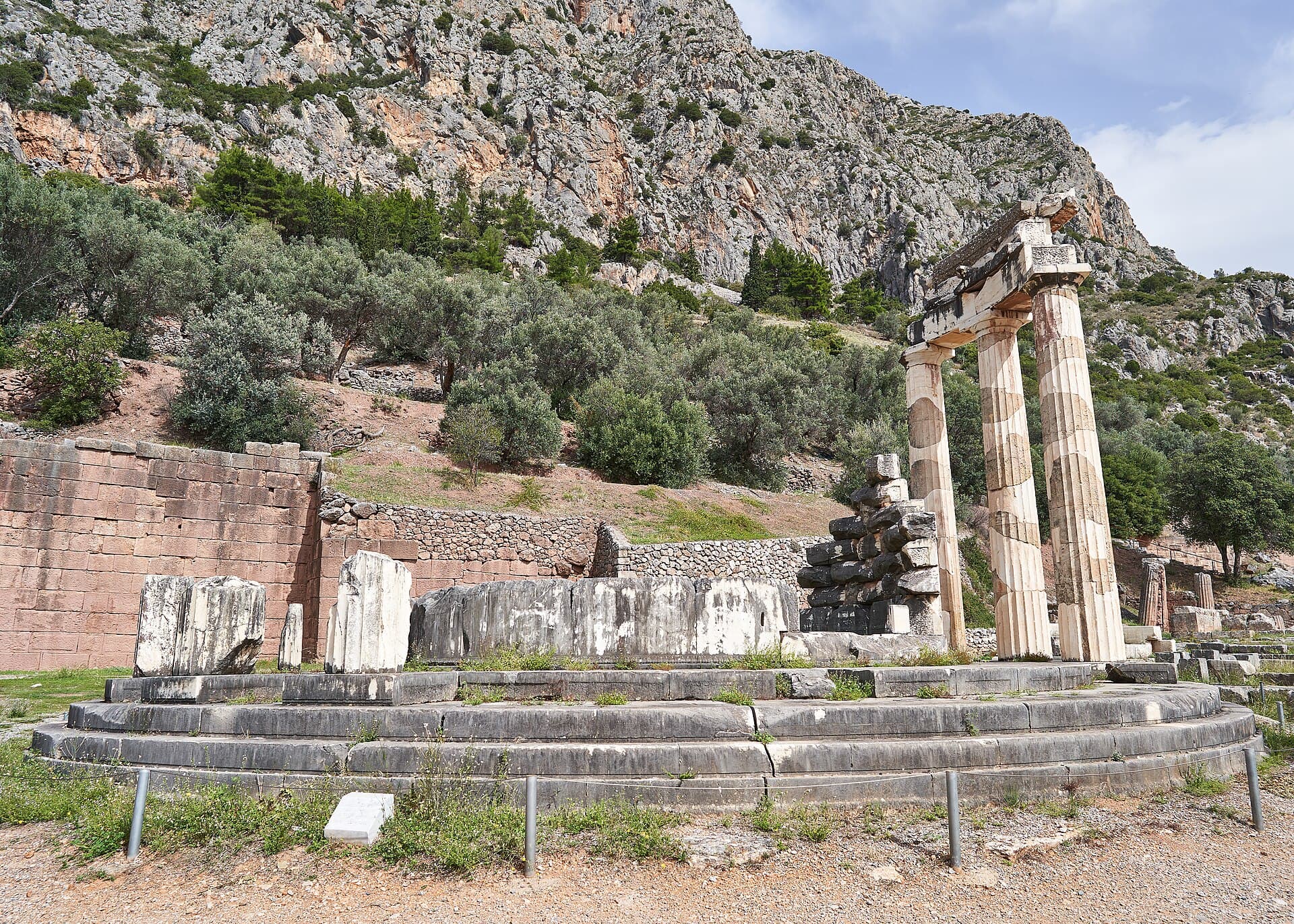
On the lower slopes of Mount Parnassus in central Greece, a chain of terraces climbs a mountainside above a valley of olive groves that runs down to the Gulf of Corinth. Cliffs the ancients called the Phaedriades, the shining ones, rise behind; a spring, the Castalia, breaks from a cleft between them. For well over a thousand years this was the sanctuary of Apollo at Delphi, home of the most consulted oracle in the Mediterranean world, and the ground here still holds a temple, a theatre, a stadium, and the foundations of a street of treasure houses, inscribed by UNESCO in 1987 as a site of outstanding universal value.
Delphi's reach is hard to overstate. Cities sent official delegations before founding colonies, declaring wars, or rewriting laws, and private questioners climbed the same path to ask about marriages, voyages, and crops. The answers, delivered through a priestess and famous for their ambiguity, sat behind decisions that shaped Greek history from Sicily to the Black Sea. Delphi was also one of the four great festival sanctuaries of Greece, and because it belonged to no single city it became a place where rival states competed in marble instead of arms, lining its Sacred Way with monuments to their own victories.
The Greeks located the centre of the earth at Delphi, and they had a story to prove it. Zeus, wanting to find the middle of the world, released two eagles from its opposite ends; they crossed in the sky above Parnassus, and the meeting point was marked with a carved stone called the omphalos, the navel. A Roman-era copy of that stone, worked over with a net-like pattern of woollen bands rendered in marble, survives in the site museum, and the idea it embodied ran through everything the sanctuary did: a question asked at Delphi was asked at the centre of things.
Myth supplied the sanctuary's charter as well as its geography. In the founding story, the young Apollo killed the serpent Python, guardian of an older oracle on the spot, and took the seat of prophecy for himself. The priestess who spoke for him was called the Pythia after the defeated serpent, the games held in his honour were the Pythian Games, and the laurel, the tree into which the fleeing nymph Daphne was transformed, became the god's emblem and the crown of his victors.
Consultation followed a fixed ritual. The Pythia was a local woman who served for life, and on the days of consultation, in the classical period the seventh day of the month for nine months of the year, she purified herself in the Castalia spring, entered the temple's inner chamber, and took her seat on a bronze tripod. Questioners, who had offered a sacrificial goat and paid a fee, put their questions through the temple priests, and the priests rendered her responses, often in polished and deliberately open-ended verse. Ancient writers, above all Plutarch, who served as a priest at Delphi, described a sweet-smelling breath or vapour, the pneuma, rising in the inner chamber and inspiring the trance.
That detail has driven one of the liveliest modern arguments about the site. In 2001 a team of geologists and archaeologists reported that two faults cross beneath the temple, that the underlying bituminous limestone can release light hydrocarbon gases, and that ethylene, a sweet-smelling compound once used as an anaesthetic, appeared in traces in nearby spring water. On this hypothesis the Pythia's trance had a partly geological trigger. Other researchers have pushed back hard, doubting that the measured quantities could intoxicate anyone and proposing alternatives from methane and carbon dioxide to purely ritual explanations. The question remains open, which is itself fitting: the mechanism of the oracle is still being interpreted, two thousand years on.
Three consultations show the oracle's range. Herodotus tells how Croesus, the fabulously rich king of Lydia, first tested the great oracles and judged Delphi the only one that answered truly, then asked whether he should attack Persia. The reply was that if he crossed the river Halys he would destroy a great empire. He marched, and the empire he destroyed was his own. The story, whatever its embroidery, preserves how the Greeks understood Delphi: the god did not lie, but he did not explain.
In 480 BC, with the Persian army descending on Attica, the Athenians received one of the darkest responses on record, softened on a second asking by the promise that a wooden wall would keep them safe. Themistocles argued that the wooden wall meant the fleet, persuaded the city to evacuate rather than defend the Acropolis, and won the sea battle at Salamis that turned the war. And at some point before 399 BC, an Athenian named Chaerephon asked whether any man was wiser than his friend Socrates. The Pythia answered that none was. Socrates, as Plato tells it in the Apology, spent the rest of his life testing that verdict, concluding that his only wisdom lay in knowing how little he knew, an inquiry that helped set Western philosophy on its course.
The sanctuary a visitor walks today is organised around the Sacred Way, a paved path that zigzags uphill through what was once a dense crowd of statues, columns, and small temple-shaped buildings called treasuries. Each treasury was built by a city-state to house its offerings and advertise its standing; Siphnos, Thebes, Corinth, and others competed along the route. The best preserved is the Treasury of the Athenians, a Doric building in island marble raised in the years around the battle of Marathon and reconstructed from its scattered blocks in 1903 to 1906, with the city of Athens funding the work on the monument its ancestors had built.
At the head of the path stands the Temple of Apollo itself. The visible ruins belong to the fourth-century BC temple, finished around 330 BC after fire and earthquake had destroyed two predecessors on the same plan. In its forecourt, ancient authors record, were carved the Delphic maxims attributed to the Seven Sages, with two above all: know thyself, and nothing in excess. Beneath the temple floor lay the adyton where the Pythia sat, and inside burned a hearth whose fire, in Greek thought, stood for the common hearth of all Greece.
Delphi was a festival ground as well as an oracle. Every four years the sanctuary held the Pythian Games, which ranked second in prestige only to the games at Olympia and differed from them in character: they began as a music competition in honour of the god of the lyre, and contests for singers and musicians kept their place beside athletics and chariot racing even after the games were reorganised in the early sixth century BC. Victors were crowned with laurel cut near the sanctuary.
The festival's architecture climbs the hill above the temple. A stone theatre from the fourth century BC, reworked under the Romans, seats some five thousand spectators with the whole sanctuary and the valley spread below the stage; higher still, at the top of the site, lies one of the best preserved stadia in Greece, its stone benches accommodating several thousand more. A short walk east, on a lower terrace, stands the sanctuary of Athena Pronaia, Athena before the temple, whose circular Tholos of about 380 BC, three of its Doric columns re-erected in 1938, has become the most photographed ruin at Delphi even though its original purpose is still uncertain.
The oracle's decline was long. Sulla stripped the sanctuary of treasure to pay his soldiers in 86 BC, and Nero is said to have carried off five hundred bronze statues; Plutarch, writing around AD 100, devoted an essay to why the oracle's voice had grown faint. A late tradition preserves what is counted as the last response: when the emperor Julian, the final pagan ruler of Rome, sent to revive the shrine in the 360s, the answer reported back was that the fair-wrought hall had fallen, that Apollo had no roof, no prophetic laurel, no speaking spring. Under Theodosius I, whose decrees of the early 390s closed the pagan sanctuaries of the empire, the oracle fell silent for good.
The site itself disappeared more slowly. Landslides and centuries of rebuilding buried the terraces, and the village of Kastri grew up directly over the temple, its houses quarrying the ancient blocks. When the French School at Athens secured the concession for what became known as the Great Excavation, the whole village had to be moved: from 1892 the houses were purchased and rebuilt at the site of modern Delphi to the west, and the excavators uncovered the temple terrace, the treasuries, the theatre, and thousands of objects. Among them, found in 1896, was the Charioteer of Delphi, a life-size bronze youth of the 470s BC dedicated after a chariot victory in the Pythian Games, his glass and onyx eyes intact, now the centrepiece of the Delphi Archaeological Museum.
There is a quiet irony folded into these terraces. Delphi's entire business was the future: for a thousand years people climbed the Sacred Way to learn what was coming, and an institution grew rich and famous on the promise of tomorrow. That institution now belongs wholly to the past. The tripod is gone, the vapour, whatever it was, disperses unread, and the questions that once decided wars survive only because historians wrote them down. What lasted was not the prophecy but the record of it, and the plainest advice of all. The maxims cut at the temple asked nothing of the god and everything of the visitor: know yourself, avoid excess. Empires that consulted the oracle have vanished with the empire it served, while those few words are still quoted daily in most of the world's languages. Delphi is what remains when an oracle stops speaking, and it turns out to be a great deal: stone, bronze, testimony, and a sentence short enough to keep.
The navel of the world
The Pythia and the tripod
Questions that moved history
The Sacred Way and the temple of the maxims
Games second only to Olympia
Silence, burial, and rediscovery
The maxims outlived the oracle
References and resources
- UNESCO World Heritage Centre. "Archaeological Site of Delphi." World Heritage List, property no. 393, inscribed 1987. whc.unesco.org/en/list/393.
- Encyclopaedia Britannica. "Delphi, ancient city, Greece." britannica.com/place/Delphi-ancient-city-Greece.
- Greek Ministry of Culture and Sports, Odysseus portal. "Delphi." odysseus.culture.gr.
- Herodotus. Histories, Book 1 (Croesus) and Book 7 (the wooden walls). Plato, Apology (the oracle on Socrates).
- Wikipedia. "Delphi," "Pythia," "Athenian Treasury," and "Charioteer of Delphi." Retrieved 2026.
- Plutarch. "On the Obsolescence of Oracles," in Moralia.