Heritage · Landmark
The Mosque-Cathedral of Córdoba: one building, two things
A prayer hall begun in 785 holds up its roof on other people's columns, stacking horseshoe arches two tiers deep in red brick and pale stone until the eye loses count. In the 1520s a Renaissance cathedral was cut into the middle of it, and the hall was left standing all the way round.Written to last.
By Confinity Heritage Editorial · 2026-08-25 · 7-minute readQuiet tools, kept out of the way.
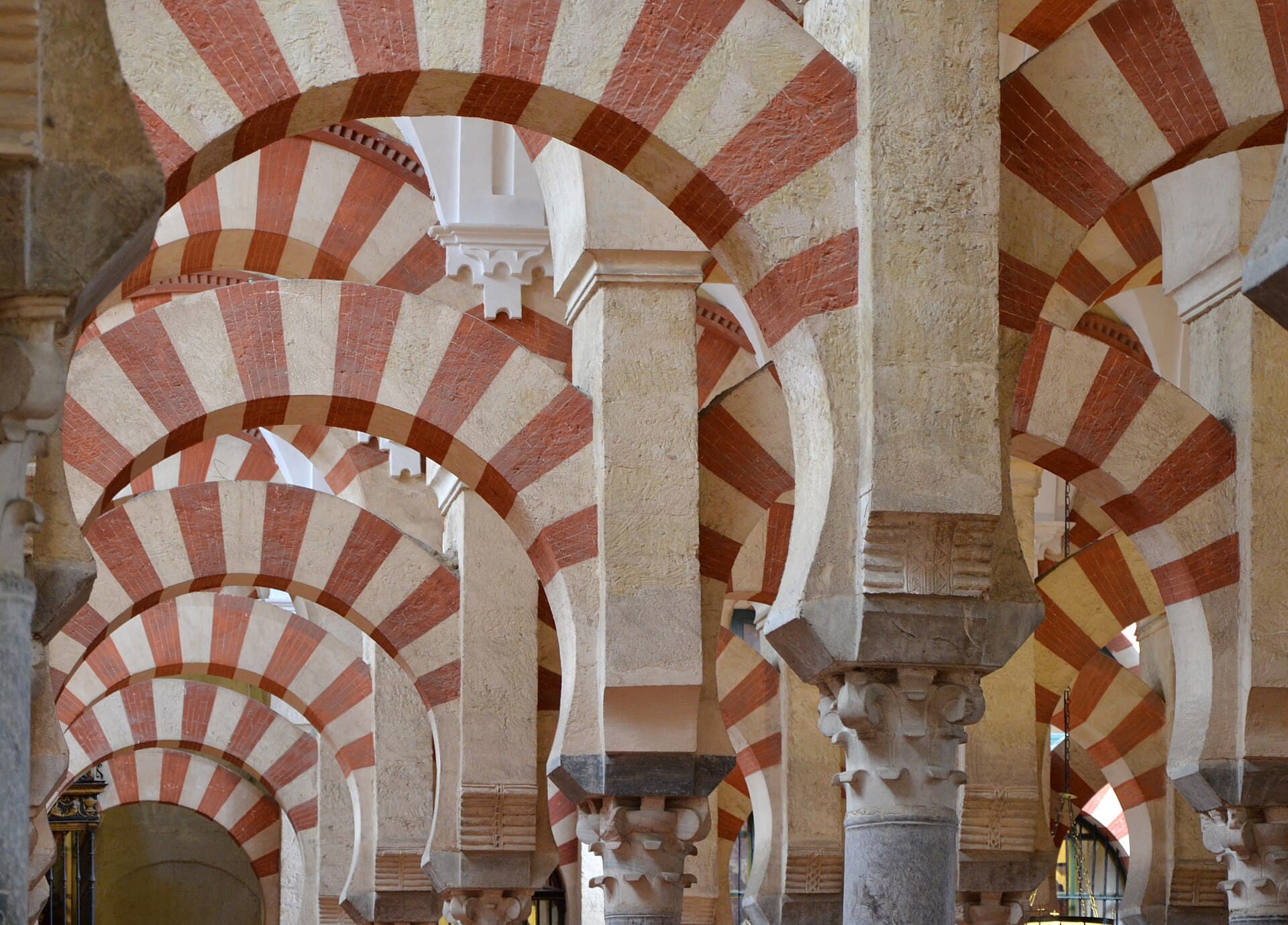
In the old centre of Córdoba, in southern Spain, a long low building keeps its back to the street and gives almost nothing away. Inside, the floor opens into a forest of columns carrying arches stacked two tiers deep, their wedge-shaped voussoirs alternating red brick and pale stone in a rhythm that repeats past the point where anyone is still counting. This is the cathedral of the Roman Catholic Diocese of Córdoba. It is also the Great Mosque of Córdoba, begun in 785 and enlarged four times before the eleventh century. Locals call it the Mezquita. UNESCO holds it inside the property "Historic Centre of Cordoba," where the Great Mosque was inscribed in 1984 and the property extended in 1994 to take in the surrounding streets and the Roman bridge.
The two identities are not sequential in the way that word usually implies. The mosque was not cleared away to make room for the cathedral, and the cathedral was not built alongside it. It was built into it, in the 1520s, in the middle of the prayer hall, with the hall left standing on every side.
The traditional account, traceable to the tenth-century historian al-Razi, holds that a Visigothic church dedicated to Saint Vincent of Saragossa stood here, that Muslims and Christians shared the site after the conquest of 711, and that in 785 Abd al-Rahman I bought out the Christian half and demolished it. UNESCO gives the short version, describing the mosque as built over the remains of the Visigoth Basilica of San Vicente.
Specialists are less settled. Fragments of Late Roman or Visigothic mosaic lie under the present floor; Pedro Marfil reads them as an episcopal complex, Fernando Arce-Sainz notes the absence of Christian iconography or a cemetery, and Nuha Khoury pointed out that the shared-church story mirrors the one told about the Great Mosque of Damascus, which makes it eloquent about Umayyad succession and weak as a record of the ground.
Construction began in 785 to 786 and the first mosque was finished in roughly a year, a speed made possible by lifting columns and capitals wholesale from Roman and Visigothic buildings nearby. About 120 went in, and they were all the wrong height: unlike the tall salvaged shafts available in Damascus, they could not raise a ceiling to the scale the emir wanted.
The answer was to build the elevation in two stages. A lower tier of horseshoe arches springs from the reused capitals; above it, carried on piers rising from those same capitals, a second tier of semicircular arches takes the ceiling. UNESCO singles out the use of double arches to support the roof as previously unheard of in Islamic religious architecture, and names the Roman Milagros aqueduct at Mérida as its forerunner. A shortage of tall second-hand columns had produced the most copied idea in western Islamic building.
Four rulers enlarged the mosque, and each extended the original system rather than improving on it. Abd al-Rahman II pushed the prayer hall eight bays south between 833 and 848, taking its depth to 64 metres. Abd al-Rahman III, who had declared a caliphate in 929, rebuilt the courtyard and raised the first true minaret, 47 metres tall and finished in 958. Al-Hakam II drove the hall a further 45 metres south from 961, adding twelve bays. Al-Mansur could not continue south because the river was in the way, so in 987 to 988 he widened the building eastward, adding eight naves and bringing the prayer hall to nineteen aisles, the largest mosque outside Abbasid Iraq. Around 850 columns of jasper, onyx, marble, granite and porphyry stand there today.
Al-Hakam's extension is where the hall stops repeating and starts arguing. He walled off a royal enclosure, the maqsura, behind a screen of interlacing horseshoe and multifoil arches and roofed its three bays with ribbed domes whose eight stone ribs cross off-centre to leave a star. Behind it the mihrab is not a niche but a small heptagonal room under a shell-shaped cupola, the earliest known mihrab built as a chamber. It was finished in November or December 965.
Then the mosaics. The chronicler Ibn Idhari records that al-Hakam asked the Byzantine emperor in Constantinople for expert mosaicists, that the emperor sent a master craftsman with roughly 1,600 kilograms of tesserae as a gift, and that the craftsman trained local workers, who finished in late 970 or early 971. Scholars find the style corroborates the account, and read the borrowing as genealogy: the Umayyads of Córdoba claiming descent from the Umayyads of Damascus, whose own great mosque was decorated the same way.
 The gold Kufic band above the arch carries Qur'anic text and a foundation notice praising al-Hakam II. Photograph by Ingo Mehling, CC BY-SA 4.0, via Wikimedia Commons.
An altarpiece hid the mosaics for centuries. They reappeared damaged in 1815, Patricio Furriel restored them in 1817 to 1818, and a fresh campaign on the maqsura began in 2024.
Córdoba fell to Ferdinand III of Castile in 1236 and the mosque was consecrated as a cathedral dedicated to the Virgin Mary, the first mass said on 29 June. The minaret took a cross and became a bell tower. Little else changed at first: the earliest altar went under the great ribbed dome at the threshold of al-Hakam's extension, and the mihrab and maqsura became the Chapel of San Pedro.
Chapels then accumulated round the edges for three centuries, from San Felipe and Santiago in 1258 to the Mudéjar Royal Chapel of 1371 and a Gothic nave cut into the Villaviciosa Chapel in 1489. Much of the upkeep fell to Mudéjar craftsmen, many of them discharging a labour tax unique to Córdoba.
In 1523 Bishop Alonso Manrique proposed cutting a Renaissance nave and transept straight through the centre of the hypostyle hall. The city council fought it, appealing over the chapter's head to Charles V, who granted permission; demolition began that spring. Hernán Ruiz I, his son Hernán Ruiz II and finally Juan de Ochoa carried it through to the elliptical crossing dome of 1599 to 1607.
The gold Kufic band above the arch carries Qur'anic text and a foundation notice praising al-Hakam II. Photograph by Ingo Mehling, CC BY-SA 4.0, via Wikimedia Commons.
An altarpiece hid the mosaics for centuries. They reappeared damaged in 1815, Patricio Furriel restored them in 1817 to 1818, and a fresh campaign on the maqsura began in 2024.
Córdoba fell to Ferdinand III of Castile in 1236 and the mosque was consecrated as a cathedral dedicated to the Virgin Mary, the first mass said on 29 June. The minaret took a cross and became a bell tower. Little else changed at first: the earliest altar went under the great ribbed dome at the threshold of al-Hakam's extension, and the mihrab and maqsura became the Chapel of San Pedro.
Chapels then accumulated round the edges for three centuries, from San Felipe and Santiago in 1258 to the Mudéjar Royal Chapel of 1371 and a Gothic nave cut into the Villaviciosa Chapel in 1489. Much of the upkeep fell to Mudéjar craftsmen, many of them discharging a labour tax unique to Córdoba.
In 1523 Bishop Alonso Manrique proposed cutting a Renaissance nave and transept straight through the centre of the hypostyle hall. The city council fought it, appealing over the chapter's head to Charles V, who granted permission; demolition began that spring. Hernán Ruiz I, his son Hernán Ruiz II and finally Juan de Ochoa carried it through to the elliptical crossing dome of 1599 to 1607.
 From above, a cruciform church breaks up through the flat tiled roof of the prayer hall. Photograph by Toni Castillo Quero, CC BY-SA 2.0, via Wikimedia Commons.
When the emperor reached Córdoba in 1526 and saw the demolition, he is reported to have told the chapter that they had built what could be built anywhere and undone what was unique in the world, a line usually boiled down to "you have destroyed something unique to build something commonplace." It is in a thousand guidebooks. Its provenance is thin. The architectural historian Michele Lamprakos traces the earliest report to Juan Gómez Bravo, a canon of Córdoba writing in 1739, more than two centuries after the visit, calls the comment apocryphal, and suggests it may have grown out of the council's own protest of 29 April 1523, which warned that the project would destroy a temple "unico en el mundo." No contemporary record carries it. The sentiment is documented in 1523 in the council minutes; the sentence is documented in 1739 in a canon's chronicle; those are two different claims. In those same years Charles was raising a Renaissance palace inside the Alhambra at Granada.
Work on the fabric never stopped. The building was listed as a national monument in 1882, and a century of restoration from 1879 onward, stripping Baroque additions and reopening earlier structures, is described by scholars as a re-Islamicising of the interior. A fire in a chapel of al-Mansur's extension brought down a roof on 8 August 2025, leaving the mihrab and the arcades untouched.
The argument over what this building is has run for two decades. The formal Catholic name is the Cathedral of Our Lady of the Assumption, while the chapter's own site presents the monument as the Mezquita-Catedral de Córdoba. That wording has moved before. The sociologist Avi Astor's case study for the European INVENT project records that the entrance leaflets carried the title "Mosque-Cathedral of Cordoba" until 1998, that a 1998 leaflet led instead with "Sacred Church Cathedral," that by around 2000 the word Mezquita had gone from them altogether, and that in 2016, under pressure from a petition and press coverage, the chapter restored the older title and gave the history a more neutral treatment.
In 2006 the cathedral chapter registered the building in the Spanish property register under article 206 of the Ley Hipotecaria of 1946, a Franco-era provision that let a bishop certify church ownership without producing a title. The fee was reported as thirty euros. It became public knowledge in 2009 and has been contested since by a secular campaign group, Plataforma Mezquita-Catedral de Córdoba: Patrimonio de tod@s, whose petition for public ownership has gathered several hundred thousand signatures. In March 2016 the secretary general of Córdoba city council reported that the building belongs neither to the Church nor to any other body, a World Heritage monument being inalienable under Spanish law. The conservative European Citizens' Forum answered that registration was declarative rather than constitutive, publicising a title held since Ferdinand III. A commission under Federico Mayor Zaragoza reported in 2018 that the Church had never owned it. The registration has not been overturned.
Spanish Muslim organisations have asked repeatedly to pray inside and have been refused. The Junta Islámica wrote to the Vatican after guards removed a praying group in 2003. On Christmas Day 2006 the Spanish Islamic Board wrote to the papal nuncio asking Benedict XVI for shared worship, saying it wanted neither control of the building nor a nostalgic al-Andalus; Bishop Juan José Asenjo refused, citing legal and historical title for exclusive Catholic use, and the Vatican has not granted the request. The current bishop, Demetrio Fernández, has defended the Christian framing of the site against what he calls a cultural reductionism that lets the label of a Muslim city eclipse the Roman, Visigothic and Christian layers. This page takes no side in that dispute.
Hagia Sophia in Istanbul poses the same question and has been given a different answer: cathedral, then mosque, then museum from 1935, then mosque again from 2020, with the Christian mosaics curtained during prayer rather than removed. Córdoba changed religion more than once too: a church briefly in 1146, a mosque again when the Castilians lost the city, then a cathedral from 1236 onward. What the two cases share is that the fabric keeps the whole record whatever the current use acknowledges. In Córdoba the qibla wall still faces south, the mihrab still holds its Byzantine gold, and the arcades still run past the Renaissance transept on both sides, whatever name is printed on the ticket.
From above, a cruciform church breaks up through the flat tiled roof of the prayer hall. Photograph by Toni Castillo Quero, CC BY-SA 2.0, via Wikimedia Commons.
When the emperor reached Córdoba in 1526 and saw the demolition, he is reported to have told the chapter that they had built what could be built anywhere and undone what was unique in the world, a line usually boiled down to "you have destroyed something unique to build something commonplace." It is in a thousand guidebooks. Its provenance is thin. The architectural historian Michele Lamprakos traces the earliest report to Juan Gómez Bravo, a canon of Córdoba writing in 1739, more than two centuries after the visit, calls the comment apocryphal, and suggests it may have grown out of the council's own protest of 29 April 1523, which warned that the project would destroy a temple "unico en el mundo." No contemporary record carries it. The sentiment is documented in 1523 in the council minutes; the sentence is documented in 1739 in a canon's chronicle; those are two different claims. In those same years Charles was raising a Renaissance palace inside the Alhambra at Granada.
Work on the fabric never stopped. The building was listed as a national monument in 1882, and a century of restoration from 1879 onward, stripping Baroque additions and reopening earlier structures, is described by scholars as a re-Islamicising of the interior. A fire in a chapel of al-Mansur's extension brought down a roof on 8 August 2025, leaving the mihrab and the arcades untouched.
The argument over what this building is has run for two decades. The formal Catholic name is the Cathedral of Our Lady of the Assumption, while the chapter's own site presents the monument as the Mezquita-Catedral de Córdoba. That wording has moved before. The sociologist Avi Astor's case study for the European INVENT project records that the entrance leaflets carried the title "Mosque-Cathedral of Cordoba" until 1998, that a 1998 leaflet led instead with "Sacred Church Cathedral," that by around 2000 the word Mezquita had gone from them altogether, and that in 2016, under pressure from a petition and press coverage, the chapter restored the older title and gave the history a more neutral treatment.
In 2006 the cathedral chapter registered the building in the Spanish property register under article 206 of the Ley Hipotecaria of 1946, a Franco-era provision that let a bishop certify church ownership without producing a title. The fee was reported as thirty euros. It became public knowledge in 2009 and has been contested since by a secular campaign group, Plataforma Mezquita-Catedral de Córdoba: Patrimonio de tod@s, whose petition for public ownership has gathered several hundred thousand signatures. In March 2016 the secretary general of Córdoba city council reported that the building belongs neither to the Church nor to any other body, a World Heritage monument being inalienable under Spanish law. The conservative European Citizens' Forum answered that registration was declarative rather than constitutive, publicising a title held since Ferdinand III. A commission under Federico Mayor Zaragoza reported in 2018 that the Church had never owned it. The registration has not been overturned.
Spanish Muslim organisations have asked repeatedly to pray inside and have been refused. The Junta Islámica wrote to the Vatican after guards removed a praying group in 2003. On Christmas Day 2006 the Spanish Islamic Board wrote to the papal nuncio asking Benedict XVI for shared worship, saying it wanted neither control of the building nor a nostalgic al-Andalus; Bishop Juan José Asenjo refused, citing legal and historical title for exclusive Catholic use, and the Vatican has not granted the request. The current bishop, Demetrio Fernández, has defended the Christian framing of the site against what he calls a cultural reductionism that lets the label of a Muslim city eclipse the Roman, Visigothic and Christian layers. This page takes no side in that dispute.
Hagia Sophia in Istanbul poses the same question and has been given a different answer: cathedral, then mosque, then museum from 1935, then mosque again from 2020, with the Christian mosaics curtained during prayer rather than removed. Córdoba changed religion more than once too: a church briefly in 1146, a mosque again when the Castilians lost the city, then a cathedral from 1236 onward. What the two cases share is that the fabric keeps the whole record whatever the current use acknowledges. In Córdoba the qibla wall still faces south, the mihrab still holds its Byzantine gold, and the arcades still run past the Renaissance transept on both sides, whatever name is printed on the ticket.
What stood on the site before 785
The height problem, and the two tiers that solved it
Four expansions and a hall that kept repeating itself
The mihrab of al-Hakam II, and the gold from Constantinople
1236: a cathedral moves in without demolishing the house
The nave of 1523, and a sentence Charles V may never have said
One building, two things
References and resources
- UNESCO World Heritage Centre: Historic Centre of Cordoba: the inscription of 1984, the 1994 extension, the criteria and the statement of outstanding universal value.
- Aggregate: Michele Lamprakos, "Memento Mauri: The Mosque-Cathedral of Cordoba": peer-reviewed architectural history, including the provenance of the Charles V quotation and the modern naming dispute.
- INVENT: Avi Astor, "Cordoba's Mosque-Cathedral as Contested Cultural Heritage": case study on the leaflets, the registration and the campaigns, funded under Horizon 2020.
- Law & Religion UK: Who owns the mosque-cathedral of Córdoba?: the 2016 city council report and the legal basis of the 2006 registration.
- The Guardian: Pope asked to let Muslims pray in cathedral: reporting on the 2006 letter to the papal nuncio and the diocese's response.
- Institute of Current World Affairs: The battle over the Córdoba Mosque-Cathedral and Spanish identity: long-form reporting on the brochures, the petition and the history of permitted prayer.
- Wikipedia: Mosque-Cathedral of Córdoba: construction phases, expansions, chapels and restorations, with sources.
- Official site of the Mezquita-Catedral de Córdoba: the cathedral chapter's own account of the monument's history.