Heritage · Landmark
Easter Island (Rapa Nui): History, the Moai and Visitor Guide
Rapa Nui, a remote Chilean island in the southeastern Pacific, holds nearly 900 moai carved by the Rapa Nui people and a UNESCO-listed national park.Written to last.
By Confinity Heritage Editorial · Updated 2026-07-31 · 7-minute readQuiet tools, kept out of the way.
Easter Island, known to its Polynesian inhabitants as Rapa Nui, is one of the most isolated inhabited places on Earth. It lies in the southeastern Pacific roughly 3,500 kilometres west of mainland Chile and about 2,000 kilometres from its nearest inhabited neighbour, Pitcairn Island. The island is famous for the moai, nearly 900 monumental stone figures carved by the Rapa Nui people between about 1250 and 1500 and raised on ceremonial platforms around the coast. In 1995 UNESCO inscribed Rapa Nui National Park, which covers much of the island, as a World Heritage Site for the cultural landscape the Rapa Nui created. The statues are only part of the story: the island is a living Rapa Nui homeland whose recent history was shaped as much from outside as from within.
Rapa Nui was settled by Polynesian voyagers who reached it by canoe, most likely from the Mangareva (Gambier) or Marquesas islands. Estimates for first settlement vary, but current archaeological evidence points to arrival around 1200 CE. Over the following centuries the islanders developed the rongorongo script and raised the ahu and moai for which the island is known. European contact began on Easter Sunday, 5 April 1722, when the Dutch navigator Jacob Roggeveen sighted the island and gave it the name that stuck in European languages. The most damaging events came in the nineteenth century. In 1862-1863 Peruvian slave raiders abducted around 1,500 islanders, roughly half the population, to labour in Peru; the few survivors who were repatriated carried smallpox, and epidemics combined with continued emigration reduced the Rapa Nui to about 111 people by 1877. Chile annexed the island in 1888, and for decades much of it was leased as a sheep ranch while islanders were confined to the settlement of Hanga Roa.
The moai were carved chiefly from the soft volcanic tuff of Rano Raraku, an extinct crater whose slopes still hold hundreds of statues, many left unfinished in the rock. A finished moai represented a deified ancestor and was raised on an ahu, a stone platform facing inland over its community. The largest raised statues stand around 10 metres tall; the biggest unfinished figure at the quarry would have exceeded 20 metres. How such multi-tonne figures were moved kilometres from the quarry has been long debated. Earlier theories proposed dragging them horizontally on wooden sledges or rollers, which would have consumed timber and linked the statues to the deforestation story. A competing hypothesis, tested experimentally by archaeologists Terry Hunt and Carl Lipo, holds that the moai were "walked" upright, rocked from side to side with ropes by small teams, consistent with the D-shaped bases of statues found along the old roads. At some point after European contact, most probably during nineteenth-century upheaval, the islanders themselves toppled the moai from their platforms. Every standing moai seen today has been re-erected in modern times.
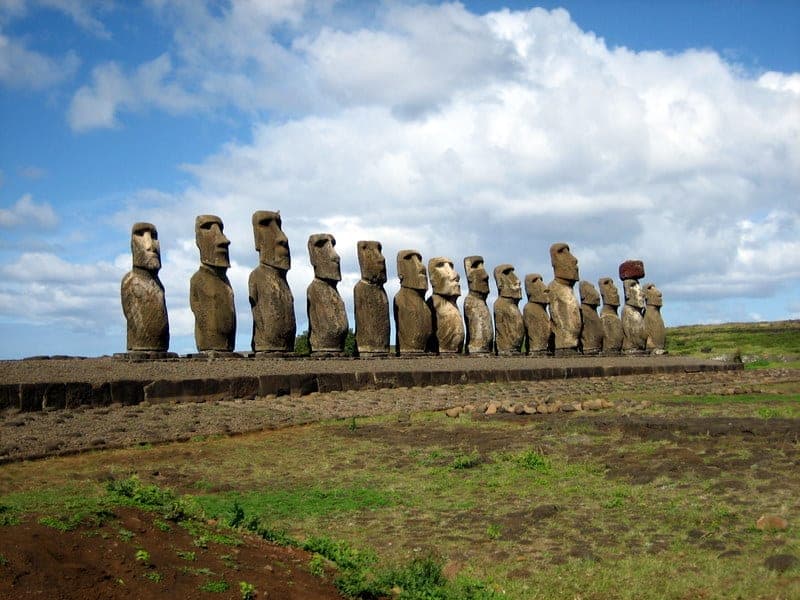
 The fifteen at Ahu Tongariki were thrown down in the islanders own conflicts, then scattered inland by a tsunami in 1960, and re-erected over five years in the 1990s. Photograph by Arian Zwegers, CC BY 2.0, via Wikimedia Commons.
For decades a popular account held that the Rapa Nui destroyed their own environment, felling the palm forests to move statues until soil erosion, famine and warfare brought a self-inflicted collapse. This "ecocide" story was popularised by Jared Diamond's 2005 book Collapse. Recent scholarship has substantially challenged it. Deforestation did occur, aided by the Polynesian rat, which ate palm seeds, but researchers using genomic data, radiocarbon dating and mapping of the island's stone-mulch gardens have found no clear evidence of a large pre-contact population that later crashed (Science; PNAS). A 2024 ancient-genome study led by researchers in Copenhagen reported steady population growth up to European arrival rather than a collapse. On this reading, the demographic catastrophe followed contact, driven by slave raiding and introduced disease rather than ecological suicide. The older narrative is now widely treated as contested, and many scholars caution against blaming the islanders for a decline largely inflicted on them.
Rapa Nui is a living community. The 2017 census recorded around 7,750 residents, of whom roughly 45 per cent identified as Rapa Nui. The Rapanui language, an Eastern Polynesian tongue, is still spoken and taught, and the annual Tapati festival celebrates traditional music, dance, carving and sport. Since 2016 the Rapa Nui community, through the Ma'u Henua organisation, has managed the national park, a shift toward Indigenous stewardship of the island's heritage.
The island is reached by air: LATAM flies from Santiago, Chile, to Mataveri Airport at Hanga Roa in about five and a half hours, with a less frequent connection from Tahiti. Since 2018 Chilean law has limited most visitors' stays to 30 days to ease pressure on the island's resources. Nearly all of the major sites, including Ahu Tongariki with its row of fifteen restored moai, the Rano Raraku quarry and the ceremonial village of Orongo, lie within Rapa Nui National Park, which requires an entry ticket and, in many areas, an authorised guide.
The moai and their platforms face steady threats from wind, rain and coastal erosion, and rising seas endanger low-lying ahu. Tourism brings income but also wear on fragile sites. In October 2022 a fire that spread from agricultural burning swept across part of the island, reaching the Rano Raraku crater and quarry and damaging a number of moai; assessments described some of the harm to the porous stone as irreversible. Chilean authorities and the Rapa Nui community continue to work with UNESCO on erosion control, fire risk and a longer-term conservation plan for the site.
The fifteen at Ahu Tongariki were thrown down in the islanders own conflicts, then scattered inland by a tsunami in 1960, and re-erected over five years in the 1990s. Photograph by Arian Zwegers, CC BY 2.0, via Wikimedia Commons.
For decades a popular account held that the Rapa Nui destroyed their own environment, felling the palm forests to move statues until soil erosion, famine and warfare brought a self-inflicted collapse. This "ecocide" story was popularised by Jared Diamond's 2005 book Collapse. Recent scholarship has substantially challenged it. Deforestation did occur, aided by the Polynesian rat, which ate palm seeds, but researchers using genomic data, radiocarbon dating and mapping of the island's stone-mulch gardens have found no clear evidence of a large pre-contact population that later crashed (Science; PNAS). A 2024 ancient-genome study led by researchers in Copenhagen reported steady population growth up to European arrival rather than a collapse. On this reading, the demographic catastrophe followed contact, driven by slave raiding and introduced disease rather than ecological suicide. The older narrative is now widely treated as contested, and many scholars caution against blaming the islanders for a decline largely inflicted on them.
Rapa Nui is a living community. The 2017 census recorded around 7,750 residents, of whom roughly 45 per cent identified as Rapa Nui. The Rapanui language, an Eastern Polynesian tongue, is still spoken and taught, and the annual Tapati festival celebrates traditional music, dance, carving and sport. Since 2016 the Rapa Nui community, through the Ma'u Henua organisation, has managed the national park, a shift toward Indigenous stewardship of the island's heritage.
The island is reached by air: LATAM flies from Santiago, Chile, to Mataveri Airport at Hanga Roa in about five and a half hours, with a less frequent connection from Tahiti. Since 2018 Chilean law has limited most visitors' stays to 30 days to ease pressure on the island's resources. Nearly all of the major sites, including Ahu Tongariki with its row of fifteen restored moai, the Rano Raraku quarry and the ceremonial village of Orongo, lie within Rapa Nui National Park, which requires an entry ticket and, in many areas, an authorised guide.
The moai and their platforms face steady threats from wind, rain and coastal erosion, and rising seas endanger low-lying ahu. Tourism brings income but also wear on fragile sites. In October 2022 a fire that spread from agricultural burning swept across part of the island, reaching the Rano Raraku crater and quarry and damaging a number of moai; assessments described some of the harm to the porous stone as irreversible. Chilean authorities and the Rapa Nui community continue to work with UNESCO on erosion control, fire risk and a longer-term conservation plan for the site.
History
The moai
Culture and the contested collapse narrative
Cultural role
Visiting
Preservation
References and resources
- UNESCO World Heritage Centre, Rapa Nui National Park
- Encyclopaedia Britannica, Easter Island
- Wikipedia, Easter Island
- Science (AAAS), Famed Polynesian island did not succumb to 'ecological suicide'
- National Center for Biotechnology Information, Ancient Rapanui genomes reveal resilience and pre-European contact with the Americas
- ScienceDaily, Scientists just proved the moai could walk