Heritage · Landmark
Palmyra: the caravan city that carved its own faces
An oasis city in the Syrian desert grew rich taxing the caravans that crossed between Rome and Persia, and its families carved their own faces and names into thousands of funerary portraits. Palmyra survived a Roman sack and seventeen centuries as a village in its own ruins, then suffered a deliberate modern destruction that its keepers refused to assist.Written to last.
By Confinity Heritage Editorial · 2026-08-23 · 7-minute readQuiet tools, kept out of the way.
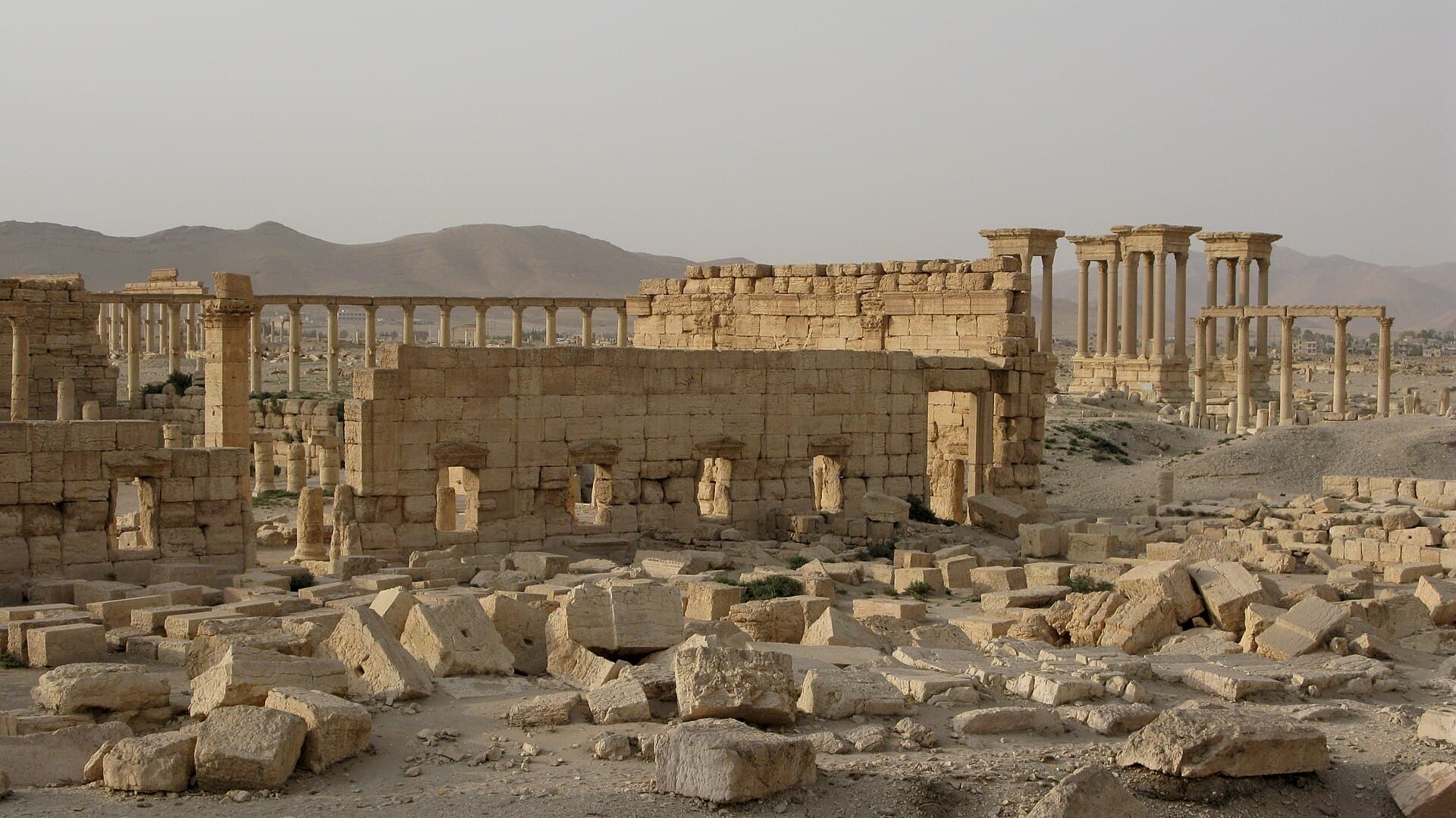
In the Syrian desert, roughly midway between the Mediterranean and the Euphrates, a spring rises at the foot of a low mountain range and feeds an oasis of date palms. The Aramaic name for the place was Tadmor, and it still is: the modern town beside the ruins, in Syria's Homs Governorate, carries the same name the settlement bore in cuneiform archives nearly four thousand years ago. The Greeks and Romans called it Palmyra, the city of palms. For about three centuries either side of the year 100, this oasis was one of the wealthiest cities of the ancient world, and since 1980 its ruins have stood on the UNESCO World Heritage List, listed as in danger since 2013.
What sets Palmyra apart from other ruined cities is how much of itself it chose to record. Its merchants wrote their tax law on stone. Its families built towers full of portraits, each face labelled with a name. And its modern history has made the city a test of what remembrance can survive: sacked by Rome in 273, reduced to a village camped inside its own temple, rediscovered and excavated, then deliberately attacked in our own decade, Palmyra has been destroyed twice and remembered through both.
Palmyra's wealth came from position. Caravans crossing between Roman Syria and the Parthian, later Persian, lands to the east faced hundreds of kilometres of open desert, and the oasis offered water, protection, and organisation at the halfway point. Palmyrene caravan chiefs ran the route as a business: they maintained armed escorts against raiders, kept agents in the towns of the Euphrates and the Persian Gulf, and moved silk, spice, pearls, and glass between the two empires. Inscriptions along its streets thank caravan chiefs by name for bringing convoys home safely, and Palmyrene traders can be traced as far as the Gulf port of Charax and the sea routes toward India.
The city's most famous document is a tax law. In 137 AD the council of Palmyra published its customs regulations on a great stone slab, in Greek and Palmyrene Aramaic side by side, fixing the duty on everything that passed through the oasis: camel loads of dry goods, olive oil, salt, perfume, the use of the springs. The Palmyrene Tariff, rediscovered in 1881 and now held in the State Hermitage Museum in St Petersburg, is the longest inscription in the Palmyrene language to survive, and it records a city that understood its fortune with a bookkeeper's clarity. Palmyra did not produce the wealth of the caravan trade; it measured, protected, and taxed it.
Wealth of that kind built an unusual culture. Palmyrenes spoke and wrote their own dialect of Aramaic in their own rounded script, used Greek for trade and diplomacy, and adopted Roman architectural forms while filling them with far older gods. Chief among these was Bel, a Mesopotamian sky god worshipped alongside the sun god Yarhibol and the moon god Aglibol; near them stood Baalshamin, lord of the heavens, and the Arabian goddess Allat. In Palmyrene sculpture the gods often wear Roman military cuirasses over Parthian trousers, an eastern pantheon dressed for a Mediterranean audience.
The Temple of Bel, dedicated in 32 AD, was the grandest expression of that mixture: a Corinthian colonnaded sanctuary set in a vast walled court, with a cella whose windows, rooftop terraces, and twin shrines followed Near Eastern ritual rather than any Roman pattern book. From its gate the Great Colonnade ran for about 1,100 metres through the city, a porticoed avenue punctuated by a monumental arch and a tetrapylon of four columned pavilions marking the central crossroads. A theatre from the second century opened onto the street, and brackets on the colonnade's columns once carried bronze statues of the citizens who paid for it all. UNESCO's inscription describes the ensemble as a crossroads where Greco-Roman art met Persian and local tradition.
West of the city, along a dry valley, Palmyra's families built their dead a skyline. The tower tombs of the Valley of the Tombs are multi-storey funerary towers, their interiors lined with hundreds of burial compartments; the finest of them, the tower of Elahbel, was raised by four brothers in 103 AD. Each compartment was sealed with a carved limestone bust: the deceased shown half length in embroidered local dress or a Greek cloak, holding a spindle, a book, a child's hand, their name and lineage cut beside them in Palmyrene.
Thousands of these portraits survive. Looted, sold, and collected since the eighteenth century, they are now dispersed through museums from Copenhagen to New York, and researchers on the Palmyra Portrait Project have catalogued around 3,000 of them, the largest body of classical portrait sculpture outside Rome itself. The corpus is remarkable for who it depicts: not emperors or generals but merchants, priests, wives, and children, each insisting on a name and a face. No other ancient city left so complete a gallery of its ordinary citizens.
Palmyra's political history peaked quickly and ended abruptly. After the Persian king captured the Roman emperor Valerian in 260, the Palmyrene lord Odaenathus drove the Persians back and was rewarded with authority over Rome's east; he was assassinated around 267. His widow Zenobia, ruling for their young son Vaballathus, turned that authority into an empire of her own. By 270 her armies had taken Egypt and much of Anatolia, and her mints struck coins bearing her son's image, then her own. The emperor Aurelian marched east in 272, defeated the Palmyrene armies at Antioch and Emesa, and took the city; Zenobia was captured on the Euphrates. One tradition parades her through Rome in golden chains, another has her die before the triumph; her end is unknown.
After a revolt in 273, Aurelian's soldiers sacked Palmyra, and the caravan trade never returned. The city became a Roman garrison, then a Byzantine frontier town, then a modest Islamic settlement, and finally a village of mud-brick houses packed for centuries inside the walled courtyard of the Temple of Bel. In the early 1930s the French Mandate antiquities service moved the villagers to the new town beside the oasis and cleared the sanctuary, opening the way for the systematic excavations that made the ruins famous.
The reach of the caravan city shows in a single monument nearly 4,000 kilometres away. At South Shields on the River Tyne, beside the Roman fort of Arbeia at the eastern end of Hadrian's Wall in Britain, stands the tombstone of Regina, a woman of the British Catuvellauni tribe who died at thirty. She was the freedwoman and wife of Barates, a man from Palmyra, and he had her carved seated in the style of his home city, with her jewellery box and wool basket. Beneath the Latin epitaph he added a line in his own script, the only Palmyrene inscription found in Britain: "Regina, the freedwoman of Barate, alas." A trader or flag-bearer at the empire's cold northern rim, he grieved in the language of the oasis.
In May 2015 the so-called Islamic State seized Palmyra, and held it, with one interruption, until March 2017. What followed was a deliberate campaign against the record. In August 2015 the group dynamited the Temple of Baalshamin and then the Temple of Bel, leaving only the cella's great entrance arch standing in the levelled sanctuary. In September it brought down seven of the best-preserved tower tombs, including the tower of Elahbel, and in October the monumental arch of the colonnade. A second occupation in early 2017 destroyed the tetrapylon and blew out part of the theatre's stage front. The site museum was ransacked and its larger sculptures defaced.
Before the city fell, staff of the antiquities service evacuated hundreds of portable objects to safety. Khaled al-Asaad, who had directed the site and its museum for forty years and continued studying it in retirement, stayed. Detained and interrogated for weeks, the 82-year-old scholar refused to tell his captors where the hidden artifacts had gone, and on 18 August 2015 they killed him. He had spent more than half a century reading the inscriptions of Palmyra, and he is remembered as the man who died keeping faith with them.
Post-war assessments found the picture grim but not hopeless. Much of the colonnade still stands, the plan of the city is intact, and many destroyed monuments collapsed into fields of reusable stone. The Lion of Allat, a monumental temple statue smashed in 2015, was pieced back together by 2017 and now stands in the National Museum of Damascus. Decades of excavation records, Polish and Syrian archives, and modern photogrammetry mean Palmyra is among the most thoroughly documented ruins on earth; the Getty Research Institute's online exhibition The Legacy of Ancient Palmyra gathers the earliest photographs of the site.
How to use that documentation is contested. Conservators broadly favour anastylosis, rebuilding only with original fallen blocks, over replica construction, and warn against fast symbolic projects. The debate became public in 2016 when the Institute for Digital Archaeology unveiled a two-thirds scale marble copy of the destroyed arch in Trafalgar Square: to some a gesture of defiance, to others a machine-carved substitute that risked treating the loss as reversible. Work on the monuments themselves has moved slowly, in a country still recovering from war, and UNESCO keeps Palmyra on the List of World Heritage in Danger while assessments continue.
Palmyra's people did something rare in the ancient world: they wrote themselves down. Not only their kings and gods but their tax rates, their caravan captains, their wives and children, each face carved half length with a name beside it. A visitor in Copenhagen or New York can still be introduced, by name, to a merchant family of the second century. That insistence is why the second destruction failed in its central aim. The towers fell, but the names had already travelled; the temple fell, but a century of photographs and drawings holds its every moulding; and the man who knew the site best accepted death rather than surrender what was hidden. A city that carved its own faces for eternity is remembered as it always intended to be, person by person, name by name, kept by everyone who decided the record was worth the keeping.
The city that taxed the desert
Gods of the oasis in Roman dress
A portrait gallery of ordinary people
Zenobia's empire and the long afterlife
A homesick line at the edge of the world
The second destruction
What can be rebuilt, and what cannot
The keepers of the record
References and resources
- UNESCO World Heritage Centre. "Site of Palmyra." World Heritage List, property no. 23, inscribed 1980; on the List of World Heritage in Danger since 2013. whc.unesco.org/en/list/23.
- Encyclopaedia Britannica. "Palmyra, Syria" and "Zenobia, queen of Palmyra." britannica.com.
- Wikipedia. "Palmyra," "Temple of Bel," "Zenobia," "Khaled al-Asaad," and "Regina (freedwoman)." Retrieved 2026.
- Palmyra Portrait Project, Aarhus University. Catalogue of Palmyrene funerary portraiture. projects.au.dk/palmyraportrait.
- Getty Research Institute. "The Legacy of Ancient Palmyra." Online exhibition, 2017. getty.edu/research.
- Arbeia South Shields Roman Fort, Tyne and Wear Archives and Museums. The tombstone of Regina. arbeiaromanfort.org.uk.