Heritage · Landmark
The Ise Grand Shrine: rebuilt every twenty years for thirteen centuries
In the cypress forests of Mie Prefecture, Japan's most venerated Shinto shrine has been completely rebuilt every twenty years for around 1,300 years. Each cycle, carpenters raise an identical sanctuary on the empty site beside the old one, the deity moves by night, and a new generation of craftsmen learns the work before the old one is gone.Written to last.
By Confinity Heritage Editorial · 2026-08-24 · 7-minute readQuiet tools, kept out of the way.
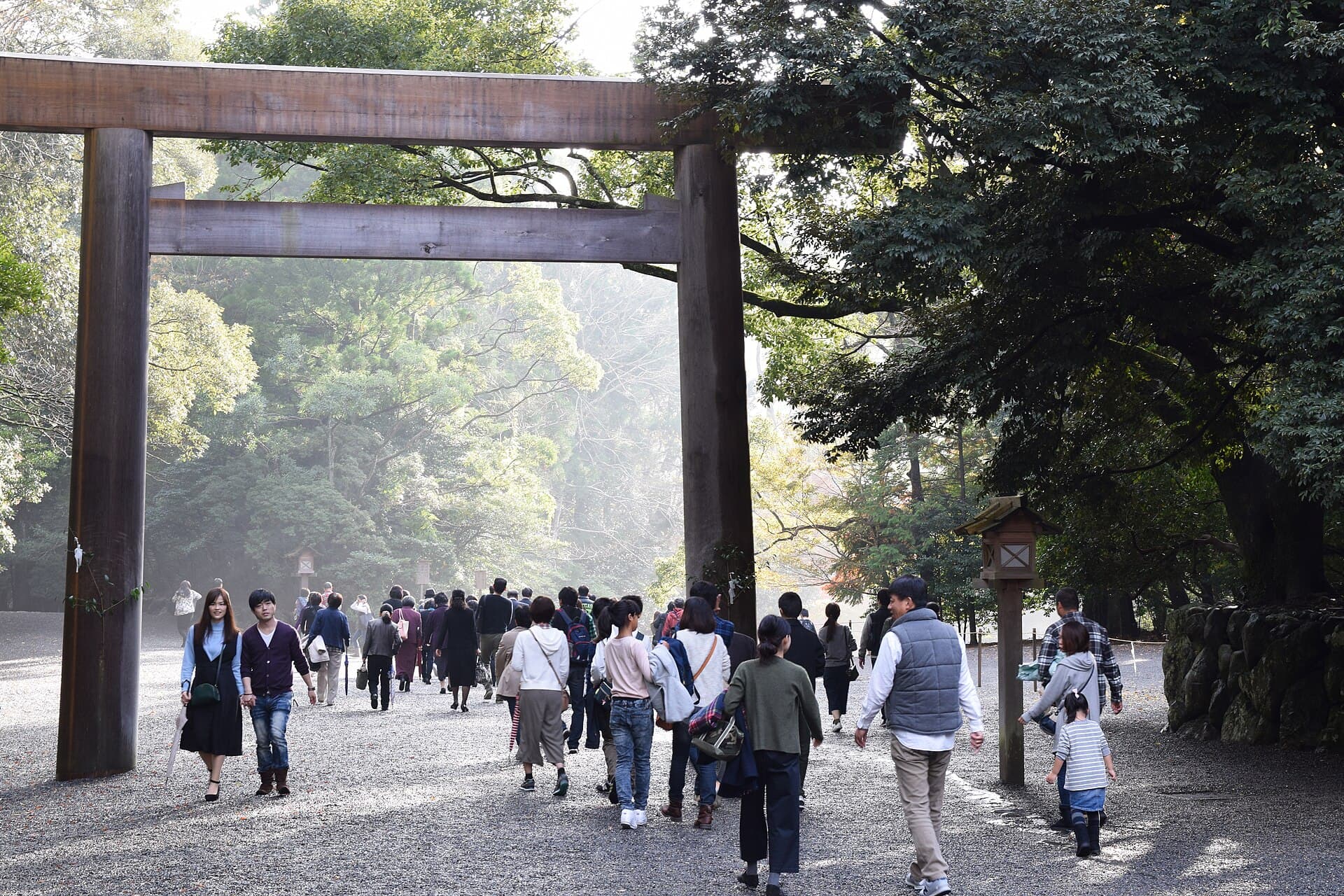
In a forested river valley in Mie Prefecture, in Japan, stands the most venerated shrine complex of the Shinto faith. Ise Jingu gathers around 125 shrines across the city of Ise and its surroundings, centred on two: the Inner Shrine, Naiku, where the sun goddess Amaterasu Omikami is enshrined with the sacred mirror of the imperial regalia, and the Outer Shrine, Geku, dedicated to Toyouke Omikami, the deity of food, clothing, and shelter. The sanctuaries themselves are modest: raised wooden halls of unpainted cypress with steep thatched roofs, in a style older than Buddhism's arrival in Japan, and they look at once archaic and freshly made.
They look freshly made because they are. Every twenty years, in a rite called the Shikinen Sengu, the main sanctuaries of both shrines are taken down and built again, identical in every joint and bundle of thatch, on an empty plot beside the standing buildings. The practice has continued, with acknowledged interruptions, for around 1,300 years: the 62nd rebuilding was completed in 2013, and the 63rd is due in 2033. No other place has renewed itself this way for so long. Ise preserves almost no material and loses almost nothing that matters, because what it hands down is not a building but the complete knowledge of how to make one.
Shrine tradition holds that Amaterasu was enshrined at Ise about two thousand years ago, on land chosen by the princess Yamatohime beside the clear waters of the Isuzu River. At the heart of Naiku rests the Yata no Kagami, the sacred mirror of the three imperial regalia; it is never displayed, and no photograph of it exists. The Outer Shrine came later, by tradition about 1,500 years ago, when Toyouke was brought from Tanba to prepare the sacred food offerings still presented to Amaterasu twice a day, a service that has continued for some fifteen centuries.
Around these two spread the associated shrines, through the town, the rice lands, and the hills. The main halls are built in a style called shinmei-zukuri, in a variant reserved for Ise alone: plain hinoki cypress left unpainted and unlacquered, floors raised on posts set directly into the earth, a ridge carrying crossed finials and rows of tapered billets, and roofs of layered miscanthus thatch. Where a temple like Todai-ji in Nara awes by mass and endurance, Ise works by restraint. The buildings hold no ornament that age could dignify, because they are not permitted to age.
The Shikinen Sengu is less a ceremony than a rolling twenty-year public work. Each main sanctuary stands beside an empty, gravelled plot of equal size, the site of the last rebuilding and the ground of the next. Preparations begin about eight years before the transfer, with rites for cutting the first timbers in the mountains and hauling them to Ise. Carpenters then raise, on the empty plot, a sanctuary that reproduces the standing one completely, down to the profile of each joint and the metal fittings on the doors.
The climax is the Sengyo, the transfer of the deity. At night, behind white silk screens, priests carry the sacred symbol to the new sanctuary, and from that hour the new building is the shrine and the old one is only timber, dismantled with the same care with which it was raised. Its materials are not discarded: the two main pillars are reused in the great torii gates at either end of the Uji Bridge, and beams, boards, and fittings are sent to shrines across Japan, where they serve for decades more. A single rebuilding thus seeds sacred architecture across the country, and the empty plot begins its twenty-year wait.
Nor is the renewal confined to buildings. Each cycle, craftsmen remake the inventory of sacred treasures and vestments, 1,576 objects in all: swords and mirrors, lacquered boxes, woven silks and brocades. Weavers, dyers, and metalworkers hold their commissions the way the carpenters do, renewed on the same twenty-year clock.
The interval is the mechanism. Twenty years is long enough for a young craftsman to master the work and short enough that a master who led one rebuilding can still train, and stand beside, the apprentice who will lead the next. The joinery without nails, the working of hinoki, the thatching, the making of the treasures: all of it is transmitted hand to hand, on schedule, with a living master always present, and nothing is left to be reconstructed from drawings by people who never saw it done.
The rebuilding is best understood as a memory system. Most monuments preserve the past by freezing an object and hoping it survives; Ise preserves the past by refreshing the people. The knowledge of the 7th century reaches the 21st because the chain of teachers never broke for long, and the buildings are the proof, renewed every twenty years like a signature confirming the archive is still readable.
The chain did break once, and the break is part of the story. Through the civil wars of the fifteenth and sixteenth centuries, the imperial court and the shogunate lost the means to fund the rebuilding, and the Sengu lapsed at the Inner Shrine for more than 120 years. The sanctuaries decayed while itinerant priests wandered Japan raising alms to restore them. Revival came in 1585, under the patronage of the unifiers of Japan, and the cycle has run with only minor disturbances since, down to the 62nd rebuilding of 2013.
Far from weakening the tradition, the lapse sharpens it. A rite that failed, was mourned, and was deliberately restarted is a decision, renewed by every generation since. They could have let Ise become a ruin with a famous past; instead they resumed the clock.
Each Sengu consumes on the order of ten thousand hinoki logs, and by the medieval period the forests around Ise could no longer supply them; for centuries the timber has come largely from the Kiso mountains of central Japan. In the 1920s the shrine began a longer repair: a planned reforestation of its own hills, planting hinoki with the aim that its own forests should again supply the rebuilding, an outcome the planners knew lay about two centuries away. Trees from those plantings contributed some of the timber for 2013, and the program continues.
It is worth pausing on what this is: an institution making provision for a need that will fall due long after everyone involved has died, trusting its successors to keep the appointment. The forest is the Sengu's logic extended to the landscape: even the raw material of memory is grown on purpose, generations ahead.
For most of Japanese history, ordinary people could not travel freely, but pilgrimage to Ise was the great exception, and in the Edo period it became a phenomenon. In recurring waves known as okage-mairi, "thanksgiving pilgrimages," millions left their villages, often without permission or money, trusting charity along the road, and walked to the shrine; the wave of 1830 is estimated to have brought several million people in a matter of months. The crowds that stream today through the torii tunnels of Fushimi Inari in Kyoto walk in a tradition of popular pilgrimage that Ise did much to create.
The modern visit keeps the old shape. Pilgrims cross the Uji Bridge over the Isuzu River, itself rebuilt each cycle, and rinse their hands in its water in the old act of purification. The paths lead through ancient groves to the foot of the sanctuaries, and there the approach ends: no one but priests and members of the imperial family passes the innermost fences, photography is not permitted at the sanctuary steps, and above the fences the visitor sees only thatched roofs, crossed finials, and the gleam of gilt fittings. What Ise shows the world has always been the outside of a kept promise.
Ise is not a UNESCO World Heritage Site; it has never been nominated, and not because it fell short. Part of the reason is religious reticence, but part is that the rebuilding sits badly with the doctrine that authenticity resides in original material. By that test a building demolished every twenty years has no original fabric at all. By Ise's test, the stone monument is the fragile one, a single copy slowly eroding, while Ise holds the master and reprints it each generation. Visiting in the 1930s, the architect Bruno Taut ranked the shrine with the Parthenon among the world's supreme buildings, and saw its plainness and its renewal as one idea.
In 1994 conservators from around the world met in Nara to confront this problem, and the resulting Nara Document on Authenticity reset the standard: authenticity, it concluded, must be judged within the culture that made the heritage, and may reside in traditions, techniques, and spirit as much as in material. The case that pressed hardest on the old doctrine was the twenty-year shrine. Ise never applied for the world's certificate of authenticity. Instead it changed the definition.
The lesson of Ise is quietly radical: permanence was never the only way to keep something. The sanctuaries on the Isuzu River are never more than twenty years old, and nothing about them has been lost in thirteen centuries, because the shrine chose transmission over preservation, people over material, a schedule over hope. Every twenty years, before the masters are gone, the whole of what they know is placed in younger hands and proven in public. That is how families keep what matters: not by sealing the past in a box, but by teaching it forward while the teachers still live. Ise has done that on time, again and again, for longer than almost anything else human beings have made.
The mirror and the rice goddess
The twenty-year rebuilding
Why twenty years
The century the rite went dark
A forest planted for rebuildings not yet scheduled
The road to Ise
The monument that redefined authenticity
A memory kept by handing it over
References and resources
- Ise Jingu. Official English site, "Soul of Japan": the shrines, rituals, and the Shikinen Sengu. isejingu.or.jp/en.
- Encyclopaedia Britannica. "Ise Shrine." britannica.com/topic/Ise-Shrine.
- Wikipedia. "Ise Grand Shrine," "Shikinen Sengu," and "Bruno Taut." Retrieved 2026.
- ICOMOS. "The Nara Document on Authenticity," 1994. icomos.org/charters/nara-e.pdf.
- Japan National Tourism Organization. "Ise Jingu Shrine." japan.travel.