Heritage · Landmark
Leptis Magna: the city that wrote itself twice
A Phoenician trading post at the mouth of a Libyan wadi grew into one of the largest cities of Roman Africa, and then gave Rome an emperor who spent a fortune rebuilding his home town. Its people went on cutting public inscriptions in Punic for generations after the city became Roman, sometimes on the same block as the Latin. In 1816 a British consul had some of those blocks shipped to a royal park in England.Written to last.
By Confinity Heritage Editorial · 2026-08-25 · 7-minute readQuiet tools, kept out of the way.
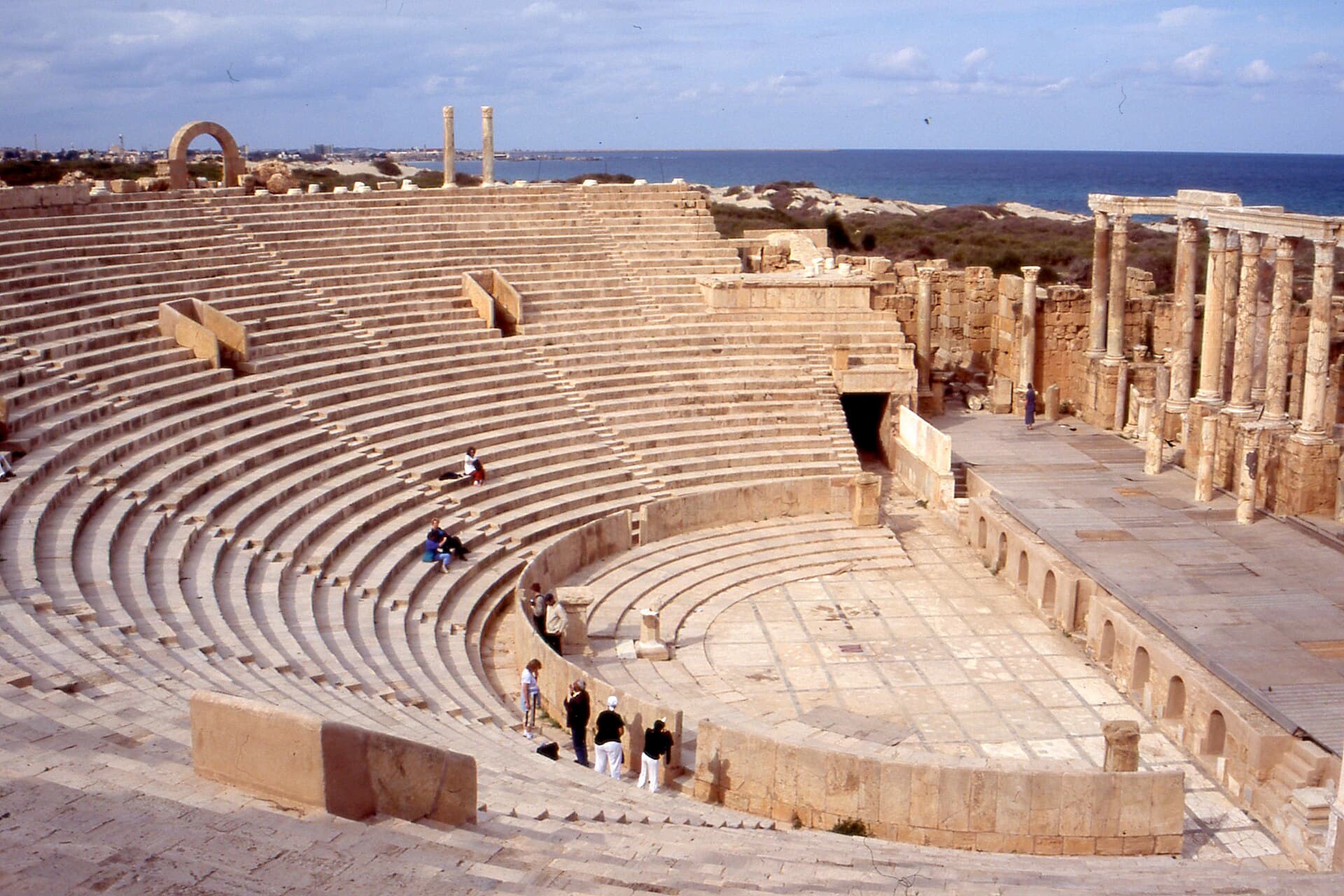
At the mouth of the Wadi Lebda, on the Libyan coast about 130 kilometres east of Tripoli, a Phoenician trading post grew into one of the largest cities of Roman Africa. Its people called it Lpqy. Greeks and Romans made that Lepcis, then Leptis Magna, to separate it from a smaller Leptis near Carthage. The ruins stand at Al Khums in Libya, on the World Heritage List since 1982 and on the Danger List since 2016.
Lepcis is unusual among Roman cities for a reason unrelated to size. It kept two written languages going at once, Latin and Neo-Punic, sometimes on the same block of stone, for generations after the city became Roman. The men who paid for its most Roman buildings signed them with Phoenician names.
The settlement dates from the second half of the seventh century BC. Its gods were Melk'ashtart and Shadrapa rather than the Baal Hammon and Tanit of Carthage, which points to settlers arriving from Phoenicia directly. The name itself is Libyan, so people were already there when the ships came.
The Punic city left more than foundations. Lepcis kept its constitution deep into the Roman period: two annual chief magistrates called suffetes, a council, an assembly. It kept its cults and its script. Its money came from olives. After backing the losing side in Rome's civil wars the city was fined three million pounds of olive oil a year, which implies something like a million trees.
Two of the finest buildings at Lepcis were paid for by the same man. Annobal Tapapius Rufus built the market in 9 and 8 BC, a colonnaded square with two octagonal pavilions for selling food in the shade. A stone table from its portico, now in the site museum, is a measuring standard carrying three units at once: the Punic cubit at 51.5 centimetres, the Roman foot at 29.6, and the Ptolemaic cubit at 52.5. A trader at Lepcis dealt in three directions, and the city put all three yardsticks on one slab.
Then the same man built the theatre, finished in AD 1 or 2, the oldest in Roman Africa and, after Sabratha, the largest on the southern shore of the Mediterranean. Its lower seats were cut into a low hill that had until then been a burial ground, and a colonnaded walk along the top rim shaded the cheap seats. Beyond the stage the ground drops to the water, which is what makes the standard photograph of Leptis Magna: pale limestone benches, a broken colonnade, then the sea.
Above the door from the orchestra into the theatre's west corridor sits a grey limestone lintel a little over three metres wide. The Latin comes first, dating the building by Augustus's titles, then naming the donor: Annobal Rufus, adorner of his country, lover of concord, flamen, sufete, in charge of sacred things, son of Himilcho Tapapius, who saw to the construction at his own expense and dedicated it. Underneath it run two lines of Neo-Punic, a literal translation of the same text.
Read the Latin alone and it looks like a provincial family taking up the language of the empire. Read both halves and the Latin turns out to be full of Punic. Annobal is Hannibal. His father is Himilcho. Sufes is the Punic suffete, an office Rome did not have. Even the honorifics, ornator patriae and amator concordiae, translate Punic titles rather than Roman ones.
That is what a bilingual public inscription tells you that a Latin one alone cannot. Cutting the same words twice, at real cost, on a lintel most people would walk under without looking up, says who was expected to be reading in the year AD 1. Nor was it a parting gesture: ninety years later an octagonal altar went up in the same orchestra with Latin on two faces and Neo-Punic on the third, and the chief magistrates were still called suffetes under Domitian. Latin won in the end, as it did everywhere, and the record of how slowly it won survives because the city wrote everything down twice.
Lucius Septimius Severus was born at Lepcis in 145 or 146, into a family that had already produced two consuls. He was proclaimed emperor in 193 and ruled until 211. He is the reason the ruins are as large as they are.
The city built him a four-way arch where the cardo crossed the decumanus, generally dated to his African journey of 203 and carved with the imperial family in procession and sacrifice. He answered with a programme aimed at his home town: a colonnaded street from the Hadrianic Baths to the port, and a new forum along it, closed at one end by a temple to his family and at the other by a basilica roughly 95 metres by 35, three aisles divided by rows of Egyptian purple granite. Its architrave records that Severus began the work and Caracalla finished it, in 216. Two of its columns carry the labours of Hercules and the retinue of Dionysus, who at Lepcis had been Melk'ashtart and Shadrapa for eight centuries.
He rebuilt the harbour too. The Wadi Lebda was dammed and given another outlet so winter floods could not choke the basin, a quay with mooring blocks was laid along the eastern pier, and a lighthouse of perhaps thirty-five metres went up on the northern mole. UNESCO calls the port one of the outstanding works of Roman technology. After antiquity the dam failed and the basin silted up.
Cassius Dio, who governed Africa in 223, thought the money had been wasted.
Lepcis declined through the third-century crisis, took the tsunami of 365, fell to the Vandals in 439, was recovered for Justinian in 533, and stood largely empty by the Arab conquest around 647. Procopius, writing in the sixth century, already describes part of it under sand.
The dunes then did what no institution did. Sand keeps rain off mortar, holds a leaning wall upright, and makes building stone too much trouble to cart away. European travellers found the ruins in the seventeenth and eighteenth centuries: columns standing out of a beach.
In 1816 Colonel Hanmer Warrington, British consul general at Tripoli, arranged for carved stone to be lifted from Lepcis and shipped home. The stated authority was Yusuf Karamanli, the Ottoman governor, said to have made a present of it to the Prince Regent; a historian commissioned by the Crown Estate has since reported that no document recording that permission has been found. The haul was itemised as 22 granite columns, 15 marble columns, ten capitals, 25 pedestals, seven loose slabs, ten pieces of cornice, five inscribed slabs and fragments of sculpture. It reached England in 1817.
Nobody wanted it. The British Museum left the stones in its courtyard for eight years. In 1826 they were handed to Sir Jeffry Wyatville, George IV's architect at Windsor, who assembled them in Windsor Great Park, with reused stone from elsewhere, into an ornamental ruin on the south shore of Virginia Water. It copies no building at Lepcis. It was built to look like a ruin in a painting, and it still does.
The case here is not the one that attaches to Nimrud, and the difference decides it. At Nimrud the palace was destroyed in 2015, and its throne-room reliefs can still be read because most of them had been carried abroad in the 1840s. Removal there produced a survival nobody intended, so an argument about return has to weigh a history holding less material in it.
Lepcis offers no such trade. The basilica stands. The arch stands. The theatre stands, with its bilingual lintel above the door. Nothing at Virginia Water preserves anything the site has lost; it is a subtraction from what survived. Nor was it presented as rescue at the time: no excavation record was made, no plan drawn of where the pieces came from, and the destination was a royal pleasure ground rather than a collection. Andrew Lane's work for Libyan Studies established provenances nobody in 1816 recorded.
None of which makes it simple. There was no Libyan antiquities service in 1816 to consult, and the columns have stood dry at Virginia Water for two centuries while the site itself was buried, dug and recruited to somebody else's politics. The point is narrower: the strongest defence available at Nimrud, that the material would otherwise be gone, is unavailable here. A lawyer acting for the Libyan authorities began writing to the Crown Estate in October 2021 and had no substantive answer by January 2025.
Italy took Tripolitania from the Ottomans in 1911 and 1912 and treated Roman ruins as title deeds. Digging at Lepcis began in 1920 and ran through the Fascist decades under Renato Bartoccini, Giacomo Guidi and Giacomo Caputo; Guidi found the Severan arch in fragments under the sand in 1928, and it was later re-erected from its own stones. The fieldwork was skilled and it was never disinterested. Massimiliano Munzi's survey of the period concludes that Italian colonial archaeologists were, often deliberately, instruments of political strategy, reconstructing idealised Roman cities for a state that called Libya its Fourth Shore. What that leaves is a site whose Roman layers were exposed with care and whose Punic and Libyan layers went mostly unsought.
Then 2011. Rebel sources claimed pro-Gaddafi forces were storing military equipment among the ruins, and NATO declined to rule out striking the site. No strike came, and afterwards the Libyan archaeologist Hafed Walda reported no visible loss. Through the second civil war, with state and international support gone, residents of Al Khums organised to guard the site. On 14 July 2016 the World Heritage Committee put all five of Libya's World Heritage properties on the List of World Heritage in Danger, citing armed groups on or near them. Leptis Magna is still listed, and the threats now on record are slower ones: decaying stone, drifting sand, graffiti and fire damage, urban encroachment, and tidal flooding working into the circus. A World Heritage Centre and ICOMOS monitoring mission reached the property in February 2025.
The city that cut its own dedications twice is being recorded again, by people standing in it with instruments, while some of its columns hold up an invented ruin in an English park.
Lpqy: the Punic city underneath
The theatre above the sea, and the market before it
Two languages on one lintel
The emperor who came home
What the sand kept
The stones in Windsor Great Park
From the Fourth Shore to the Danger List
References and resources
- UNESCO World Heritage Centre. "Archaeological Site of Leptis Magna." World Heritage List, property no. 183, inscribed 1982, criteria (i)(ii)(iii); on the List of World Heritage in Danger since 2016. whc.unesco.org/en/list/183.
- Reynolds, J. M., and J. B. Ward-Perkins. The Inscriptions of Roman Tripolitania. Rome: British School at Rome, 1952. Online edition, King's College London, 2009: IRT 318, 319, 321-323, 347 and 428. inslib.kcl.ac.uk/irt2009.
- Lane, Andrew. "The Ruins at Virginia Water (part 1)." Libyan Studies 34 (2004): 67-94; and "Emperor's Dream to King's Folly: The Provenance of the Antiquities from Lepcis Magna Incorporated into the 'Ruins' at Virginia Water (part 2)." Libyan Studies 43 (2012): 67-80.
- Munzi, Massimiliano. "Italian archaeologists in colonial Tripolitania." Libyan Studies 43 (2012): 81-110.
- Ward-Perkins, J. B. The Severan Buildings of Lepcis Magna: An Architectural Survey. Ed. Philip Kenrick. London: Society for Libyan Studies, 1993.
- Livius.org. Jona Lendering, "Lepcis Magna," with the site pages on the theatre, the macellum, the port and the Severan basilica. livius.org/articles/place/lepcis-magna.
- The National. Tariq Tahir, "Revealed: How chunk of Libyan heritage ended up in grounds of UK's Windsor Castle." 24 January 2025. thenationalnews.com.