Heritage · Landmark
The Konark Sun Temple: a chariot carved in stone
On the shore of the Bay of Bengal, a thirteenth-century king built a temple in the form of the sun god's chariot, with twelve pairs of carved stone wheels and seven straining horses. The wheels still work as sundials, its greatest hall has been sealed and full of sand since 1903, and European sailors once steered by it as the Black Pagoda.Written to last.
By Confinity Heritage Editorial · 2026-08-23 · 7-minute readQuiet tools, kept out of the way.
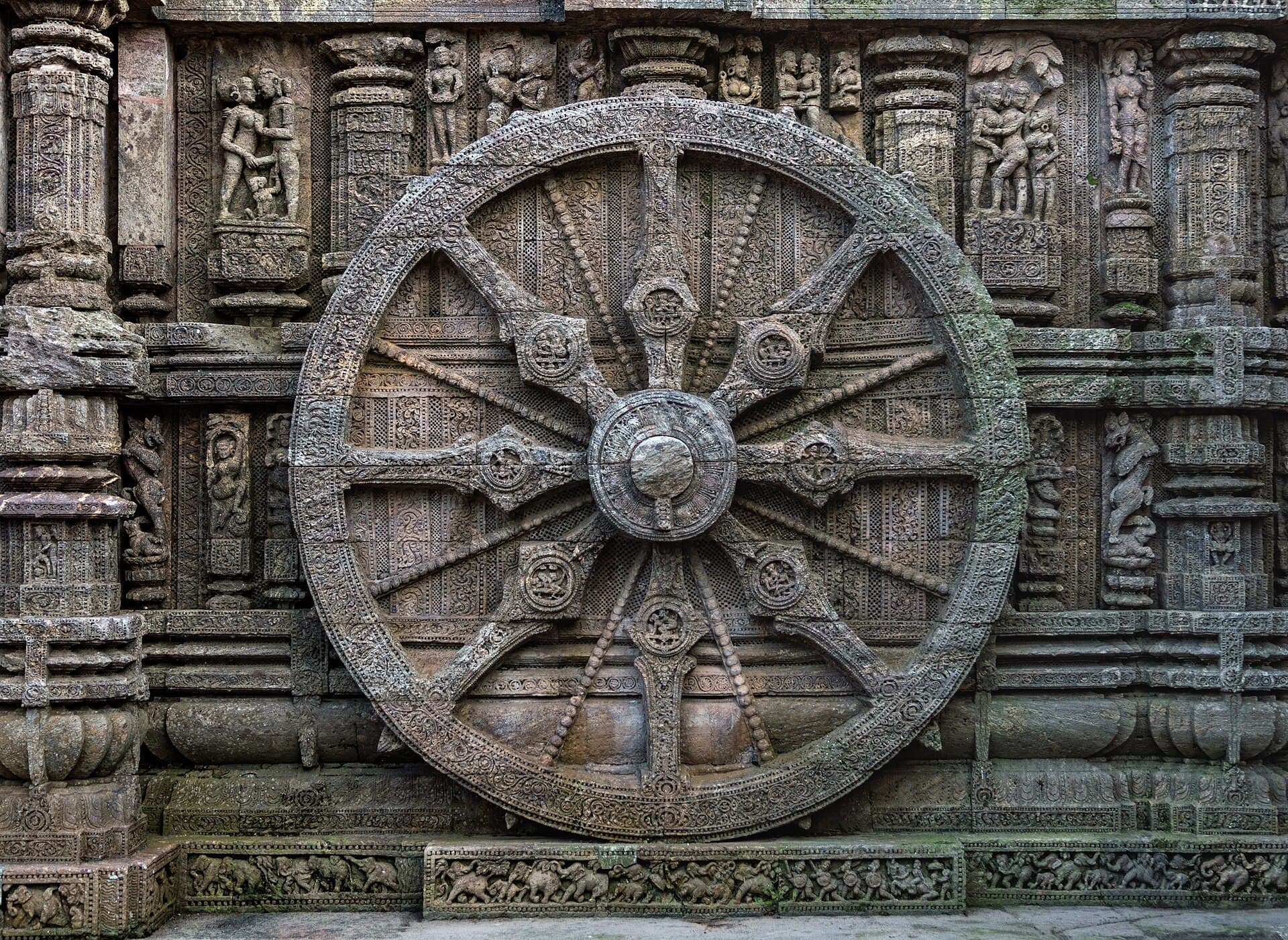
Where the Odisha coastline meets the Bay of Bengal, in eastern India, a temple stands that was never content to be a building. Its architects conceived it as a vehicle: the chariot of Surya, the sun god, caught in stone at the moment of setting out across the sky. Twelve pairs of wheels, each nearly three metres across and carved in deep relief, line the base of the structure. Seven stone horses strain at its front. The name of the place declares its dedication, for Konark joins the Sanskrit words kona, a corner or angle, and arka, the sun. Since 1984 the temple has been inscribed on the UNESCO World Heritage List as one of the most celebrated monuments of the subcontinent.
The chariot was built around 1250 by King Narasimhadeva I of the Eastern Ganga dynasty, a ruler whose reign marked the high point of medieval Odishan power and whose temple was meant to announce it. What survives today is both immense and incomplete. The main sanctuary tower, which may have risen more than sixty metres, collapsed centuries ago, and the great audience hall that remains has been closed to every visitor since 1903, when British engineers filled it with sand and sealed its doors to keep it standing. The result is one of the strangest situations in world architecture: a temple whose largest surviving room has been dark, full, and silent for over a century, while the wheels outside it go on telling the time by shadow, just as they were cut to do seven hundred years ago.
Narasimhadeva I ruled from 1238 to 1264, and tradition connects the temple to his military successes against the sultans of Bengal, a thanksgiving raised around 1250 at the height of his power, on a stretch of coast associated with Surya long before the Ganga kings. What his architects did was take a metaphor that Indian art had used for centuries, the sun crossing the sky in a horse-drawn chariot, and build it at the scale of a cathedral.
The conceit is worked out with complete conviction. The twelve pairs of wheels are commonly read as the months of the year, or the twenty-four as the hours of the day, and the seven horses as the days of the week, so the temple becomes a calendar as much as a vehicle. The whole structure faces east, positioned so that the first light of dawn off the sea struck the entrance. In the larger canon of Indian temple architecture the Konark chariot stands with the great achievements of other medieval kingdoms, the way the ruins of Hampi speak for Vijayanagara further south, as a moment when a dynasty put its entire idea of itself into stone.
The wheels are the temple's signature, and they are more than ornament. Each is carved as a working wheel, with a hub, a rim, an axle, and spokes, every surface dense with medallions of dancers, animals, and foliage. Eight thick spokes divide the wheel, with eight thinner spokes set between them, and the carvers cut a line of small beads along the edges of the spokes. Together these make a functioning sundial. The day from sunrise to sunrise divides among the eight major spokes, each marking a period of three hours, so the wide spokes read as hours in blocks. The minor spokes halve those intervals, and the beads between them divide the wheel face into minutes, roughly three minutes to a bead. To read the dial, a visitor places a finger or a thin stick upright at the centre of the hub and watches where its shadow falls: which major spoke, which minor spoke, which bead. Guides at the site still demonstrate the method, and the reading it gives tracks the local solar time to within a few minutes. A dial that has needed no winding, repair, or adjustment since the thirteenth century is a fair claim to being among the oldest working instruments on earth.
The temple as built had the standard elements of the Kalinga style at an unprecedented scale. Behind the pillared dance hall stood the jagamohana, the audience hall, a stepped pyramid of stone about thirty-nine metres high, and behind that rose the deul, the sanctuary tower over the image of Surya, which scholars estimate may have stood sixty metres or more, the tallest temple tower of its age in India. That tower is gone. When it fell, and why, remains one of the standing debates of Indian architectural history. One line of argument blames the ground itself, holding that the enormous mass was raised too quickly on sandy coastal foundations that could not carry it. Another points to the sixteenth century, when the general known as Kalapahad sacked Odisha's temples around 1568 and is said to have desecrated Konark. Others cite the repeated cyclones and lightning strikes of the Bay of Bengal coast, and some early accounts suggest the tower may never have been finished at all. What is certain is that by the nineteenth century the sanctuary was a mound of fallen stone, and the jagamohana, itself slowly failing, was the largest thing left standing.
The rescue of that hall produced the temple's most arresting modern fact. By 1900 the jagamohana's interior was shedding stone, its corbelled roof threatening to come down as the tower had. The British administration of Bengal, under Lieutenant Governor John Woodburn, chose a blunt remedy: engineers filled the entire hall with sand, packing the interior solid so the walls could no longer buckle inward, and in 1903 the doorways were walled up with stone. The hall has been sealed ever since. No one alive has stood inside the temple's greatest room. Whatever carving lines its inner walls has been pressed in darkness against a body of sand for more than a century, preserved by entombment, a building kept standing by being made solid. Surveys suggest the sand has settled over the decades, and what to do about it now sits at the centre of the site's conservation debates.
If the wheels are the temple's instruments, the friezes are its memory. Almost no surface at Konark was left plain. Around the platform run processions of nearly two thousand elephants, no two alike, alongside horses, soldiers, and hunters. Musicians and dancers fill the terraces of the jagamohana roof, colossal female figures with drums, cymbals, and veenas, a stone orchestra facing the sea. Between them the carvers set the ordinary life of thirteenth-century Odisha: royal courts and departures for war, pilgrims and cooks, sailors and a giraffe that records trade contact with Africa. The temple is also one of the principal homes, with Khajuraho, of the erotic sculpture of the medieval Indian canon: couples in intimate embrace fill many of the niches, carved with the same care as the deities, part of the temple's larger programme of depicting life whole. Rabindranath Tagore wrote of Konark that here the language of stone surpasses the language of man, and the friezes are what he meant.
For the European ships working up the Bay of Bengal, the temple served an entirely practical purpose. Its dark mass on the low coastline was a fixed point for navigation, and sailors' charts named it the Black Pagoda, in contrast to the whitewashed Jagannath temple at Puri down the coast, their White Pagoda. Around the landmark, stories gathered. The most persistent tells of a great loadstone crowning the tower, a magnet powerful enough to pull ships toward the shore and confuse their compasses, until sailors landed and carried it off, and the tower, robbed of the keystone holding its stones in balance, began to fall. No evidence supports the magnet, but the legend records how badly the tower's fall demanded explanation. Another tale honours the builders: twelve hundred artisans laboured twelve years on the temple, and when the final crowning stone defeated them, the young son of the chief architect set it in place overnight, then gave his life to spare the twelve hundred from the king's anger. The story is legend, but the number has become the temple's shorthand for the human effort it consumed.
Konark today is among the most visited monuments in eastern India, in the care of the Archaeological Survey of India since the early twentieth century. Three kilometres away, Chandrabhaga beach draws thousands of pilgrims each February for the Chandrabhaga Mela, when devotees bathe at dawn and salute the rising sun, and every winter the temple grounds host a festival of classical dance against the floodlit stone. Conservation remains a live argument. Specialists have long debated whether the 1903 sand filling should be removed, now that modern engineering could support the hall by other means, and whether opening the interior would reveal preserved carving or invite collapse; laser scanning and structural studies have been commissioned to map the monument's condition before any decision is taken. Meanwhile the temple has passed into the everyday life of the country in the most literal way: the carved wheel of Konark appears on the reverse of India's ten rupee banknote, so a likeness of the sundial rides in pockets from Kashmir to Kanyakumari.
What Konark keeps, in the end, is time itself. The kingdom that built it is gone, the god's image no longer stands in the sanctuary, and the tower fell so long ago that no one can say for certain how. Yet the wheels still turn their shadows. A visitor with a stick and a patient eye can read the hour from a dial cut in the reign of Narasimhadeva I, while behind the sealed doors the temple's greatest room waits in the dark, holding whatever the sand has kept. Places endure in different ways: some as ruins, some as restorations, and a few, like this one, as instruments that go on doing their work. The chariot of the sun has not moved in seven centuries, and it has never once been late.
A king's offering to the sun
Wheels that tell the time
The tower that fell
Sealed with sand
A carved record of a living world
The Black Pagoda and the loadstone crown
The temple in modern India
A timepiece that outlived its tower
References and resources
- UNESCO World Heritage Centre. "Sun Temple, Konarak." World Heritage List, property no. 246, inscribed 1984. whc.unesco.org/en/list/246.
- Archaeological Survey of India. "Sun Temple, Konarak." Ticketed monuments, Bhubaneswar Circle. asi.nic.in.
- Encyclopaedia Britannica. "Konarak" and "Eastern Ganga dynasty." britannica.com.
- Wikipedia. "Konark Sun Temple," "Narasimhadeva I," and "Indian 10-rupee note." Retrieved 2026.
- Odisha Tourism. "Konark" and "Chandrabhaga Beach." odishatourism.gov.in.