Heritage · Landmark
Sigiriya: the citadel on the Lion Rock
A usurper king raised his palace on a granite tower nearly 180 metres above the Sri Lankan plain, ringed by water gardens that still run after rain. Fifteen centuries on, its cloud maidens and graffiti wall keep the memory of everyone who ever climbed it.Written to last.
By Confinity Heritage Editorial · Updated 2026-07-31 · 7-minute readQuiet tools, kept out of the way.
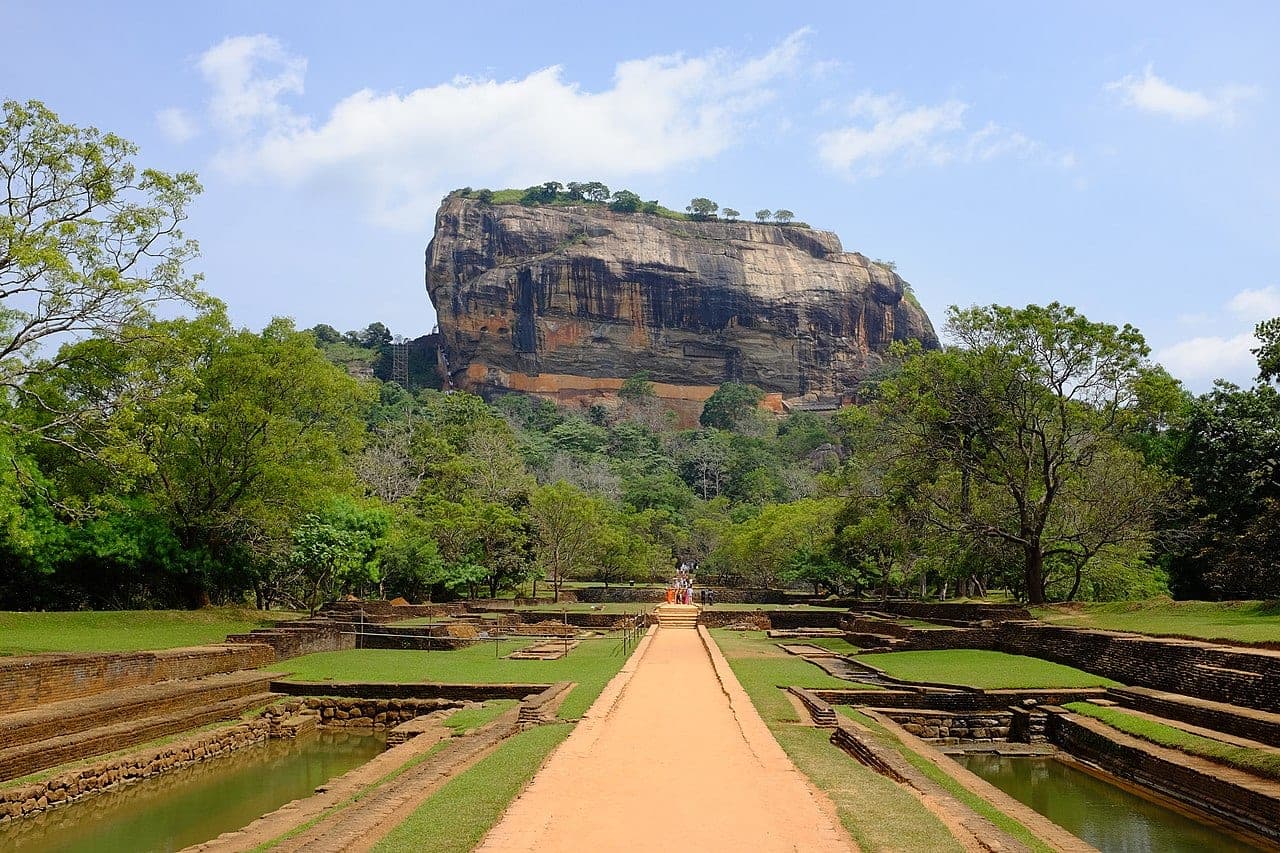
Rising sheer from the green plain of Sri Lanka's central lowlands, the granite mass of Sigiriya lifts nearly 180 metres into the sky, its flat crown some 349 metres above the sea (Wikipedia). From a distance it reads as a single dark tooth of rock in an ocean of paddy and forest, so abrupt that it seems less a hill than an event. Travellers have looked up at it for more than two thousand years, and for a few extraordinary decades in the fifth century it carried on its summit the palace of a king.
The name means Lion Rock, from the Sinhala Sinhagiri, and it once described a real thing: a colossal lion of brick and plaster whose paws still guard the final stair to the summit, as they have since the reign of King Kashyapa. Around and below them lies one of the oldest designed landscapes to survive anywhere, a scheme of water gardens, boulder gardens and terraces laid out with an engineer's precision. Sigiriya is at once a fortress, a pleasure garden, a gallery of painting, and, for the long centuries that followed, a place of prayer. It is also, in the fullest sense, a place of memory.
Long before any palace crowned it, the rock was a refuge for the devout. Sheltered caves at its base carry Brahmi inscriptions and cut drip-ledges dating to around the third century BCE, marks left by Buddhist monks who used the overhangs as a forest hermitage (UNESCO). Then, in 477 CE, it became the stage for one of the darkest stories in the island's chronicles.
King Dhatusena of Anuradhapura had two sons: Moggallana, born of the royal consort and heir to the throne, and Kashyapa, born of a lesser wife. Kashyapa seized power in a coup, and, according to the Culavamsa chronicle, had his father walled up alive and left to die (Wikipedia). Moggallana fled to India, vowing to return, and the usurper was left to rule with vengeance hanging over him.
It was fear, as much as ambition, that built Sigiriya. Kashyapa, who reigned from 477 to 495 CE, abandoned the open royal city of Anuradhapura and moved his capital to the rock, where a sheer summit and a ring of gardens and moats offered both defence and grandeur (Britannica). On the flat top, over an area of roughly a hectare and a half, he raised a palace with cisterns cut into the living stone. Halfway down, on a broad terrace, he built the lion gateway that gave the rock its name. For eighteen years the outcast king held his court in the sky.
What survives at Sigiriya is not only a citadel but a garden, and it is the garden that most astonishes. Laid out on the gently sloping western approach, it ranks among the oldest landscaped gardens known anywhere, and one of the best preserved from the ancient world (Wikipedia). The design moves through three distinct kinds of ground, so that the approach becomes a sequence of moods.
 The rock is the plug of an eroded volcano, and the gardens at its foot are among the oldest landscaped grounds anywhere still readable on the ground. Photograph by Tlbatt, CC BY-SA 4.0, via Wikimedia Commons.
Nearest the entrance lie the water gardens, set out on a strict symmetrical plan along a central axis. Rectangular bathing pools, islanded pavilions and channels are arranged so that water is both mirror and ornament, and beneath the surface runs a network of conduits that fed fountains by gravity and simple pressure. Remarkably, some of those fountains still lift water after heavy rain, which places them among the oldest working hydraulic devices on earth (Britannica).
Beyond the formal pools the ground breaks into the boulder gardens, where winding paths thread between huge natural rocks left where they fell. Many carry cut notches and sockets, the fixings for brick walls and timber pavilions that once stood against them. Higher still, the terraced gardens climb toward the base of the rock in a series of concentric, brick-retained levels, linked by limestone stairways that climb by degrees to the foot of the sheer ascent.
Partway up the western face, in a sheltered pocket of rock, survives the most celebrated painting of ancient Sri Lanka: the Sigiriya frescoes. Figures of women rise from a bank of cloud, bare to the waist and laden with flowers and jewels, so that they have long been known as the cloud maidens or celestial nymphs. Medieval visitors believed the gallery once held some five hundred such figures; today only about eighteen remain, protected in their recess from sun and rain (Wikipedia). Their identity is still debated, whether apsaras, court ladies, or figures in a procession, but their grace has not faded.
Below the paintings runs the mirror wall, a long parapet of brick faced with a lime plaster so highly polished that, by tradition, the king could see his reflection as he walked. The plaster, said to have been worked from lime, egg white and honey and burnished until it shone, still survives in places along the gallery. What makes the wall priceless is what later visitors did to it. From roughly the eighth to the tenth centuries, travellers scratched verses into its surface, most of them written in praise of the painted women above. The archaeologist Senarat Paranavitana deciphered and published 685 of these verses in his study Sigiri Graffiti, drawn from more than fifteen hundred inscriptions, and they count among the earliest bodies of Sinhala poetry to survive (Wikipedia). The graffiti are a rare record of ordinary feeling: a thousand-year-old crowd, moved by beauty, leaving its name.
At the northern end of the terrace stood the lion. A monumental figure of brick and plaster once rose against the rock, and the stairway to the summit passed between its paws and up through its throat, so that every visitor entered the royal citadel through the body of a lion. Only the paws, massive and clawed, survive today, flanking the final climb (UNESCO). From them the rock takes its name, and to stand between them is to feel the scale of the ambition that shaped the place.
Kashyapa's reign ended as violently as it began. In 495 CE Moggallana returned from India with an army, and the two brothers met in battle on the plain below the rock. The chronicles relate that Kashyapa's forces, seeing his war elephant turn aside, believed their king was in retreat and abandoned the field; isolated and beaten, Kashyapa took his own life (Wikipedia). Moggallana carried the capital back to Anuradhapura, and the brief age of the rock as a seat of kings was over.
The rock then returned to the use it had known before the palace. Buddhist monasteries were re-established at Sigiriya and at the neighbouring outcrops of Pidurangala and Ramakale, and the site served as a monastic community for centuries, until roughly the fourteenth century, after which it was largely given back to the forest (UNESCO). For some four hundred years the gardens silted, the walls fell, and the jungle closed over the terraces.
The wider world came back to it in the nineteenth century. A British officer, Jonathan Forbes, recorded the rock in 1831, and from the 1890s the archaeologist H.C.P. Bell carried out the first systematic surveys and excavations, clearing the gardens (Britannica). The work continued through the twentieth century, culminating in the major campaign of Sri Lanka's Cultural Triangle project, which uncovered and stabilised much of what visitors see today.
Sigiriya was inscribed on the UNESCO World Heritage List in 1982 as the Ancient City of Sigiriya, recognised under three cultural criteria for its influence on later art and architecture, its testimony to a civilisation that has vanished, and its value as an outstanding example of an ancient urban and garden plan (UNESCO). The listing covers not only the summit but the whole planned landscape around it: the gardens, moats and ramparts that make Sigiriya a complete design rather than a single monument.
Protection brings its own pressures. Sigiriya is one of Sri Lanka's most visited places, and the daily climb of thousands of feet, together with heat, humidity and the monsoon, wears at the fragile fabric of the site. The frescoes are especially vulnerable to light, damp and the touch of hands, and access to them is now closely controlled. Conservation work by the Sri Lankan authorities, at times with international support, continues on the paintings, the mirror wall and the brickwork of the gardens: the patient repair that keeps a fifteen-hundred-year-old place standing.
Sigiriya endures because it holds so many kinds of memory at once. It remembers a son's crime and a father's death, and the loneliness of a king who built a palace in the sky because he feared the ground. It remembers the skill of engineers who taught water to climb, and of painters who fixed a moment of beauty on a cliff. It remembers, in the verses of the mirror wall, the voices of ordinary travellers who wrote down what they felt, and it remembers the quiet centuries of monks who prayed among the ruins after the kings had gone.
To climb it now is to move through all of that time in a single afternoon: past pools that still fill with rain, between the paws of the vanished lion, up to a summit where only foundations meet the wind. What Kashyapa built to secure a throne outlived the throne entirely, and became something he never intended: a keeping-place for the memory of everyone who has passed this way. It gathers the lives that touched it and carries them forward, so that a distant king, an anonymous poet, and a visitor today are all, for a moment, held together on the same rock.
The rock is the plug of an eroded volcano, and the gardens at its foot are among the oldest landscaped grounds anywhere still readable on the ground. Photograph by Tlbatt, CC BY-SA 4.0, via Wikimedia Commons.
Nearest the entrance lie the water gardens, set out on a strict symmetrical plan along a central axis. Rectangular bathing pools, islanded pavilions and channels are arranged so that water is both mirror and ornament, and beneath the surface runs a network of conduits that fed fountains by gravity and simple pressure. Remarkably, some of those fountains still lift water after heavy rain, which places them among the oldest working hydraulic devices on earth (Britannica).
Beyond the formal pools the ground breaks into the boulder gardens, where winding paths thread between huge natural rocks left where they fell. Many carry cut notches and sockets, the fixings for brick walls and timber pavilions that once stood against them. Higher still, the terraced gardens climb toward the base of the rock in a series of concentric, brick-retained levels, linked by limestone stairways that climb by degrees to the foot of the sheer ascent.
Partway up the western face, in a sheltered pocket of rock, survives the most celebrated painting of ancient Sri Lanka: the Sigiriya frescoes. Figures of women rise from a bank of cloud, bare to the waist and laden with flowers and jewels, so that they have long been known as the cloud maidens or celestial nymphs. Medieval visitors believed the gallery once held some five hundred such figures; today only about eighteen remain, protected in their recess from sun and rain (Wikipedia). Their identity is still debated, whether apsaras, court ladies, or figures in a procession, but their grace has not faded.
Below the paintings runs the mirror wall, a long parapet of brick faced with a lime plaster so highly polished that, by tradition, the king could see his reflection as he walked. The plaster, said to have been worked from lime, egg white and honey and burnished until it shone, still survives in places along the gallery. What makes the wall priceless is what later visitors did to it. From roughly the eighth to the tenth centuries, travellers scratched verses into its surface, most of them written in praise of the painted women above. The archaeologist Senarat Paranavitana deciphered and published 685 of these verses in his study Sigiri Graffiti, drawn from more than fifteen hundred inscriptions, and they count among the earliest bodies of Sinhala poetry to survive (Wikipedia). The graffiti are a rare record of ordinary feeling: a thousand-year-old crowd, moved by beauty, leaving its name.
At the northern end of the terrace stood the lion. A monumental figure of brick and plaster once rose against the rock, and the stairway to the summit passed between its paws and up through its throat, so that every visitor entered the royal citadel through the body of a lion. Only the paws, massive and clawed, survive today, flanking the final climb (UNESCO). From them the rock takes its name, and to stand between them is to feel the scale of the ambition that shaped the place.
Kashyapa's reign ended as violently as it began. In 495 CE Moggallana returned from India with an army, and the two brothers met in battle on the plain below the rock. The chronicles relate that Kashyapa's forces, seeing his war elephant turn aside, believed their king was in retreat and abandoned the field; isolated and beaten, Kashyapa took his own life (Wikipedia). Moggallana carried the capital back to Anuradhapura, and the brief age of the rock as a seat of kings was over.
The rock then returned to the use it had known before the palace. Buddhist monasteries were re-established at Sigiriya and at the neighbouring outcrops of Pidurangala and Ramakale, and the site served as a monastic community for centuries, until roughly the fourteenth century, after which it was largely given back to the forest (UNESCO). For some four hundred years the gardens silted, the walls fell, and the jungle closed over the terraces.
The wider world came back to it in the nineteenth century. A British officer, Jonathan Forbes, recorded the rock in 1831, and from the 1890s the archaeologist H.C.P. Bell carried out the first systematic surveys and excavations, clearing the gardens (Britannica). The work continued through the twentieth century, culminating in the major campaign of Sri Lanka's Cultural Triangle project, which uncovered and stabilised much of what visitors see today.
Sigiriya was inscribed on the UNESCO World Heritage List in 1982 as the Ancient City of Sigiriya, recognised under three cultural criteria for its influence on later art and architecture, its testimony to a civilisation that has vanished, and its value as an outstanding example of an ancient urban and garden plan (UNESCO). The listing covers not only the summit but the whole planned landscape around it: the gardens, moats and ramparts that make Sigiriya a complete design rather than a single monument.
Protection brings its own pressures. Sigiriya is one of Sri Lanka's most visited places, and the daily climb of thousands of feet, together with heat, humidity and the monsoon, wears at the fragile fabric of the site. The frescoes are especially vulnerable to light, damp and the touch of hands, and access to them is now closely controlled. Conservation work by the Sri Lankan authorities, at times with international support, continues on the paintings, the mirror wall and the brickwork of the gardens: the patient repair that keeps a fifteen-hundred-year-old place standing.
Sigiriya endures because it holds so many kinds of memory at once. It remembers a son's crime and a father's death, and the loneliness of a king who built a palace in the sky because he feared the ground. It remembers the skill of engineers who taught water to climb, and of painters who fixed a moment of beauty on a cliff. It remembers, in the verses of the mirror wall, the voices of ordinary travellers who wrote down what they felt, and it remembers the quiet centuries of monks who prayed among the ruins after the kings had gone.
To climb it now is to move through all of that time in a single afternoon: past pools that still fill with rain, between the paws of the vanished lion, up to a summit where only foundations meet the wind. What Kashyapa built to secure a throne outlived the throne entirely, and became something he never intended: a keeping-place for the memory of everyone who has passed this way. It gathers the lives that touched it and carries them forward, so that a distant king, an anonymous poet, and a visitor today are all, for a moment, held together on the same rock.
A throne bought with a father's life
Gardens of water, boulder and terrace
The maidens, the mirror, and the lion
After the king: monks, jungle, and rediscovery
A protected rock
What the rock remembers
References and resources
- UNESCO World Heritage Centre: Ancient City of Sigiriya, inscribed 1982
- Encyclopaedia Britannica: Sigiriya
- Wikipedia: Sigiriya
- Senarat Paranavitana, Sigiri Graffiti (Oxford University Press, 1956): the standard study of the mirror-wall verses.
- Central Cultural Fund of Sri Lanka: the Cultural Triangle programme, which conserves Sigiriya