Heritage · Landmark
Hampi: the capital that fell and the temple that lived
A granite valley on the Tungabhadra river held one of the largest cities on Earth, the capital of the Vijayanagara Empire, until a single battle in 1565 emptied it for good. Persian and Portuguese travellers wrote that nothing they had seen compared to it. Amid the ruins, the Virupaksha temple never closed, and its unbroken worship still carries the memory of everything that fell around it.Written to last.
By Confinity Heritage Editorial · 2026-08-23 · 7-minute readQuiet tools, kept out of the way.
On the banks of the Tungabhadra river in northern Karnataka, in India, a plain of enormous granite boulders holds the ruins of one of the largest cities the early modern world ever built. The village that gives the site its name, Hampi, is today a small place of temples, banana groves, and pilgrim lodgings. The city that surrounds it, Vijayanagara, the "city of victory," was the capital of an empire that ruled most of southern India for more than two centuries. Its remains spread across more than four thousand hectares of hills, irrigated valleys, and walled enclosures, and since 1986 they have been inscribed on the World Heritage List as the Group of Monuments at Hampi.
Two facts about Hampi sit side by side and refuse to resolve. The first is the scale of what stood here: around the year 1500, Vijayanagara was home to several hundred thousand people, and visitors from Persia and Portugal ranked it among the greatest cities on Earth. The second is the speed of its ending. In 1565 a single lost battle emptied the capital within months, and it was never lived in as a city again. Between them stands a third, quieter fact: in the middle of the ruin field, one temple never stopped. The Virupaksha shrine was a place of worship before the empire existed, served the empire while it lasted, and has kept its daily rites through every century since.
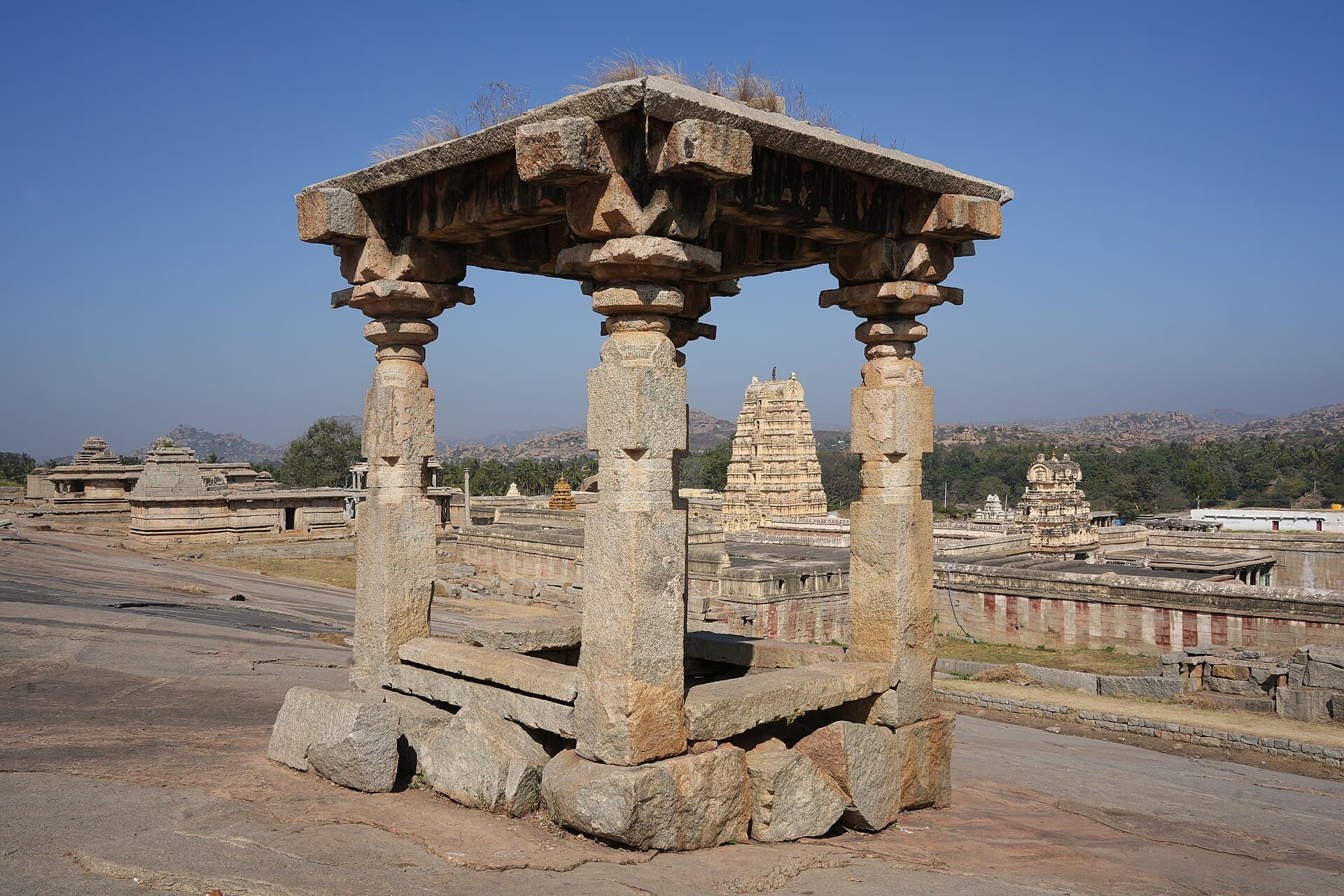
Long before there were kings at Hampi there was the river and the goddess. Pampa, a local deity identified with the Tungabhadra itself, was worshipped on these banks in early medieval times, and her marriage to Shiva, honoured here as Virupaksha, made the ford a place of pilgrimage. The name Hampi descends from Pampa. Inscriptions and shrine remains show that worship at the Virupaksha temple reaches back centuries before the empire, and the small stone temples scattered over Hemakuta hill, the rise from which the hero photograph above looks down on the great gopuram, belong to that older sacred landscape rather than to the imperial city.
The land carries an older story still. In local and textual tradition, the boulder hills along this stretch of the Tungabhadra are Kishkindha, the monkey kingdom of the Ramayana, where the exiled Rama met Hanuman and made his alliance with the monkey king Sugriva. Anjaneya Hill, rising across the river, is honoured in local tradition as the birthplace of Hanuman, and pilgrims still climb its long whitewashed stair. The founders of Vijayanagara were not settling an empty place; they built their capital inside a landscape people already held sacred, and drew authority from it.
The empire was founded in 1336 by two brothers, Harihara and Bukka of the Sangama family, at a moment when the sultanates of the north were pressing into peninsular India. Their city grew into the seat of a state that came to dominate the south, and under Krishnadevaraya, who reigned from 1509 to 1529, it reached its height. Estimates put the capital's population around 1500 at between 250,000 and 500,000 people, and historians have often described it as second in size only to Beijing among the cities of its time.
The scale is still legible on the ground. Lines of fortification ran for miles across the hills, and the Persian envoy Abdur Razzaq counted seven rings of wall between the outer edge and the citadel. Canals cut from the Tungabhadra fed tanks, baths, and fields, and some still water the banana plantations growing among the ruins. The city held merchant quarters, mosques for its Muslim soldiers and traders, Jain temples, and long colonnaded bazaars aligned on its great shrines.
Vijayanagara is unusually well described for a medieval Indian city because foreign visitors kept writing about it in tones of disbelief. Abdur Razzaq, who came from Herat as an ambassador in 1443, wrote that the city was such that the eye had not seen a place like it in all the world, and reported bazaars of jewellers openly selling pearls, rubies, and diamonds.
The fullest account came from the Portuguese traveller Domingo Paes, who visited around 1520, in Krishnadevaraya's reign. Paes judged the city as large as Rome and wrote about what daily abundance looked like: markets heaped with fruit and game, streets where roses were sold every morning because the people could not live without them, and a court whose festivals filled platforms and pavilions with processions of elephants, horses, and dancers. His countryman Fernao Nunes followed around 1535 and set down a history of the kings. Their chronicles, translated in Robert Sewell's A Forgotten Empire in 1900, remain the closest thing we have to walking the living city.
The builders of Vijayanagara worked in the stone the landscape gave them, and their masterpiece is the Vittala temple, raised and enlarged through the fifteenth and sixteenth centuries for Vishnu in his form as Vitthala. In its courtyard stands the stone chariot, a shrine of Garuda carved as a processional car complete with wheels, one of the most recognised monuments in India and the image printed on the country's 50-rupee banknote. The temple's halls are famous for another marvel: slender granite colonnettes, carved in clusters around the main pillars, that ring with distinct musical tones when struck, so that the building itself could be played.
Elsewhere the sculptors worked at a colossal scale. The Lakshmi Narasimha, carved from a single boulder in 1528, shows Vishnu's lion-headed form seated beneath a canopy of serpent hoods, six and a half metres of granite fury. The figure of Lakshmi that once sat on his knee was broken away when the city fell, and the statue's cracked immensity has become an emblem of both the empire's reach and its ruin. Around these set pieces spread hundreds of shrines, mandapas, and carved doorways, a whole city's worth of belief cut into stone.
South of the sacred riverfront lay the royal enclosures, where the business of empire was staged. The Mahanavami platform, a great tiered stage of carved granite, was where the kings reviewed troops and processions during the autumn festival that Paes described in wonder. Nearby, excavation uncovered a stepped tank of dark schist, its blocks cut and numbered so neatly that it looks machined.
The court's architecture also recorded a conversation between traditions. The Lotus Mahal, a pavilion in the zenana enclosure, sets Islamic arches and plaster ornament on a Hindu temple plan, and the elephant stables, a row of eleven high domed chambers, would not look out of place in a sultanate capital. This blended courtly style flourished here generations before the Mughal synthesis that produced the Taj Mahal far to the north.
The end came with terrible speed. In January 1565, at Talikota north of the Krishna river, the allied armies of the Deccan sultanates of Bijapur, Ahmadnagar, Golconda, and Bidar met the Vijayanagara army led by the regent Rama Raya. The battle turned, Rama Raya was captured and executed on the field, and the imperial army broke. The court fled south with what treasure it could carry, and the victors reached the undefended capital.
What followed was not a raid but a demolition. The city was plundered and burned for months, its markets stripped, its statues broken, its wooden superstructures fired. The empire itself survived for decades from new seats at Penukonda and later Chandragiri, but the capital was finished. No ruler rebuilt it, no population returned, and the greatest city of the south passed almost directly from metropolis to ruin, leaving the fields, the walls, and the granite gods to the river valley.
For three centuries the site belonged to farmers, pilgrims, and the occasional astonished surveyor. Colonial-era scholars mapped and photographed the ruins in the nineteenth century, the Archaeological Survey of India took up excavation and conservation in the twentieth, and in 1986 UNESCO inscribed the Group of Monuments at Hampi on the World Heritage List. Recognition did not end the arguments. From 1999 to 2006 the property sat on the List of World Heritage in Danger after two bridge projects threatened its setting; the crisis produced a dedicated management authority for the wider heritage area.
Hampi has never been only an archaeological site, and that is the harder half of its modern story. A living village sits inside the protected zone, and shops and homes long occupied the old colonnades of the bazaar street below the Virupaksha gopuram. Court-ordered clearances and relocation drives, most sharply in 2011, moved families out of the monuments in the name of conservation, and the disputes over who may live in a heritage landscape continue. The place that was emptied by an army in 1565 is still negotiating, five centuries later, how full it is allowed to be.
Empires are machines for being remembered, and Vijayanagara's machine failed in a single winter. Walls, mint, court chronicles, seven rings of fortification: none of it kept the city alive past the army that guarded it. What carried Hampi's memory across the wreck was something far smaller, a shrine on the riverbank that simply did not stop. Worship at the Virupaksha temple predates the empire, continued through the sack while palaces burned a short walk away, and goes on this morning, with bells, pilgrims, and offerings, inside a tower the ruined city built for it. Seen from Hemakuta hill, the living temple stands amid the dead capital like a lamp left burning in an abandoned house. What survives is rarely what was mightiest. It is what someone, every single day, chose to keep.
A landscape older than the empire
The city of victory
What the travellers saw
Granite made to sing
The royal centre
Talikota and the emptying
Ruins, a listing, and a living village
The temple that never stopped
References and resources
- UNESCO World Heritage Centre. "Group of Monuments at Hampi." World Heritage List, property no. 241, inscribed 1986. whc.unesco.org/en/list/241.
- Encyclopaedia Britannica. "Hampi" and "Vijayanagar." britannica.com.
- Archaeological Survey of India. "World Heritage Sites: Hampi." asi.nic.in.
- Robert Sewell. A Forgotten Empire: Vijayanagar. 1900. Includes the translated chronicles of Domingo Paes and Fernao Nunes.
- Wikipedia. "Hampi," "Vijayanagara," "Virupaksha Temple, Hampi," "Vittala Temple," and "Battle of Talikota." Retrieved 2026.