Heritage · Landmark
Karnak: the temple that remembered Egypt
On the east bank of the Nile at Luxor stands the largest religious complex of the ancient world, built and rebuilt by some thirty pharaohs across roughly two thousand years. Karnak was the house of Amun-Ra and the memory of the Egyptian state, a place where kings carved their annals into the walls and where even the names hacked out by rivals ended up preserved inside the stones.Written to last.
By Confinity Heritage Editorial · 2026-08-23 · 7-minute readQuiet tools, kept out of the way.
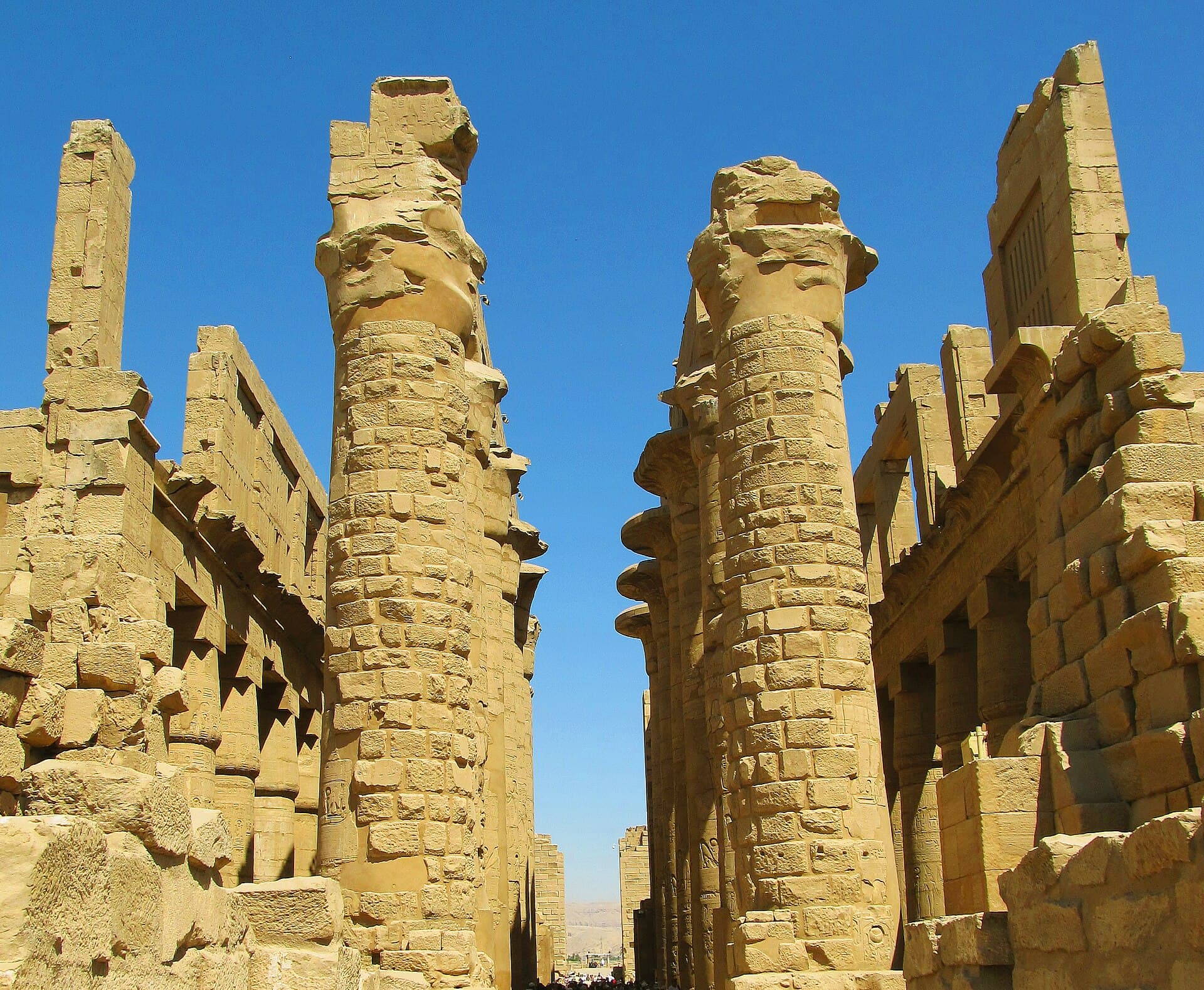
On the east bank of the Nile at Luxor, in the south of modern Egypt, a field of pylons, courts, and columns spreads across the site the ancient Egyptians called Ipet-isut, "the most select of places." This is Karnak, the great sanctuary of the god Amun-Ra at Thebes, and it is generally counted the largest religious complex ever raised in the ancient world. The precinct of Amun alone covers a vast walled enclosure, and around it lie further precincts for the goddess Mut and the falcon god Montu, so that the whole sacred zone approaches two square kilometres. To walk it today is to walk through a city built for a god.
No single ruler built Karnak, and no single century could have. The earliest surviving structures go back to the Middle Kingdom, around the twentieth century BC, and construction continued into the Ptolemaic period, a span of roughly two thousand years in which some thirty pharaohs left their mark. Each generation treated the temple as unfinished business: a new pylon in front of the last one, a new court, a new obelisk, a new hall. The result reads less like a building than like sediment, layer upon layer of royal ambition pressed into sandstone. Since 1979 Karnak has been inscribed on the UNESCO World Heritage List as part of Ancient Thebes with its Necropolis, together with Luxor Temple and the royal tombs across the river.
The logic of Karnak is accumulation. The temple of Amun grew along two axes, one running east to west toward the Nile and one running south toward the precinct of Mut and, beyond it, Luxor Temple. Kings added to both. Senusret I raised an elegant limestone way-station now called the White Chapel; Thutmose I and Thutmose III walled and roofed the core; Amenhotep III built the vast Third Pylon; Horemheb, Seti I, Ramesses II, and the rulers of later dynasties kept extending the approach until ten pylons stood in sequence. The First Pylon, the largest of all and still unfinished, was among the last, begun in the thirtieth dynasty. Because every addition was placed in front of or around what already existed, the visitor moving inward toward the sanctuary moves backward in time, from the latest gateways at the edges to the oldest stones at the heart.
That growth was not only architectural. Karnak was one of the wealthiest institutions in Egypt, endowed by conquest and taxation until the estate of Amun controlled land, ships, workshops, and tens of thousands of labourers. The temple's scale is the physical record of that arrangement: when a pharaoh returned from campaign, a share of the spoils went to the god, and the god's house grew with the state.
The image most people carry of Karnak is the Great Hypostyle Hall, and it earns the attention. Begun in earnest under Seti I and completed and decorated under his son Ramesses II in the thirteenth century BC, the hall packs 134 sandstone columns into a space of about 5,000 square metres. The twelve columns of the central aisle rise to about 21 metres and carry open papyrus capitals broad enough for dozens of people to stand on; the 122 flanking columns are lower, their closed-bud capitals crowding together so that the interior reads as a stone thicket. Clerestory windows of pierced stone above the side aisles let a filtered light fall into the gloom.
The hall was a papyrus marsh made permanent, an image of the world at the moment of creation, when a mound of earth first rose from the waters. Every surface was carved. Seti I's reliefs on the northern walls are among the finest of the New Kingdom, and the outer faces carry battle scenes from the wars of Seti and Ramesses II in Syria and Canaan. The roof is gone, and the paint survives only in protected patches high on the architraves, but the forest of columns still does what it was built to do. It makes a person feel the scale of the institution that raised it.
Karnak was also a landscape of obelisks, single shafts of Aswan granite raised in pairs before the gateways. Most have fallen or been carried away, to Rome and elsewhere, but two still stand. One belongs to Thutmose I. The taller one was raised by Hatshepsut, the woman who ruled Egypt as pharaoh in the fifteenth century BC. Her obelisk stands about 29.5 metres tall and weighs around 320 tonnes, and when it was erected it was the tallest obelisk in the world. Its fallen twin lies near the sacred lake, its carving legible at ground level. Hatshepsut recorded that the pair was quarried and transported in seven months.
South of the main temple, priests dug the sacred lake, the largest of its kind in Egypt, lined with stone and fed by groundwater. Here the clergy of Amun purified themselves before entering the sanctuary, and sacred geese, birds of Amun, were kept on the water. The lake still holds its rectangle after three thousand years.
Karnak never stood alone. A processional road ran south for 2.7 kilometres to Luxor Temple, lined over the centuries with hundreds of sphinxes, ram-headed ones near Karnak, where the ram was the animal of Amun, and human-headed ones along the long straight stretch rebuilt under Nectanebo I in the fourth century BC. Buried for centuries beneath fields and later streets, the route was excavated in stages over decades, and in November 2021 the restored Avenue of Sphinxes was reopened along its full length in a ceremony that returned the two temples to a single processional landscape.
The road existed for a festival. Once a year, during the Nile flood season, the cult images of Amun, his consort Mut, and their son Khonsu left Karnak in portable barque shrines, carried on the shoulders of priests or towed upriver by barge, and travelled to Luxor Temple for the feast of Opet, and each year crossed the river for the Beautiful Festival of the Valley. There, in rites hidden from the crowds that feasted outside, the king communed with Amun and had his royal essence renewed. The procession bound god, king, and city into one annual circuit, and the reliefs that record it, carved at Luxor in the reign of Tutankhamun, still show the oarsmen, the offering-bearers, and the crowds along the banks.
Karnak functioned as something close to a national archive. Thutmose III had a chamber in his festival hall carved with a king list naming dozens of his predecessors, a claim of continuity now in the Louvre. Around the central sanctuary he inscribed his Annals, a year-by-year account of his campaigns in Syria and Canaan, including the battle of Megiddo, with inventories of tribute delivered to Amun. Ramesses II covered wall after wall with his version of the battle of Kadesh against the Hittites, and later had the text of his peace treaty with them, among the earliest surviving international treaties, carved at the temple. Sheshonq I recorded his Levantine campaign on the Bubastite Portal, a relief that historians still set beside the biblical account of Shishak. Whatever a dynasty wanted remembered, it wrote at Karnak, because writing it at Karnak made it official.
The archive also records what Egypt tried to forget. Some two decades after Hatshepsut's death, agents of Thutmose III moved through the temple hacking out her names and images and reassigning her monuments. At Karnak her obelisks were too sacred to topple, so masonry sheathing was built around their lower halves instead, and that sheathing shielded the covered carving from three thousand years of weather. The censorship became the preservative.
The same irony swallowed Akhenaten. Early in his reign the heretic king built temples to his sole god, the Aten, just east of the precinct of Amun, using small standardised blocks called talatat that a single worker could carry. After his death the temples were demolished and the blocks tipped as fill into the Second, Ninth, and Tenth Pylons. When modern restorers dismantled those pylons they found tens of thousands of talatat inside, an accidental archive sealed within the act of erasure, and from them scholars have reassembled scenes of a court and a theology that later Egypt refused to name. Tutankhamun's restoration stela, set up at Karnak, describes the temples the boy king found "fallen into ruin" and the cults he restored, the official closing of the episode, carved in the very place that had absorbed its debris.
Karnak has been worked continuously by archaeologists since the nineteenth century, and since 1967 the Franco-Egyptian Centre for the Study of the Temples of Karnak has run excavation, recording, and anastylosis, the careful re-erection of monuments from their original blocks. Its open-air museum holds structures recovered from inside later pylons, including the White Chapel of Senusret I and the Red Chapel of Hatshepsut, buildings that survive only because they were dismantled and used as fill. The work is unending; blocks are still being matched, foundations still being read. Within the UNESCO property, Karnak stands with Luxor Temple on the east bank and, across the river, the mortuary temples and the Valley of the Kings, the whole ensemble inscribed together in 1979 as Ancient Thebes.
For two thousand years Karnak was where the Egyptian state kept its memory. Kings wrote their victories on its walls, listed their ancestors in its chapels, renewed their right to rule in its festival, and paid for its growth with the proceeds of empire. And when the state chose to forget, the temple kept that too: a queen's obelisk protected by the wall meant to hide it, a heresy preserved in tens of thousands of blocks buried inside the gates of orthodoxy. The lesson of Karnak is that a record maintained long enough outlives every editor. The names came back. The chapels were reassembled from the rubble they had been reduced to. What was written at Thebes, even what was crossed out there, is still being read.
Two thousand years of building
The forest of columns
Needles of granite and the sacred lake
The road to Luxor and the festival of Opet
The state's ledger in stone
The deletions that kept the record
Diggers and rebuilders
What a building can remember
References and resources
- UNESCO World Heritage Centre. "Ancient Thebes with its Necropolis." World Heritage List, property no. 87, inscribed 1979. whc.unesco.org/en/list/87.
- Encyclopaedia Britannica. "Karnak" and "Hatshepsut." britannica.com.
- Wikipedia. "Karnak," "Great Hypostyle Hall," "Avenue of Sphinxes," and "Opet Festival." Retrieved 2026.
- Centre Franco-Égyptien d'Étude des Temples de Karnak (CFEETK). cfeetk.cnrs.fr.
- Digital Karnak Project, University of California. "Karnak: Experience the temple through time." digitalkarnak.ucsc.edu.
- Blyth, Elizabeth. Karnak: Evolution of a Temple. Routledge, 2006.