Heritage · Landmark
Abu Simbel: the temples that were moved to save them
In the 1960s the rising waters of a new reservoir threatened to drown two temples that Ramesses II had cut into a Nubian cliff more than three thousand years earlier. Fifty nations answered a UNESCO appeal, sawed the monuments into more than a thousand numbered blocks, and rebuilt them on higher ground, keeping both the colossal statues and the twice-yearly sunrise that still reaches the inner sanctuary.Written to last.
By Confinity Heritage Editorial · Updated 2026-07-31 · 7-minute readQuiet tools, kept out of the way.
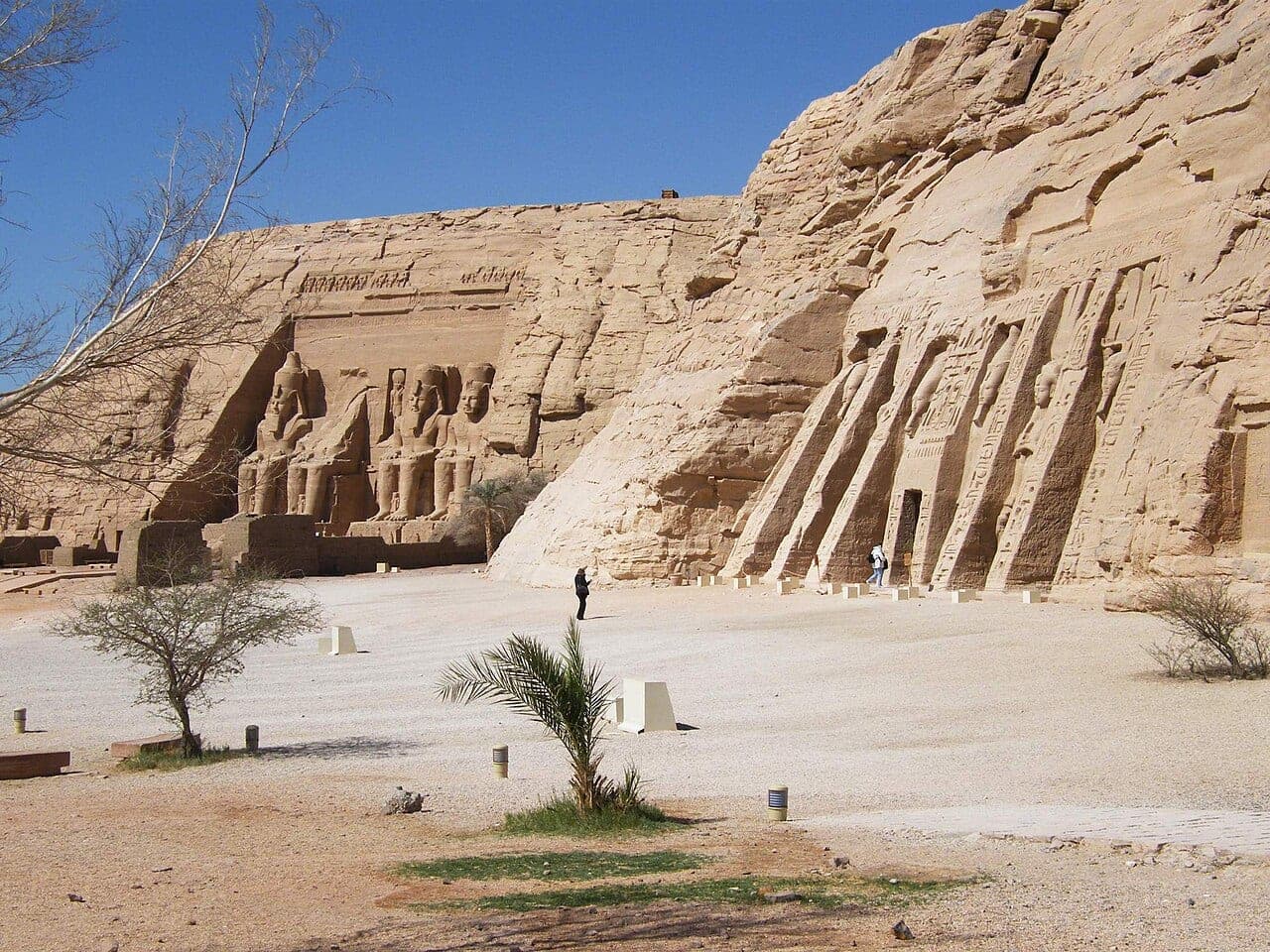
On a sandstone cliff above the west bank of the Nile in southern Egypt, four seated figures gaze east toward the rising sun. Each is about twenty metres tall, carved from the living rock, and each wears the face of the same man: Ramesses II, the pharaoh who ordered the mountain opened and shaped into a monument to himself and to the gods of his kingdom. Behind that facade the rock was hollowed into halls and chambers that reach some sixty metres into the hillside, so that the temple is less a building than a cave dressed in the form of a temple. This is the Great Temple of Abu Simbel, and beside it, a short walk to the north, its smaller companion honours the queen Nefertari.
Abu Simbel is remembered for two things that rarely meet in the same place. It is one of the boldest statements of royal power to survive from the ancient world, and it is the site of one of the most ambitious acts of preservation the modern world has attempted. In the 1960s the temples faced drowning beneath a rising reservoir, and an international effort sawed them apart and lifted them, block by numbered block, to higher ground. The story of Abu Simbel is therefore twice told: once by the king who built it, and again by the engineers and archaeologists who refused to let it disappear.
Ramesses II ruled Egypt for roughly sixty-six years, from about 1279 to 1213 BC, during the Nineteenth Dynasty of the New Kingdom, and few pharaohs left as many monuments behind. Work on Abu Simbel is generally dated to the earlier part of his reign, begun around 1264 BC and continued for about two decades before completion. The site sat far to the south, in Nubia, near the frontier where Egypt met the lands and trade routes of the upper Nile.
That location was the point. A temple this size, cut into a cliff on the river road into Egypt, spoke to everyone who passed. To Egyptian subjects it declared the reach of the crown; to Nubians to the south it was a reminder of who held power over the region. The Great Temple was dedicated to three state gods of the age, Ra-Horakhty, Amun and Ptah, and to the deified Ramesses himself, placing the living king among the divine. Building it meant quarrying directly into rock, a technique that produced a monument bound permanently to the hillside, which is exactly what would make moving it so difficult three thousand years later.
The facade of the Great Temple rises about thirty-three metres high and thirty-eight metres wide, dominated by the four seated colossi of Ramesses, each roughly twenty metres tall. Smaller figures of the king's family stand by his legs, no higher than his knees, a deliberate contrast of scale. Inside, a hall lined with pillars carved as the king in the form of the god Osiris leads deeper toward the sanctuary. The interior walls carry reliefs of Ramesses at war, most famously his campaign against the Hittites at the Battle of Kadesh, where the king is shown drawing his bow from a speeding chariot.
 Four seated figures of the same king, each about twenty metres high, cut from the cliff rather than set against it. Photograph by Arian Zwegers, CC BY 2.0, via Wikimedia Commons.
The Small Temple, a short distance away, was dedicated to the goddess Hathor and to Nefertari, the king's principal wife. Its facade carries six standing statues over ten metres high; on each side of the doorway two figures of Ramesses flank one of Nefertari shown as Hathor (Institute of Egyptian Art and Archaeology, University of Memphis; World History Encyclopedia). What is unusual is the equality of scale: the queen is carved the same height as the king, a rare honour in Egyptian royal art, and small reliefs of the royal children stand beside each colossus.
The most quoted feature of Abu Simbel is a trick of alignment. Twice a year, around 22 February and 22 October, the rising sun reaches straight down the long axis of the Great Temple and lights the seated gods in the innermost sanctuary. The rays fall on Amun, Ra-Horakhty and the deified Ramesses, while Ptah, associated with the underworld, is left in shadow at the edge of the group. The two dates are often linked to the king's coronation and birth, though the exact intention is debated, and before the temple was moved the alignment fell about a day earlier (Egyptian heritage and travel reporting).
For much of its later history the Great Temple lay half-swallowed by drifting sand, its colossi buried to the shoulders. The site fell out of general knowledge in Europe until March 1813, when the Swiss traveller Johann Ludwig Burckhardt, journeying through Nubia in disguise, caught sight of the upper frieze and the crowns of the giant statues protruding from the dune. He could not reach the entrance, which was sealed under sand, and he moved on.
A few years later the Italian strongman and adventurer Giovanni Belzoni returned to the site and, on 1 August 1817, succeeded in digging out enough of the doorway to enter the Great Temple for what was likely the first time in centuries. What early visitors found inside was a monument remarkably preserved by the same sand that had hidden it, its painted reliefs sheltered from wind and weather. Through the nineteenth century Abu Simbel became a fixed point on the Nile itinerary for travellers, artists and photographers, its scale difficult to convey and hard to forget.
The threat that would define Abu Simbel's modern story arrived with the Aswan High Dam. Begun in 1960, the dam was meant to control the Nile's floods and generate electricity, but the reservoir forming behind it, Lake Nasser, would rise high enough to submerge the temples of Lower Nubia, Abu Simbel among them. That same year the Director-General of UNESCO launched an international appeal, the Campaign to Save the Monuments of Nubia, and some fifty countries answered.
The solution chosen for Abu Simbel was audacious. Between 1964 and 1968 workers cut the two temples out of the cliff and sawed them into blocks, then lifted the pieces to a new site sixty-five metres higher and about two hundred metres back from the water. The Great Temple was divided into roughly eight hundred blocks and the Small Temple into a few hundred more, together well over a thousand pieces, some weighing many tonnes. On the new ground the blocks were reassembled with such care that the joins were disguised, and the whole was set against artificial domes of concrete that recreate the original hillside. Crucially, the builders preserved the solar alignment, so that the sun still reaches the sanctuary twice a year. The operation, carried out by an international team and supervised on site by figures including the Polish archaeologist Kazimierz Michalowski, remains one of the great feats of applied archaeology.
Today the rebuilt temples sit above Lake Nasser, reached by road from Aswan or by a short flight, and the crowds that once arrived by river boat now come in convoys and on aircraft. The two dawns of the solar alignment draw the largest gatherings, when visitors assemble before sunrise to watch the light travel the length of the Great Temple, an event now marked locally as a festival.
Preservation did not end when the last block was set. The reconstructed structure has to be watched: the concrete domes, the internal supports, the humidity inside the halls and the wear brought by heavy visitor numbers all require steady care. The site is managed within Egypt's antiquities system and lies inside the wider protected landscape of the Nubian monuments. The very success of the rescue created a new responsibility, that of maintaining a monument that is now partly a modern engineering structure as well as an ancient one.
Abu Simbel matters as memory on more than one level. It is a memorial the king built for himself, an attempt to fix his name in stone for eternity, and in that narrow sense Ramesses succeeded beyond any reasonable hope: his face is among the most recognised images from the ancient world. But the temple also carries a second, more recent memory, of the moment when nations agreed that a place could belong to humanity as a whole and be worth saving together.
The Nubian campaign, which ran until 1980 and was later described by the UNESCO Courier as the greatest archaeological rescue of its kind, changed how the world thought about heritage. It helped shape the 1972 convention that created the idea of World Heritage, and in 1979 the Nubian Monuments from Abu Simbel to Philae were themselves inscribed on that list. For an archive of remembrance, Abu Simbel offers a plain lesson: what we choose to carry forward is a decision, renewed by each generation. The temples were not saved by chance. They were saved because people decided that losing them was not acceptable, and then did the difficult, costly work of keeping them. Remembering, the site suggests, is not passive. It is something we build, and sometimes something we must move a mountain to protect.
Four seated figures of the same king, each about twenty metres high, cut from the cliff rather than set against it. Photograph by Arian Zwegers, CC BY 2.0, via Wikimedia Commons.
The Small Temple, a short distance away, was dedicated to the goddess Hathor and to Nefertari, the king's principal wife. Its facade carries six standing statues over ten metres high; on each side of the doorway two figures of Ramesses flank one of Nefertari shown as Hathor (Institute of Egyptian Art and Archaeology, University of Memphis; World History Encyclopedia). What is unusual is the equality of scale: the queen is carved the same height as the king, a rare honour in Egyptian royal art, and small reliefs of the royal children stand beside each colossus.
The most quoted feature of Abu Simbel is a trick of alignment. Twice a year, around 22 February and 22 October, the rising sun reaches straight down the long axis of the Great Temple and lights the seated gods in the innermost sanctuary. The rays fall on Amun, Ra-Horakhty and the deified Ramesses, while Ptah, associated with the underworld, is left in shadow at the edge of the group. The two dates are often linked to the king's coronation and birth, though the exact intention is debated, and before the temple was moved the alignment fell about a day earlier (Egyptian heritage and travel reporting).
For much of its later history the Great Temple lay half-swallowed by drifting sand, its colossi buried to the shoulders. The site fell out of general knowledge in Europe until March 1813, when the Swiss traveller Johann Ludwig Burckhardt, journeying through Nubia in disguise, caught sight of the upper frieze and the crowns of the giant statues protruding from the dune. He could not reach the entrance, which was sealed under sand, and he moved on.
A few years later the Italian strongman and adventurer Giovanni Belzoni returned to the site and, on 1 August 1817, succeeded in digging out enough of the doorway to enter the Great Temple for what was likely the first time in centuries. What early visitors found inside was a monument remarkably preserved by the same sand that had hidden it, its painted reliefs sheltered from wind and weather. Through the nineteenth century Abu Simbel became a fixed point on the Nile itinerary for travellers, artists and photographers, its scale difficult to convey and hard to forget.
The threat that would define Abu Simbel's modern story arrived with the Aswan High Dam. Begun in 1960, the dam was meant to control the Nile's floods and generate electricity, but the reservoir forming behind it, Lake Nasser, would rise high enough to submerge the temples of Lower Nubia, Abu Simbel among them. That same year the Director-General of UNESCO launched an international appeal, the Campaign to Save the Monuments of Nubia, and some fifty countries answered.
The solution chosen for Abu Simbel was audacious. Between 1964 and 1968 workers cut the two temples out of the cliff and sawed them into blocks, then lifted the pieces to a new site sixty-five metres higher and about two hundred metres back from the water. The Great Temple was divided into roughly eight hundred blocks and the Small Temple into a few hundred more, together well over a thousand pieces, some weighing many tonnes. On the new ground the blocks were reassembled with such care that the joins were disguised, and the whole was set against artificial domes of concrete that recreate the original hillside. Crucially, the builders preserved the solar alignment, so that the sun still reaches the sanctuary twice a year. The operation, carried out by an international team and supervised on site by figures including the Polish archaeologist Kazimierz Michalowski, remains one of the great feats of applied archaeology.
Today the rebuilt temples sit above Lake Nasser, reached by road from Aswan or by a short flight, and the crowds that once arrived by river boat now come in convoys and on aircraft. The two dawns of the solar alignment draw the largest gatherings, when visitors assemble before sunrise to watch the light travel the length of the Great Temple, an event now marked locally as a festival.
Preservation did not end when the last block was set. The reconstructed structure has to be watched: the concrete domes, the internal supports, the humidity inside the halls and the wear brought by heavy visitor numbers all require steady care. The site is managed within Egypt's antiquities system and lies inside the wider protected landscape of the Nubian monuments. The very success of the rescue created a new responsibility, that of maintaining a monument that is now partly a modern engineering structure as well as an ancient one.
Abu Simbel matters as memory on more than one level. It is a memorial the king built for himself, an attempt to fix his name in stone for eternity, and in that narrow sense Ramesses succeeded beyond any reasonable hope: his face is among the most recognised images from the ancient world. But the temple also carries a second, more recent memory, of the moment when nations agreed that a place could belong to humanity as a whole and be worth saving together.
The Nubian campaign, which ran until 1980 and was later described by the UNESCO Courier as the greatest archaeological rescue of its kind, changed how the world thought about heritage. It helped shape the 1972 convention that created the idea of World Heritage, and in 1979 the Nubian Monuments from Abu Simbel to Philae were themselves inscribed on that list. For an archive of remembrance, Abu Simbel offers a plain lesson: what we choose to carry forward is a decision, renewed by each generation. The temples were not saved by chance. They were saved because people decided that losing them was not acceptable, and then did the difficult, costly work of keeping them. Remembering, the site suggests, is not passive. It is something we build, and sometimes something we must move a mountain to protect.
A king carved into the mountain
Colossi, reliefs, and a shaft of morning sun
Buried in sand, found again
The rescue that moved a mountain
Guarding the temples in the age of the tour bus
What it means to save a place together
References and resources
- UNESCO World Heritage Centre, "Nubian Monuments from Abu Simbel to Philae" (inscribed 1979)
- UNESCO World Heritage Centre, "International Campaign to Save the Monuments of Nubia" (launched 1960)
- Wikipedia, "Abu Simbel"
- Wikipedia, "International Campaign to Save the Monuments of Nubia"
- Institute of Egyptian Art and Archaeology, University of Memphis, "Small Temple at Abu Simbel"
- World History Encyclopedia, "Temple of Hathor, Abu Simbel"
- Encyclopaedia Britannica, "Abu Simbel"