Heritage · Landmark
Carthage: the ruins Rome left and the salt that was never sown
Two cities lie stacked on one hill above the Gulf of Tunis: the Punic capital that ran the western Mediterranean until Rome burned it in 146 BC, and the Roman colony raised over its ashes. Almost everything said about the first was written by the people who destroyed it, including the most famous detail of all, which no ancient source records.Written to last.
By Confinity Heritage Editorial · 2026-08-25 · 7-minute readQuiet tools, kept out of the way.
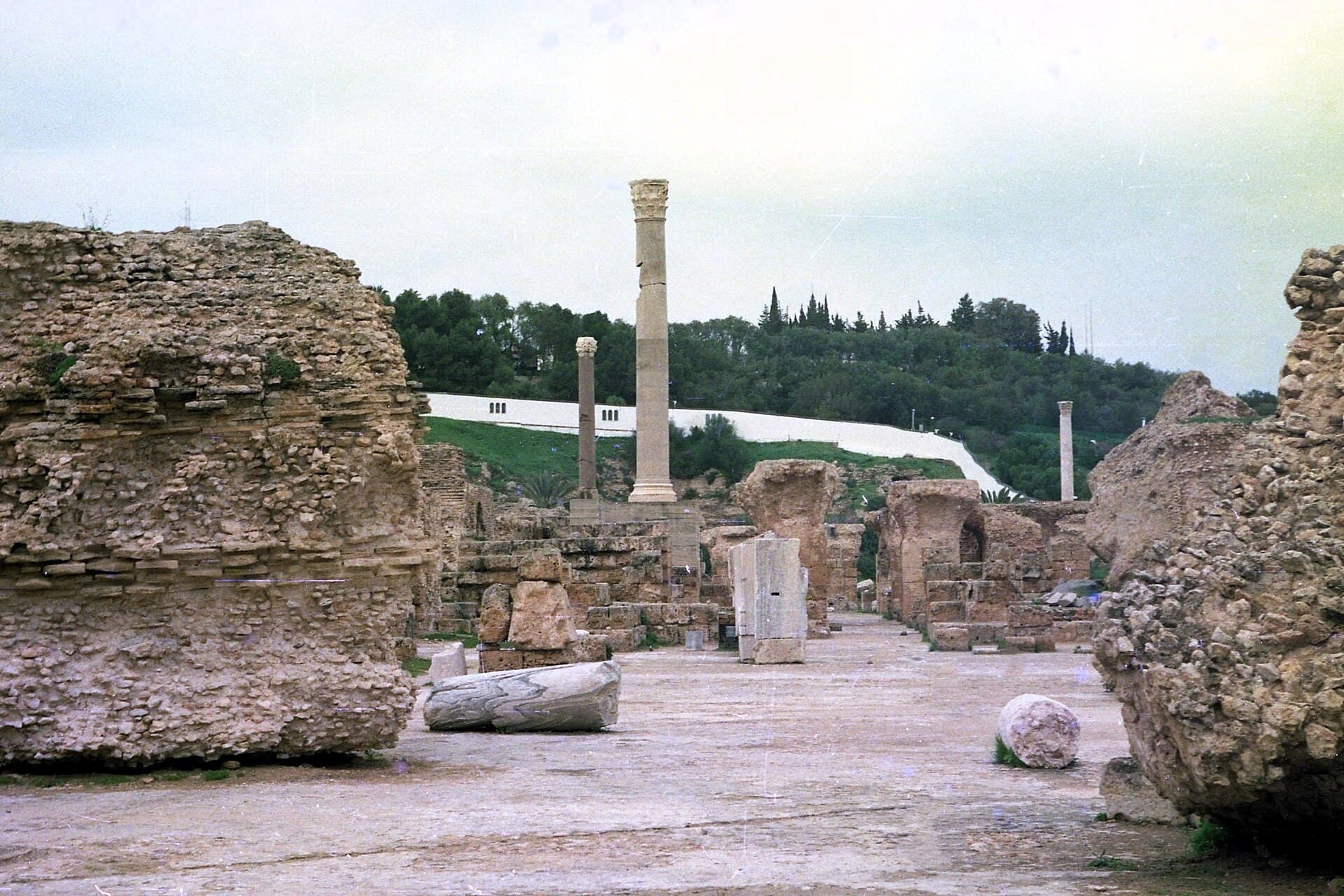
On a low hill above the Gulf of Tunis, a short drive from the capital of Tunisia, two cities lie stacked on one site: Punic Carthage, founded from Tyre and grown into the greatest maritime power of the western Mediterranean, and the Roman colony raised over its ashes. UNESCO inscribed the archaeological site of Carthage in 1979, citing the Punic ports, the tophet, the necropolises, the theatre, the basilicas and the Antonine baths across 498 hectares now interleaved with a living suburb.
Almost everything a visitor knows on arrival comes from Roman and Greek writers, because the Carthaginians left barely a page of their own. That imbalance runs through the whole site. It is also why the most famous detail about Carthage, repeated in classrooms for well over a century, has no ancient source behind it.
The traditional foundation date is 814 BC, a figure reaching us through Greek chronography rather than any Carthaginian record. The founder in that tradition is Elissa, whom Latin writers call Dido: a princess of Tyre who fled after her brother Pygmalion murdered her husband, and bargained on the African coast for as much land as an oxhide could cover. She cut it into strips thin enough to ring a hill, and the citadel above the harbours was the Byrsa ever after. The Greek word byrsa means oxhide, which suggests a story grown from the name rather than the reverse.
Virgil later bound Dido to Aeneas, though the fall of Troy and the traditional founding of Carthage sit four centuries apart. Archaeology is more cautious. Excavation shows a settlement raised on virgin ground with no earlier occupation beneath it, and the oldest datable material belongs to the eighth century BC. Elissa leaves no trace outside literature, but a new city built from nothing on an empty promontory is what the excavators found.
Carthage sat on a promontory commanding the narrows between Sicily and Africa, so that shipping crossing the Mediterranean had to pass its door. From the sixth century BC it turned that position into a trading empire reaching along the North African coast, into southern Iberia, and across Sicily, Sardinia, Corsica, Malta and the Balearics.
The machinery of that empire is still legible in the ground. South of the Byrsa lie two linked artificial basins, the Punic cothon: a rectangular merchant harbour opening into a circular naval one. The inner ring was lined with covered docking bays and slipways for hauling ships from the water, with an island at the centre carrying a cabin from which the admiral could watch the whole basin. Ancient description puts the capacity at as many as 220 warships, and the entrance could be closed with a boom. Both basins survive as shallow lagoons among the villas, the circular one still holding its island.
Rome and Carthage fought three times: the First Punic War of 264 to 241 BC, decided at sea and costing Carthage Sicily; the Second, from 218 to 201 BC, which brought Hannibal over the Alps and ended at Zama; and the Third, from 149 to 146 BC, which was less a war than a demolition, urged on by Cato the Elder, who ended speeches on any subject with the observation that Carthage must be destroyed.
The siege ran nearly three years. In the spring of 146 BC Scipio Aemilianus breached the walls from the harbour side, and for six days Roman troops worked through the residential quarters street by street, firing the buildings behind them. Fifty thousand survivors were sold into slavery. The Senate confiscated the site, ordered further demolition, and cursed anyone who might resettle it. Polybius, who was there, recorded that Scipio wept as the city burned and quoted Homer on the day Troy would fall.
Everyone knows what happened next. The Romans ploughed the ruins and sowed them with salt so that nothing would ever grow there again. It is one of the most quoted facts in ancient history, a perfect emblem of total war.
No ancient source says it. Not Polybius, who watched. Not Appian, who gives the fullest surviving account of the siege. Not Livy, not Diodorus, not Strabo. Ancient writers do describe drawing a plough symbolically over a destroyed city, and Near Eastern texts describe strewing salt across razed sites, most famously Shechem in the ninth chapter of Judges. None of them names Carthage.
The claim appears in print by 1863, and it entered scholarly literature through B. L. Hallward's chapter in the first edition of the Cambridge Ancient History in 1930, from which it passed into general histories and school textbooks as established fact. It was demolished in 1986 by R. T. Ridley, in an article titled "To Be Taken with a Pinch of Salt: The Destruction of Carthage", which followed the footnotes backwards until the trail stopped in the modern period with nothing underneath it. Susan Stevens and Paolo Visona confirmed the finding in the same journal two years later, and B. H. Warmington, who had repeated the story himself, published a formal retraction.
The question worth asking is why it lasted. It lasted because it is vivid, because it fits what people already believed about Roman vengeance, and because it needs no evidence to feel true. The phrase Carthaginian peace still carries that image into arguments about modern treaties. Forty years after Ridley, the salt is in circulation. An invented detail outlived every surviving source for a century, which is worth pausing on: a record can be lost, but it can also be quietly added to.
The salt story took hold in a vacuum, and the vacuum is the deeper problem. Punic Carthage produced literature, treaties and histories across seven centuries, and virtually none of it survives. When the city fell, its libraries were destroyed or handed to the client kings of Africa, according to Pliny the Elder, who adds that the Senate held back one work: the twenty-eight books of Mago on agriculture, ordered translated into Latin. Even that survives only as quotations in Varro, Columella and Pliny.
What remains is thin. A Greek version of the navigator Hanno's coastal voyage. Thousands of short votive inscriptions cut in stone. A passage of Punic dialogue preserved, and mangled, in a comedy by Plautus. Everything else about Carthaginian religion, politics and character reaches us through Greeks and Romans who fought the city, several writing once it could no longer answer back.
Nowhere does that matter more than in the precinct at Salammbo, south of the Byrsa, excavated from 1921: an open enclosure of carved stelae standing over urns holding the cremated remains of infants and young animals, in deposits running from the eighth century BC to the city's fall.
The literary charge is old. Cleitarchus describes a bronze statue of Kronos with sloping hands above a brazier; Diodorus Siculus writes that during Agathocles' siege in 310 BC the Carthaginians sacrificed two hundred children of noble families, with three hundred more offered voluntarily; Plutarch adds parents buying infants from the poor while flutes and drums covered the noise; and Tertullian claims around 200 AD that the practice continued in secret. Against this: none of these writers was an eyewitness, they contradict one another on method, they describe older children than the urns contain, no such statue has been found, and the far better documented Punic Wars carry no such accusation.
The bones have not settled it. In 2010 Jeffrey Schwartz, Frank Houghton, Roberto Macchiarelli and Luca Bondioli published an osteological study arguing that the remains do not support systematic sacrifice: in a sample of 540 individuals, roughly 38 per cent had died before or during birth, judged by bone size, dental development and the absence of neonatal lines: a burial ground for the naturally dead. Patricia Smith, Gal Avishai, Joseph Greene and Lawrence Stager replied in Antiquity that the analysis had not allowed for the shrinkage of bone during cremation, which makes the dead look younger than they were. Paolo Xella, Josephine Quinn, Valentina Melchiorri and Peter van Dommelen argued in 2013 that the number of burials is far too low for ordinary infant mortality and that the written sources should stand, while reading the tophet as a place of limited rites rather than mass killing. Sabatino Moscati had long since read it as a cemetery for infants who died naturally and were then ritually offered. The argument is live, and anyone who tells you it is closed is choosing a side.
Rome came back to the hill. The refoundation was begun on Caesar's orders and carried through under Augustus, and within a century the new Carthage was capital of the province of Africa, the empire's principal grain supplier, and by some ancient reckonings a rival to Alexandria for second city after Rome. The Byrsa summit was levelled for a forum, and an aqueduct ran down from Zaghouan to fill the vast Malga cisterns.
The most complete survivor of that city is in the photograph above. The Antonine Baths were begun under Hadrian and finished under Antoninus Pius, the largest Roman baths in Africa and among the largest anywhere in the empire. The soft coastal clay could not carry the usual basement service floors, so the complex was raised, and what stands on the shoreline is that towering substructure, one re-erected column giving the scale of what sat on top. It burned when the Vandals took the city in 439.
This was also a capital of early Christianity. Tertullian wrote here; Cyprian was its bishop and was executed outside the walls in 258; the Council of Carthage of 397 confirmed the biblical canon for the western Church; and Augustine, who studied here before becoming bishop of Hippo, returned for the councils that fought the Donatist schism. Byzantine forces held the city from 533 until an Umayyad army sacked it in 698, after which power moved to Kairouan and Tunis and the ruins served as a quarry.
The result reads nothing like Pompeii, sealed in a day and kept whole. Carthage was destroyed twice, rebuilt once, and carried off piecemeal over a thousand years, and the gaps are the point. The harbour that ran an empire is a pond. The literature of seven centuries is a handful of quotations in the language of the victors. And the one thing about the place almost everyone can recite was put there by writers working two millennia after the fact.
Elissa, the oxhide, and what the spades found
The circular harbour and the empire it served
Three wars, and six days in 146 BC
The salt that was never sown
The archive Rome gave away
The tophet, and an argument still open
Rome's second Carthage, and what is left of it
References and resources
- UNESCO World Heritage Centre. "Archaeological Site of Carthage." World Heritage List, property no. 37, inscribed 1979, criteria (ii)(iii)(vi). whc.unesco.org/en/list/37.
- Ridley, R. T. "To Be Taken with a Pinch of Salt: The Destruction of Carthage." Classical Philology 81, no. 2 (1986): 140-146.
- Warmington, B. H. "The Destruction of Carthage: A Retractatio." Classical Philology 83, no. 4 (1988): 308-310. See also Stevens, Susan T., "A Legend of the Destruction of Carthage," and Visona, Paolo, "On the Destruction of Carthage Again," Classical Philology 83, no. 1 (1988).
- Schwartz, J. H., F. Houghton, R. Macchiarelli and L. Bondioli. "Skeletal Remains from Punic Carthage Do Not Support Systematic Sacrifice of Infants." PLoS ONE 5, no. 2 (2010): e9177.
- Smith, P., G. Avishai, J. A. Greene and L. E. Stager. "Aging Cremated Infants: The Problem of Sacrifice at the Tophet of Carthage." Antiquity 85 (2011): 859-874. See also the 2013 exchange in Antiquity 87, and Schwartz et al., "Two Tales of One City," Antiquity 91 (2017).
- Wikipedia. "Carthage," "Ancient Carthage," "Cothon," "Tophet," "Third Punic War" and "Baths of Antoninus." Retrieved 2026.