Heritage · Landmark
Todai-ji: the Great Buddha of Nara
A bronze Buddha some fifteen metres tall has sat in Nara since 752, its head melted in two wars and twice recast, its hall burned and rebuilt smaller yet still among the largest wooden buildings on earth. A log storehouse beside it has kept an inventoried imperial collection for almost 1,300 years, and a hall above the precinct has repeated the same March ceremony every year since the statue was new.Written to last.
By Confinity Heritage Editorial · 2026-08-23 · 7-minute readQuiet tools, kept out of the way.
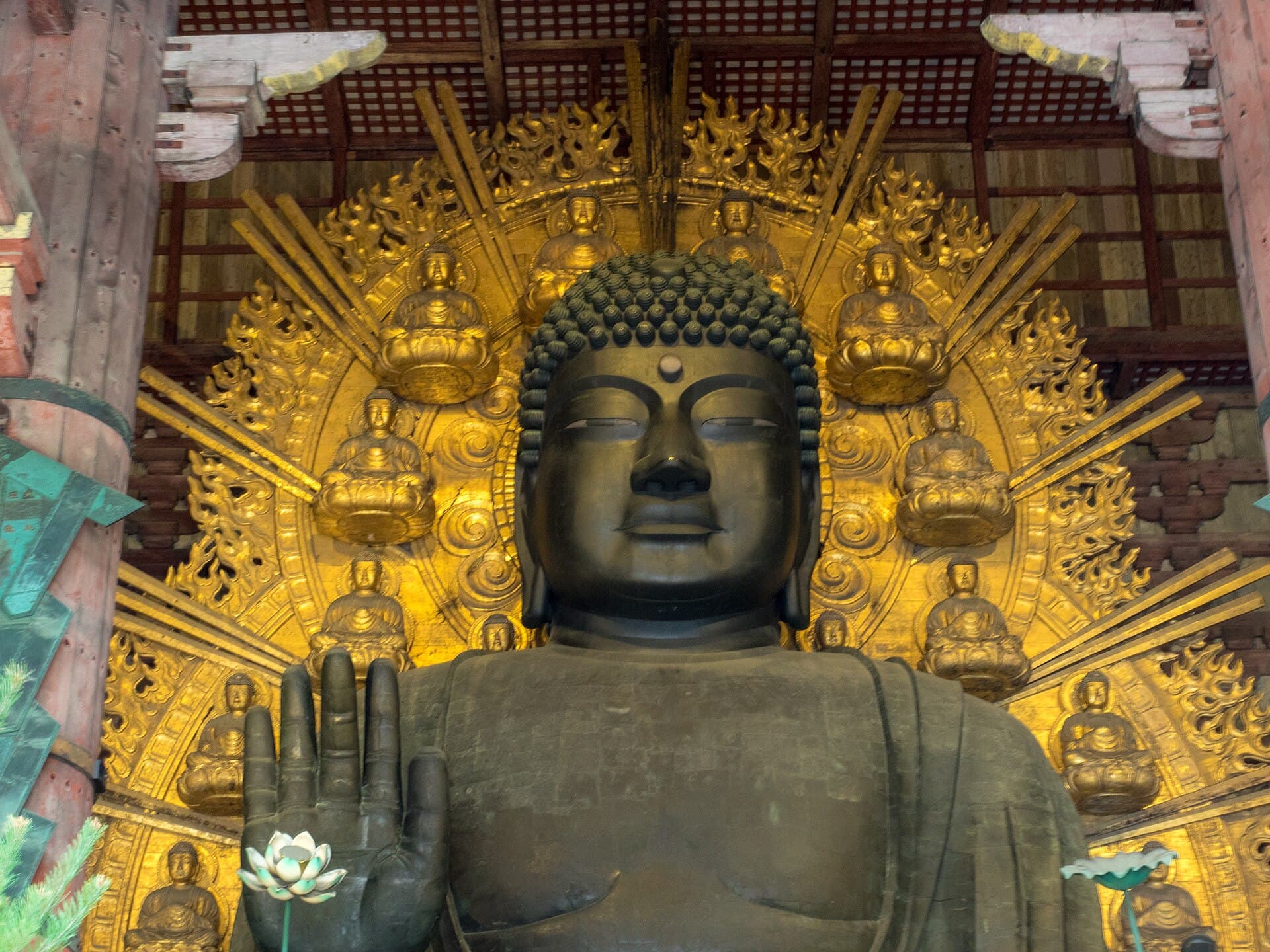
In the old capital of Nara, in modern Japan, a wooden hall of improbable size rises above a park where sacred deer wander between the pilgrims. This is the Daibutsuden, the Great Buddha Hall of Tōdai-ji, and inside it sits a bronze figure of the cosmic Buddha Vairocana roughly fifteen metres tall, cast in the middle of the eighth century at the command of Emperor Shōmu. The temple was conceived as the head of a national network of provincial monasteries and became the spiritual centre of the Nara state. Since 1998 it has been inscribed by UNESCO within the World Heritage property "Historic Monuments of Ancient Nara", alongside the shrines, palace site, and primeval forest of the city that was Japan's capital from 710 to 784.
What makes Tōdai-ji remarkable is not preservation in the ordinary sense, because very little of it stands as it first stood. The Great Buddha has lost its head to fire twice and wears a replacement cast a thousand years after its body. The vast hall around it is the third on the site and smaller than either predecessor. The temple's real inheritance is a set of habits: a statue repaired whenever it broke, a ceremony repeated every March for more than 1,250 years without a single missed season, and a log storehouse whose contents have been inventoried and cared for since the year 756. Tōdai-ji is what an institution looks like when it decides that continuity matters more than original fabric.
Emperor Shōmu reigned over a country in trouble. A smallpox epidemic in the 730s had killed a large share of the population, including all four brothers of the dominant Fujiwara family, and rebellion and crop failure followed. Shōmu's response was religious on a national scale. He ordered a monastery and convent founded in every province, and in 743 he issued an edict calling for a colossal image of Vairocana, the Buddha whose body was understood to contain the whole universe, to anchor the entire system. Tōdai-ji, the Great Eastern Temple, would be the head of that provincial network and the home of the statue.
The casting was an act of national mobilisation. Court records speak of hundreds of thousands of labourers and donors drawn into the work, and the statue consumed a huge share of the bronze then available in Japan, cast in stages over several years in the late 740s. Gilding it required gold, which Japan had never mined in quantity; when gold was discovered in the northern province of Mutsu in 749, it was greeted as a miracle and sent south for the Buddha's skin. Historians have long observed that the project came close to exhausting the treasury, and the strain it placed on the young state is part of its meaning: a government had staked its solvency on a single act of devotion.
The statue was consecrated in 752 in one of the great international ceremonies of the early medieval world. In the eye-opening ritual, a Buddhist image becomes sacred at the moment its pupils are painted, and the brush at Tōdai-ji was held by Bodhisena, an Indian monk who had travelled to Japan by way of China, while the retired Emperor Shōmu, the empress, and the reigning Empress Kōken looked on. Thousands of monks and officials attended, among them envoys and performers from Tang China and the Korean kingdoms, and music and dance from across Asia filled the precinct. For a court at the far eastern end of the Silk Road, the ceremony was a declaration that Nara belonged to a civilised world that stretched to Persia and beyond.
The proof of that claim still exists. Many of the objects used or displayed at the eye-opening, including masks, instruments, banners, and the very brush and cords associated with the ritual, were preserved afterwards rather than dispersed. They passed into a repository that stands a short walk north of the Great Buddha Hall, and their survival there turned a single day in 752 into something later centuries could still touch.
That repository is the Shōsō-in, a raised storehouse of interlocking cypress logs built in the eighth century. In 756, on the forty-ninth day after Shōmu's death, his widow Empress Kōmyō dedicated more than six hundred of his personal belongings to the Great Buddha, accompanied by a written inventory, and further dedications followed. The collection, now around 9,000 items in the care of the Imperial Household Agency, has remained together and documented ever since, which makes it, by most reckonings, the oldest continuously curated collection in the world.
Its contents read like a customs ledger of the eighth-century Silk Road: cut glass bowls of Persian type, a five-stringed lute inlaid with mother-of-pearl that is the only surviving instrument of its kind, game boards, medicines, textiles, and state papers. The storehouse was kept under seal, opened only with imperial permission, and its treasures were aired and checked in a recurring rite of inspection; today a selection is shown each autumn at the Nara National Museum, and the rest waits in climate-controlled successor buildings beside the original. Objects survive everywhere by accident. The Shōsō-in is rarer than that: a place where objects survived on purpose, with the paperwork to prove it, for nearly 1,300 years.
The temple itself had no such untouched history. In 1180, during the wars that ended the Heian age, the Taira general Shigehira burned Nara, and the Daibutsuden went up with much of the city; the Great Buddha's head melted and fell. The monk Chōgen, then over sixty, spent the rest of his life raising funds and Chinese-influenced engineering to rebuild the hall and recast what the fire had taken. In 1567 war returned, this time a battle between the Miyoshi and Matsunaga clans fought in the temple grounds, and the hall burned again, taking the head with it once more. For over a century afterwards the Buddha sat exposed to the rain.
The statue that visitors face today is therefore a patchwork of centuries: portions of the original eighth-century casting survive in the body and the lotus petals, the head is an Edo-period recasting from the 1690s, and other parts date from the medieval restorations between. The present hall, completed in 1709, is seven bays wide where the original was eleven, about 57 metres across against a predecessor of roughly 86, yet it remained the largest wooden building in the world into the late twentieth century and is still among the largest on earth. Japan's architectural history is full of such returns; Kyoto's Kinkaku-ji, burned in 1950 and rebuilt within five years, is a modern chapter of the same instinct. At Tōdai-ji the instinct is the monument.
The approach to the temple passes through the Nandaimon, the Great South Gate, rebuilt around 1200 under Chōgen's programme in a muscular style borrowed from Song China. In its flanking bays stand two wooden guardian kings, the Niō, each about 8.4 metres tall, completed in 1203 by the master sculptors Unkei and Kaikei with their workshops, reportedly in only 69 days. Built from thousands of jointed blocks of cypress, they are counted among the summits of Japanese sculpture, and conservation work in the late twentieth century found documents sealed inside them naming the carvers, a signature hidden in the body of the work for eight centuries.
Around gate and hall alike move the deer of Nara Park, well over a thousand of them, bowing to visitors for rice crackers. They are not ornamental. In the founding legend of the neighbouring Kasuga shrine, the deity Takemikazuchi arrived in Nara riding a white deer, and the animals have been protected for centuries as sacred messengers of the gods. Their presence in the precinct is a reminder that Tōdai-ji was never a Buddhist island: temple, shrine, forest, and animals formed a single sacred landscape, and the UNESCO inscription of 1998 treats them as one.
East of the Great Buddha Hall, up a slope of stone steps and lanterns, stands the Nigatsu-dō, the Hall of the Second Month. Every March its balcony becomes the stage for Omizutori, the best-known portion of a two-week rite of repentance called Shuni-e, in which monks confess faults on behalf of the nation, giant pine torches are run along the railing showering sparks over the crowd, and sacred water is drawn from a well said to flow, once a year, from distant Wakasa. The rite was founded in 752, the year the Great Buddha opened its eyes, and it has been performed every year since without interruption, through civil war, through the fires of 1180 and 1567, and through a night in 1667 when the Nigatsu-dō itself burned and the observance simply continued while the hall was rebuilt around it.
More than 1,250 consecutive performances make Shuni-e one of the oldest annually repeated ceremonies anywhere in the world. Nothing about its survival was automatic. Each year, someone had to decide that the sequence would not break on their watch, and each year for thirteen centuries someone has.
Tōdai-ji's lesson sits in the gap between two ideas of permanence. The temple never managed the first kind: it burned, melted, shrank, and was patched with whatever century happened to be passing. It mastered the second: an institution that survived by rebuilding rather than by never burning, a ceremony that treated a single missed year as unthinkable, and a storehouse that held its inventory through the entire history of a nation. The head of the Buddha is newer than its hands, the hall is smaller than its ancestors, and none of that diminishes the place, because what was kept was never the material. It was the commitment, renewed annually in fire and paperwork and bronze, that this thing would continue. Very few human undertakings can show 1,300 years of receipts. In Nara, one can.
The emperor's vow and the nation's bronze
An eye-opening watched by Asia
The storehouse that never lost its inventory
Fire, war, and a patchwork Buddha
Guardians at the gate, messengers in the park
The ceremony that has never missed a year
What Todai-ji keeps
References and resources
- UNESCO World Heritage Centre. "Historic Monuments of Ancient Nara." World Heritage List, property no. 870, inscribed 1998. whc.unesco.org/en/list/870.
- Tōdai-ji. Official website, history and visitor pages. todaiji.or.jp.
- Encyclopaedia Britannica. "Tōdai Temple." britannica.com/topic/Todai-Temple.
- Imperial Household Agency. "The Shōsō-in Treasure House." shosoin.kunaicho.go.jp.
- Nara National Museum. "Annual Exhibition of Shōsō-in Treasures." narahaku.go.jp.
- Wikipedia. "Tōdai-ji," "Shōsō-in," "Omizutori," and "Nandaimon (Tōdai-ji)." Retrieved 2026.