Heritage · Landmark
Fushimi Inari: the mountain of ten thousand names
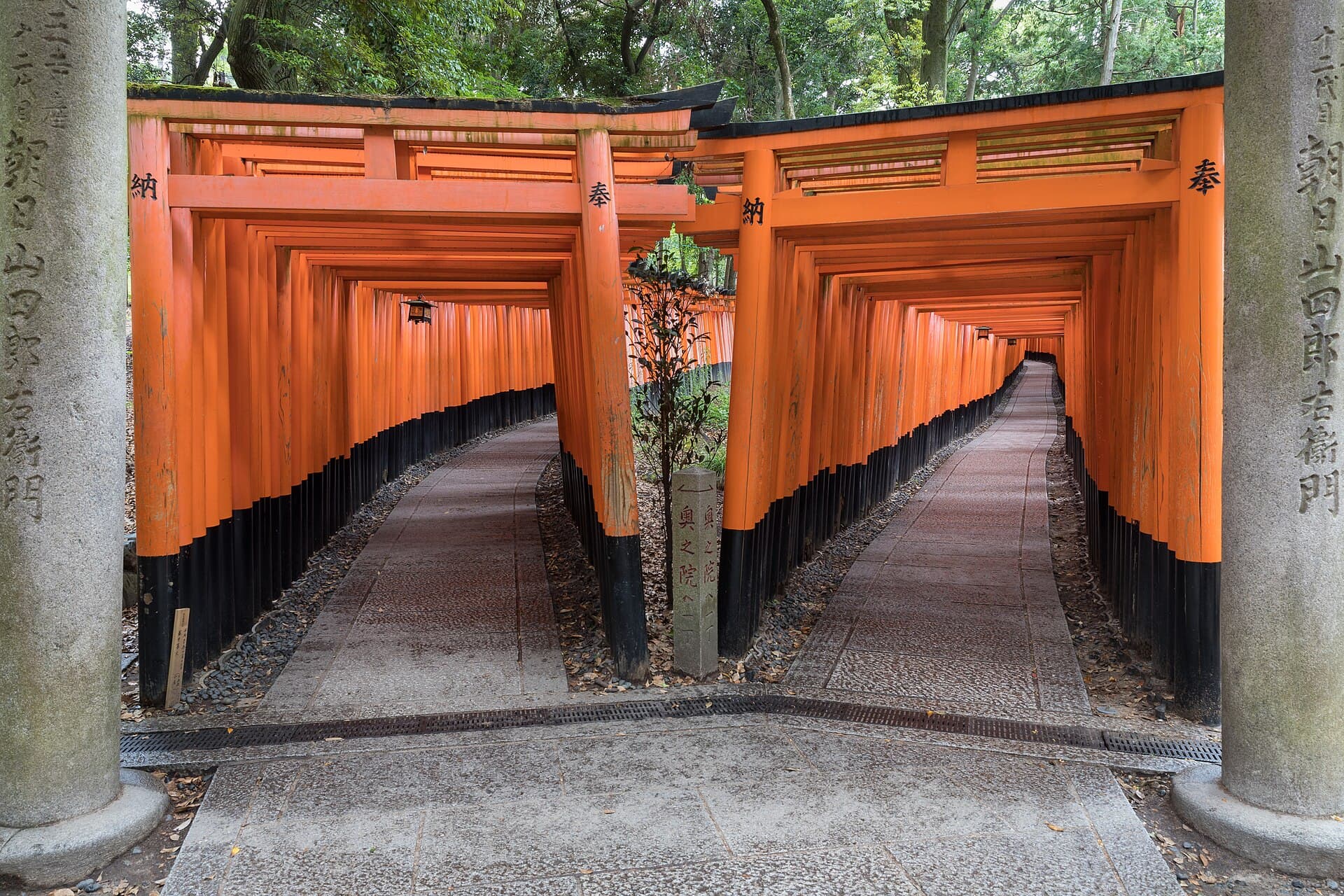
On a wooded mountain south of Kyoto, roughly ten thousand vermilion gates arcade a four kilometre path, and every one of them is a donation, inscribed on its back with a giver's name and the date of the gift. The head shrine of Inari, kami of rice and prosperity, has been accepting these thank-yous for centuries, replacing each gate as the cedar weathers, so the tunnel itself is a ledger of gratitude that never stops being rewritten.Written to last.
By Confinity Heritage Editorial · 2026-08-23 · 7-minute readQuiet tools, kept out of the way.
At the southern edge of Kyoto, in Japan, a forested mountain called Inariyama rises 233 metres above the old capital, and a shrine has stood at its foot since the year 711. Fushimi Inari-taisha is the head shrine of Inari, the kami of rice, of harvests, and by long extension of prosperity in every form, and it presides over a network of some 30,000 Inari shrines scattered across the country, from grand city sanctuaries to tiny altars tucked behind office buildings. Rice was wealth in old Japan; taxes were paid in it, salaries measured in it, and the deity who made it grow became, naturally enough, the deity a merchant or a manufacturer would also turn to. That slow widening of Inari's portfolio, from the paddy field to the balance sheet, is the key to everything a visitor sees on the mountain today.
What the visitor sees, above all, is gates. Behind the main sanctuary the path to the summit climbs for roughly four kilometres, and for long stretches it runs through an unbroken arcade of vermilion torii, the famous senbon torii, "thousand gates," though the true count across the mountain is usually put at about ten thousand. Walked in the early morning the tunnels glow like the inside of a lantern. But the spectacle is not the point. Turn around on the path and look at the backs of the gates, and each one carries an inscription in black lacquer: the name of a donor and the date of the gift. Every gate on the mountain is a thank-you, erected by a person or a company whose prayer was answered, and the tunnel as a whole is a ledger of gratitude that has been accumulating, weathering, and renewing itself for centuries.
The shrine's own tradition dates the founding to 711, when the powerful Hata clan, immigrants from the Korean peninsula who had settled the Kyoto basin, enshrined Inari on the mountain. An old provincial record preserves the founding legend: a wealthy Hata ancestor used a mounded rice cake as an archery target, and when his arrow struck it, the cake turned into a white bird and flew to the peak of Inariyama, where rice sprang up on the spot where it landed. Chastened by the omen, he built a shrine there. The story compresses the whole theology of the place into a single image, wealth treated carelessly taking wing, and abundance returning only where it is honoured.
The shrine predates Kyoto itself; the capital was founded at Heian-kyo in 794, and Fushimi Inari grew with it, gathering imperial patronage and popular devotion in equal measure. The buildings suffered the fate of almost everything in the region during the Onin War, burning in the fighting of the 1460s, and the present main sanctuary, the Go-Honden, dates from the rebuilding of 1499. The great two storey Romon gate at the entrance carries its own story of a prayer repaid: tradition holds that the warlord Toyotomi Hideyoshi donated it in 1589 after praying to Inari for his mother's recovery from illness. Even at the front door, the architecture is a receipt for an answered request.
The custom that built the tunnels took hold in the Edo period, when worshippers began donating a torii to have a wish granted or to give thanks for one already fulfilled. The habit compounded. Individuals gave small gates; families gave larger ones; and as Inari's role as patron of business hardened into convention, companies began giving the largest of all, so that the names lacquered onto the pillars today run from private citizens to some of the best known corporations in Japan, each with the month and year of dedication. The shrine still accepts new gates, with the cost depending on size, from hundreds of thousands of yen for a modest gate to more than a million for a grand one.
Walking uphill, then, is walking through an archive. The gates are not arranged by donor or date; a family's thank-you from one decade stands shoulder to shoulder with a corporation's from another, all painted the same vermilion, all the same shape, distinguished only by size and by the writing on their backs. The colour itself carries meaning: vermilion has long been held in Japan to ward off misfortune, and the traditional pigment also helped preserve the wood beneath it. The effect is of a single continuous structure, but the pillars tell the truth: not one monument, but thousands of small ones, standing close enough together to become a tunnel.
The gates are cedar, and cedar rots. Exposed on a rainy, forested mountainside, a torii lasts on the order of a decade before the base decays and it must be taken down. This is not a flaw in the system; it is the system. When a gate fails, the space it occupied becomes available, a new donor's gate rises in its place, and the shrine's carpenters and painters go on with a maintenance cycle that has no imaginable end. At any given moment the tunnels contain gates that are fresh and glossy, gates fading toward orange, and gates in their final seasons, the whole arcade slowly churning like a forest canopy.
The consequence is strange and moving. Almost nothing on the mountain path is old, and yet the thing itself is ancient. The senbon torii is a monument in the way a river is a landmark: its substance is always passing through, its form persists. Each individual name will eventually come down with its gate, surviving only in the shrine's records and the donor family's memory, and another name will take its place. The mountain has been holding this rolling census of gratitude for centuries, and there is no reason it should ever stop.
Everywhere on the mountain, stone foxes watch the path. The fox, kitsune, is the messenger of Inari, and the statues come in facing pairs, often bibbed in red cloth by worshippers. Look closely at their mouths: many hold a sheaf of rice, a jewel, a scroll, and most famously a key, the key to the rice granary. In popular belief the line between messenger and deity blurred long ago, and many visitors simply speak of the fox god. Votive tablets at Fushimi Inari are shaped like fox faces, and worshippers draw their own expressions on them, so that racks of grinning, scowling, serene foxes hang in the courtyards, one more layer of individual voices added to the mountain.
Above the double row of gates at the start of the climb, the crowds thin, and the character of the mountain changes. The upper paths wind past groves dense with otsuka, private stone altars dedicated to Inari under personal names, each raised by a family, a business, or a devotional group. There are tens of thousands of them, moss covered, banked up the slopes in tiers, many still tended with candles, miniature torii, and offerings of rice and sake. If the gates are the shrine's public ledger, the otsuka are its private one, an entire mountainside of individual dedications accumulated over generations.
The shrine grounds never close. Fushimi Inari is open through the night, and a night walk through the gates, lanterns glowing at intervals and the forest loud with insects, remains one of Kyoto's most atmospheric experiences. From the Yotsutsuji intersection partway up, the city spreads out below in a field of lights. The full circuit of the summit takes two to three hours, and pilgrims have been making it for a thousand years, some of them at hours when the mountain belongs to the foxes.
Inari's association with commerce keeps the shrine at the centre of Japanese business culture. Companies send delegations to pray for the year's fortunes; new ventures are blessed; and at hatsumode, the first shrine visit of the New Year, Fushimi Inari draws millions of worshippers in the opening days of January, placing it among the most visited sacred sites in the country. The same era that filled the gates with corporate names has filled the paths with cameras: for years running, travel platforms have ranked Fushimi Inari as the single most popular destination in Japan for foreign visitors, and the lower tunnels at midday can be shoulder to shoulder.
That fame carries strain. The shrine manages crowds that its paths were never designed for, and the quiet the mountain once guaranteed now has to be sought, early, late, or high on the trail. Unlike Kinkaku-ji, which can be taken in from a single viewpoint, Fushimi Inari rewards persistence; the climb itself filters the crowd, and the upper mountain still offers what the lower gates advertise. The shrine has responded as it always has, by continuing: accepting gates, tending altars, staying open, letting the mountain absorb one more generation of visitors as it has absorbed every other.
Most great monuments have an author. A shogun gilded a pavilion; an emperor raised a mausoleum; a city built a cathedral and put its name on the door. Fushimi Inari has no author. No one designed the senbon torii, no one funded it, and no one finished it. It was assembled, gate by gate, out of a thousand years of individual thank-yous, each one carrying a name, each one built to last a decade, the whole of it apparently permanent. It may be the purest architecture of gratitude anywhere on earth: a structure whose building material is acknowledgement, whose maintenance plan is the human habit of asking and giving thanks, and whose inscription is not one dedication but ten thousand, continuously fading and continuously renewed. The people who raised the oldest gates are gone, and their cedar is gone too. But the form they joined still stands on the mountain, and somewhere on the lower path, a new gate is going up with a fresh name on its back.
The rice kami comes to the mountain
Ten thousand gates, each with a name on its back
A ledger that rewrites itself
Foxes with keys in their mouths
The mountain of private altars
Prosperity's shrine in a crowded century
A monument with no single builder
References and resources
- Fushimi Inari Taisha. Official site, English pages. inari.jp/en.
- Encyclopaedia Britannica. "Inari," Japanese mythology. britannica.com/topic/Inari.
- Kyoto City Official Travel Guide. "Fushimi Inari-taisha Shrine." kyoto.travel.
- Japan Guide. "Fushimi Inari Shrine." japan-guide.com/e/e3915.html.
- Wikipedia. "Fushimi Inari-taisha" and "Inari Okami." Retrieved 2026.
- Agency for Cultural Affairs, Japan. Cultural property listings for the Fushimi Inari-taisha main sanctuary.