Heritage · Landmark
Anuradhapura: the sacred city and its living tree
For roughly thirteen centuries this dry plain held the capital of the island, a landscape of monasteries and brick stupas fed by reservoirs that still carry water. Invasion emptied it and the jungle closed over it, but in a walled garden at its centre a fig tree planted in the third century BC is still alive, still watered, and still written about, as it has been without a break for more than two thousand three hundred years.Written to last.
By Confinity Heritage Editorial · 2026-08-25 · 7-minute readQuiet tools, kept out of the way.
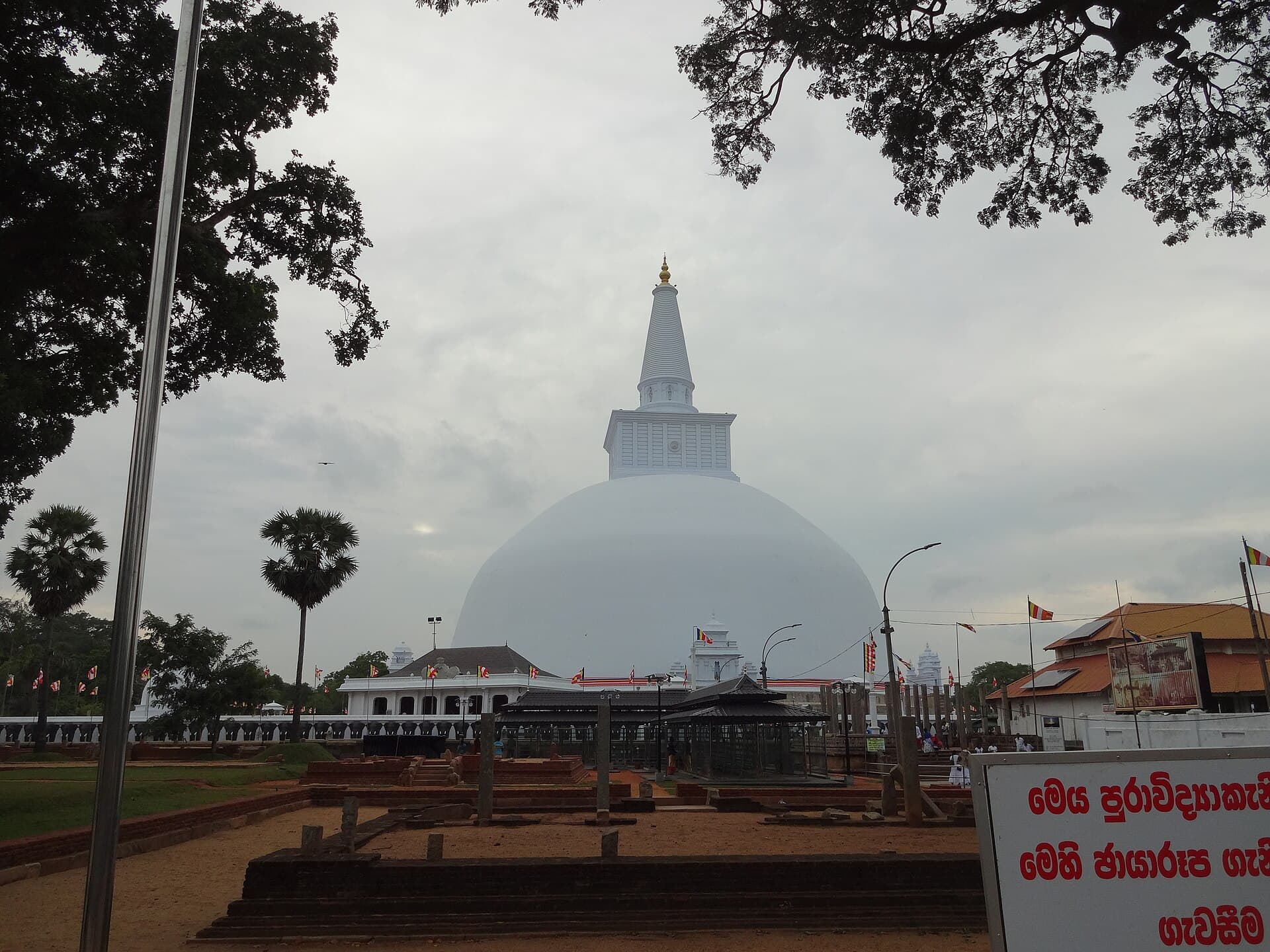
On the dry northern plain of Sri Lanka, three enormous domes of brick rise out of scrub and paddy land. They are what remains visible of Anuradhapura, royal capital of the island from around the fourth century BC until the end of the tenth. UNESCO, which inscribed the Sacred City in 1982, describes a capital that flourished for 1,300 years and was abandoned after an invasion in 993.
What a visitor walks through is the wreckage of a working city: monastery precincts covering square kilometres, bathing ponds cut in granite, pillars of vanished halls in rows like a burnt forest, reservoirs that read on a map as lakes. At the centre, behind a wall built to keep elephants out, grows a sacred fig with props under its oldest limbs.
By Sri Lankan tradition a cutting was taken from the southern branch of the bodhi tree at Bodh Gaya, under which the Buddha is said to have reached enlightenment. The nun Sanghamitta, a daughter of the Mauryan emperor Ashoka, carried it to the island in the third century BC, and King Devanampiya Tissa planted it in his royal park. That tree is the Jaya Sri Maha Bodhi, on a terrace 6.5 metres above the ground and ringed by younger bo trees planted as a windbreak.
The claim attached to it needs its qualifiers kept in place: the oldest living human-planted tree in the world with a known planting date. Sri Lanka's Central Cultural Fund gives the shorter version, the oldest documented tree in the world. Every word is doing work. Older living trees exist and are not close, since bristlecone pines have been ring-dated to almost five thousand years. But none has a birth certificate; their ages are read backwards out of wood. This one has a date because people wrote it down at the time and kept writing.
The tree is not remarkable for being old. It is remarkable because a chain of human beings recorded, generation after generation, that they were looking after it. King Vasabha, who reigned from 65 to 107, set four Buddha statues around it. King Kirthi Sri Meghavarna laid a stone terrace and lattice wall in the fourth, both found again during modern excavation and opened to the public in 2010. The Chinese pilgrim Faxian, on the island between 411 and 413, described a shrine at its foot with a Buddha image inside and worshippers coming without pause. The enclosing wall went up in the eighteenth century to keep wild elephants off; the golden fence around the trunk dates only to 1969.
The record holds the injuries too, which is how you know it is a record and not a legend. Storms broke branches in 1907 and 1911. A man cut one down in 1929. In 1985 gunmen killed pilgrims on the upper terrace, and access there has been restricted since. Twenty-three centuries of watering, propping and mourning, all entered somewhere in writing. The tree is the object; the archive is the achievement.
Almost every date above rests on one book. The Mahavamsa is a chronicle of the island in Pali verse, attributed to a monk named Mahanama at the Mahavihara monastery in Anuradhapura in the fifth or sixth century AD. It was not invented from nothing: the Mahavihara monks had kept annals since the third century BC, and Mahanama worked from those older Sinhala commentaries.
A page about memory should say how the memory reaches it. The Mahavamsa was compiled centuries after the earliest events it narrates, by a monk of one monastic fraternity, in a form built to inspire devotion as much as inform. It opens with three visits of the Buddha to the island that appear in no early source, and it tells the rival monasteries' story from the Mahavihara's side. Its regnal dates are internally consistent but externally contested: tradition places Devanampiya Tissa's reign in 307-267 BC, while the adjusted chronology followed by Wilhelm Geiger and most modern scholars moves it to 247-207 BC, which is why the planting is given variously as 288 BC or 236 BC.
So the chronicle is both the reason the tree can be dated and a document with its own purposes; both are true at once. Excavation at the citadel has pushed settlement here back to around 900 BC, well before the chronicle's founding date, so the monks were describing a place already ancient when they began counting.
The oldest is the Thuparamaya, the earliest documented Buddhist monument on the island, raised under Devanampiya Tissa at the request of the missionary monk Mahinda to hold what tradition calls the Buddha's right collarbone. It is small beside its neighbours, bell-shaped, ringed by two rows of slender pillars left from a vanished circular roof. The dome standing now dates from an 1842 rebuilding.
The Ruwanwelisaya, in the photograph above, is the one most pilgrims come for. King Dutugemunu began it around 140 BC and died before it was finished. The original stupa stood about 55 metres high; the restored monument reaches roughly 103 metres, with a circumference near 290 metres. Its modern history is a fundraising story: a restoration society formed in 1902, the pinnacle crowned in 1940, a final crowning in 2019.
The Jetavanaramaya is the extraordinary one. Begun by King Mahasena, who reigned from 273 to 301, and finished by his son, it rose to about 122 metres, making it the tallest stupa ever built and, at the time, the third tallest structure on earth, behind only the Great Pyramid of Giza and the Pyramid of Khafre. Something near 93 million fired bricks went into it, on a foundation sunk 8.5 metres to bedrock. A twelfth-century rebuild left it lower, and it stands at about 71 metres today.
None of this was possible without engineering the rain. Anuradhapura sits in the dry zone, where the year divides into a wet monsoon and a long thirst, and the answer was the tank: an earthen reservoir closed by a bund and released through sluices into paddy. Abhaya Wewa dates to the fifth or fourth century BC; Tissa Wewa was raised by Devanampiya Tissa himself, its embankment running 3.2 kilometres at about 7.6 metres high.
The masterpiece came in the fifth century AD under King Dhatusena, whose Kala Wewa complex, finished around 460, holds some 123 million cubic metres. From its central sluice a canal called the Yodha Ela carried water about 87 kilometres to Tissa Wewa at Anuradhapura, falling on average six inches per mile, roughly 9.5 centimetres per kilometre, across the first 27 kilometres. Holding a gradient that shallow over that distance, with no instrument more sophisticated than water itself, is the sort of achievement the stupas overshadow. Dhatusena's son Kashyapa then killed his father, took the throne and moved the court to the rock fortress at Sigiriya.
The city held three great monastic complexes, and their rivalry shaped it. The Mahavihara was the orthodox Theravada foundation. The Abhayagiri, established by King Valagamba in the first century BC, grew into an international institution open to Mahayana and Vajrayana teaching, and was the first custodian of the tooth relic. The Jetavana was founded after Mahasena's men pillaged the Mahavihara, an act the chronicle records with some bitterness. Parakramabahu I abolished both junior fraternities in the twelfth century. The Abhayagiri precinct alone holds more than thirty bodies of water, among them the granite-lined bathing ponds called the Kuttam Pokuna.
At the foot of the steps into these buildings sit the two carvings that became the signature of the period. The sandakada pahana, or moonstone, is a semicircular slab in concentric bands: flames outermost, then elephant, horse, lion and bull in procession, then creeper, swans, and a half lotus at the centre. It is usually read as the cycle of samsara, and the visitor crosses it on the way in. Flanking the steps stand guardstones, the muragala, which across these centuries evolved from plain uprights to vessels of abundance, then dwarf attendants, then coiled nagaraja figures. Together they turn a staircase into an argument about what you are entering.
In 993 the Chola emperor Rajaraja I took the city, and his son Rajendra I finished the conquest two decades later. The court moved southeast to Polonnaruwa and never came back. The tanks silted, the monasteries emptied, and the forest closed over the brick. Pilgrims kept coming to the bodhi tree, but the city around it dissolved. In 1821 John Davy found "a small mean village, in the midst of a desert," still holding a tank, some stone pillars and a few great mounds.
Recovery began in the 1870s under British administration, when the site became the seat of the North Central Province. In July 1890 the colonial government made Harry Charles Purvis Bell the first Archaeological Commissioner of Ceylon; he ran the Archaeological Survey until 1912. The discipline soon became domestic: Senarath Paranavitana, Commissioner from 1940 to 1956, went on to teach archaeology at the University of Peradeniya campus of the University of Ceylon and to publish the island's inscriptions. In 1949 a preservation plan moved the modern town eastward into a purpose-built New Town so the ancient city could be left alone. UNESCO inscribed it in 1982.
Anuradhapura is not a ruin field with a ticket barrier around it. It is a working pilgrimage centre, busiest on full moon poya days and above all at Poson in June, which marks Buddhism's arrival on the island. Pilgrims come dressed in white, and a visitor who wears white will be read correctly. Shoulders and knees stay covered. Shoes and hats come off before any temple terrace, including the sand around the stupas, hot enough by midday to make socks a kindness. The bodhi tree's upper terrace is closed to general access, and turning your back on a Buddha image for a photograph is taken as a small insult.
That etiquette is not decoration. It is the current instalment of a practice running here since the third century BC: people agreeing how to look after something, and passing the agreement on. The stupas are the visible proof, but the tree is the better lesson. It has outlived the kingdom that planted it, the empire that abandoned it and the one that came looking for it again, and it did so because in every century somebody wrote down that they had watered it.
Jaya Sri Maha Bodhi: a tree with a written life
What the Mahavamsa is, and what it wants
Three mountains of brick
The water beneath everything
Fraternities, and the stones at the threshold
Jungle, then survey
What a visitor meets
References and resources
- UNESCO World Heritage Centre. "Sacred City of Anuradhapura." World Heritage List, property no. 200, inscribed 1982. whc.unesco.org/en/list/200.
- Central Cultural Fund of Sri Lanka. "Anuradhapura: The Sacred Ancient Capital." ccf.gov.lk/anuradhapura.
- Wikipedia. "Anuradhapura," "Jaya Sri Maha Bodhi," "Ruwanwelisaya," "Jetavanaramaya," "Thuparamaya," and "Mahavamsa." Retrieved 2026.
- Wikipedia. "Abhayagiri vihara," "Sandakada pahana," "Muragala," "Kala Wewa," and "Senarath Paranavitana." Retrieved 2026.