Heritage · Landmark
The Ellora Caves: three faiths in one cliff
Along a basalt escarpment in Maharashtra, 34 rock-cut sanctuaries were carved over four centuries by Buddhists, Hindus, and Jains working side by side. At their center stands the Kailasa temple, the largest monolithic structure on earth, cut top-down from a single rock by removing an estimated 200,000 tonnes of stone.Written to last.
By Confinity Heritage Editorial · 2026-08-23 · 7-minute readQuiet tools, kept out of the way.
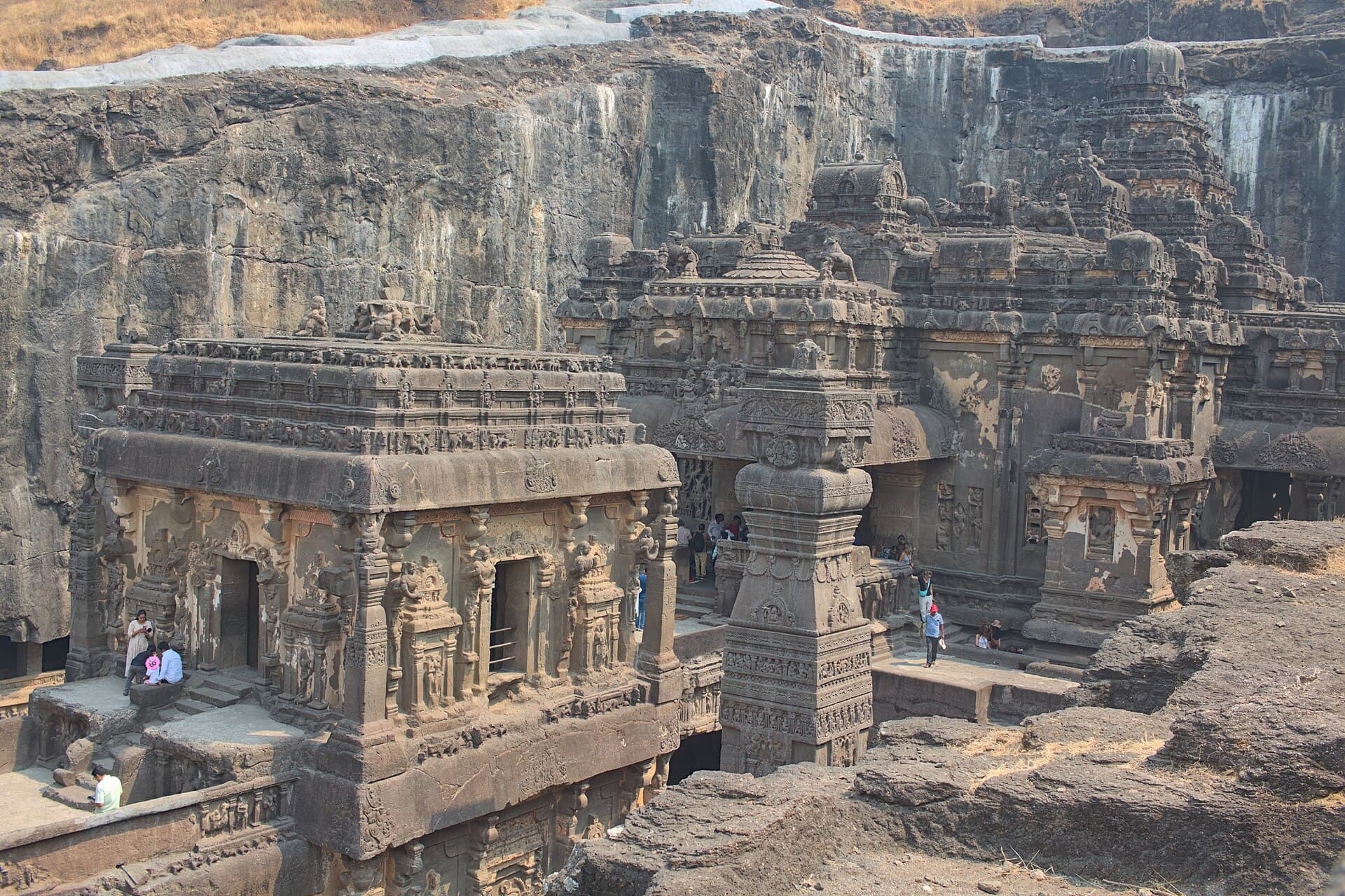
In the Deccan uplands of Maharashtra, in western India, a basalt cliff called the Charanandri escarpment runs for about two kilometres, and cut into its face are 34 major cave temples and monasteries. They are not buildings in the ordinary sense. Nothing here was assembled; every hall, column, stair, and colossal figure was carved out of the living rock of the Deccan Traps, the vast sheets of lava that hardened over the region tens of millions of years ago. Work at Ellora ran from roughly the 6th century to the 10th, through the reigns of the Kalachuri, Chalukya, and Rashtrakuta dynasties, and the result has been inscribed on the UNESCO World Heritage List since 1983.
What sets Ellora apart from every other cave site in India is written in its numbering. Caves 1 to 12, at the southern end, are Buddhist. Caves 13 to 29 are Hindu. Caves 30 to 34, at the northern end, are Jain. Three religions carved their sanctuaries into the same cliff, often at the same time, sharing quarry faces, techniques, and very likely the same families of artisans, for some four centuries. The site is a monument to coexistence before the word existed: one rock, patiently divided among three ways of remembering the sacred, with no wall between them but a short walk along the scarp.
The phases overlap rather than follow one another neatly. Some of the earliest excavations are Hindu, begun in the 6th century under Kalachuri patronage; the main Buddhist campaign ran from about 600 to 730; the Jain caves came last, in the 9th and 10th centuries, as Rashtrakuta power matured and then waned. For long stretches, chisels were ringing in Buddhist, Hindu, and Jain excavations at once. Dynasties changed, and with them the emphasis of royal patronage, but no phase erased another. The finished caves stood open together, and pilgrims of each tradition passed the shrines of the others on the way to their own.
That tolerance was not an accident of geography. Rulers in the medieval Deccan commonly endowed institutions of more than one faith, and a shared cliff advertised that breadth. Ellora made the policy permanent. A king could sponsor a Shiva temple within sight of a Buddhist monastery and a Jain assembly hall, and the mountain would hold all three claims in the same stone, on equal terms, for as long as basalt lasts.
The southern caves are mostly viharas, residential monasteries with cells, shrines, and refectories cut around columned halls, some rising three storeys inside the cliff. Cave 12, called Tin Thal, stacks three full floors of halls behind a plain facade. The masterpiece of the group is Cave 10, the Vishvakarma cave, a prayer hall whose ceiling is carved into curved stone ribs imitating the timber roofs of earlier wooden shrines, with a large seated Buddha before its votive stupa. Craftsmen later nicknamed it the carpenter's cave, honoring Vishvakarma, the divine architect.
Monasteries on this scale needed money, and the money came past the front door. Ellora sits on an old caravan route that linked the cities of the interior Deccan with the ports of the western coast, and the merchants who moved cloth, grain, and gems along it were generous donors to the communities in the rock. The pattern was ancient: across India, Buddhist cave monasteries cluster along trade roads, where monks offered rest and merit to travelers and travelers endowed halls in return. At Ellora the arrangement kept hundreds of monks, and later the site itself, in continuous view of the moving world.
Near the middle of the escarpment stands Cave 16, the Kailasa temple, and the word cave undersells it. It is a complete freestanding temple complex, a shrine tower about thirty metres high, a columned hall, a gateway, galleries, life-size elephants, and two victory pillars, all standing in a courtyard roughly 82 metres deep and 46 metres wide, and every part of it is one continuous piece of the mountain. It is the largest monolithic structure ever cut from a single rock, covering about twice the area of the Parthenon in Athens. Excavating it meant removing an estimated 200,000 tonnes of basalt or more, basket by basket.
The temple was raised, or rather revealed, under the Rashtrakuta king Krishna I in the 8th century, and dedicated to Shiva as an image of Mount Kailash, the god's Himalayan home. Its walls carry some of the most dramatic sculpture in India, above all the panel of the demon king Ravana straining to shake Kailash itself while Shiva pins the mountain calm with one foot. A later Rashtrakuta copper plate grant preserves the wonder the finished temple provoked: it records that even the gods were astonished, and that the architect himself, looking at what he had made, could not believe it was the work of his own hands.
The Kailasa was carved from the top down. Workers began on the plateau above the cliff, cutting three deep trenches into the rock and sinking them, over decades, until a rectangular island of basalt stood free of the mountain. Then the sculptors shaped that island into a temple, working downward from the tower's crown to the courtyard floor, finishing the upper levels while the lower ones were still solid stone. The method dispensed with scaffolding, since the uncut rock below was the platform, but it abolished every second chance. Nothing could be added, propped, or moved. A masonry builder who misjudges a course takes it down and relays it; at Kailasa a single deep error would have stood forever.
That is why the Kailasa is sometimes called the sculptor's temple. It is architecture as pure subtraction, a building made entirely of decisions about what to take away, planned in full before the first trench was cut and executed without a joint, a beam, or a brick. The plan, the engineering, and the art are one act. Nowhere else did rock-cut architecture, an old craft in India by the 8th century, push its own logic so far.
The Hindu caves around the Kailasa have their own weight. Cave 29, Dhumar Lena, is among the earliest at the site, a vast cruciform hall whose plan is closely related to the great cave of Elephanta near Mumbai. Cave 21, Rameshvara, carries river goddesses of unusual grace at its entrance. Cave 15 records in stone the transition of the site itself: begun as a Buddhist monastery, it was rededicated to Hindu worship as patronage shifted, and its upper floor holds a celebrated sequence of Vishnu and Shiva reliefs.
At the northern end the Jain caves close the sequence on a quieter note. Smaller than their neighbours, they answer with density of detail: Cave 32, the Indra Sabha, is a two-storeyed court whose lotus ceilings, carved elephants, and seated tirthankaras are finished with a jeweller's patience. They belong to the Digambara tradition, and they were never wholly given up. Jain worshippers still come to these shrines, which means that at Ellora the distance between monument and living temple has never fully opened.
Ellora's history has one absence that is itself remarkable: the site was never forgotten. Its sister site Ajanta Caves, hidden in a horseshoe gorge some hundred kilometres away, was abandoned, swallowed by forest, and only stumbled upon again by a British hunting party in 1819. Ellora, standing beside a working road, never fell out of sight. Pilgrims kept coming, and so did outsiders. Travelers and chroniclers writing in Persian under the Deccan sultanates and the Mughals recorded their astonishment at the carved mountain, some concluding that no merely human workshop could have produced it.
Not every visitor came in admiration. Accounts from the reign of the emperor Aurangzeb, in the late 17th century, report attempts to deface the carvings. The visible result is chisel scars on some figures and little more. The basalt that had absorbed two centuries of construction absorbed the destruction too, and blunted it; harming the Kailasa turned out to demand nearly the labor that making it had.
The caves today are in the care of the Archaeological Survey of India, which maintains the site, and their inscription on the World Heritage List in 1983 recognized both the artistic achievement and the record of religious tolerance. The chief enemy now is water. Monsoon rain works through joints in the basalt and seeps down cave walls, feeding algae and mineral crusts and threatening the fragile traces of painted plaster that survive on the Kailasa's ceilings, evidence that the temple was once brightly finished. Conservators monitor the seepage, seal fractures in the rock above, and manage the heavy visitor traffic that Ellora, unlike hidden Ajanta, has carried without interruption for more than a thousand years.
What Ellora preserves, in the end, is a lesson about keeping. Three faiths trusted their memory to the same cliff, and the cliff kept all three, side by side, without ranking them. The merchants' road brought the world past the caves and never let them be forgotten; the basalt outlasted neglect and outlasted malice. And at the center stands the Kailasa, the temple made by taking away, where an architect looked at the mountain, saw what was already inside it, and spent a lifetime removing everything that was not the temple. Most of what people build is addition. Ellora is the rarer thing: a memory carved by subtraction, held in stone that three traditions still share.
A cliff shared by three faiths
The Buddhist south and the road that paid for it
Kailasa: the largest sculpture on earth
Architecture by subtraction
Shiva's halls and the Jain north
Never lost
Keeping the stone standing
A cliff that kept three memories
References and resources
- UNESCO World Heritage Centre. "Ellora Caves." World Heritage List, property no. 243, inscribed 1983. whc.unesco.org/en/list/243.
- Archaeological Survey of India. "Ellora Caves, Aurangabad." asi.nic.in.
- Encyclopaedia Britannica. "Ellora Caves." britannica.com/place/Ellora-Caves.
- Wikipedia. "Ellora Caves" and "Kailasa Temple, Ellora." Retrieved 2026.