Heritage · Landmark
Ellis Island: America's golden door
Between 1892 and 1954 roughly twelve million people entered the United States through the immigration station on Ellis Island, and an estimated four in ten Americans descend from at least one of them. The ship manifests recorded there became one of the great genealogical archives of the world, searchable today by anyone with a family name and a question.Written to last.
By Confinity Heritage Editorial · 2026-08-23 · 7-minute readQuiet tools, kept out of the way.
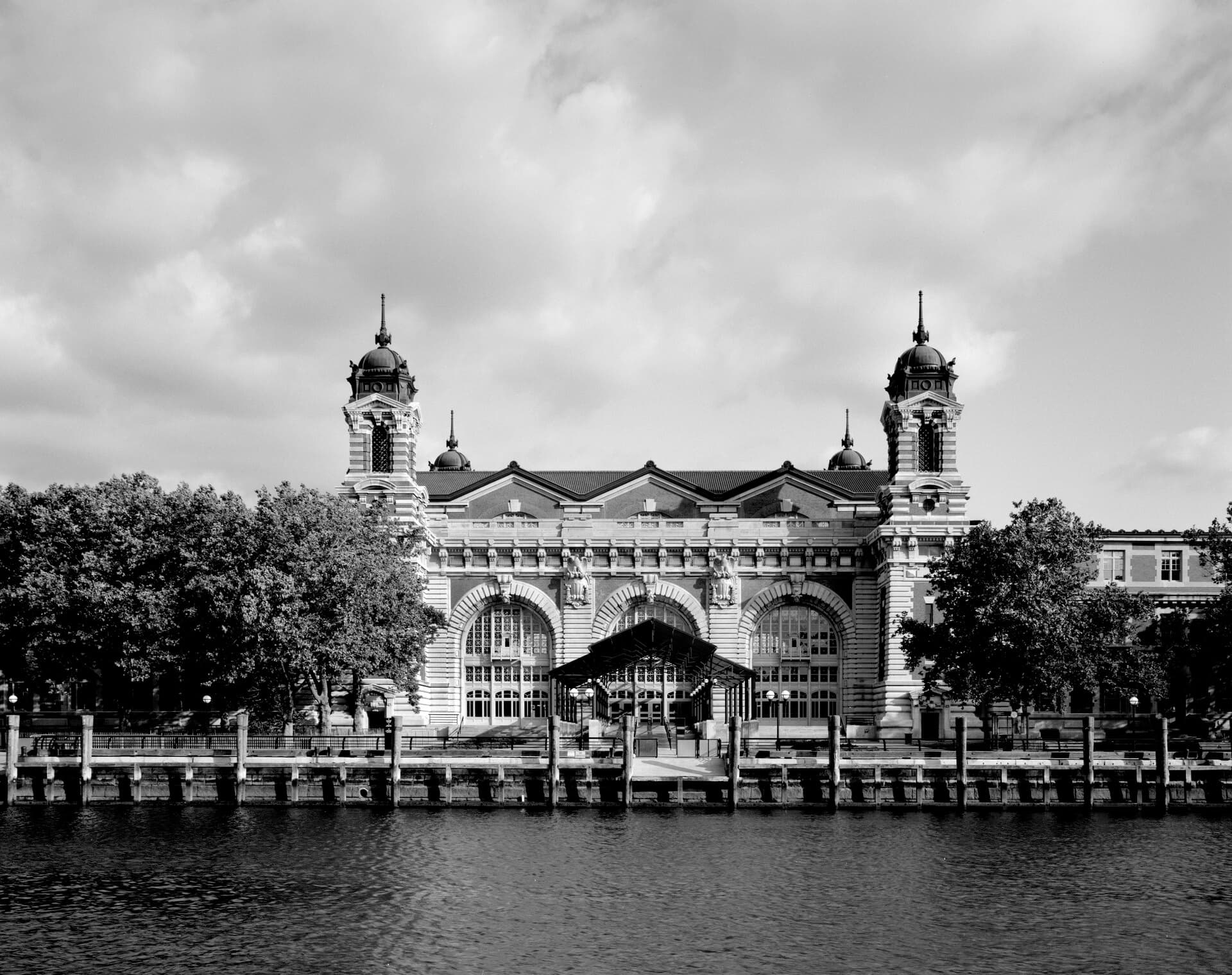
In the upper bay of New York Harbor, on a low island within sight of the Statue of Liberty, stands the hall through which the modern United States assembled much of itself. Between January 1892 and November 1954 the federal immigration station on Ellis Island processed roughly twelve million arriving immigrants, most of them in the two extraordinary decades before the First World War. The National Park Service repeats a striking estimate: close to 40 percent of Americans alive today can trace at least one ancestor to a name recorded there. Few buildings anywhere carry that kind of demographic weight. This one is a pile of red brick and limestone in the French Renaissance manner, with four copper-domed towers and a single vast room at its heart.
The island itself was made for the job. Named for Samuel Ellis, a merchant who owned it in the eighteenth century, it measured barely three acres when the federal government took over immigration control from the states in 1890. Landfill, some of it ballast and spoil from the digging of the New York subway, eventually raised it to more than 27 acres. The first station, a barn-like structure of Georgia pine, opened on 1 January 1892 and burned to the ground one night in June 1897; no one died, but immigration records reaching back to 1855, inherited from the earlier Castle Garden depot, were lost with it. The fireproof building that replaced it opened in December 1900, receiving 2,251 people on its first day, and it is the one that twelve million would remember.
The station's first arrival has become its emblem. On the morning of 1 January 1892 a seventeen-year-old from County Cork named Annie Moore came down the gangway of the steamship Nevada with her two younger brothers, ahead of the other steerage passengers, and became the first immigrant registered at Ellis Island. Officials marked the occasion by presenting her with a ten-dollar gold piece, reportedly more money than she had ever held. She was met by her parents, who had gone ahead to New York, and she lived out her life in the tenements of the Lower East Side, dying in 1924.
Even her story needed the archive to set it straight. For decades American accounts followed the wrong Annie Moore, a Texas woman of the same name who died under a streetcar, until a genealogist traced the real one in 2006 to a hard immigrant life in Manhattan and an unmarked grave in Queens, since given a headstone. Statues of Annie and her brothers now stand at Cobh, the Irish port she left, and on the island where she landed, a girl carrying a bundle at either end of the crossing.
Ellis Island was a filter for the poor. First and second class passengers were inspected briefly aboard ship and walked ashore in Manhattan; only steerage passengers were ferried to the island. They climbed a steep staircase into the Registry Room, the double-height hall everyone came to call the Great Hall, beneath a vaulted ceiling that was rebuilt in Guastavino tile after the Black Tom munitions explosion of 1916 shook the original plaster loose. The climb itself was the first test. Doctors of the Public Health Service watched each person mount the stairs, alert for a limp, a cough, laboured breathing, in what became known as the six-second medical exam. At the top an assistant flipped each eyelid with a buttonhook, looking for trachoma, a contagious eye disease that meant almost certain exclusion.
Anyone who raised a doubt received a chalk mark on the shoulder of their coat: E for eyes, H for heart, L for lameness, X for suspected mental defect. The marked stepped out of line for closer examination; the rest moved on to a legal inspector who, with the ship's manifest open before him, asked the same battery of twenty-nine questions the shipping company had already recorded. For most people the entire passage through the building took three to five hours and ended at the Stairs of Separation, where the ways parted toward the railroad ticket office, the ferry to Manhattan, or detention.
Roughly one in five arrivals was detained for a time, for further medical checks, for a hearing, or simply to wait for money or a relative to appear. But the number finally refused entry was small: about 2 percent across the station's life, perhaps a quarter of a million people in all. For them, and for the families divided by an inspector's ruling, the place earned the name immigrants gave it in a dozen languages: the Island of Tears. Exclusion fell mostly on the sick, on contract labourers, and on those judged likely to become a public charge, and it could mean a child sent back across the ocean with a single accompanying parent while the rest of the family stayed.
The island's southern half tells that side of the story. A hospital complex of some 750 beds grew there, one of the largest public health undertakings of its era, treating arrivals for everything from measles to tuberculosis. Around 350 babies were born on Ellis Island, and about 3,500 people died there, within sight of the country they had crossed the world to enter.
The most durable Ellis Island story is the one that never happened. Generations of American families have repeated it: a tired clerk, unable to spell a Polish or Sicilian surname, wrote down something shorter and the family carried it ever after. In fact the inspectors at Ellis Island wrote down no names at all. They worked from the ship's manifest, a list compiled at the port of departure, usually by agents who spoke the passenger's language, and their task was to check the person against the page, not to christen anyone. Many inspectors were immigrants or the children of immigrants themselves and worked in several languages, with interpreters on call for dozens more.
Name changes were real, but they happened elsewhere: at a steamship office in Europe, in a first American classroom or workplace, or at a courthouse years later, when a new citizen chose a name that would sit more easily in American mouths. The surviving manifests show the opposite of the legend. They are where the original spelling, the name a family carried from the old country, was preserved.
The flood crested in 1907, when 1,004,756 immigrants passed through Ellis Island in a single year; on 17 April of that year the station processed 11,747 people in one day. The First World War cut arrivals to a trickle, and the country that emerged from it wanted fewer newcomers. A literacy test came in 1917, an emergency quota in 1921, and then the Immigration Act of 1924, which fixed small national-origin quotas and moved inspection to American consulates abroad. Immigrants now arrived with visas already in hand and mostly walked ashore at the piers.
The Great Hall emptied. For its last three decades Ellis Island served mainly as a detention and deportation centre, holding people the country was putting out rather than letting in, and during the Second World War it interned resident nationals of enemy states. On 12 November 1954 the last detainee, a Norwegian seaman named Arne Peterssen, was released, and the station closed without ceremony.
The government declared the island surplus property, and for a generation it simply rotted. Salt air worked on the roofs, vandals and weather did the rest, and saplings grew in the Great Hall. In 1965 President Johnson placed Ellis Island within the Statue of Liberty National Monument, but serious money arrived only in the 1980s, when the Statue of Liberty-Ellis Island Foundation, under the businessman Lee Iacocca, raised private funds to restore both monuments for the statue's 1986 centennial. The main building's share came to about $160 million, described at the time as the largest restoration project in American history, and the Ellis Island National Museum of Immigration opened in the renovated hall in September 1990.
The restoration was deliberately partial. The ferry slip still holds the mothballed ferryboat Ellis Island, and the 29 hospital and support buildings on the south side remain unrestored, stabilised against collapse and open only to guided hard-hat tours. Even the island's ownership is split: in 1998 the Supreme Court ruled that the original three acres lie in New York while the landfilled remainder belongs to New Jersey, so that a visitor crosses a state line walking from the Great Hall to the hospital wards.
The station's paperwork outlived the station. In 2001 the Foundation opened the American Family Immigration History Center on the island and put the ship manifests online, in a free searchable database that has grown to more than 65 million passenger records spanning 1820 to 1957. Family historians on every continent use it daily, and for many of them a single manifest line is the earliest written trace their family possesses: a name in a purser's hand, an age, an occupation, a village left behind, the relative waiting at an address in America, the few dollars declared at the rail.
That is the quiet inheritance of Ellis Island. A bureaucratic instrument, drawn up to satisfy an inspection law, became one of the great genealogical records of the world. The building was restored because millions of people wanted somewhere to stand in their grandparents' footsteps; the archive endures because a line of ink can hold a whole decision, the moment a family bet everything on a harbor they had never seen. To find that line, and to keep it, is to hear the first sentence of an American story told in the old spelling of your own name.
The girl from Cork
Six seconds in the Registry Room
The island of tears
The myth of the changed name
Peak, quotas, and the closing door
Ruin and restoration
A line in a manifest
References and resources
- National Park Service. "Ellis Island," part of Statue of Liberty National Monument. nps.gov/elis.
- The Statue of Liberty-Ellis Island Foundation. "Ellis Island" and the passenger search database of the American Family Immigration History Center. statueofliberty.org and heritage.statueofliberty.org.
- Encyclopaedia Britannica. "Ellis Island." britannica.com/place/Ellis-Island.
- Library of Congress. "Today in History: January 1," on the opening of Ellis Island and Annie Moore. loc.gov.
- Supreme Court of the United States. New Jersey v. New York, 523 U.S. 767 (1998), on the island's jurisdictional boundary.
- Save Ellis Island. On the unrestored hospital complex of the island's south side. saveellisisland.org.