Heritage · Landmark
Cahokia: the lost metropolis of the Mississippi
Around the year 1100, the largest city north of Mexico stood not in Europe or Asia but on the Mississippi floodplain opposite modern St. Louis, home to more people than London at the time. Its builders left no writing, its true name is unknown, and much of it was levelled for railroad fill and suburbs before anyone thought to keep it. What remains is Monks Mound, the greatest earthen structure in the Americas north of Mexico, and the traditions of the descendant nations who never forgot.Written to last.
By Confinity Heritage Editorial · 2026-08-23 · 7-minute readQuiet tools, kept out of the way.
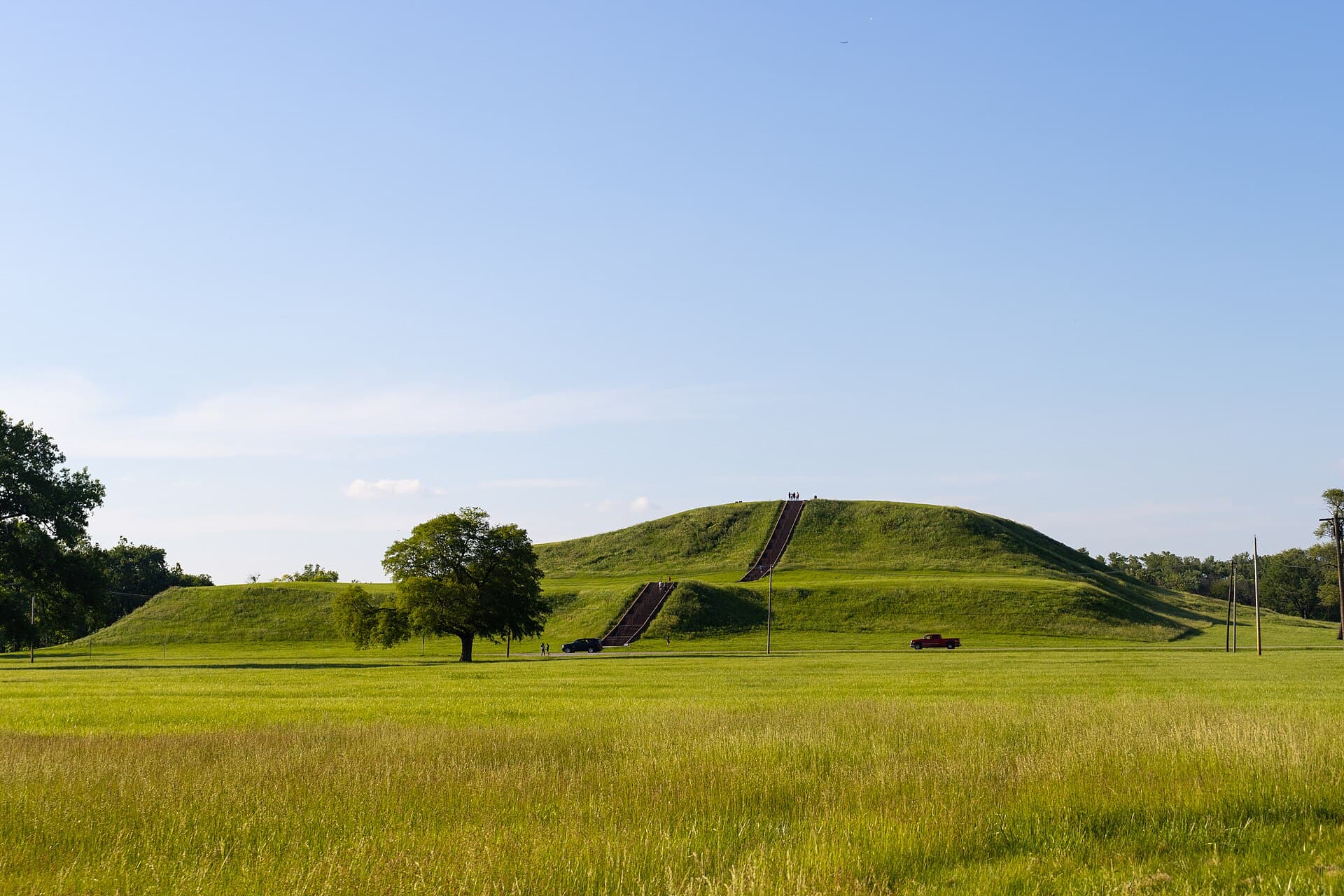
On the broad Mississippi floodplain of southern Illinois, a few miles east of the river from modern St. Louis, a grass-covered platform of earth rises about thirty metres above the fields. Around it, scattered across a state historic site and the suburbs beyond, stand the survivors of what was once a city of roughly 120 mounds. Nine hundred years ago this was the largest city in what is now the United States, the capital of the Mississippian world, with a population estimated at 10,000 to 20,000 people at its height around 1100. London, at that same moment, held fewer people. UNESCO inscribed the site on the World Heritage List in 1982.
And yet almost everything a visitor is told about the place begins with an admission of loss. The name "Cahokia" is borrowed. It belongs to a subtribe of the Illiniwek, or Illinois Confederacy, who were living nearby when French missionaries arrived in the late seventeenth century, some three centuries after the city had emptied. The Cahokia people did not build the mounds and made no claim to them. The builders themselves left no writing, so their own name for their city, and for themselves, is unknown. What survives is earth, artifacts, and the oral traditions of descendant nations, and out of those materials archaeologists have assembled the story of a metropolis.
The city rose on the American Bottom, a wide, fertile stretch of Mississippi floodplain where rivers met and maize grew well. People had lived there for centuries in modest villages, but around 1050 something changed with startling speed. Archaeologists, most prominently Timothy Pauketat, describe it as a "big bang": within a generation, the old settlement was swept away and a planned city laid out over it, organized on a grand axial design aligned roughly to the cardinal directions. Neighborhoods of thatched-roof houses went up in ordered rows. Borrow pits opened where thousands of workers dug earth for new mounds. The population multiplied several times over in a few decades, drawing migrants from across the region, while satellite mound centers rose at what are now East St. Louis and St. Louis.
Why it happened remains argued: suggested spurs range from a supernova visible in daylight in 1054 to new strains of maize, new religious movements, and the ambitions of a rising elite. What is not argued is the scale of the result. At its peak the city covered around sixteen square kilometres and held some 120 mounds of earth: flat-topped platforms for buildings of rank, conical burial mounds, and low ridge-topped mounds marking key points in the plan.
At the center of everything stood the great mound, and it still does. Monks Mound is about 30 metres tall, roughly 291 metres long and 236 metres wide, with a base covering about five and a half hectares, larger in footprint than the Great Pyramid of Giza. It is the largest earthen structure in the Americas north of Mexico, and it was built without wheels, draft animals, or metal tools: an estimated 622,000 cubic metres of soil, carried from the borrow pits one woven basket-load at a time, layered and engineered in stages over decades. On the summit stood an enormous pole-and-thatch building, about 32 metres long, probably the residence or temple of the paramount chief, from which the whole city and its farmlands could be seen.
The name, like the city's, is an accident of later history. In the early 1800s a small community of Trappist monks settled nearby and farmed the mound's terraces for a few years before disease and hardship drove them out. The monks stayed less than a decade; the name stayed for good.
South of Monks Mound the city's builders did something almost as laborious as raising the mound itself: they made the ground flat. The Grand Plaza, covering roughly twenty hectares, was artificially levelled and filled, a public space that could hold the city's whole population for ceremonies, feasts, markets, and the spectator sport of chunkey, in which players hurled spears at a rolling stone disc. Around its edges rose the mounds of the elite, so that public life unfolded in an arena framed by authority.
West of the mound, excavators in the 1960s found something subtler: great circles of postholes. The largest, reconstructed on site, held 48 red cedar posts in a circle about 125 metres across. From a central observation post, marker posts aligned with the sunrise at the equinoxes and the summer and winter solstices, with the equinox sun appearing to rise out of Monks Mound itself. The circles, nicknamed Woodhenge, were rebuilt at least five times over the city's life, each rebuilding slightly larger. Cahokia's planners, like calendar-keepers on every continent, tied the city's ritual year to the turning sky.
The most unsettling discoveries came from one of the smallest mounds. Mound 72, a low ridge-top mound south of the plaza, was excavated between 1967 and 1971 by Melvin Fowler, and it held the remains of about 270 people buried in the decades around 1050 to 1150. At its heart lay the burial that has become Cahokia's emblem: a man in his forties laid on a platform of some 20,000 marine shell beads arranged in the shape of a falcon, his head aligned with the bird's head, its wings beneath his arms. The falcon dancer, or Birdman, was a central figure in Mississippian belief, and the burial reads as the funeral of a ruler cast as the myth itself. Later analysis found paired male and female bodies within the beaded burial, shifting interpretations toward lineage and renewal rather than a single heroic chief.
Around this centerpiece lay evidence of a harder truth, stated plainly by the excavators: mass graves of young women in ordered rows, and a pit of men and women who had been struck down and buried together, some showing signs that they were alive when the pit was filled. Human sacrifice accompanied elite burial at Cahokia. Power in the young metropolis was sacred, dramatic, and enforced.
Cahokia was not a walled world. Its materials map a continent: copper from the Great Lakes, mica from the southern Appalachians, marine shell from the Gulf of Mexico, chert hoes quarried at Mill Creek in southern Illinois and traded out by the thousand. Traffic ran outward too. Finely made Cahokian pottery, red flint-clay figurines carved in the city's workshops, and the distinctive long-nosed god maskettes of its religion have been found from Wisconsin to Louisiana. Chunkey itself spread across the eastern half of the continent and was still played by Southeastern nations centuries after the city fell silent. Some archaeologists describe outright Cahokian outposts far up the Mississippi; others prefer to speak of influence and pilgrimage. Either way, for two centuries the city was the cultural capital of much of North America, exporting a style, a game, and a cosmology.
Around 1175 the city's rulers did something new and telling: they walled themselves in. A palisade of some 15,000 to 20,000 logs, with regular bastions, was thrown around Monks Mound and the central precinct, and rebuilt several times at enormous cost in timber. Whatever the walls answered, the city beyond them was already thinning, and no single cause of the decline is accepted. Tree-ring records show repeated drought cycles in the 1100s and 1200s; a major Mississippi flood around 1200 has been read in the sediments; deforestation and resource stress, contested but plausible, may have degraded the floodplain; and the palisade era speaks of conflict, whether feared or real. By 1350 the city was essentially empty, part of a wider emptying of the central Mississippi valley in the same era that saw the cliff dwellings of Mesa Verde abandoned in the Southwest.
What did not end was the people. Mississippian culture continued in towns across the South and Midwest into the era of European contact, and descendant nations carry the thread today. The Osage and the other Dhegihan Siouan peoples, among them the Quapaw, Omaha, Ponca, and Kaw, preserve oral traditions tied to the mound-building world of the confluence region, and the broader Southeastern tribes kept building mounds and dancing that world's ceremonies for centuries. Cahokia was abandoned; its civilization moved, dispersed, and became ancestral.
The city's second destruction was quicker than its first. St. Louis was known in the nineteenth century as Mound City for the earthworks on its own bank of the river, and its greatest, Big Mound, was carted away as railroad fill by 1869. Across the river, farmers ploughed mounds flat, and in 1931 the enormous Powell Mound was bulldozed by its landowner in part to forestall preservation. Interstate lanes were later driven through the ancient city's grid, and suburbs grew over its neighborhoods. Illinois had bought the core of the site as a state park in 1925, and protection slowly widened into today's Cahokia Mounds State Historic Site, which preserves about 80 surviving mounds. The 1982 UNESCO inscription placed the site alongside the pyramids and cities of the wider world, yet Cahokia still barely figures in American schooling, squeezed out by a national story that begins at the Atlantic coast in 1607 and by an old reluctance to grant that a city of this order stood here first.
Every great city trusts something to carry its name forward: chronicles, inscriptions, the momentum of continuous habitation. Cahokia had none of these. Its name is a borrowed label from strangers who came later, its rulers are known only by the beads they were buried on, and part of its skyline was sold off as fill dirt by people who did not ask what it was. What it kept was earth, raised basket by basket into a mound that has outlasted the city, the monks, and every explanation offered for it, and a living memory held by the Osage and the other descendant nations who know the mound-builders as grandparents rather than as a mystery. The country built on top of the metropolis mostly forgot it. The earth and the descendants did not, and between them the greatest city of pre-Columbian North America is still on the record.
A big bang on the American Bottom
Monks Mound, basket by basket
The plaza and the sky
Mound 72 and the theater of power
A city with reach
The long leaving
Levelled and overlooked
A metropolis remembered in earth
References and resources
- UNESCO World Heritage Centre. "Cahokia Mounds State Historic Site." World Heritage List, property no. 198, inscribed 1982. whc.unesco.org/en/list/198.
- Cahokia Mounds State Historic Site. Official site, Collinsville, Illinois. cahokiamounds.org.
- Encyclopaedia Britannica. "Cahokia Mounds State Historic Site." britannica.com.
- Wikipedia. "Cahokia," "Monks Mound," "Mound 72," and "Woodhenge (Cahokia)." Retrieved 2026.
- Pauketat, Timothy R. Cahokia: Ancient America's Great City on the Mississippi. Viking, 2009.
- Fowler, Melvin L. The Cahokia Atlas: A Historical Atlas of Cahokia Archaeology. Illinois Historic Preservation Agency, 1997.