Heritage · Landmark
Ayutthaya: the capital that lost its own record
Brick towers and headless Buddhas stand in mown grass on an island where three rivers meet, all that is left of a capital UNESCO ranks among the largest and most cosmopolitan cities of its age. When a Burmese army burned it in April 1767, the court's own archive burned with the palaces, and the kingdom that rose afterwards had to write the history of the one it had replaced.Written to last.
By Confinity Heritage Editorial · 2026-08-25 · 7-minute readQuiet tools, kept out of the way.
An hour north of Bangkok, on a flat island where the Chao Phraya, Lopburi and Pa Sak rivers meet, brick towers rise out of mown grass. For four centuries this was the capital of Siam, the kingdom that became Thailand. Founded in 1351, it grew into one of the largest and most cosmopolitan cities of its age, a centre of global diplomacy and commerce.
In April 1767 a Burmese army took the city after a siege of fourteen months, burned it, and marched much of the surviving population north. It was never rebuilt on the same ground. What sets Ayutthaya apart from other ruined capitals is less the scale of the destruction than what the fire did to the evidence: much of the court's written record went with the palaces, so its history reaches us through books compiled after its death by the dynasty that replaced it, and through the papers of foreigners passing through while it stood.
King Ramathibodi I founded Ayutthaya in 1351. The rivers made the choice: seagoing ships could reach the city up the Chao Phraya from the Gulf of Siam, yet it sat above the reach of the tidal bore, so foreign warships could not simply sail up and open fire. The water itself moved later: the Chao Phraya was cut through to run past the city only in 1857.
Inside the walls, streets, canals and moats ran on a grid served by a water system UNESCO calls advanced and unusual for its day. What is known of that layout comes largely from maps drawn by foreign envoys, the first sign of a pattern that runs through the subject.
The annual flood was a weapon. Siamese defence rested on the certainty that the rains would force a besieging army back each year. In 1766 the Burmese refused to go, sitting out the wet season and undermining the base of the wall.
Two tower forms dominate the ruins: the prang, a tapering spire inherited from the Khmer builders of Angkor and rebuilt here in brick under stucco, and the chedi, the bell-shaped stupa of the Sinhalese tradition favoured by the court from the fifteenth century. To raise a prang was to claim descent from Angkor.
Wat Mahathat, at the ceremonial heart of the island, held the great relic and the supreme patriarch's seat. Its central prang fell in the reign of Songtham, was raised again, and came down for good in 1904, leaving a stump ringed by headless seated Buddhas.
Wat Phra Si Sanphet, inside the palace precinct, housed no monks: it was the king's chapel, and its three bell chedis hold the ashes of three kings. Its standing Buddha was sheathed in gold, and in 1767 the building was set alight to melt the metal off it; the ruined bronze core went downriver, and Rama I enshrined it in a chedi at Wat Pho.
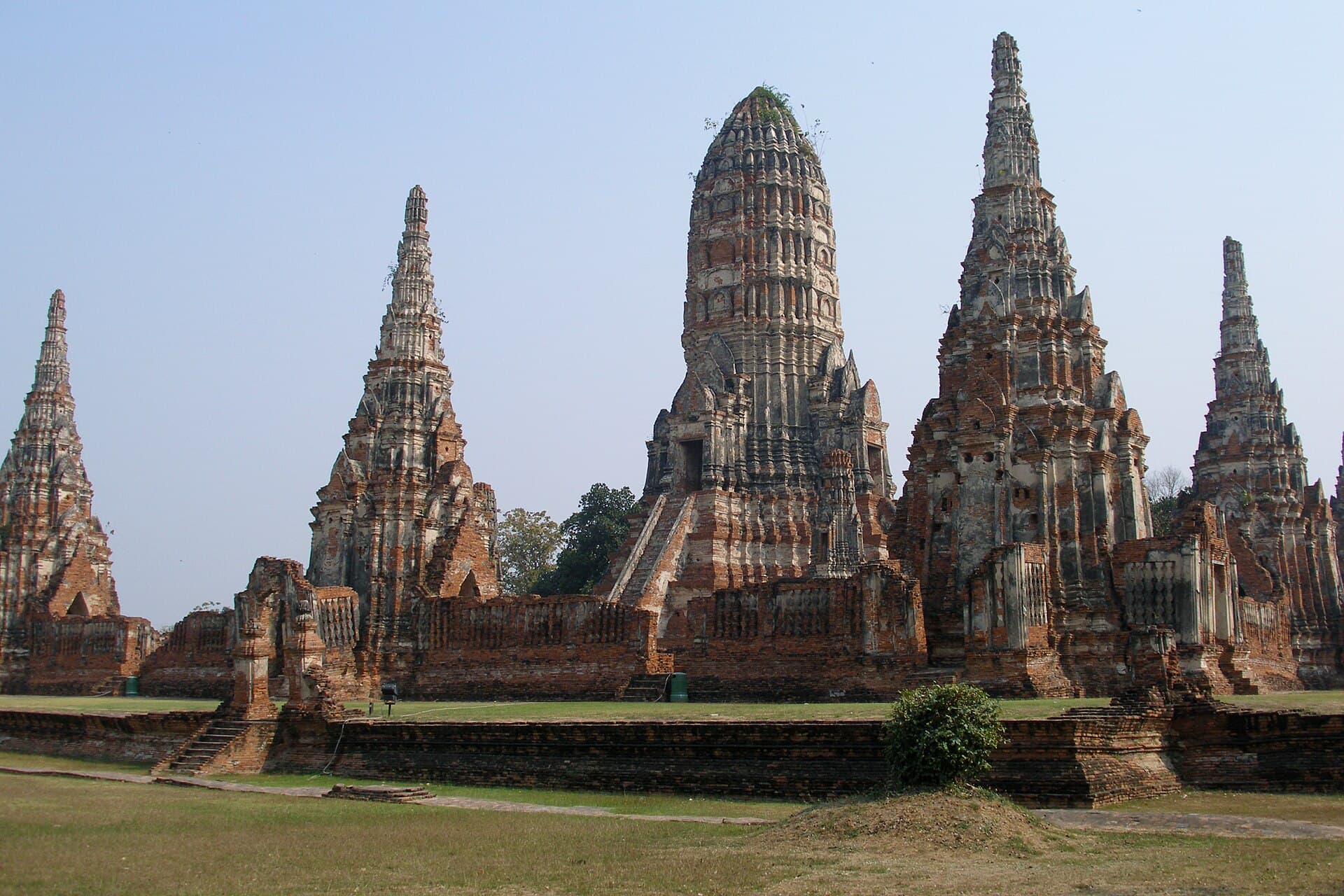
Wat Chaiwatthanaram, on the west bank beyond the island, is the temple in the photograph above, raised by King Prasat Thong in 1630 in a deliberately Khmer manner: a 35-metre central prang with four smaller prangs on a platform, ringed by eight spired crematory halls and a square gallery holding some 120 seated Buddhas. The plan models the universe: the central tower is Meru, the small prangs the four continents in the world sea.
Foreigners could not live inside the walls. Their enclaves lay downstream of the palace on both banks, the Portuguese on the west facing the Japanese on the east, with Dutch, Chinese, Persian, Malay and Mon quarters strung along the water; a contemporary phrase put the settlements at forty nations. The court exchanged ambassadors with Versailles, with the Mughals at Delhi and with the courts of Japan and China.
Those residents wrote things down, and their writing is now a principal source. Jeremias van Vliet, the Dutch Company's man in the city, counted 350 to 400 temples, almost every one of them gilded, in his description of the kingdom of 1638, and wrote a short history of its kings around 1640 from Thai manuscripts that have since disappeared. Simon de la Loubère came for Louis XIV in 1687 and Engelbert Kaempfer in 1690. How many people lived here is not among the things they settled: the specialist estimate is 150,000 to 200,000 in the seventeenth century, while the million still in circulation rests on one dataset that two others contradict. What is settled is a date: van Vliet's history of the kings of Siam is some forty years older than the earliest Siamese chronicle that survives.
The siege began in February 1766 and the city fell on 7 April 1767. The Burmese looted the island, burned it, and deported some thirty thousand people, King Uthumphon among them. Not all the fire was theirs: three months before the walls were breached, a blaze inside the city destroyed around ten thousand houses.
What burned in the palaces deserves care, because the story grows in the telling. The sweeping version has every book in Siam going up at once; UNESCO puts it more narrowly and still severely: the Siamese court kept meticulous records, many were destroyed in the sack, and some survived and remain an important source. Manuscripts existed outside the capital too. What was concentrated on the island was the state's account of itself: the chronicles, the law, the registers.
Scholars count around eighteen versions of the Royal Chronicles of Ayutthaya, and only one of substance predates the fall: the Luang Prasoet Chronicle, composed in 1681 by the chief royal astrologer at King Narai's order, which turned up in a private house in 1907 and went to the royal library that King Chulalongkorn, whose name Chulalongkorn University carries, had opened to the public. Even that text survives only through an eighteenth-century copy, stops at 1605, and is a dated list rather than a narrative.
Every fuller account was compiled or recompiled after the city was gone, under Taksin at Thonburi and then the Chakri kings at Bangkok: the Nai Kaeo version of 1782, the Phan Chanthanumat version of 1795, the Royal Autograph version of 1855. The editing sits inside the manuscripts. The Phan Chanthanumat chronicle carries two contradictory accounts of the reigns of Narai, Phetracha and Suea, divided by a royal order of Rama I instructing an official to put the narrative into proper sequence; the draft that displeased the king survives beside its replacement. The Royal Autograph chronicle is named for the corrections King Mongkut wrote by hand between its lines, which Prince Damrong promoted into the main text when he printed it in 1912.
The fullest surviving description of the city is not European either: the Thai Description of Ayutthaya was assembled from survivors' memories after the fall. The rest was made by the victors. In Burma, Mon-speaking interviewers questioned the deported Siamese, Uthumphon among them, and worked their answers into a chronicle; the Mon original is lost, but Burmese and Thai versions survive as the Ayutthaya Testimonies. Much of what is known of the city's last decades is oral history taken down in captivity by the army that destroyed it. When a capital's archive burns, the history that survives is written by the people who came after and the people who were passing through.
The headless images are the first thing most visitors photograph, and the caption they get is that the Burmese cut the heads off in 1767. What the chronicles record is fire, gold-stripping and captive-taking: images were broken for their metal, not beheaded as a policy.
The ruins then stood open for two centuries, quarried for brick and dug over by treasure hunters. A market for the heads themselves came later still. Detached Buddha heads had little value even to dealers before the 1960s; once Western interiors made them a fashionable object, images in unguarded ruins began to be cut by organised gangs. In November 2009 Thailand's deputy national police chief reported more than twenty heads taken from Ayutthaya temples in a matter of weeks, blaming buyers abroad who wanted them for their living rooms. Assigning every missing head to a single April is tidier than the record allows.
The most photographed object on the site is a sandstone Buddha head held in the aerial roots of a bodhi fig at Wat Mahathat. The stories in circulation are that a thief left it, or that it has lain there since the sack. The historical park's own archaeologist says otherwise: a workman moved the head during the restoration of 1968 to 1970 and set it under the young tree, and the roots have closed over it since. Photographs from the early 1990s show them not yet wrapped around it.
Taksin drove the Burmese garrison out of the ruins in November 1767 but would not rebuild there, putting his capital downstream at Thonburi; in 1782 Rama I crossed the river and founded Bangkok on the east bank, with moats dug to make it an island as Ayutthaya had been. UNESCO's assessment states plainly that Ayutthaya's urban template and architectural form were recreated on purpose, and that surviving Ayutthaya architects and builders did the work.
In places the copying was literal. Rama I's ramparts, 7.2 kilometres of wall and sixty-three gates, were raised partly from material salvaged out of the ruins of Ayutthaya's own fortifications and carried downriver by boat. Even the name travelled: Bangkok's full ceremonial title holds Ayutthaya inside it, so the surviving capital still announces itself as a continuation of the burned one.
The Fine Arts Department began clearing the ruins in 1969, the historical park was declared in 1976, and in 1991 UNESCO inscribed 289 hectares, about two-fifths of the island. Wat Chaiwatthanaram lies outside that core.
Then the water came back. On 4 October 2011 the bank gave way beside Wat Chaiwatthanaram and the park stayed under for more than a month. The verdict was not the one the photographs suggest. UNESCO and ICOMOS judged the damage to the masonry slight and found the real casualty in the mural paintings, where salt crystallising out of drying brick lifted the paint from the wall. A second loss came from the repair: ICOMOS criticised the hurried restoration run across more than a hundred monuments in 2012, and Thailand halted mural work pending a review of the resins used. A twelve-year conservation project at Wat Chaiwatthanaram, largely United States funded, closed in November 2024.
In 1956, digging beneath the ruined prang of Wat Mahathat, Fine Arts Department workers reached a crypt seventeen metres down and brought up gold ornaments, votive tablets and nested reliquaries sealed since the Ayutthaya period. A capital can lose its archive and still keep its deposits: the city left its history to be written by others, and the ground went on holding what the fire could not reach.
The island between three rivers
Prang, chedi, and the temples of the royal island
The port capital and the quarters of strangers
The sack of 1767 and the burning of the record
The Buddhas without heads
Bangkok, the copy of a lost city
Water, brick, and the park today
References and resources
- UNESCO World Heritage Centre. "Historic City of Ayutthaya." World Heritage List, property no. 576, inscribed 1991. whc.unesco.org/en/list/576.
- ICOMOS. Advisory Mission Report, Historic City of Ayutthaya, 28 April to 2 May 2014. whc.unesco.org/document/136457.
- Baker, Chris. "Markets and Production in the City of Ayutthaya before 1767." Journal of the Siam Society, vol. 99 (2011). thesiamsociety.org.
- Hodges, Ian. "Time in Transition: King Narai and the Luang Prasoet Chronicle of Ayutthaya." Journal of the Siam Society, vol. 87 (1999). thesiamsociety.org.
- Dressler, Jan R. "A Note on the Source Texts of Cushman's Royal Chronicles of Ayutthaya." Journal of the Siam Society, vol. 101 (2013). thesiamsociety.org.
- Cushman, Richard D., translator, and David K. Wyatt, editor. The Royal Chronicles of Ayutthaya: A Synoptic Translation. Bangkok: The Siam Society, 2000.
- Reid, Anthony. Southeast Asia in the Age of Commerce 1450 to 1680, volume 2: Expansion and Crisis. New Haven: Yale University Press, 1993.
- Vickery, Michael. "The Composition and Transmission of the Ayudhya and Cambodian Chronicles." In Perceptions of the Past in Southeast Asia, 1979.
- Vandenberg, Tricky. "Wat Maha That" and related monument studies. ayutthaya-history.com.
- Reuters. "Thai police vow crackdown on Buddha statue thieves." 26 November 2009. chinadaily.com.cn.
- World Monuments Fund and the U.S. Ambassadors Fund for Cultural Preservation. "Wat Chaiwatthanaram," conservation project, 2012 to 2024. wmf.org.
- Wikipedia. "Ayutthaya Historical Park," "Ayutthaya Kingdom," "Siege of Ayutthaya," "Wat Chaiwatthanaram," "Ayutthaya Testimonies," and "Fortifications of Bangkok." Retrieved 2026.