Heritage · Landmark
Baalbek: the sanctuary in the Bekaa and its great stones
On a low hill in the Lebanese highlands stand the largest temples the Roman world ever raised, and beneath them three limestone blocks of roughly 800 tonnes apiece. Larger ones still lie half-cut in the quarry down the road, abandoned mid-job by the men who were making them, and that unfinished work is the clearest surviving record of how any of it was done.Written to last.
By Confinity Heritage Editorial · 2026-08-25 · 7-minute readQuiet tools, kept out of the way.
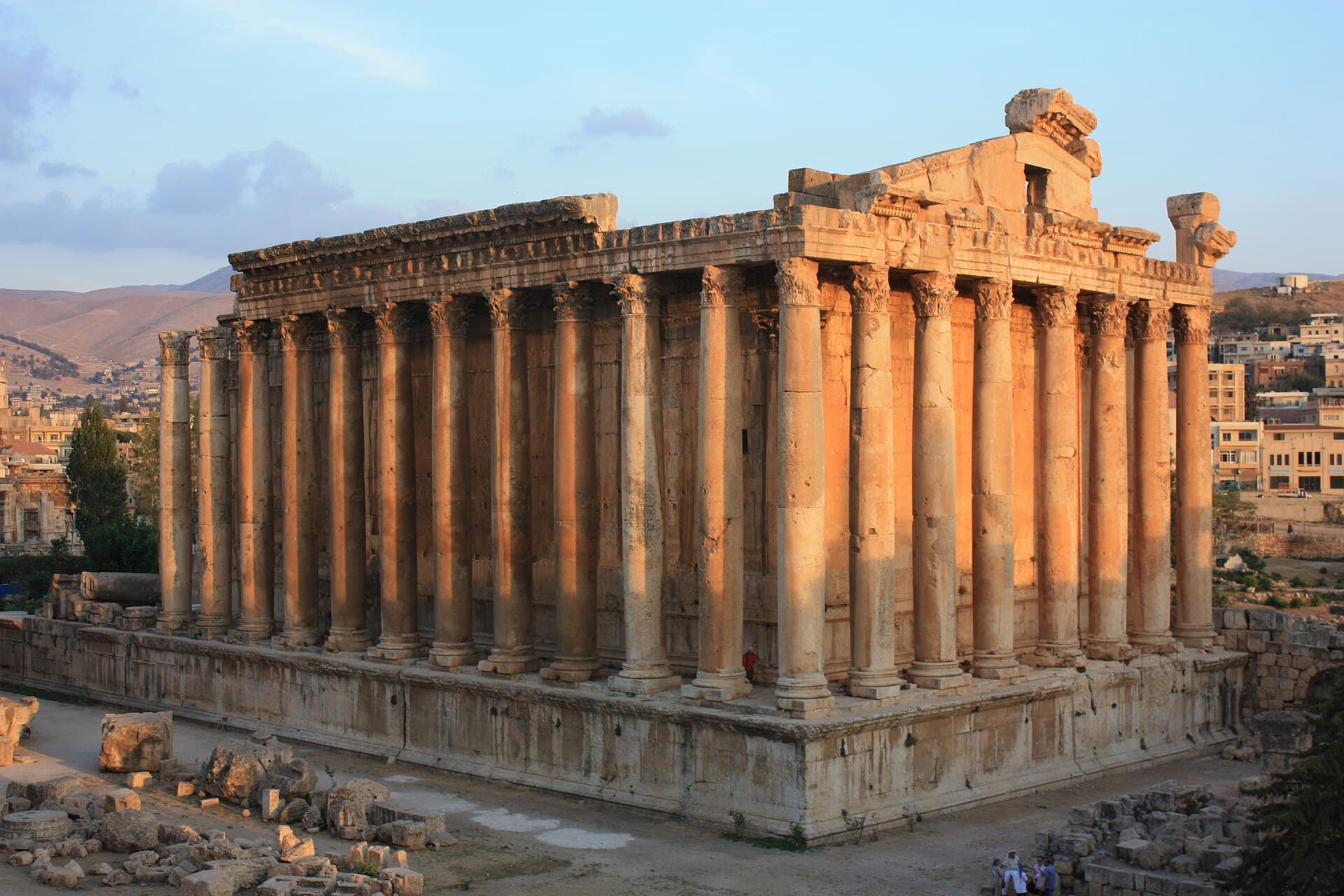
Baalbek stands at the northern end of the Bekaa valley in Lebanon, about 1,150 metres up with the Anti-Lebanon range behind it. The Romans called it Heliopolis, made it a colony, and over two centuries filled its low hill with the largest temples they built anywhere. UNESCO inscribed the site in 1984 under criteria (i) and (iv), describing it as among the finest surviving examples of Imperial Roman architecture.
Six columns are the first thing anyone sees, in a row with their entablature still on top, all that is left of a peristyle of fifty-four. Beside them stands a second temple so nearly complete that it is regularly named among the best preserved Roman buildings anywhere. Under the western side of the platform runs a wall of limestone blocks so large that people have argued about them for fifteen hundred years.
Tell Baalbek shows nearly continuous occupation for eight or nine thousand years. Cleaning at the Temple of Jupiter opened a deep trench whose study pushed the settlement back to the Pre-Pottery Neolithic, with early Bronze Age sherds among the finds. The site sat on the inland road from Tyre toward Palmyra, though Assyrian and Egyptian records barely mention it.
In the Canaanite period the temples served a triad: a god, his consort, their son. The altar of what became the Temple of Jupiter stood at the high point of that earlier mound, the usual sign of building over a cult already in place. Under the Seleucids the town was Heliopolis, sun city; the Roman colony of Colonia Julia Augusta Felix Heliopolitana was settled with legionary veterans under Augustus. Daniel Lohmann has argued that the Romans found an unfinished pre-Roman terrace here and absorbed it into their plan. The valley's Baal became Jupiter Heliopolitanus without quite ceasing to be Baal.
Work on the Temple of Jupiter probably began around 15 BC, and a graffito on one of the topmost column drums shows it was near completion by AD 60. Its peristyle held fifty-four unfluted Corinthian columns, ten across each end and nineteen down each side, 19.9 metres high on shafts nearly 2.5 metres across, the tallest of any classical temple. Twenty-seven were upright in the sixteenth century, nine by the 1759 earthquakes. Six stand now, carrying entablature blocks of up to 60 tonnes and one corner block past 100 tonnes, all raised 19 metres by Roman crews.
The neighbouring temple, 66 metres long and 31 high, keeps forty-two columns, nineteen upright, and an interior among the richest to survive from antiquity. It was probably commissioned under Antoninus Pius (138 to 161). Everyone calls it the Temple of Bacchus. Nobody knows that it was. The name was proposed by Otto Puchstein on the strength of its carving, chiefly the dancing maenads on the parapets inside, and stuck without ever being confirmed. Bacchus was not among the three gods UNESCO records as the Heliopolitan triad: Jupiter, Venus and Mercury.
The round temple below the acropolis, added under Septimius Severus in the early third century, is the Temple of Venus in some accounts and the Circular Temple in others, while villagers called it El Barbara after the saint whose church it housed into the eighteenth century. These names are modern conveniences laid over buildings whose dedications were never recorded.
The platform's foundation walls were built from about twenty-four monoliths, roughly 300 tonnes each at the lowest course. The tallest of them, on the west, carries a second course of three blocks that have carried their own name since at least the early Byzantine period: the Trilithon, the Three Stones. Each is over 19 metres long, 4.3 metres high and 3.6 metres deep, and each weighs between 750 and 800 tonnes. They are among the heaviest worked blocks ever set into any building.
Larger ones never left the quarry, under a kilometre away and slightly uphill of the temple. The most famous is Hajjar al-Hibla, the Stone of the Pregnant Woman, about 20 metres long and 1,000 tonnes, tilted at a steep angle and still joined to bedrock underneath. A second found there in the 1990s, the Stone of the South, is put at 1,242 tonnes. In June 2014 a German Archaeological Institute team working with Jeanine Abdul Massih of the Lebanese University found a third beneath the others: 19.6 metres long, 6 metres wide, at least 5.5 metres high, and around 1,650 tonnes, the largest worked stone block known from the ancient world. It surfaced during a lull in the fighting at the Syrian border and was announced that December.
These blocks are the most cited exhibit in the claim that ancient people could not have moved them and that some other agency must have. The claim is old, and beside Hajjar al-Hibla it is not hard to see how anyone arrives at it: the disproportion between the object and a human body is hard to hold in the mind. The Scottish traveller David Urquhart, visiting in 1860, wrote that the riddle of the stones shut out every other thought, and decided the work belonged to the age of Noah and was halted by the flood. Local legend credits Cain, giants under Nimrod, or Solomon and a workforce of djinns who downed tools, the story's explanation for the blocks left in the quarry. The historian Dell Upton has observed that the absence of any record of who commissioned or paid for the complex makes it "a very accommodating screen upon which to project strikingly varied stories."
The engineering evidence points somewhere less thrilling and more interesting. The quarry sits above the temple platform, so the blocks were dragged downhill and never had to be lifted at all. Margarete van Ess of the German Archaeological Institute has explained that they were split from the limestone along natural fissures between the rock strata, the technique used at the Pont du Gard, then hauled out, probably by capstan, a human-driven winch, and possibly on a sledge. In 1977 Jean-Pierre Adam argued in the journal Syria that blocks of this order could travel on rollers using capstans and pulley blocks, calculating that 512 workers could shift a 557-tonne block. The harder problem, raising 60-tonne and 100-tonne entablature blocks 19 metres into the air, was solved by the same crews on the same hill.
The strongest evidence is the quarry floor. The unfinished blocks are still attached to bedrock along their bases, the cutting channels the quarrymen worked around them still open. That is not a mystery but a job in progress, frozen where it stopped, showing the method step by step. A study in 2015 found cracks and a defect on one face of Hajjar al-Hibla, the likeliest reason it was left where it lies.
What gets lost when the other story wins is the people. Somebody cut those channels, in shifts, in the heat, for wages, under a supervisor whose name is also gone. A tale about giants or visitors takes that work and hands it to someone else. It is a strange kind of forgetting, one that flatters the monument by robbing the men who made it.
The Temple of Jupiter was already earthquake-damaged when Theodosius had it demolished in 379. Under Justinian, eight of the complex's Corinthian columns went to Constantinople for the rebuilding of Hagia Sophia. When Muslim armies took the town in the 630s the ruined sanctuary was fortified and given the name it still carries locally, al-Qalaa, the fortress. Marwan II sacked it in 748, the Mongols pulled down its defences in 1260, and most of the surviving fortress architecture dates from the Mamluk sultan Qalawun in the 1280s. For most of its life since antiquity this was a castle with temples inside it.
Modern excavation began with a state visit. Kaiser Wilhelm II and his wife passed through on 1 November 1898 en route to Jerusalem, and he came away struck by the scale of the ruins and the condition of the town around them. The team he dispatched was at work within a month. Otto Puchstein and his colleagues dug until 1904, and Theodor Wiegand published the 1898 to 1905 seasons in volumes that still underpin the documentation. They found nothing datable earlier than the Roman occupation, part of why the pre-Roman history took another century to surface. The quarry survey behind the 2014 block was co-directed from the Lebanese University, and the Archaeological Museum of the American University of Beirut, founded in 1868 and third oldest in the Near East, holds collections that give finds like Baalbek's their regional context.
Since 1956 the ruins have doubled as a stage. The Baalbeck International Festival was created under the patronage of President Camille Chamoun and run by volunteers, staging music, opera, theatre and dance among the temples each July and August. Fairuz and the Rahbani Brothers performed there from 1957 and became inseparable from the place in Lebanese memory, as did Umm Kulthum in 1966, Ella Fitzgerald in 1971 and Miles Davis in 1973. The calendar since reads as a record of the country's interruptions: suspended for twenty-two years from 1975 for the civil war, revived in 1997, cancelled in 2006 when war broke out, partly moved to Beirut in 2013 and 2014 because of instability at the Syrian border, streamed through 2020 and 2021, and played in Beirut again in 2024 with war over the region before returning to the ruins in 2025.
Baalbek is not on the List of World Heritage in Danger, and the temples stand. The inscription's integrity statement records fifteen years of armed conflict and continuing urban pressure on the sanctuary's setting, and the buildings took minor damage from the shockwaves of nearby bombing in 2006. Tourism, which the town depends on, has been cut back by the civil war, by spillover from the Syrian war between 2011 and 2017, and since 2023 by conflict across the district.
The six columns will not be joined by a seventh, and the trilithon has held its course of the wall for two thousand years. Nine hundred metres away a block that nobody finished lies in the open at the angle its cutters left it, its channels still visible in the rock. Of everything at Baalbek that abandoned stone carries the most human information: a decision, a defect, a day when the work stopped. It deserves to be remembered as work, done by people whose names the site has lost, and the surest way to lose them a second time is to hand the job to someone else.
A hill that was holy long before Rome
Six columns, and a temple whose name is a guess
The trilithon
What the quarry knows
Al-Qalaa, and the emperor who sent the archaeologists
Fairuz among the columns
The site today
References and resources
- UNESCO World Heritage Centre. "Baalbek." World Heritage List, property no. 294, inscribed 1984, criteria (i)(iv). whc.unesco.org/en/list/294.
- Batuman, Elif. "The Myth of the Megalith." The New Yorker, 18 December 2014. newyorker.com/tech/annals-of-technology/baalbek-myth-megalith.
- Adam, Jean-Pierre. "A propos du trilithon de Baalbek: le transport et la mise en oeuvre des megalithes." Syria 54 (1977), 31-63. persee.fr.
- Ruprechtsberger, Erwin M. "Vom Steinbruch zum Jupitertempel von Heliopolis/Baalbek (Libanon)." Linzer Archaeologische Forschungen 30 (1999).
- Wiegand, Theodor, ed. Baalbek: Ergebnisse der Ausgrabungen und Untersuchungen in den Jahren 1898 bis 1905. Berlin, 1921-1925.
- Baalbeck International Festival. "History." baalbeck.org.lb/en/history.
- Smithsonian Magazine. "World's Largest Ancient Stone Block Found in Lebanon." smithsonianmag.com.
- Wikipedia. "Baalbek," "Baalbek Stones," "Temple of Jupiter (Baalbek)," and "Temple of Bacchus." Retrieved 2026.