Heritage · Landmark
The Hiroshima Peace Memorial: the dome that remained
A skeletal dome beside the Motoyasu River marks the point above which the first atomic bomb used in war detonated at 8:15 a.m. on 6 August 1945. Around it, Kenzo Tange's Peace Memorial Park gathers a cenotaph, a museum, a children's monument hung with paper cranes, and a register of names that grows longer every year.Written to last.
By Confinity Heritage Editorial · 2026-08-23 · 7-minute readQuiet tools, kept out of the way.
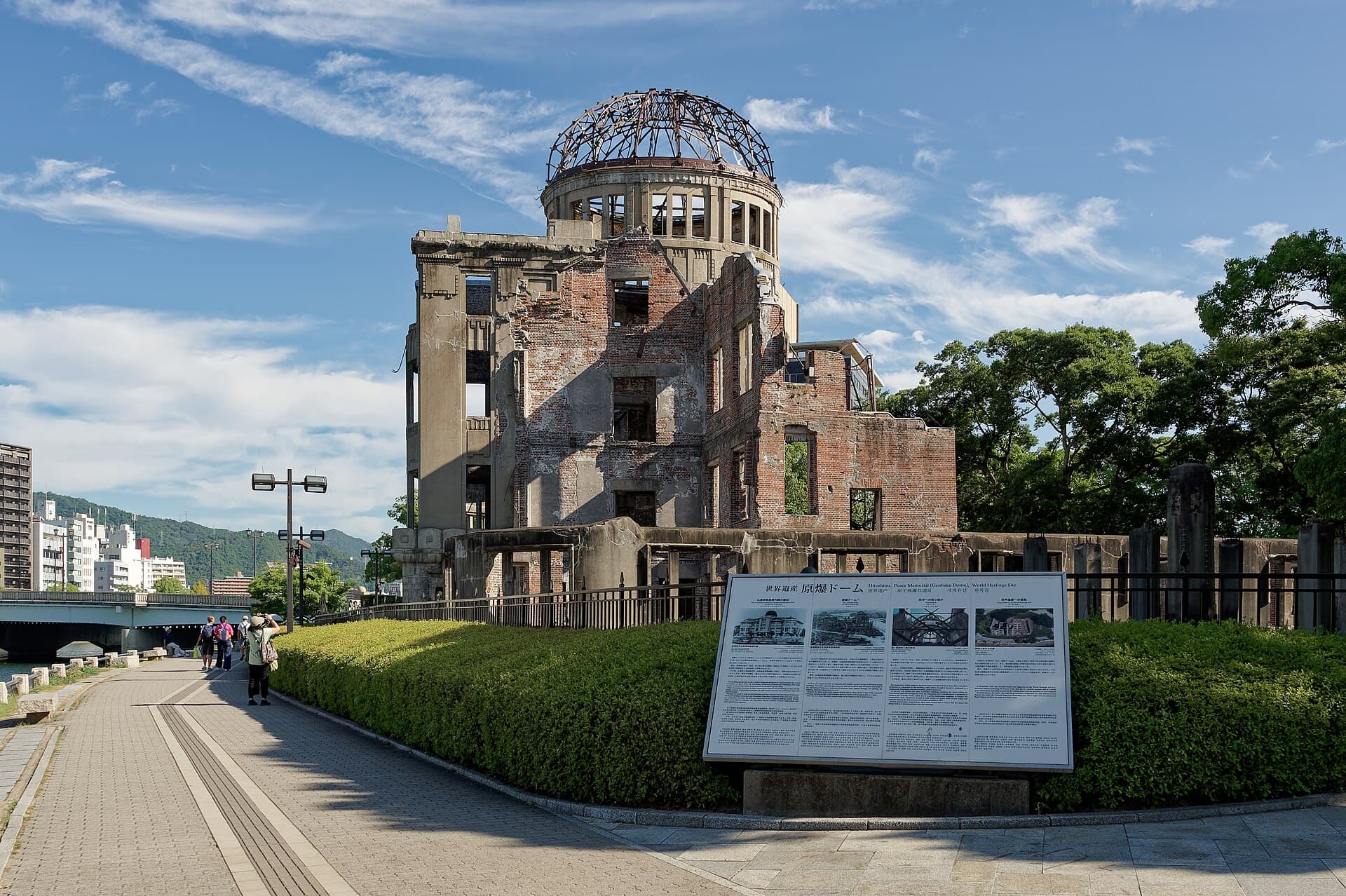
On the bank of the Motoyasu River in Hiroshima, in western Japan, stands the shell of a building kept, on purpose, in the state it was left in on the morning of 6 August 1945. Its dome is a lattice of bare steel ribs; its walls are broken brick and scorched render; grass grows inside rooms that no longer have floors above them. The people of Hiroshima call it the Genbaku Dome, the Atomic Bomb Dome. It is the one ruin the city chose not to clear away when it rebuilt everything else, and since 1996 it has been inscribed on the UNESCO World Heritage List as the Hiroshima Peace Memorial.
The Dome does not stand alone. Across the river spreads the Peace Memorial Park, laid out by the architect Kenzo Tange on ground that was once the city's busiest commercial district. The park holds a cenotaph sheltering a register of the dead, a museum that preserves the belongings and testimony of survivors, a monument to the children who died, a flame that has burned since 1964, and, each sixth of August, a ceremony attended by tens of thousands. Together the ruin and the park form one of the most visited places of remembrance on earth, and almost every element of them was argued over; the arguments are part of the history.
The building began with no shadow over it at all. In 1915 Hiroshima Prefecture completed a new exhibition hall on the east bank of the Motoyasu, designed by Jan Letzel, a young Czech architect then working in Japan. His Hiroshima Prefectural Commercial Exhibition Hall was a confident European-style composition of brick and steel, three storeys tall, rising to a five-storey central stair tower capped with an elliptical copper dome. In a city of low wooden houses it was a landmark, reflected in the river beside it.
For thirty years it served the ordinary purposes of a prospering regional capital. It displayed and sold the products of the prefecture, hosted exhibitions and trade fairs, and changed names as its role shifted, becoming the Prefectural Products Exhibition Hall in 1921 and the Hiroshima Prefectural Industrial Promotion Hall in 1933. By the last years of the Second World War its exhibitions had ceased and its offices were occupied by government agencies and wartime control associations. It was, until the morning that changed its meaning, a working building full of clerks.
At 8:15 a.m. on 6 August 1945, an American B-29 released a single bomb over the centre of Hiroshima. It detonated about 600 metres above the ground, almost directly over the hall: the hypocentre lay roughly 160 metres to its southeast. Everyone inside the building died. Across the city, the blast and firestorm destroyed or burned out nearly everything within a two-kilometre radius. By the end of 1945 the bombing had killed an estimated 140,000 people, out of a population of around 350,000; the figures remain debated, because the city's records burned with the city, and radiation continued to claim lives for years afterwards.
The hall's survival as a recognisable shape was an accident of geometry. Because the explosion occurred nearly overhead, the shock wave struck the building almost vertically downward rather than from the side, and its stout brick walls and steel frame, unusually robust for Hiroshima at the time, were crushed but not swept away. The copper cladding of the dome vanished in the heat, leaving the steel frame open to the sky. In a plain of ash, the gutted tower by the river became a point of orientation, and within a few years residents had begun calling it the Atomic Bomb Dome.
Whether it should remain was an open question for two decades. Hiroshima rebuilt quickly, and many citizens, including many survivors, wanted the ruin demolished: it was structurally precarious, and for people who had lived through the morning it commemorated, the sight of it was a daily return to grief. Others argued that once it fell, the city would have no physical witness left, since almost everything else near the hypocentre had already been cleared. The city left the question unresolved, and the shell weathered and weakened.
Part of what shifted the argument was a schoolgirl's diary. Hiroko Kajiyama had been exposed to the bomb as a baby and died of leukaemia in 1960, at sixteen; she had written that only that ruined hall would go on telling people what had happened. Her words circulated among campaigners for preservation, and in July 1966 the Hiroshima City Council resolved to preserve the Dome permanently. A fundraising campaign drew donations from across Japan and abroad, and the first engineering works to stabilise the ruin were carried out in 1967. Later campaigns have paid for periodic reinforcement works, under a policy the city still holds: the Dome is to be kept as it was, neither restored nor allowed to fall.
While the Dome's fate was still uncertain, the ground across the river was already being remade. In 1949 the national government designated Hiroshima a City of Peace, and a design competition for a memorial park on the levelled Nakajima district, once a dense neighbourhood of shops and houses, was won by Kenzo Tange. The park was completed in 1954 and made Tange's reputation far beyond Japan.
Its power lies in a single line. Tange raised the Peace Memorial Museum on slender pillars at the southern end of the park, and aligned it with a cenotaph and, across the water, the Dome itself, so that a visitor standing at the cenotaph sees the ruin framed within the arch. The composition binds the modern park to the surviving witness: the axis runs from the living city, through the memorial to the dead, to the building that saw it happen. Between cenotaph and river burns the Flame of Peace, lit in 1964 on a pedestal of Tange's design, with the stated intention that it burn until the last nuclear weapon is gone.
The cenotaph itself is a saddle-shaped concrete arch, its form drawn from the clay house figures placed on ancient Japanese tombs, sheltering a stone chest. Inside the chest lies the Register of the Atomic Bomb Victims: volumes of handwritten names of those who died in the bombing or in the decades since from its effects. Each year, on the morning of 6 August, newly confirmed names are added, and the register now holds well over three hundred thousand. The chest carries an epitaph, composed by the scholar Tadayoshi Saika, usually rendered as "Let all the souls here rest in peace, for we shall not repeat the evil." The sentence has no stated subject, and the city's official reading is that it speaks for all of humanity.
North of the cenotaph stands the Children's Peace Monument, unveiled in 1958 and topped by the bronze figure of a girl lifting a folded crane. She is Sadako Sasaki, who was two years old at the time of the bombing, developed leukaemia in 1955, and folded paper cranes through her illness in the hope of recovery, dying that October at twelve. Her classmates raised the monument with donations from thousands of schools, and children around the world still send millions of folded cranes each year, which are displayed in glass cases around the statue.
Every year on the anniversary, the city holds the Peace Memorial Ceremony before the cenotaph. At 8:15 the Peace Bell sounds and the crowd stands in silence; the register receives its new names; the mayor reads a Peace Declaration addressed to the governments of the world; and two children read a Commitment to Peace. In the evening the remembrance softens into light, as thousands of paper lanterns, each carrying a name or a message, are floated in the tradition of toro nagashi down the Motoyasu River past the Dome, a tradition drawn from rites for guiding the spirits of the dead.
In December 1996 the World Heritage Committee inscribed the Genbaku Dome on the World Heritage List as the Hiroshima Peace Memorial, judging it a stark and powerful symbol of the most destructive force ever created by humankind and of the hope for its abolition. The inscription was not unanimous in spirit: the United States dissociated itself from the decision, noting among other things its concern that the inscription lacked the historical context of the war, and China expressed reservations of its own. The listing records both the inscription and the statements beside it. The inscribed property is small, the ruin and its fenced plot; the park, cenotaph, and museum form its setting and its meaning.
The Peace Memorial Museum, opened in 1955 and renewed most recently in 2019, holds the material record: a watch stopped at 8:15, a child's burned tricycle, clothing, drawings by survivors, and the scientific account of what a nuclear weapon does to a city. But its most important holdings may be voices. For decades the museum and the city have recorded the testimony of the hibakusha, the survivors of the bombing, and survivors have long spoken in person to visiting schoolchildren. That work now runs against time: the average age of the survivors has passed eighty-five, and so since 2012 Hiroshima has trained successors, called denshosha, who learn a survivor's account over several years and undertake to tell it after the survivor is gone. In 2024 the survivors' national organisation, Nihon Hidankyo, received the Nobel Peace Prize for that long labour of witness.
This is what distinguishes Hiroshima's memorial from most monuments: it is not finished, and it is not meant to be. The register under the cenotaph grows every August. The testimony archive grows as the speakers diminish. The Dome is inspected and braced so that it can go on failing to fall. A place that could have been cleared in a season has instead become a permanent act of keeping, sustained by a city that decided, after long argument, that the hardest thing to look at was the one thing it could not afford to lose.
A hall for commerce on the Motoyasu
Fifteen minutes past eight
The argument over the ruin
An axis through the park
The register and the cranes
The sixth of August and the world's list
Keeping the voices
References and resources
- UNESCO World Heritage Centre. "Hiroshima Peace Memorial (Genbaku Dome)." World Heritage List, property no. 775, inscribed 1996. whc.unesco.org/en/list/775.
- UNESCO World Heritage Committee. Report of the 20th Session, Merida, 1996, including statements recorded at inscription. whc.unesco.org.
- Hiroshima Peace Memorial Museum. Official site, exhibits, and testimony programs. hpmmuseum.jp.
- The City of Hiroshima. Peace Memorial Ceremony, Peace Declaration, and Register of the Atomic Bomb Victims. city.hiroshima.lg.jp.
- Encyclopaedia Britannica. "Hiroshima" and "atomic bombing of Hiroshima." britannica.com.
- Wikipedia. "Hiroshima Peace Memorial," "Hiroshima Peace Memorial Park," and "Sadako Sasaki." Retrieved 2026.