Heritage · Landmark
Bibliotheca Alexandrina: the library that did not burn
A tilted granite disc leans out of the ground on the Alexandria waterfront, its seaward wall carved with characters from some hundred and twenty writing systems. It was built to answer the most famous lost collection in the world, and the truth about how that collection was lost is stranger and duller than the fire everyone remembers.Written to last.
By Confinity Heritage Editorial · 2026-08-25 · 7-minute readQuiet tools, kept out of the way.
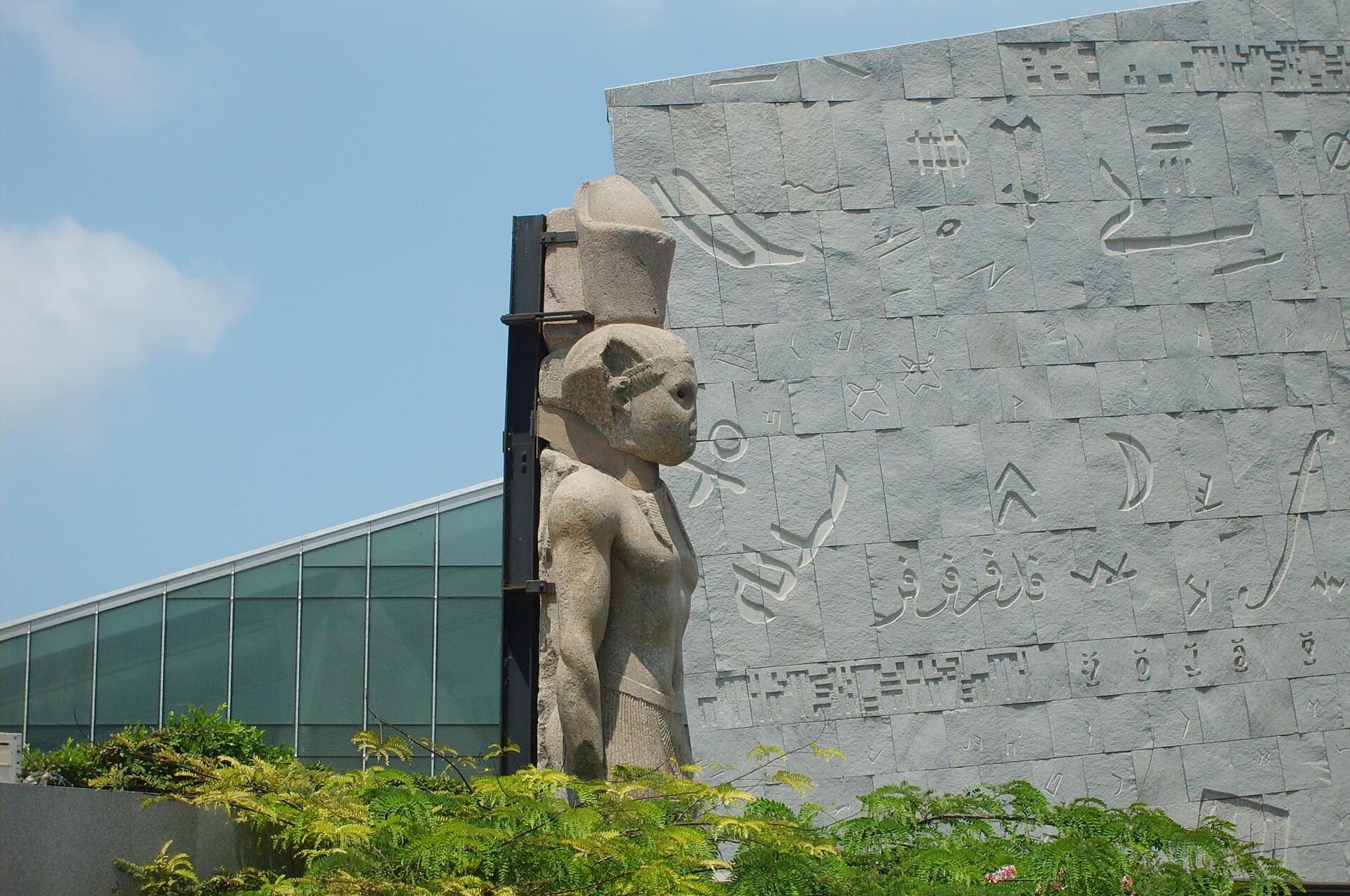
On the seafront at Alexandria, in northern Egypt, a grey granite disc leans out of the ground and tips toward the Mediterranean. It is 160 metres across, sunk some 12 metres into the earth and rising to 32 metres on its seaward side, its roof a glazed slope angled at the water like the face of a sundial. This is the Bibliotheca Alexandrina, opened in 2002 and named for the most famous library in history, which stood somewhere in this city and has never been found.
The plot was chosen in 1974 by a committee at Alexandria University, on ground between the campus and the harbour. Most of what a visitor knows before arriving is the myth attached to the name, and most of that myth is wrong.
Egypt took the revival scheme to UNESCO, and at the end of the 1980s an anonymous international competition went out to the profession. More than 1,300 architects from 77 countries registered and 524 entries came back. In 1989 the jury gave it to Snøhetta, a Norwegian office barely two years old that had built almost nothing.
The scheme is a circle, tilted. Sinking the disc into the ground keeps the building low against the Corniche while giving it eleven storeys inside. The main reading room runs to 20,000 square metres on eleven cascading levels, stepping down the slope of the roof so that a reader on any terrace can see across the others and up through the glass. Construction began in the mid-1990s, some 220 million dollars went into it, and the complex was inaugurated on 16 October 2002.
The thing a visitor stands in front of is not the roof but the wall. Nearly 6,000 square metres of grey granite, quarried near Aswan and cut into blocks about 20 centimetres thick, curve around the northern face of the disc, and every block is carved. The scheme holds roughly 4,000 characters drawn from around 120 writing systems: alphabets and syllabaries, hieroglyphs and runes, musical and mathematical notation, Braille, bar codes. The Norwegian artist Jorunn Sannes developed the design during the competition and worked it out with the sculptor Kristian Blystad; the letters were cut by hand.
Nothing on it spells anything. A bar code sits beside a hieroglyph at the same size and depth, with no precedence between them, so the subject is not any text but the habit of marking a surface and expecting someone later to read it.
The ancient library was never open to Alexandria. It was part of the Mouseion, a shrine to the Muses inside the royal quarter, and its scholars lived at the king's expense: salaried, housed, fed at a common table and exempt from tax. The head librarian doubled as tutor to the king's heir. Its first purpose was to display the wealth of Egypt; research was the by-product. Alexandria was a Greek city grafted onto a country already ancient, and the Pyramids of Giza were about as old to the scholars of the Mouseion as those scholars are to us.
The work done there is why the place matters. Zenodotus, the first recorded head librarian, shelved the collection by the first letter of the author's name, the earliest known use of alphabetical order as a filing system. Callimachus compiled the Pinakes, a catalogue in 120 books listing authors and their works, the ancestor of every library catalogue since. Eratosthenes measured the circumference of the earth, Aristophanes of Byzantium invented Greek accent marks and first broke poetry into lines on the page, and Aristarchus of Samothrace produced the editions of Homer that classicists still argue with.
Nobody knows how large the collection was. Ancient figures run from 40,000 to 700,000 rolls, and the high ones do not survive arithmetic. Counting the Greek authors known to have written by the end of the third century BC and allowing each of them fifty rolls, Roger Bagnall arrives near 31,250, and notes that the Pinakes, at 120 books, could not physically have listed hundreds of thousands of titles.
The best-known story about how the shelves filled comes from Galen. Every ship that put into Alexandria had its books taken ashore by order of the king, copied by royal scribes, and the copies handed back to the owners while the originals went into the library, shelved with the note "a book from the ships". Galen tells a second in the same passage: a Ptolemy borrowed the Athenian state texts of the tragedians against a deposit of fifteen talents of silver, had them copied on the finest material, returned the copies and told Athens to keep the money.
Both are worth their caveats. Galen wrote in the second century AD, four hundred years later, and says in the same breath that he is retelling what the physician Zeuxis had written, and doing so only because Zeuxis had gone out of fashion and become hard to find. He never says which Ptolemy. The anecdote exists to explain a bibliographic curiosity: a copy of the Hippocratic Epidemics inscribed as a book from the ships, emended by Mnemon of Side. Late, second-hand testimony in service of a footnote is not the same as invention, and the collecting policy is attested from other directions, including royal agents buying at the book fairs of Rhodes and Athens.
Everyone knows how it ended: the Library of Alexandria burned. The evidence will not carry that.
Julius Caesar was besieged in the city in 48 BC and set fire to ships in the harbour. Seneca, quoting Livy, says 40,000 scrolls were lost; Plutarch says the flames spread from the docks and took the great library. Cassius Dio, writing more carefully, says the dockyards and the storehouses of grain and of books went up, and Florus and Lucan mention only the fleet and some houses near the water. The usual modern reading of Dio is that what burned was warehouse stock waiting for export, not the collection. The institution demonstrably continued: Strabo visited the Mouseion around 20 BC, Didymus of Alexandria turned out somewhere between 3,500 and 4,000 books in the decades after, and Suetonius records Domitian sending scribes to Alexandria to recopy what Rome had lost.
What did the damage was politics. In 145 BC Ptolemy VIII purged his predecessor's supporters. Aristarchus, the head librarian, fled to Cyprus and died there; foreign scholars were expelled and scattered to Rhodes and Pergamon, and the librarianship went to one of the king's palace guards. Later Ptolemies handed the post out as patronage. Under Rome, membership of the Mouseion was awarded for distinction in government, the army or athletics, and members no longer had to teach, research or live in the city. The last recorded members belong to the 260s AD. Aurelian's recapture of the city from the Palmyrenes around 273 wrecked the palace quarter, and Diocletian wrecked it again in 297; Bagnall notes a consensus forming around 273 as the likeliest date of major loss, while conceding that no ancient source says so.
The daughter library at the Serapeum is the next candidate. Bishop Theophilus demolished the temple in 391 under Theodosius I's ban on pagan cult, but whether books were still in it is not recorded, and writers after 391 speak of the Serapeum's literature in the past tense. As for the Arab conquest, the tale that the caliph Omar had the books fed to the bath furnaces, enough to heat Alexandria for six months, first appears in al-Qifti before 1248 and in Bar Hebraeus later that century, six hundred years after Amr ibn al-As entered the city in 642. Its central character, John Philoponus, was almost certainly dead by then. Alfred Butler called it a fable in 1902, Bernard Lewis has argued it was manufactured under Saladin to excuse the Ayyubid breakup of a Fatimid collection, and Diana Delia reads it as a moral tale about the faithful living among unbelievers.
Strip the candidates away and what remains is not a catastrophe but a budget line. The patronage stopped, the scholars left and taught elsewhere, the librarianship became a favour, Rome cared less about the city each century, better-funded libraries opened in other capitals, and the buildings were caught at last in wars that had nothing to do with them.
Bagnall adds the part nobody wants. Papyrus is durable but not immortal: rolls stayed usable for a century, sometimes two or three hundred years in dry storage, and Alexandria is humid. A collection lasts only as long as somebody keeps copying it, and by the reign of Tiberius little of what the first Ptolemies gathered would still have been legible. His conclusion is deliberately deflating, that an unburned building full of rotting books would have made no difference at all.
That is the ordinary way a collection ends, and it is worse than a fire, because there is no afternoon to point at, no villain, no anniversary. Things are lost by inattention far more often than by catastrophe, and inattention leaves no ash to find.
The modern institution knows this, which is why so much of its work is maintenance. Alongside the reading room it runs a Manuscripts Museum and Manuscripts Center, a restoration laboratory for damaged books, twelve research centres, four museums and a planetarium, and it receives around 1.5 million visitors a year. Its Digital Assets Repository puts digitised collections online, and it holds a copy of the Internet Archive: the web from 1996 to 2007, roughly 1.5 petabytes on 880 computers, free to anyone who asks. The date on that mirror is its own quiet lesson, a backup of the world's memory made once and then not continued.
The tension in the building is worth stating plainly. It was designed to shelve eight million volumes, four million on open shelves and the rest in compact storage, and it opened with roughly half a million books because the money had gone into the architecture. It has depended on gifts since, including half a million volumes from the Bibliothèque nationale de France, and critics have called it a state vanity project with air on its shelves. Alexandria's ancient remains and its new library have sat on Egypt's UNESCO Tentative List since July 2003 without being inscribed. In 2011, when state authority collapsed, students from the neighbouring universities linked arms around the building to keep it from being looted, which is the only guarantee a library has ever had.
A tilted disc on the Corniche
The wall of every alphabet
What the first library actually was
The books from the ships
The fire everyone remembers
Defunded, dispersed, superseded
Manuscripts, servers, and a copy of the web
References and resources
- Snøhetta. "Bibliotheca Alexandrina" and "People and The Library of Alexandria." snohetta.com.
- Bibliotheca Alexandrina. "Overview" and the Internet Archive at the BA. bibalex.org.
- Bagnall, Roger S. "Alexandria: Library of Dreams." Proceedings of the American Philosophical Society 146, no. 4 (2002).
- Galen. Commentary on Hippocrates' Epidemics, Kühn 17a.605 to 608, translated at attalus.org.
- UNESCO World Heritage Centre. "Alexandria, ancient remains and the new library." Tentative List of Egypt, ref. 1822.
- Butler, Alfred J. The Arab Conquest of Egypt, 2nd ed. Oxford, 1978. Delia, Diana. "From Romance to Rhetoric." American Historical Review 97 (1992).
- Wikipedia. "Library of Alexandria" and "Bibliotheca Alexandrina." Retrieved 2026.