Heritage · Country
Belarus Culture and Heritage
The castles of Mir and Nesvizh, the primeval Bialowieza forest with its bison, and the painter Marc Chagall belong to a land that carries memory with unusual weight. A guide to Belarusian heritage, to the ancestral remembrance days of Radunitsa and Dziady, and to the places of mourning left by a war that took a very large share of the nation's people.Written to last.
By Confinity Heritage Editorial · Updated 2026-07-31 · 8-minute readQuiet tools, kept out of the way.
Belarus lies at the flat green centre of Europe, a land of slow rivers, peat bogs and forest that has been fought across more often than almost any other. Its people have learned to hold the past close. Each spring, whole families walk out to the cemeteries to share a meal beside the graves of their parents and grandparents; each autumn, an older rite once called the dead home to the supper table. Between those two customs sits a national temperament that treats remembrance less as ceremony than as obligation.
That temperament has been tested as few nations' have. The land that produced the castles of Mir and Nesvizh, the forest of Bialowieza and the painter Marc Chagall also lost a very large share of its people in the Second World War, and its map is marked with the sites of that loss.
Belarus is a landlocked country of just over 207,000 square kilometres, bordered by Russia, Ukraine, Poland, Lithuania and Latvia. The land is low and gently rolling, drained by the Dnieper, the Neman, the Western Dvina and the Pripyat, whose southern marshes, the Polesia, form one of Europe's largest wetlands. Roughly two fifths of the territory is forested, a cover that shaped both its farming and its wars.
The population is around 9.2 million, about a fifth of it in the capital, Minsk. Belarus has two official languages, Belarusian and Russian, and a majority Eastern Orthodox faith with a substantial Roman Catholic minority in the west. A founding republic of the Soviet Union, it declared independence in 1991. Its recent history carries an environmental wound as well: the 1986 Chernobyl explosion, across the border in Ukraine, laid much of its fallout on southern Belarus, whose resettled villages have become another kind of place of memory.
Minsk. First mentioned in the chronicles in 1067, the capital was almost entirely destroyed in the Second World War, when its Jewish ghetto, among the largest in occupied Europe, was annihilated. Rebuilt after 1944 in a monumental Soviet style, Minsk today is a planned twentieth-century city laid over a medieval street plan, its Independence Avenue an almost continuous ensemble of postwar architecture.
 The Radziwill seat at Nesvizh held one of the great private libraries and archives of eastern Europe, most of which was dispersed between Russian, Polish and Belarusian collections. Photograph by Alexxx1979, CC BY-SA 4.0, via Wikimedia Commons.
Brest. On the Western Bug at the Polish frontier, Brest is known for the Brest Fortress, whose garrison held out against the German assault of June 1941 for weeks after the front had moved east, and whose memorial complex, opened in 1971, is one of the country's principal sites of mourning.
Vitebsk. The old merchant city on the Western Dvina was the birthplace, in 1887, of Marc Chagall, whose floating fiddlers and green skies drew on its wooden houses and Hasidic streets. After the revolution he founded an art school here that briefly gathered Kazimir Malevich and the Suprematists, making Vitebsk a centre of the European avant-garde. The city keeps a house-museum and art centre in his name.
Grodno (Hrodna). The western city near the Lithuanian and Polish borders keeps the best-preserved historic centre in the country, with an Old Castle begun under Grand Duke Vytautas, a later royal palace and Baroque Catholic churches. Its oldest monument is the Kalozha Church of Saints Boris and Gleb, built before 1183, its walls set with polished coloured stones.
Polotsk. First recorded in 862, Polotsk is the oldest town in Belarus. Its Saint Sophia Cathedral, raised in the eleventh century, was the first stone church on Belarusian soil; here Saint Euphrosyne founded her convent, and here Francysk Skaryna, who in 1517 became the first to print books in an East Slavic language, was born. The town keeps a museum of Belarusian book printing.
The recorded history of Belarus begins with the Principality of Polotsk, a powerful early state on the Western Dvina that emerged within the loose federation of Kievan Rus. By the eleventh century Polotsk had its own dynasty and Saint Sophia Cathedral, and in the twelfth its own saint in Euphrosyne. Turau and the towns of the Neman were the other early nuclei of Belarusian life.
The Radziwill seat at Nesvizh held one of the great private libraries and archives of eastern Europe, most of which was dispersed between Russian, Polish and Belarusian collections. Photograph by Alexxx1979, CC BY-SA 4.0, via Wikimedia Commons.
Brest. On the Western Bug at the Polish frontier, Brest is known for the Brest Fortress, whose garrison held out against the German assault of June 1941 for weeks after the front had moved east, and whose memorial complex, opened in 1971, is one of the country's principal sites of mourning.
Vitebsk. The old merchant city on the Western Dvina was the birthplace, in 1887, of Marc Chagall, whose floating fiddlers and green skies drew on its wooden houses and Hasidic streets. After the revolution he founded an art school here that briefly gathered Kazimir Malevich and the Suprematists, making Vitebsk a centre of the European avant-garde. The city keeps a house-museum and art centre in his name.
Grodno (Hrodna). The western city near the Lithuanian and Polish borders keeps the best-preserved historic centre in the country, with an Old Castle begun under Grand Duke Vytautas, a later royal palace and Baroque Catholic churches. Its oldest monument is the Kalozha Church of Saints Boris and Gleb, built before 1183, its walls set with polished coloured stones.
Polotsk. First recorded in 862, Polotsk is the oldest town in Belarus. Its Saint Sophia Cathedral, raised in the eleventh century, was the first stone church on Belarusian soil; here Saint Euphrosyne founded her convent, and here Francysk Skaryna, who in 1517 became the first to print books in an East Slavic language, was born. The town keeps a museum of Belarusian book printing.
The recorded history of Belarus begins with the Principality of Polotsk, a powerful early state on the Western Dvina that emerged within the loose federation of Kievan Rus. By the eleventh century Polotsk had its own dynasty and Saint Sophia Cathedral, and in the twelfth its own saint in Euphrosyne. Turau and the towns of the Neman were the other early nuclei of Belarusian life.
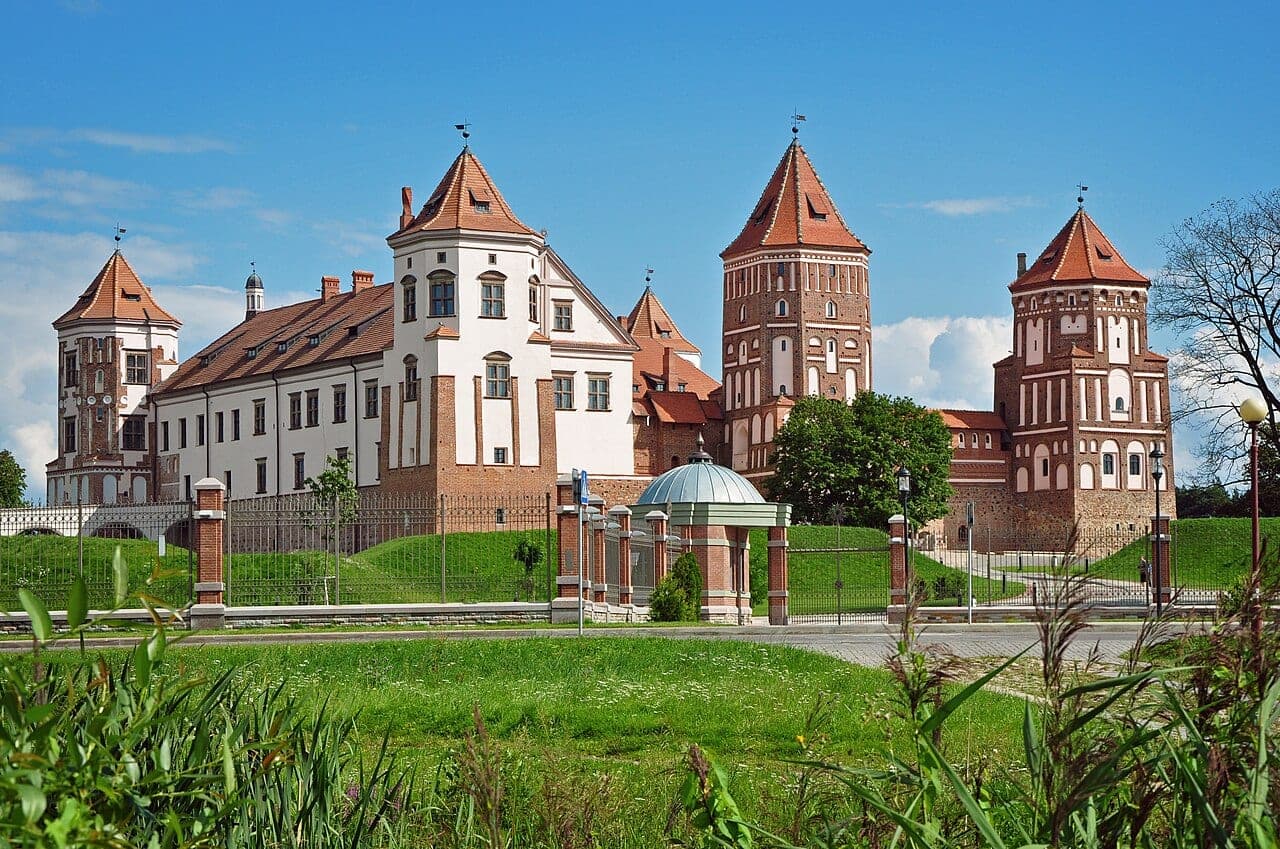
 Mir Castle carries Gothic, Renaissance and Baroque work in one building, and was used as a ghetto by the occupying German administration in 1941 and 1942. Photograph by Alexxx1979, CC BY-SA 4.0, via Wikimedia Commons.
From the thirteenth century these lands became the demographic and administrative heart of the Grand Duchy of Lithuania, a large multi-ethnic state in which the East Slavic, Orthodox population outnumbered the Baltic Lithuanians who founded it. Its chancery language was Ruthenian, an ancestor of modern Belarusian, in which the three Statutes of Lithuania of 1529, 1566 and 1588 were written. The Union of Lublin in 1569 joined the Grand Duchy to Poland in the Polish-Lithuanian Commonwealth, and the Union of Brest of 1596 brought much of the Orthodox population into communion with Rome as Greek Catholics.
The partitions of the Commonwealth in 1772, 1793 and 1795 transferred the Belarusian lands to the Russian Empire. Imperial rule brought integration: the Greek Catholic Church was abolished in 1839, the Belarusian language was discouraged in print, and the region lay within the Pale of Settlement, home to one of the world's largest Jewish populations.
The twentieth century fell on Belarus with exceptional violence. The First World War drove its front line through the country; the 1921 Treaty of Riga then divided the Belarusian lands between Poland and Soviet Russia. Worse followed. Under German occupation from 1941 to 1944, Belarus became a centre of partisan resistance and of reprisal: by the most commonly cited estimates the republic lost between a quarter and a third of its population, well over a million and a half people, a proportion among the heaviest suffered by any nation in the war. Its Jewish communities were almost entirely destroyed in the Holocaust, and at least 5,295 villages were burned, some with their inhabitants inside. The Soviet offensive of 1944 liberated the ruins. As the Byelorussian Soviet Socialist Republic the country was rebuilt and industrialised, absorbed the Chernobyl disaster of 1986, and became the independent Republic of Belarus in 1991.
Belarusian is an East Slavic language, close to Ukrainian and Russian and written in Cyrillic, though for centuries a Latin script, the Lacinka, was also used. Since a 1995 referendum, Belarusian and Russian have shared official status, and both are widely spoken; a mixed everyday speech blending the two, trasianka, is common. UNESCO classes Belarusian as vulnerable, and its cultivation in literature, schooling and song remains a matter of national attention.
The country's name means, literally, "White Rus" or White Ruthenia, from the Slavic root Rus that also gave Russia its name. The origin of the "white" has been debated for centuries: that it marked the Rus lands left unconquered by the Mongols and so counted free, or that it described the pale dress and fair hair of the inhabitants. The name settled on this territory only late, around the sixteenth century; before that its people were known as Litvins, after the Grand Duchy of Lithuania to which their lands belonged, a memory still audible in Belarusian regional identity.
The most famous product of Belarusian craft is the Slutsk belt, a long silk sash woven with silver and gold thread at the Radziwill family's manufactory in the eighteenth century and worn by the nobility of the Commonwealth. A classical belt ran three and a half to four metres, patterned differently on each face so it could be folded to show the season or the occasion; its lost weaving technique has since been recovered. Older still is Belarusian straw weaving, the plaiting of rye straw into boxes, figures and the ritual "spiders" hung in the home, inscribed on UNESCO's intangible-heritage list in 2022.
Folk culture keeps its own instruments: the reed dudka, the hammered cymbaly and the bagpipe-like duda, played behind the calendar songs of the farming year. Embroidered linen towels, the rushnik, carry protective patterns and appear at every threshold of life from birth to burial. The table is built on the potato, so central that Belarusians call themselves bulbashy after it: draniki, the fried potato pancake, is close to a national dish, joined by machanka, kalduny dumplings, cold beet soup and dense rye bread. Feast days such as the midsummer Kupalle keep the older rhythms of the countryside alive.
Belarus has long been a meeting point of the Christian east and west. The majority belong to the Belarusian Orthodox Church, an exarchate of the Moscow Patriarchate, whose faith reaches back to the baptism of Polotsk and to Saint Euphrosyne, honoured as a patron of the nation. A significant Roman Catholic minority, strongest around Grodno, gives many western towns their Baroque churches and their own calendar of festivals. Between the two once stood the Greek Catholic Church, created at Brest in 1596 and, at its height, the confession of most of the peasantry, before its abolition under the empire in 1839.
The country's older Jewish heritage was immense and is now largely a heritage of memory: for centuries Belarusian towns were centres of Jewish learning and of Hasidic and Litvak tradition, communities almost wholly destroyed between 1941 and 1944. Beneath and around the churches, folk belief has proved durable, much of it attached to the dead and the seasons. Pilgrimage remains strong, the Orthodox gathering at the icon of the Mother of God at Zhyrovichy, one of the country's holiest sites, while the Catholic fair at Budslau, honouring its miraculous icon, was inscribed by UNESCO in 2018.
Belarusian remembrance runs along two channels that have flowed together over a thousand years: the Christian offices for the dead, Orthodox and Catholic, and an older stratum of ancestral rites the Church absorbed rather than erased. An Orthodox funeral follows within days of death, the open coffin watched through the night, the priest chanting "Vechnaya pamyat", eternal memory, before burial; families then keep the ninth and fortieth days and the anniversary, offering kutya, a sweetened wheat or barley dish, as across the Orthodox world.
The two great days of collective remembrance are Radunitsa and Dziady. Radunitsa, on the ninth day after Easter, is a public holiday given over almost entirely to the cemetery: families clean the graves, then share a meal beside them, leaving eggs, bread and a portion of food for the departed, a rite understood not as grief but as the extension of Easter's joy to the dead. Dziady, literally "the forefathers", is the older autumn commemoration, kept unofficially around the start of November, in which households once set an extra place at the supper table and invited the ancestors to eat with the living. Its pre-Christian roots are plain, and it is the rite that Adam Mickiewicz, born on these lands, made the subject of his great poetic drama.
The heaviest sites of Belarusian memory belong to the Second World War, and the country treats them with corresponding weight. The Khatyn memorial, opened in 1969, stands on the site of a village whose people were driven into a barn and burned alive in March 1943; 149 died there, among them 75 children, and the sole survivor, the blacksmith Iosif Kaminsky, is figured in the central bronze carrying his dead son. Khatyn was made to stand for hundreds of villages destroyed in the same way, and its grounds hold a symbolic cemetery of the settlements burned and never rebuilt, with bells that toll across the clearing. At Brest, the Hero-Fortress memorial marks the garrison's stand of 1941 with its stone monument "Courage" and an eternal flame. These are places of family pilgrimage, visited on the days of remembrance as the village graves are.
Belarus lost a quarter of its population between 1941 and 1944, and the archives took proportionate damage, which shapes everything about research here.
What survives is held centrally and well. The National Historical Archives in Minsk and Grodno hold Orthodox and Catholic metrical books, required of parishes under Russian rule from 1722, and the revision lists taken as tax censuses between 1795 and 1858. Because Belarus was part of the Polish-Lithuanian Commonwealth before the partitions, older material is in Polish and in Latin, and some of it is in Warsaw, Vilnius and Saint Petersburg rather than Minsk.
The Jewish record is central here in a way it is not elsewhere. Belarus was the heart of the Pale of Settlement, Jews were a large share of the population of every town, and the metrical books kept for Jewish communities survive in quantity at Minsk and Grodno. Almost the entire community was murdered between 1941 and 1944, so those registers are the record of a population that no longer exists in the place they were written.
Soviet-era registration through ZAGS offices covers births, marriages and deaths from 1918 onward, and access to twentieth-century files is restricted.
The partisan war and the burned villages are the other archive. Khatyn is the memorial for the hundreds of villages destroyed with their inhabitants, and the lists of those villages, with the names of the people in them, are the closest thing many families have to a death record.
Belarus counts four UNESCO World Heritage sites, two shared with neighbours. Mir Castle, a fortified sixteenth-century residence blending Gothic, Renaissance and Baroque work, was inscribed in 2000; the Radziwill family complex at Nesvizh, the seat and mausoleum of the ruling family, followed in 2005. Both have been extensively restored and now serve as museums. The Bialowieza Forest, first inscribed in 1979 and later extended across the Belarus-Poland border as a single transboundary site, protects one of the last remnants of the primeval lowland forest that once covered the plain, and shelters the European bison, the continent's heaviest land animal, brought back from the edge of extinction. The fourth, the Struve Geodetic Arc, is a chain of survey points laid out between 1816 and 1855 to measure the shape of the earth across ten countries; several of its stations lie in Belarus.
Belarus's intangible heritage is also entering the lists, with straw weaving inscribed in 2022, the Budslau Catholic fair in 2018 and the spring rite of the Jurauski Karahod earlier. Further sites, among them Saint Sophia at Polotsk, the Kalozha Church at Grodno and the Brest Fortress, sit on the country's tentative list for future nomination.
The symbol of Belarus's digital ambitions is the National Library in Minsk, a rhombicuboctahedron of glass that opened in 2006; it has led the digitisation of the national collection, including the books of Francysk Skaryna, reproduced online for the five-hundredth anniversary of Belarusian printing. Museums have followed with virtual tours, while the Khatyn and Brest memorials maintain digital records of the destroyed villages and the fortress defenders.
For the large Belarusian diaspora, scattered by a century of war, revolution and migration, these online archives are a way back to family origins: digitised parish and civil registers and memorial databases of the wartime dead let descendants trace names and places their families left generations ago, turning heritage preservation into personal reconnection.
Belarus continues to shape culture beyond its borders. Marc Chagall remains one of the most beloved painters of the twentieth century, his imagery drawn permanently from the Vitebsk of his childhood. In 2015 Svetlana Alexievich became the first Belarusian to win the Nobel Prize in Literature, for a body of work built entirely from remembrance: for decades she recorded the testimony of ordinary people who lived through the Soviet century, the Second World War, the Afghan war and Chernobyl, assembling their voices into what the Nobel committee called a monument to suffering and courage.
At home, a revival of folk music, textile craft and the Belarusian language draws younger people back to the older culture, while its cuisine, festivals and crafts travel with emigrants. The result is a national identity that leans heavily on memory, on a language and history more than once at risk of being lost, and on remembering the dead as a first duty of the living.
The castles restored. After decades of neglect and wartime damage, Mir Castle and the Radziwill complex at Nesvizh were painstakingly rebuilt and reopened as museums around the years of their UNESCO inscriptions, returning two of the country's greatest monuments to public life.
The Slutsk belt recovered. The intricate technique of the eighteenth-century Slutsk sashes had been lost for generations; in the 2010s a Belarusian enterprise studied surviving originals and recreated the weaving on modern looms, reviving a craft that had come to symbolise the nation's Commonwealth-era heritage.
Straw into heritage of humanity. The farmhouse craft of plaiting rye straw into boxes, figures and hanging ornaments joined UNESCO's Representative List of the Intangible Cultural Heritage of Humanity in 2022, securing recognition for one of the most distinctively Belarusian of folk arts.
The bison brought back. The European bison, hunted to extinction in the wild by the early twentieth century, was bred back from a handful of captive animals and returned to the Bialowieza Forest, where the shared Belarusian and Polish herd is now among the largest free-living populations of the species.
Mir Castle carries Gothic, Renaissance and Baroque work in one building, and was used as a ghetto by the occupying German administration in 1941 and 1942. Photograph by Alexxx1979, CC BY-SA 4.0, via Wikimedia Commons.
From the thirteenth century these lands became the demographic and administrative heart of the Grand Duchy of Lithuania, a large multi-ethnic state in which the East Slavic, Orthodox population outnumbered the Baltic Lithuanians who founded it. Its chancery language was Ruthenian, an ancestor of modern Belarusian, in which the three Statutes of Lithuania of 1529, 1566 and 1588 were written. The Union of Lublin in 1569 joined the Grand Duchy to Poland in the Polish-Lithuanian Commonwealth, and the Union of Brest of 1596 brought much of the Orthodox population into communion with Rome as Greek Catholics.
The partitions of the Commonwealth in 1772, 1793 and 1795 transferred the Belarusian lands to the Russian Empire. Imperial rule brought integration: the Greek Catholic Church was abolished in 1839, the Belarusian language was discouraged in print, and the region lay within the Pale of Settlement, home to one of the world's largest Jewish populations.
The twentieth century fell on Belarus with exceptional violence. The First World War drove its front line through the country; the 1921 Treaty of Riga then divided the Belarusian lands between Poland and Soviet Russia. Worse followed. Under German occupation from 1941 to 1944, Belarus became a centre of partisan resistance and of reprisal: by the most commonly cited estimates the republic lost between a quarter and a third of its population, well over a million and a half people, a proportion among the heaviest suffered by any nation in the war. Its Jewish communities were almost entirely destroyed in the Holocaust, and at least 5,295 villages were burned, some with their inhabitants inside. The Soviet offensive of 1944 liberated the ruins. As the Byelorussian Soviet Socialist Republic the country was rebuilt and industrialised, absorbed the Chernobyl disaster of 1986, and became the independent Republic of Belarus in 1991.
Belarusian is an East Slavic language, close to Ukrainian and Russian and written in Cyrillic, though for centuries a Latin script, the Lacinka, was also used. Since a 1995 referendum, Belarusian and Russian have shared official status, and both are widely spoken; a mixed everyday speech blending the two, trasianka, is common. UNESCO classes Belarusian as vulnerable, and its cultivation in literature, schooling and song remains a matter of national attention.
The country's name means, literally, "White Rus" or White Ruthenia, from the Slavic root Rus that also gave Russia its name. The origin of the "white" has been debated for centuries: that it marked the Rus lands left unconquered by the Mongols and so counted free, or that it described the pale dress and fair hair of the inhabitants. The name settled on this territory only late, around the sixteenth century; before that its people were known as Litvins, after the Grand Duchy of Lithuania to which their lands belonged, a memory still audible in Belarusian regional identity.
The most famous product of Belarusian craft is the Slutsk belt, a long silk sash woven with silver and gold thread at the Radziwill family's manufactory in the eighteenth century and worn by the nobility of the Commonwealth. A classical belt ran three and a half to four metres, patterned differently on each face so it could be folded to show the season or the occasion; its lost weaving technique has since been recovered. Older still is Belarusian straw weaving, the plaiting of rye straw into boxes, figures and the ritual "spiders" hung in the home, inscribed on UNESCO's intangible-heritage list in 2022.
Folk culture keeps its own instruments: the reed dudka, the hammered cymbaly and the bagpipe-like duda, played behind the calendar songs of the farming year. Embroidered linen towels, the rushnik, carry protective patterns and appear at every threshold of life from birth to burial. The table is built on the potato, so central that Belarusians call themselves bulbashy after it: draniki, the fried potato pancake, is close to a national dish, joined by machanka, kalduny dumplings, cold beet soup and dense rye bread. Feast days such as the midsummer Kupalle keep the older rhythms of the countryside alive.
Belarus has long been a meeting point of the Christian east and west. The majority belong to the Belarusian Orthodox Church, an exarchate of the Moscow Patriarchate, whose faith reaches back to the baptism of Polotsk and to Saint Euphrosyne, honoured as a patron of the nation. A significant Roman Catholic minority, strongest around Grodno, gives many western towns their Baroque churches and their own calendar of festivals. Between the two once stood the Greek Catholic Church, created at Brest in 1596 and, at its height, the confession of most of the peasantry, before its abolition under the empire in 1839.
The country's older Jewish heritage was immense and is now largely a heritage of memory: for centuries Belarusian towns were centres of Jewish learning and of Hasidic and Litvak tradition, communities almost wholly destroyed between 1941 and 1944. Beneath and around the churches, folk belief has proved durable, much of it attached to the dead and the seasons. Pilgrimage remains strong, the Orthodox gathering at the icon of the Mother of God at Zhyrovichy, one of the country's holiest sites, while the Catholic fair at Budslau, honouring its miraculous icon, was inscribed by UNESCO in 2018.
Belarusian remembrance runs along two channels that have flowed together over a thousand years: the Christian offices for the dead, Orthodox and Catholic, and an older stratum of ancestral rites the Church absorbed rather than erased. An Orthodox funeral follows within days of death, the open coffin watched through the night, the priest chanting "Vechnaya pamyat", eternal memory, before burial; families then keep the ninth and fortieth days and the anniversary, offering kutya, a sweetened wheat or barley dish, as across the Orthodox world.
The two great days of collective remembrance are Radunitsa and Dziady. Radunitsa, on the ninth day after Easter, is a public holiday given over almost entirely to the cemetery: families clean the graves, then share a meal beside them, leaving eggs, bread and a portion of food for the departed, a rite understood not as grief but as the extension of Easter's joy to the dead. Dziady, literally "the forefathers", is the older autumn commemoration, kept unofficially around the start of November, in which households once set an extra place at the supper table and invited the ancestors to eat with the living. Its pre-Christian roots are plain, and it is the rite that Adam Mickiewicz, born on these lands, made the subject of his great poetic drama.
The heaviest sites of Belarusian memory belong to the Second World War, and the country treats them with corresponding weight. The Khatyn memorial, opened in 1969, stands on the site of a village whose people were driven into a barn and burned alive in March 1943; 149 died there, among them 75 children, and the sole survivor, the blacksmith Iosif Kaminsky, is figured in the central bronze carrying his dead son. Khatyn was made to stand for hundreds of villages destroyed in the same way, and its grounds hold a symbolic cemetery of the settlements burned and never rebuilt, with bells that toll across the clearing. At Brest, the Hero-Fortress memorial marks the garrison's stand of 1941 with its stone monument "Courage" and an eternal flame. These are places of family pilgrimage, visited on the days of remembrance as the village graves are.
Belarus lost a quarter of its population between 1941 and 1944, and the archives took proportionate damage, which shapes everything about research here.
What survives is held centrally and well. The National Historical Archives in Minsk and Grodno hold Orthodox and Catholic metrical books, required of parishes under Russian rule from 1722, and the revision lists taken as tax censuses between 1795 and 1858. Because Belarus was part of the Polish-Lithuanian Commonwealth before the partitions, older material is in Polish and in Latin, and some of it is in Warsaw, Vilnius and Saint Petersburg rather than Minsk.
The Jewish record is central here in a way it is not elsewhere. Belarus was the heart of the Pale of Settlement, Jews were a large share of the population of every town, and the metrical books kept for Jewish communities survive in quantity at Minsk and Grodno. Almost the entire community was murdered between 1941 and 1944, so those registers are the record of a population that no longer exists in the place they were written.
Soviet-era registration through ZAGS offices covers births, marriages and deaths from 1918 onward, and access to twentieth-century files is restricted.
The partisan war and the burned villages are the other archive. Khatyn is the memorial for the hundreds of villages destroyed with their inhabitants, and the lists of those villages, with the names of the people in them, are the closest thing many families have to a death record.
Belarus counts four UNESCO World Heritage sites, two shared with neighbours. Mir Castle, a fortified sixteenth-century residence blending Gothic, Renaissance and Baroque work, was inscribed in 2000; the Radziwill family complex at Nesvizh, the seat and mausoleum of the ruling family, followed in 2005. Both have been extensively restored and now serve as museums. The Bialowieza Forest, first inscribed in 1979 and later extended across the Belarus-Poland border as a single transboundary site, protects one of the last remnants of the primeval lowland forest that once covered the plain, and shelters the European bison, the continent's heaviest land animal, brought back from the edge of extinction. The fourth, the Struve Geodetic Arc, is a chain of survey points laid out between 1816 and 1855 to measure the shape of the earth across ten countries; several of its stations lie in Belarus.
Belarus's intangible heritage is also entering the lists, with straw weaving inscribed in 2022, the Budslau Catholic fair in 2018 and the spring rite of the Jurauski Karahod earlier. Further sites, among them Saint Sophia at Polotsk, the Kalozha Church at Grodno and the Brest Fortress, sit on the country's tentative list for future nomination.
The symbol of Belarus's digital ambitions is the National Library in Minsk, a rhombicuboctahedron of glass that opened in 2006; it has led the digitisation of the national collection, including the books of Francysk Skaryna, reproduced online for the five-hundredth anniversary of Belarusian printing. Museums have followed with virtual tours, while the Khatyn and Brest memorials maintain digital records of the destroyed villages and the fortress defenders.
For the large Belarusian diaspora, scattered by a century of war, revolution and migration, these online archives are a way back to family origins: digitised parish and civil registers and memorial databases of the wartime dead let descendants trace names and places their families left generations ago, turning heritage preservation into personal reconnection.
Belarus continues to shape culture beyond its borders. Marc Chagall remains one of the most beloved painters of the twentieth century, his imagery drawn permanently from the Vitebsk of his childhood. In 2015 Svetlana Alexievich became the first Belarusian to win the Nobel Prize in Literature, for a body of work built entirely from remembrance: for decades she recorded the testimony of ordinary people who lived through the Soviet century, the Second World War, the Afghan war and Chernobyl, assembling their voices into what the Nobel committee called a monument to suffering and courage.
At home, a revival of folk music, textile craft and the Belarusian language draws younger people back to the older culture, while its cuisine, festivals and crafts travel with emigrants. The result is a national identity that leans heavily on memory, on a language and history more than once at risk of being lost, and on remembering the dead as a first duty of the living.
The castles restored. After decades of neglect and wartime damage, Mir Castle and the Radziwill complex at Nesvizh were painstakingly rebuilt and reopened as museums around the years of their UNESCO inscriptions, returning two of the country's greatest monuments to public life.
The Slutsk belt recovered. The intricate technique of the eighteenth-century Slutsk sashes had been lost for generations; in the 2010s a Belarusian enterprise studied surviving originals and recreated the weaving on modern looms, reviving a craft that had come to symbolise the nation's Commonwealth-era heritage.
Straw into heritage of humanity. The farmhouse craft of plaiting rye straw into boxes, figures and hanging ornaments joined UNESCO's Representative List of the Intangible Cultural Heritage of Humanity in 2022, securing recognition for one of the most distinctively Belarusian of folk arts.
The bison brought back. The European bison, hunted to extinction in the wild by the early twentieth century, was bred back from a handful of captive animals and returned to the Bialowieza Forest, where the shared Belarusian and Polish herd is now among the largest free-living populations of the species.
National Overview
Notable Cities
Historical Foundations
Linguistic and Etymological Roots
Cultural Identity
Religion and Spirituality
Remembrance and Mourning Traditions
Tracing a Family in Belarus
Heritage Preservation Efforts
Digital Heritage
Contemporary Cultural Influences
Success Stories
References and resources
- UNESCO World Heritage Centre - Belarus - state-party page for the country's World Heritage sites.
- UNESCO World Heritage Centre - Mir Castle Complex - the 2000 inscription.
- UNESCO World Heritage Centre - Radziwill Complex at Nesvizh - the 2005 inscription and the family's history.
- UNESCO World Heritage Centre - Bialowieza Forest - the transboundary primeval forest and its bison.
- UNESCO World Heritage Centre - Struve Geodetic Arc - the ten-country survey chain, with points in Belarus.
- Belarus.by - Slutsk Belts - the Radziwill sashes and their recreation.
- Belarus.by - Belarusian straw weaving added to UNESCO list - the 2022 intangible-heritage inscription.
- Belarus.by - Khatyn - the memorial to the burned villages of the war.
- Belarus.by - Brest Fortress - the 1941 defence and the memorial complex.
- Belarus.by - Marc Chagall - the painter of Vitebsk.
- Wikipedia - Radonitsa - the Orthodox spring day of remembrance.
- Wikipedia - Dziady - the ancestral commemoration and its pre-Christian roots.
- Wikipedia - Etymology of Belarus - the meaning and history of "White Rus".
- Nobel Prize - Svetlana Alexievich - the 2015 Nobel laureate in literature.
- Encyclopaedia Britannica - Belarus - geography, history and political background.