Heritage · Country
Costa Rica Culture and Heritage
A country that traded its army for schoolteachers and won back its forests from the edge of ruin, where perfect stone spheres older than any written record rest in a southern river delta. This is a guide to Costa Rica's heritage, from the marimba of Guanacaste to the calypso of the Limón coast, and to the ways its peoples keep faith with their dead.Written to last.
By Confinity Heritage Editorial · Updated 2026-07-31 · 8-minute readQuiet tools, kept out of the way.
Costa Rica greets and farewells with the same two words: pura vida, pure life. The phrase serves as hello, goodbye, thanks and reassurance, and carries a whole national temperament: the insistence that life, whatever it brings, is fundamentally good. That optimism is not naive. It was built by choices most countries never made. On 1 December 1948, after a short and bloody civil war, the victors abolished the national army and turned its budget toward schools and clinics, and the nation has kept no standing military since (Britannica). Half a century later, having stripped its forests nearly bare, it reversed course and became the first tropical country to stop and undo its own deforestation (Reforestation in Costa Rica).
A heritage archive reads a country by how it holds on to things, and Costa Rica holds on carefully. It keeps the stone spheres carved by a people who left no writing, the dark statue of the Virgin that two million pilgrims walk to each August, the calypso of the Caribbean coast, the balsa masks of the Boruca and the painted oxcarts that once hauled coffee to the sea.
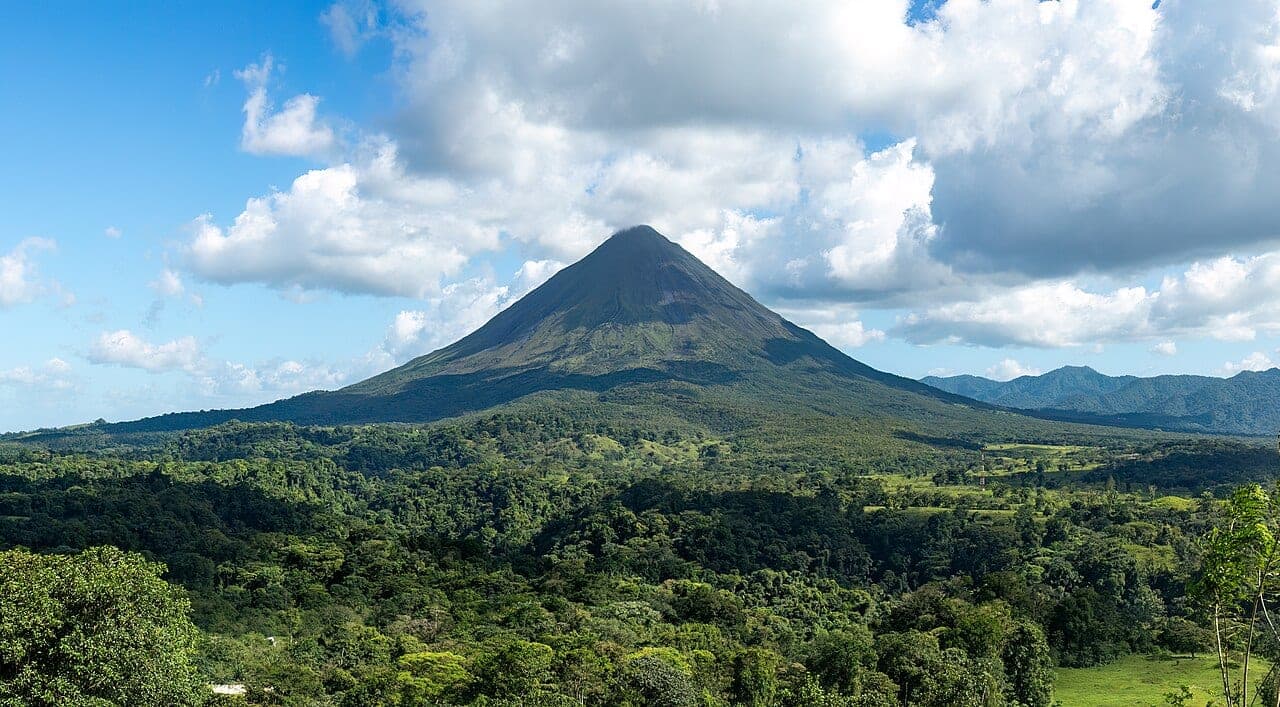
Costa Rica occupies a narrow bridge of land in Central America, bordered by Nicaragua to the north and Panama to the south, between the Caribbean Sea and the Pacific Ocean. It covers only about 51,000 square kilometres, yet a spine of volcanic mountains folds it into an extraordinary range of habitats, from cloud forest and páramo to dry savanna and lowland rainforest (Britannica). Some five million people live here, most in the temperate Central Valley around the capital, San José.
The country's smallness makes its natural wealth astonishing. Costa Rica holds close to five per cent of the planet's known species on roughly three hundredths of one per cent of its land, and has placed more than a quarter of its territory under protection (GVI). Its economy, once dependent on coffee and bananas, now leans on ecotourism, technology and medical devices, and its social indicators rank among the highest in Latin America (Britannica). The currency is the colón, the language is Spanish, and four sites carry UNESCO World Heritage status, three natural and one archaeological.
San José. The capital sits in the Central Valley at about 1,150 metres, founded in 1738 and made the seat of government in 1823. Coffee money paid for its finest building, the Teatro Nacional of 1897. The Gold Museum and Jade Museum hold the country's finest Indigenous metalwork and stonework, and the National Museum occupies the Bellavista barracks, the fortress whose wall was breached when the army was abolished (Britannica).
Cartago. Founded in 1563 by Juan Vázquez de Coronado, Cartago was the colonial capital for more than two centuries. It lies beneath the Irazú volcano, whose earthquakes left the roofless shell known as Las Ruinas at its heart. Its true centre of gravity is the Basilica of Our Lady of the Angels, destination of the nation's greatest pilgrimage (Tico Times).
Limón. Puerto Limón, on the Caribbean, is Costa Rica's principal Atlantic port and the capital of its Afro-Caribbean culture. It grew in the 1870s around the railway to the coffee highlands, built largely by migrant workers from Jamaica and the wider British West Indies (Jamaicans.com). Each October the city fills for the Carnaval de Limón, and its streets carry the sound of calypso and the smell of rice cooked in coconut milk.
Liberia. The capital of Guanacaste province in the dry north-west, Liberia is nicknamed the Ciudad Blanca, the White City, for its pale colonial houses. This is cattle country, home of the sabanero, the Guanacaste cowboy, and the heartland of the marimba and the folk traditions celebrated each 25 July as the Annexation of Nicoya (Wikipedia). Its international airport is the gateway to the Pacific beaches and dry forests of the north-west.
Long before the Spanish, the isthmus was a meeting place of cultures, part Mesoamerican in the north and part South American in the south. In the Diquís delta of the south-west, a chiefdom society flourished between roughly AD 500 and 1500 and carved the enigmatic stone spheres, near-perfect globes of gabbro up to more than two metres across, whose purpose and making remain unresolved (UNESCO). The ancestors of today's Bribri, Cabécar and Boruca worked gold, farmed and traded here.
 Guayabo has paved causeways, aqueducts and building platforms, and its water system still runs. Photograph by Elisabeth Tonglet, CC BY-SA 2.0, via Wikimedia Commons.
Columbus reached the Caribbean shore in 1502 on his fourth and final voyage, and Spanish settlers came in search of the gold the coast's name promised (Britannica). They found little of it. Within the Captaincy General of Guatemala, Costa Rica became a poor and isolated frontier, its colonists farming small plots for want of Indigenous labour or mineral wealth, a poverty that historians argue seeded a comparatively equal society of smallholders. Independence arrived quietly in 1821, more by news from the north than by revolution, and the country joined and then left the short-lived Federal Republic of Central America.
Coffee changed everything. From the 1830s the crop grew into the economic engine whose export wealth built the roads, the railway to Limón and the institutions of a modern state (Britannica). The decisive rupture came in 1948, when a disputed presidential election triggered a 44-day civil war led by José Figueres Ferrer at a cost of around two thousand lives. In victory, Figueres did what few soldiers ever do: on 1 December 1948 he abolished the army, symbolically breaking a wall of the Bellavista barracks, and the 1949 constitution enshrined the ban, extended the vote to women and granted full citizenship to Costa Ricans of African descent (Tico Times). The peace it protected let the country become, decades later, a broker of regional peace and a pioneer of conservation.
The country's name means "rich coast." It is usually traced to the gold ornaments coastal peoples showed the earliest Spanish arrivals, a promise of wealth the barren interior never fulfilled (costa-rica-guide.com). Spanish is the official and near-universal language, spoken in a gentle Costa Rican variety whose speakers are known affectionately as ticos, from their habit of adding the diminutive -tico to words.
Costa Rica remains, quietly, a multilingual country. Indigenous languages endure in the southern mountains, chiefly Bribri and Cabécar of the Chibchan family, spoken in the Talamanca highlands, alongside smaller communities keeping Maleku, Boruca and others alive (Encyclopedia.com). On the Caribbean coast, descendants of West Indian migrants speak Limonese Creole, an English-based tongue locally called Mekatelyu, carried from Jamaica in the nineteenth century and still passed down in Limón's homes and churches (Jamaicans.com). Each of these languages is a living archive of the people who speak it.
The painted oxcart, the carreta, is the country's defining folk symbol. Built from the mid-nineteenth century to haul coffee from the highlands to the Pacific, the carts gained their spectacular decoration in the early 1900s, when Sarchí's workshops began covering wheels and panels with flowers, stars and geometric patterns whose regional styles once told a driver's home district (UNESCO ICH). UNESCO recognised the oxherding and oxcart traditions in 2005, and the craft still lives in Sarchí's family workshops.
Guayabo has paved causeways, aqueducts and building platforms, and its water system still runs. Photograph by Elisabeth Tonglet, CC BY-SA 2.0, via Wikimedia Commons.
Columbus reached the Caribbean shore in 1502 on his fourth and final voyage, and Spanish settlers came in search of the gold the coast's name promised (Britannica). They found little of it. Within the Captaincy General of Guatemala, Costa Rica became a poor and isolated frontier, its colonists farming small plots for want of Indigenous labour or mineral wealth, a poverty that historians argue seeded a comparatively equal society of smallholders. Independence arrived quietly in 1821, more by news from the north than by revolution, and the country joined and then left the short-lived Federal Republic of Central America.
Coffee changed everything. From the 1830s the crop grew into the economic engine whose export wealth built the roads, the railway to Limón and the institutions of a modern state (Britannica). The decisive rupture came in 1948, when a disputed presidential election triggered a 44-day civil war led by José Figueres Ferrer at a cost of around two thousand lives. In victory, Figueres did what few soldiers ever do: on 1 December 1948 he abolished the army, symbolically breaking a wall of the Bellavista barracks, and the 1949 constitution enshrined the ban, extended the vote to women and granted full citizenship to Costa Ricans of African descent (Tico Times). The peace it protected let the country become, decades later, a broker of regional peace and a pioneer of conservation.
The country's name means "rich coast." It is usually traced to the gold ornaments coastal peoples showed the earliest Spanish arrivals, a promise of wealth the barren interior never fulfilled (costa-rica-guide.com). Spanish is the official and near-universal language, spoken in a gentle Costa Rican variety whose speakers are known affectionately as ticos, from their habit of adding the diminutive -tico to words.
Costa Rica remains, quietly, a multilingual country. Indigenous languages endure in the southern mountains, chiefly Bribri and Cabécar of the Chibchan family, spoken in the Talamanca highlands, alongside smaller communities keeping Maleku, Boruca and others alive (Encyclopedia.com). On the Caribbean coast, descendants of West Indian migrants speak Limonese Creole, an English-based tongue locally called Mekatelyu, carried from Jamaica in the nineteenth century and still passed down in Limón's homes and churches (Jamaicans.com). Each of these languages is a living archive of the people who speak it.
The painted oxcart, the carreta, is the country's defining folk symbol. Built from the mid-nineteenth century to haul coffee from the highlands to the Pacific, the carts gained their spectacular decoration in the early 1900s, when Sarchí's workshops began covering wheels and panels with flowers, stars and geometric patterns whose regional styles once told a driver's home district (UNESCO ICH). UNESCO recognised the oxherding and oxcart traditions in 2005, and the craft still lives in Sarchí's family workshops.
 Diquis spheres, shown here outside the Legislative Assembly. Hundreds were moved as ornaments before anyone recorded where they had stood, and their arrangement was the part that carried the meaning. Photograph by Mariordo, CC BY-SA 4.0, via Wikimedia Commons.
Music runs through the culture from both coasts. The marimba, a wooden xylophone that took root in Guanacaste, is the national instrument, the sound of the folk dances of the north-west (The Costa Rica News). On the Caribbean side, calypso tells local stories over guitar and banjo, a tradition carried to national attention by the Limón songwriter Walter Ferguson (Tico Travel). Coffee is a daily ritual as much as an export, and the table is anchored by gallo pinto, the breakfast of rice and beans, and the casado, a lunch plate named for the everyday marriage of rice, beans, plantain and meat.
Costa Rica is historically and officially Roman Catholic, one of the few states to name Catholicism its established church, though evangelical Protestantism and the non-religious have grown in recent decades. The nation's spiritual centre is the small statue known as La Negrita, Our Lady of the Angels, said to have been found on a rock by a woman, Juana Pereira, on 2 August 1635 and now enshrined in the basilica at Cartago as the country's patroness (Wikipedia).
Other faiths persist alongside the Church. In the Talamanca mountains, Bribri and Cabécar communities keep cosmologies centred on Sibö, their creator, and on the balance of earth, water, fire and air, with knowledge held by ritual specialists (everyculture.com). On the Caribbean coast, the Afro-Costa Rican community blends Protestant and Baptist churches, brought from the British West Indies, with a wider Caribbean inheritance. The Pan-Africanist Marcus Garvey, who worked in Limón around 1910, left a lasting mark, and chapters of his Universal Negro Improvement Association became centres of pride for the coast (MIR Online).
Catholic mourning shapes the customs of most of the country. Death is followed by a velorio, a wake at which family and neighbours keep company with the body through the night, then by burial and the novenario, nine evenings of the rosary for the repose of the soul. Each 2 November, All Souls' Day, Costa Ricans visit the cemeteries, clean and repaint the graves, lay flowers and attend Mass for their dead.
The nation's largest act of collective devotion is the Romería, the pilgrimage to Cartago. In the days before 2 August, close to two million people walk to the Basilica of Our Lady of the Angels, many completing the last stretch on their knees, to thank La Negrita or ask her intercession (Tico Times). It is remembrance and petition braided together, the whole country moving toward a single hillside.
Indigenous and Afro-Caribbean communities keep their own rites. Among the Boruca of the southern Pacific, the Fiesta de los Diablitos, held from 31 December to 2 January, is a three-day masked drama in which men in hand-carved balsa masks re-enact their ancestors' struggle against the Spanish conquest, an act of communal memory that keeps a history of survival alive (Wikipedia). On the Caribbean coast, families of West Indian descent have long observed Nine Night, the Afro-Caribbean wake held on the ninth evening after a death, when relatives and neighbours sing hymns, share food and stories and send the spirit on its way, a tradition rooted in West African belief and carried across the Atlantic to Limón (Catholics and Cultures).
Costa Rica is one of the easiest countries in Latin America to trace a family in, and the reason is a small colonial population that stayed put.
Catholic parish registers begin in the seventeenth century, and because the colony was poor, thinly settled and had few Indigenous people left after the first century of contact, the number of founding families was small. The result is that a very large share of Costa Ricans descend from a limited group of colonial households, and the genealogical connections between them have been worked out in detail. Costa Rican genealogy is unusually social for that reason: everyone turns out to be related.
Civil registration began in 1888 and is held by the Registro Civil, which is part of the electoral tribunal and is well maintained. The Archivo Nacional in San José holds the colonial and national series, and FamilySearch has digitised a great deal of the parish material.
Two populations sit outside that colonial core. The Afro-Caribbean community of Limón descends largely from Jamaicans recruited to build the railway and to work the banana plantations from the 1870s, and their records are Jamaican before they are Costa Rican: parish registers in Jamaica, and the labour and immigration files here. And the Indigenous peoples of the Talamanca highlands, Bribri and Cabécar among them, keep their own clan systems, which are matrilineal, so descent and land pass through women in a way the national registry does not reflect.
Costa Rica's four World Heritage inscriptions pair a single cultural site with three of the finest protected wildernesses in the Americas. The Precolumbian Chiefdom Settlements with Stone Spheres of the Diquís, inscribed in 2014 as the country's first cultural site, protect four locations where the spheres survive in their original settings, a rare record of a society that vanished before the Spanish came (UNESCO). Many spheres were dynamited or hauled off as garden ornaments during the banana boom, which makes the survivors all the more precious (The Met).
The natural sites are of global rank. Cocos Island National Park, a rainforested island some 550 kilometres out in the Pacific, was inscribed in 1997 for marine life that includes great schools of hammerhead sharks (UNESCO). La Amistad International Park, listed in 1983 and shared with Panama, protects the largest unbroken forest in Central America (Wikipedia). The Área de Conservación Guanacaste, added in 1999, safeguards a corridor from the Pacific across dry forest, rainforest and volcanoes, a landmark experiment in restoring tropical dry forest (UNESCO). Underpinning all of it is the system of payments for environmental services, which pays landowners to keep and restore forest, financed in part by a fuel tax (Reforestation in Costa Rica).
Costa Rica's memory institutions have moved steadily online. The National Museum, in the former army fortress, publishes digital collections; the Pre-Columbian Gold Museum has catalogued its metalwork for remote study; and the National Archives and National Library hold digital documents, maps and periodicals from the colonial era forward.
The living heritage is being recorded too. Ethnographers and community members have documented the Bribri and Cabécar languages, the songs of Limón calypso and the making of Boruca masks, work that matters most where fluent speakers and master artisans are few. Scientific institutions, including the National Biodiversity Institute's legacy databases, have digitised species records that make the country's natural heritage searchable worldwide, extending the archive from culture into the forest itself.
Modern Costa Rica exports an idea as much as a product: that a small, peaceful and green country can prosper. That reputation draws millions of visitors a year and has carried pura vida far beyond its borders, while its runs on almost entirely renewable electricity are studied abroad as a model of climate policy.
Its culture reaches outward in other ways. The Afro-Caribbean cooking of Limón, its rice and beans in coconut milk and its rondón stew, has entered the national menu, and calypso is now celebrated as national heritage rather than a coastal curiosity. Costa Rican writers, filmmakers and footballers carry the country's name abroad, and the 2014 World Cup run of a side from a country with no army delighted a global audience. The Boruca masks that once served a village ritual are now sought by collectors, giving the community both income and a platform to tell its own story.
An army turned into schools. The abolition of the military in 1948 and its constitutional ban in 1949 freed resources for education and health, and remains the choice Costa Ricans credit for their stability (Tico Times).
A Nobel for peace. In 1987 President Óscar Arias Sánchez won the Nobel Peace Prize for the plan that ended the civil wars then tearing Central America apart, an accord its five presidents signed that year (NobelPrize.org).
Forests brought back from the edge. Having lost much of its forest by the 1980s, Costa Rica became the first tropical country to reverse deforestation, roughly doubling its forest cover through protected areas and payments to landowners (Reforestation in Costa Rica).
The spheres recognised at last. The 2014 UNESCO inscription of the Diquís stone spheres gave international protection to the work of a people who left no written record, ensuring the surviving spheres will now be kept (UNESCO).
Diquis spheres, shown here outside the Legislative Assembly. Hundreds were moved as ornaments before anyone recorded where they had stood, and their arrangement was the part that carried the meaning. Photograph by Mariordo, CC BY-SA 4.0, via Wikimedia Commons.
Music runs through the culture from both coasts. The marimba, a wooden xylophone that took root in Guanacaste, is the national instrument, the sound of the folk dances of the north-west (The Costa Rica News). On the Caribbean side, calypso tells local stories over guitar and banjo, a tradition carried to national attention by the Limón songwriter Walter Ferguson (Tico Travel). Coffee is a daily ritual as much as an export, and the table is anchored by gallo pinto, the breakfast of rice and beans, and the casado, a lunch plate named for the everyday marriage of rice, beans, plantain and meat.
Costa Rica is historically and officially Roman Catholic, one of the few states to name Catholicism its established church, though evangelical Protestantism and the non-religious have grown in recent decades. The nation's spiritual centre is the small statue known as La Negrita, Our Lady of the Angels, said to have been found on a rock by a woman, Juana Pereira, on 2 August 1635 and now enshrined in the basilica at Cartago as the country's patroness (Wikipedia).
Other faiths persist alongside the Church. In the Talamanca mountains, Bribri and Cabécar communities keep cosmologies centred on Sibö, their creator, and on the balance of earth, water, fire and air, with knowledge held by ritual specialists (everyculture.com). On the Caribbean coast, the Afro-Costa Rican community blends Protestant and Baptist churches, brought from the British West Indies, with a wider Caribbean inheritance. The Pan-Africanist Marcus Garvey, who worked in Limón around 1910, left a lasting mark, and chapters of his Universal Negro Improvement Association became centres of pride for the coast (MIR Online).
Catholic mourning shapes the customs of most of the country. Death is followed by a velorio, a wake at which family and neighbours keep company with the body through the night, then by burial and the novenario, nine evenings of the rosary for the repose of the soul. Each 2 November, All Souls' Day, Costa Ricans visit the cemeteries, clean and repaint the graves, lay flowers and attend Mass for their dead.
The nation's largest act of collective devotion is the Romería, the pilgrimage to Cartago. In the days before 2 August, close to two million people walk to the Basilica of Our Lady of the Angels, many completing the last stretch on their knees, to thank La Negrita or ask her intercession (Tico Times). It is remembrance and petition braided together, the whole country moving toward a single hillside.
Indigenous and Afro-Caribbean communities keep their own rites. Among the Boruca of the southern Pacific, the Fiesta de los Diablitos, held from 31 December to 2 January, is a three-day masked drama in which men in hand-carved balsa masks re-enact their ancestors' struggle against the Spanish conquest, an act of communal memory that keeps a history of survival alive (Wikipedia). On the Caribbean coast, families of West Indian descent have long observed Nine Night, the Afro-Caribbean wake held on the ninth evening after a death, when relatives and neighbours sing hymns, share food and stories and send the spirit on its way, a tradition rooted in West African belief and carried across the Atlantic to Limón (Catholics and Cultures).
Costa Rica is one of the easiest countries in Latin America to trace a family in, and the reason is a small colonial population that stayed put.
Catholic parish registers begin in the seventeenth century, and because the colony was poor, thinly settled and had few Indigenous people left after the first century of contact, the number of founding families was small. The result is that a very large share of Costa Ricans descend from a limited group of colonial households, and the genealogical connections between them have been worked out in detail. Costa Rican genealogy is unusually social for that reason: everyone turns out to be related.
Civil registration began in 1888 and is held by the Registro Civil, which is part of the electoral tribunal and is well maintained. The Archivo Nacional in San José holds the colonial and national series, and FamilySearch has digitised a great deal of the parish material.
Two populations sit outside that colonial core. The Afro-Caribbean community of Limón descends largely from Jamaicans recruited to build the railway and to work the banana plantations from the 1870s, and their records are Jamaican before they are Costa Rican: parish registers in Jamaica, and the labour and immigration files here. And the Indigenous peoples of the Talamanca highlands, Bribri and Cabécar among them, keep their own clan systems, which are matrilineal, so descent and land pass through women in a way the national registry does not reflect.
Costa Rica's four World Heritage inscriptions pair a single cultural site with three of the finest protected wildernesses in the Americas. The Precolumbian Chiefdom Settlements with Stone Spheres of the Diquís, inscribed in 2014 as the country's first cultural site, protect four locations where the spheres survive in their original settings, a rare record of a society that vanished before the Spanish came (UNESCO). Many spheres were dynamited or hauled off as garden ornaments during the banana boom, which makes the survivors all the more precious (The Met).
The natural sites are of global rank. Cocos Island National Park, a rainforested island some 550 kilometres out in the Pacific, was inscribed in 1997 for marine life that includes great schools of hammerhead sharks (UNESCO). La Amistad International Park, listed in 1983 and shared with Panama, protects the largest unbroken forest in Central America (Wikipedia). The Área de Conservación Guanacaste, added in 1999, safeguards a corridor from the Pacific across dry forest, rainforest and volcanoes, a landmark experiment in restoring tropical dry forest (UNESCO). Underpinning all of it is the system of payments for environmental services, which pays landowners to keep and restore forest, financed in part by a fuel tax (Reforestation in Costa Rica).
Costa Rica's memory institutions have moved steadily online. The National Museum, in the former army fortress, publishes digital collections; the Pre-Columbian Gold Museum has catalogued its metalwork for remote study; and the National Archives and National Library hold digital documents, maps and periodicals from the colonial era forward.
The living heritage is being recorded too. Ethnographers and community members have documented the Bribri and Cabécar languages, the songs of Limón calypso and the making of Boruca masks, work that matters most where fluent speakers and master artisans are few. Scientific institutions, including the National Biodiversity Institute's legacy databases, have digitised species records that make the country's natural heritage searchable worldwide, extending the archive from culture into the forest itself.
Modern Costa Rica exports an idea as much as a product: that a small, peaceful and green country can prosper. That reputation draws millions of visitors a year and has carried pura vida far beyond its borders, while its runs on almost entirely renewable electricity are studied abroad as a model of climate policy.
Its culture reaches outward in other ways. The Afro-Caribbean cooking of Limón, its rice and beans in coconut milk and its rondón stew, has entered the national menu, and calypso is now celebrated as national heritage rather than a coastal curiosity. Costa Rican writers, filmmakers and footballers carry the country's name abroad, and the 2014 World Cup run of a side from a country with no army delighted a global audience. The Boruca masks that once served a village ritual are now sought by collectors, giving the community both income and a platform to tell its own story.
An army turned into schools. The abolition of the military in 1948 and its constitutional ban in 1949 freed resources for education and health, and remains the choice Costa Ricans credit for their stability (Tico Times).
A Nobel for peace. In 1987 President Óscar Arias Sánchez won the Nobel Peace Prize for the plan that ended the civil wars then tearing Central America apart, an accord its five presidents signed that year (NobelPrize.org).
Forests brought back from the edge. Having lost much of its forest by the 1980s, Costa Rica became the first tropical country to reverse deforestation, roughly doubling its forest cover through protected areas and payments to landowners (Reforestation in Costa Rica).
The spheres recognised at last. The 2014 UNESCO inscription of the Diquís stone spheres gave international protection to the work of a people who left no written record, ensuring the surviving spheres will now be kept (UNESCO).
National Overview
Notable Cities
Historical Foundations
Linguistic and Etymological Roots
Cultural Identity
Religion and Spirituality
Remembrance and Mourning Traditions
Tracing a Family in Costa Rica
Heritage Preservation Efforts
Digital Heritage
Contemporary Cultural Influences
Success Stories
References and resources
- Encyclopaedia Britannica, Costa Rica. Geography, society and government.
- Encyclopaedia Britannica, History of Costa Rica. From pre-Columbian settlement to the republic.
- UNESCO World Heritage Centre, Stone Spheres of the Diquís. The 2014 cultural inscription.
- UNESCO World Heritage Centre, Cocos Island National Park. The Pacific island and its marine life.
- UNESCO World Heritage Centre, Area de Conservación Guanacaste. Dry forest, rainforest and volcanoes.
- UNESCO Intangible Cultural Heritage, Oxherding and oxcart traditions. The carreta and boyeo, recognised in 2005.
- The Metropolitan Museum of Art, A Stone Sphere from Costa Rica. The spheres and their dispersal.
- Tico Times, Costa Rica's Abolition of the Army. The 1948 war and 1949 constitution.
- NobelPrize.org, The Nobel Peace Prize 1987. Óscar Arias and the peace plan.
- Reforestation in Costa Rica, Wikipedia. Reversing deforestation and paying for forest.
- Danza de los Diablitos, Wikipedia. The Boruca masked festival.
- Jamaicans.com, The Story of Jamaica Town in Limón. West Indian migration to Limón.