Heritage · Country
Kashmir Culture and Heritage
Kashmir built its holiest buildings out of deodar wood, so they burn, and they have burned repeatedly. When the shrine of Dastgir Sahib was gutted in 2012 it was rebuilt from a digital survey made beforehand. This is a guide to Kashmiri heritage, from a mystic poetry shared by two religions to a craft tradition that survived everything except the market.Written to last.
By Confinity Heritage Editorial · Updated 2026-08-20 · 8-minute readQuiet tools, kept out of the way.
Kashmiri builders worked in deodar cedar because the valley has earthquakes and timber frames survive them, and the result is a religious architecture of wooden pillars, tiered pyramidal roofs and latticed screens that looks like nothing else in South Asia. The cost of that choice is fire. The shrine at Charar-e-Sharief burned down in 1995 during a siege. The shrine of Dastgir Sahib at Khanyar burned in 2012. Both have been rebuilt, and the second was rebuilt accurately because someone had made a detailed digital survey of it first.
This is a place where the heritage question is not whether something will be lost but how well it was recorded before it was. That applies to the buildings, to a craft economy under pressure, to a language losing its readers, and to a population that has itself been divided and displaced. This profile sets out what Kashmir holds and what has happened to it, and where the facts are contested it says who is asserting them.
Kashmir in the cultural sense used here means the Kashmir Valley, an oval basin about 140 kilometres long between the Pir Panjal range and the Greater Himalaya, drained by the Jhelum and holding Dal and Wular lakes. It is the historic homeland of the Kashmiri language and of the culture described below, and it is one part of a much larger territory whose status is disputed.
The dispute should be stated plainly and not resolved here. Since 1947 the former princely state of Jammu and Kashmir has been divided. India administers the areas it constituted, from 31 October 2019, as the union territories of Jammu and Kashmir and of Ladakh, following the revocation on 5 August 2019 of the special status the region had held under Article 370 of the Indian constitution. Pakistan administers Azad Jammu and Kashmir and Gilgit-Baltistan. China administers Aksai Chin. India and Pakistan each claim the whole of the former princely state, the ceasefire line agreed in 1972 is the Line of Control, and the United Nations Security Council has passed resolutions on the question and maintains an observer group, UNMOGIP, on the ground. This page describes heritage in the valley and takes no position on where the territory belongs.
Population is roughly seven to eight million in the valley, overwhelmingly Muslim, with a small resident Kashmiri Pandit population and a much larger displaced one. The summer capital is Srinagar.
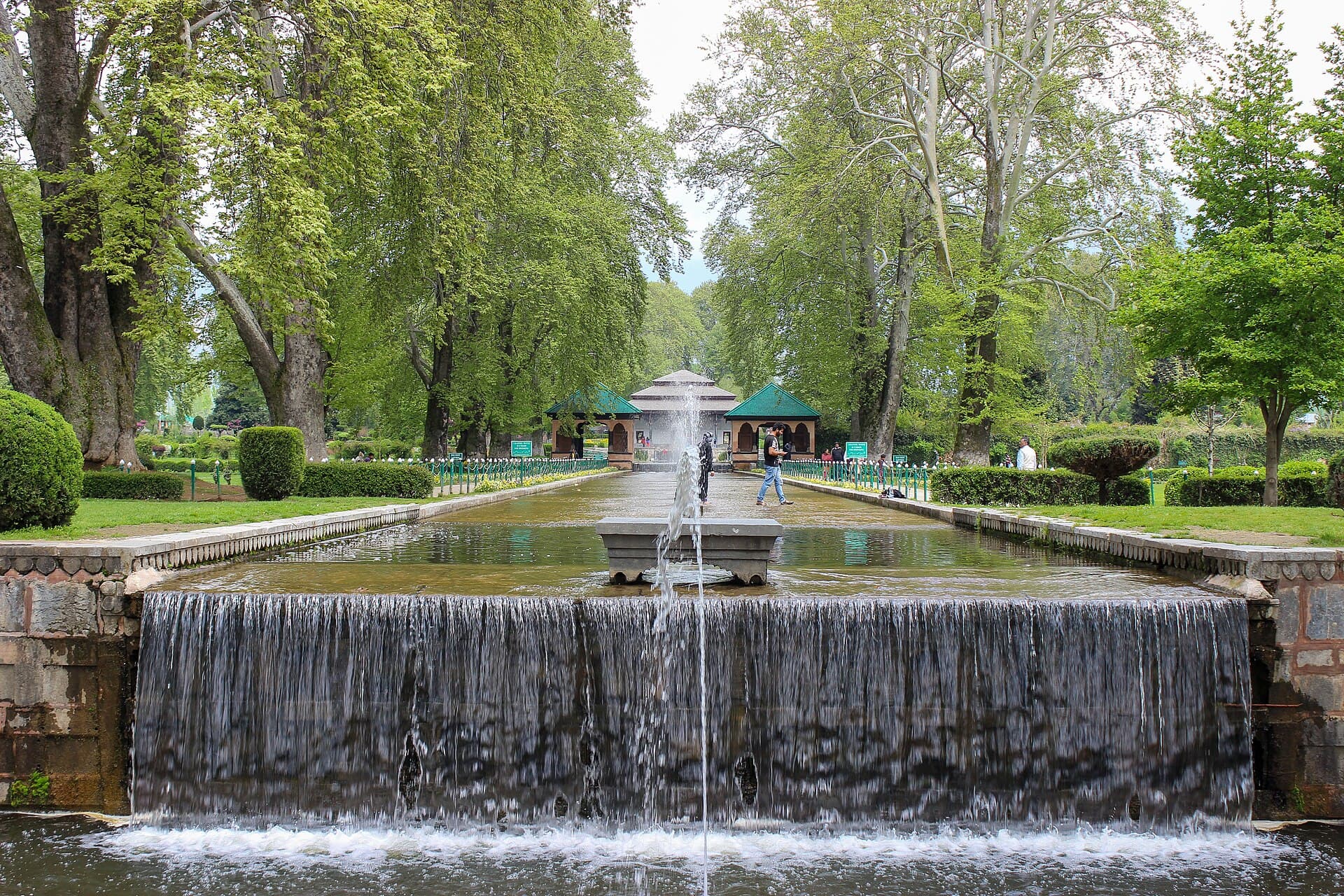
Srinagar. The valley's principal city, built along the Jhelum and around Dal Lake, with the wooden Jamia Masjid founded in the fourteenth century, the Khanqah of Shah Hamadan on the riverbank, the Hazratbal shrine on the lake's western shore, and the Mughal gardens on the slopes above the water. The old city is where the craft workshops are.
Anantnag. In the south of the valley, close to Martand, the ruined eighth-century sun temple on a plateau with a colonnaded courtyard, and to the springs the district is named for.
Charar-e-Sharief. A town in Budgam built around the shrine of Sheikh Noor-ud-din Noorani, the valley's patron saint, and the site of the 1995 fire.
Baramulla. The old gateway to the valley on the route to Muzaffarabad, a trading town whose position on the Line of Control has defined its modern history.
Pampore. The saffron town on the karewa terraces south of Srinagar, producing what is generally held to be the most valuable saffron in the world and now a protected geographical indication.
Kashmir has a written history unusual for its region. The Rajatarangini, composed by Kalhana in the twelfth century, is a chronicle of the valley's dynasties written with an attempt at chronology and source criticism, and it is often described as the earliest work of its kind in the Indian tradition.
 Martand was raised by Lalitaditya in the eighth century and pulled down in the fifteenth. What stands is a colonnade around an empty court, on a plateau with the whole valley visible from it. Photograph by Ankur P, CC BY-SA 2.0, via Wikimedia Commons.
The valley was a major Buddhist centre from the time of Ashoka and is traditionally associated with the fourth Buddhist council. It then became one of the great centres of Sanskrit learning and of Shaiva philosophy. The Karkota ruler Lalitaditya, in the eighth century, built the Martand sun temple whose ruins still stand. Kashmiri Shaivism, the non-dual Trika school developed by Abhinavagupta and others around the tenth and eleventh centuries, is one of the significant philosophical systems of South Asia and was produced here.
Islam arrived gradually from the fourteenth century, largely through Sufi preachers, and the conversion of the valley was accomplished more by persuasion than by conquest. The Shah Mir sultanate, the Mughals from 1586, Afghan rule from 1753, Sikh rule from 1819 and Dogra rule from 1846 followed. The Dogra period matters for what came after: the state was sold to Gulab Singh under the Treaty of Amritsar in 1846, which gave a Hindu dynasty rule over a Muslim-majority population, an arrangement that shaped the politics of 1947.
At partition the princely state's ruler acceded to India in October 1947 as fighting was already under way, and the first India-Pakistan war followed. The division of the territory dates from the ceasefire of 1949. An armed insurgency began in the valley in 1989 and 1990, and the years since have been the context for everything described below.
Kashmiri, called Koshur by its speakers, is spoken by roughly seven million people. It belongs to the Dardic group within Indo-Aryan, and it is not a dialect of anything: it has its own phonology, including vowels that are difficult to write in neighbouring scripts, and its own literature going back centuries.
Its script history is a heritage problem in itself. Kashmiri was historically written in Sharada, a script that developed from Brahmi and probably originated in Kashmir, and which is now used almost nowhere except in some Kashmiri Pandit religious contexts. The modern standard is a modified Perso-Arabic script, while many Pandits, particularly after 1990, have published in Devanagari. A language with three scripts and no single one that all its speakers read is a language whose written heritage is hard to keep in circulation.
Kashmiri also has an unusual relationship to schooling. Urdu has been the official language and the medium of instruction, English is the language of higher education, and Kashmiri has often been taught, when taught at all, as a subject rather than used as a medium. The result is millions of fluent speakers who cannot comfortably read their own literature.
The valley's crafts are its most concrete inheritance and among the most refined anywhere. The kani shawl is woven on a handloom with small wooden sticks rather than a shuttle, one for each colour, so that a single fine shawl can take two or more people several years; pashmina is spun from the underfleece of the changthangi goat of the Ladakh plateau and has geographical indication protection. Sozni is needle embroidery worked so finely that the reverse is often as clean as the face.
Papier-mache, called naqashi, arrived with Persian craftsmen and produces boxes, vessels and panels built up from paper pulp, burnished, then painted in fine gold and colour by a painter working freehand. In architecture, khatamband is a ceiling made of small pieces of wood fitted together in geometric patterns without nails, and pinjrakari is the wooden lattice screen, both of them systems that can be dismantled and re-set. Walnut wood carving, carpet weaving and copperwork complete the set.
All of it is under the same pressure: long training, low returns, competition from machine-made imitation, and a market disrupted by decades of conflict and by the interruption of tourism. Craft is the part of Kashmiri heritage where the threat is straightforwardly economic.
The valley's religious history is layered rather than sequential, and its most distinctive feature is the degree to which the layers acknowledge each other.
Lal Ded, also called Lalleshwari, was a fourteenth-century woman ascetic whose vakhs, short verses in early Kashmiri, are among the founding texts of the language. She is claimed within the Shaiva tradition and is also revered by Kashmiri Muslims, who often call her Lalla Arifa. Sheikh Noor-ud-din Noorani, known as Nund Rishi, founded the Rishi order of Kashmiri Sufism in the same century and preached in Kashmiri rather than Persian; his shruks are the other pillar of the literature. That two figures of different religions stand together at the origin of the written language is the fact Kashmiris most often reach for when describing what the valley was.
Sufi shrines, khanqahs and ziarats, are the principal religious buildings, and the practice around them, visiting, tying threads, seeking intercession, has been criticised by reformist movements in recent decades. Hazratbal holds a relic venerated as a hair of the Prophet; its disappearance in December 1963 and recovery days later produced the largest popular mobilisation the valley had seen to that point.
Kashmiri Shaivism survives as a philosophical tradition with an international following, though the community that carried it in the valley has largely gone. Buddhism, once dominant, remains in the wider region in Ladakh rather than in the valley.
Kashmiri Muslim funerals follow the general Islamic pattern, with burial as soon as possible, prayer over the body, and interment on the side facing Mecca. The observances that follow are specific and named: the fatiha, gatherings at which the Quran is recited for the deceased; the chahrum on the fourth day; and the chehlum on the fortieth, which is the principal memorial occasion. Graves in the valley are typically simple, and burial grounds are attached to the mosque or the shrine, with the most sought-after ground being close to a saint.
Kashmiri Pandit practice runs on the Hindu sequence of cremation followed by shraddha rites, with observances on the tenth, eleventh and twelfth days and an annual remembrance, and the family priest holding the genealogical record. Displacement broke the geography this depends on. Rites that assume a particular river, a particular cremation ground and a particular priest are difficult to perform from a camp in Jammu or a flat in Delhi, and the community's remembrance since 1990 has been substantially reconstructed rather than continued.
Between January and March 1990, according to figures cited in published accounts of the exodus, somewhere between 90,000 and 100,000 Kashmiri Pandits left the valley out of an estimated population of 120,000 to 140,000. The causes and responsibility are disputed and are argued about in strongly opposed terms; what is not disputed is that the community that had lived in the valley continuously for many centuries is now largely outside it, and that its shrines, houses and cremation grounds are used, unused or gone.
The conflict produced a further category of mourning with no settled form. The Association of Parents of Disappeared Persons, formed in Srinagar in 1994, has documented cases of men who disappeared after being taken into custody, and has campaigned on behalf of the women it calls half-widows, whose husbands are neither confirmed dead nor returned. Estimates of the number vary widely between the organisation, other rights groups and official sources, and are contested. The heritage point is narrow and clear: a mourning tradition that depends on a body, a burial and a fixed fortieth day cannot be performed when there is no confirmation of death, and families in this position have been left without a rite to complete.
Kashmiri family records are divided by a line that also divides the archives, and the older tradition sits underneath both.
The pandits, hereditary genealogists at pilgrimage sites, kept written registers of families who came to perform rites, entered by village and clan and added to on each visit. In Kashmir and among Kashmiri Pandits this tradition connects to the wider north Indian system, and family papers, land records and shrine registers carry the rest.
Under the Dogra maharajas from 1846 the state produced land settlement records, the jamabandi, which name cultivators and their fathers village by village and are the most complete pre-1947 record of ordinary Kashmiri families. Those are held by the revenue departments on both sides of the Line of Control, so a family's land record may be in Srinagar and the family in Muzaffarabad, or the reverse.
1947 is the break. Partition and the first war divided the territory, moved people in both directions, and left records where the people were not. Successive conflicts since have added displacement: the Kashmiri Pandits who left the valley in 1990, and the families displaced along the Line of Control.
The most contested modern record is the missing. Estimates of enforced disappearances in the valley since 1989 run into the thousands, kept by the Association of Parents of Disappeared Persons rather than by any government, and the unmarked graves surveyed in the north of the valley have never been fully investigated. The families call themselves half-widows, because there is no death record.
The valley's built heritage has had a hard century, and fire is the recurring mechanism. The shrine of Charar-e-Sharief was destroyed in 1995 after a prolonged standoff between militants and the Indian army; each side blamed the other. It has been rebuilt, and Kashmiri architectural writers have criticised the reconstruction for abandoning the thick insulating walls of the original in favour of glazing, so that the building no longer performs as the old one did. The shrine of Dastgir Sahib at Khanyar, around two hundred years old, was gutted on 25 June 2012.
The Dastgir Sahib rebuild is the one clear success and it is worth being precise about why. The building had been recorded in detail, and that survey allowed reconstruction on the original plinth and underground base with the geometry preserved. The lesson is unglamorous: the decisive conservation work happened years before the fire, in the form of documentation.
Institutionally, the Archaeological Survey of India maintains Martand, Avantipora and the other stone monuments; the Sri Pratap Singh Museum in Srinagar, founded in 1898, holds the principal collections of manuscripts, textiles and sculpture; and the Mughal gardens of Srinagar, Shalimar, Nishat and Chashme Shahi among them, are on India's tentative list for World Heritage but have not been inscribed. Nothing in the Kashmir Valley currently holds World Heritage status.
The floods of September 2014, which put much of Srinagar under water, damaged libraries, private manuscript collections and museum stores, and are the clearest recent demonstration that the valley's threats are not only political.
Documentation has become the valley's most effective conservation tool because it is the one that survives the building. The Dastgir Sahib case is the proof, and the INTACH Kashmir chapter and university departments have carried out listing and measured survey of the old city's timber architecture, which is the material most at risk from fire, decay and redevelopment.
Manuscript digitisation is the second front. Kashmiri, Persian and Sanskrit manuscripts held in the Sri Pratap Singh Museum, in university and oriental research libraries, and in private hands are being catalogued and imaged, work made more urgent by the 2014 floods and by the dispersal of Pandit family collections after 1990.
Language and literature have gone online largely through community effort. Digital archives of Kashmiri poetry, of the vakhs and shruks, and of Pandit publications in Devanagari have been built by diaspora volunteers, and Kashmiri now has Unicode support, keyboards and a growing body of digitised text, though the three-script problem means no single digital corpus reaches all its speakers.
Saffron, pashmina and the papier-mache workshops keep Kashmir present in the luxury trade, and geographical indication protection for Kashmiri saffron and pashmina has been used to defend both against imitation. The reputation is enormous relative to the volume actually produced, which is exactly the condition in which counterfeiting flourishes.
Kashmiri music and poetry have had a visible revival, with the sufiyana kalam tradition performed and recorded, chakri and rouf still sung at gatherings, and a generation of Kashmiri musicians and writers working in both Kashmiri and English and reaching audiences far beyond the valley. The 2014 floods, the periodic communications shutdowns, and the events of August 2019 have all been documented from inside by Kashmiri photographers and journalists whose work is now a substantial part of the record.
Tourism has always been the valley's other economy and has always been the first thing to stop. Its collapse and partial recovery over three decades has determined how many weavers, carvers and painters could stay in their trades, which makes the visitor economy a heritage variable rather than merely a commercial one.
A shrine rebuilt from its own record. Dastgir Sahib was gutted in June 2012 and reconstructed accurately on its original base because a detailed survey of the building existed beforehand.
A language founded by two traditions at once. The vakhs of Lal Ded and the shruks of Nund Rishi stand together at the beginning of written Kashmiri and are honoured across the valley's religious divide.
Crafts defended by name. Geographical indication protection for Kashmiri saffron and for pashmina gives producers a legal instrument against imitation, in trades where the imitation is the main threat.
A chronicle that took its own history seriously. Kalhana's twelfth-century Rajatarangini gave the valley a written dynastic record with a stated concern for chronology and sources, unusual for its time and place.
Martand was raised by Lalitaditya in the eighth century and pulled down in the fifteenth. What stands is a colonnade around an empty court, on a plateau with the whole valley visible from it. Photograph by Ankur P, CC BY-SA 2.0, via Wikimedia Commons.
The valley was a major Buddhist centre from the time of Ashoka and is traditionally associated with the fourth Buddhist council. It then became one of the great centres of Sanskrit learning and of Shaiva philosophy. The Karkota ruler Lalitaditya, in the eighth century, built the Martand sun temple whose ruins still stand. Kashmiri Shaivism, the non-dual Trika school developed by Abhinavagupta and others around the tenth and eleventh centuries, is one of the significant philosophical systems of South Asia and was produced here.
Islam arrived gradually from the fourteenth century, largely through Sufi preachers, and the conversion of the valley was accomplished more by persuasion than by conquest. The Shah Mir sultanate, the Mughals from 1586, Afghan rule from 1753, Sikh rule from 1819 and Dogra rule from 1846 followed. The Dogra period matters for what came after: the state was sold to Gulab Singh under the Treaty of Amritsar in 1846, which gave a Hindu dynasty rule over a Muslim-majority population, an arrangement that shaped the politics of 1947.
At partition the princely state's ruler acceded to India in October 1947 as fighting was already under way, and the first India-Pakistan war followed. The division of the territory dates from the ceasefire of 1949. An armed insurgency began in the valley in 1989 and 1990, and the years since have been the context for everything described below.
Kashmiri, called Koshur by its speakers, is spoken by roughly seven million people. It belongs to the Dardic group within Indo-Aryan, and it is not a dialect of anything: it has its own phonology, including vowels that are difficult to write in neighbouring scripts, and its own literature going back centuries.
Its script history is a heritage problem in itself. Kashmiri was historically written in Sharada, a script that developed from Brahmi and probably originated in Kashmir, and which is now used almost nowhere except in some Kashmiri Pandit religious contexts. The modern standard is a modified Perso-Arabic script, while many Pandits, particularly after 1990, have published in Devanagari. A language with three scripts and no single one that all its speakers read is a language whose written heritage is hard to keep in circulation.
Kashmiri also has an unusual relationship to schooling. Urdu has been the official language and the medium of instruction, English is the language of higher education, and Kashmiri has often been taught, when taught at all, as a subject rather than used as a medium. The result is millions of fluent speakers who cannot comfortably read their own literature.
The valley's crafts are its most concrete inheritance and among the most refined anywhere. The kani shawl is woven on a handloom with small wooden sticks rather than a shuttle, one for each colour, so that a single fine shawl can take two or more people several years; pashmina is spun from the underfleece of the changthangi goat of the Ladakh plateau and has geographical indication protection. Sozni is needle embroidery worked so finely that the reverse is often as clean as the face.
Papier-mache, called naqashi, arrived with Persian craftsmen and produces boxes, vessels and panels built up from paper pulp, burnished, then painted in fine gold and colour by a painter working freehand. In architecture, khatamband is a ceiling made of small pieces of wood fitted together in geometric patterns without nails, and pinjrakari is the wooden lattice screen, both of them systems that can be dismantled and re-set. Walnut wood carving, carpet weaving and copperwork complete the set.
All of it is under the same pressure: long training, low returns, competition from machine-made imitation, and a market disrupted by decades of conflict and by the interruption of tourism. Craft is the part of Kashmiri heritage where the threat is straightforwardly economic.
The valley's religious history is layered rather than sequential, and its most distinctive feature is the degree to which the layers acknowledge each other.
Lal Ded, also called Lalleshwari, was a fourteenth-century woman ascetic whose vakhs, short verses in early Kashmiri, are among the founding texts of the language. She is claimed within the Shaiva tradition and is also revered by Kashmiri Muslims, who often call her Lalla Arifa. Sheikh Noor-ud-din Noorani, known as Nund Rishi, founded the Rishi order of Kashmiri Sufism in the same century and preached in Kashmiri rather than Persian; his shruks are the other pillar of the literature. That two figures of different religions stand together at the origin of the written language is the fact Kashmiris most often reach for when describing what the valley was.
Sufi shrines, khanqahs and ziarats, are the principal religious buildings, and the practice around them, visiting, tying threads, seeking intercession, has been criticised by reformist movements in recent decades. Hazratbal holds a relic venerated as a hair of the Prophet; its disappearance in December 1963 and recovery days later produced the largest popular mobilisation the valley had seen to that point.
Kashmiri Shaivism survives as a philosophical tradition with an international following, though the community that carried it in the valley has largely gone. Buddhism, once dominant, remains in the wider region in Ladakh rather than in the valley.
Kashmiri Muslim funerals follow the general Islamic pattern, with burial as soon as possible, prayer over the body, and interment on the side facing Mecca. The observances that follow are specific and named: the fatiha, gatherings at which the Quran is recited for the deceased; the chahrum on the fourth day; and the chehlum on the fortieth, which is the principal memorial occasion. Graves in the valley are typically simple, and burial grounds are attached to the mosque or the shrine, with the most sought-after ground being close to a saint.
Kashmiri Pandit practice runs on the Hindu sequence of cremation followed by shraddha rites, with observances on the tenth, eleventh and twelfth days and an annual remembrance, and the family priest holding the genealogical record. Displacement broke the geography this depends on. Rites that assume a particular river, a particular cremation ground and a particular priest are difficult to perform from a camp in Jammu or a flat in Delhi, and the community's remembrance since 1990 has been substantially reconstructed rather than continued.
Between January and March 1990, according to figures cited in published accounts of the exodus, somewhere between 90,000 and 100,000 Kashmiri Pandits left the valley out of an estimated population of 120,000 to 140,000. The causes and responsibility are disputed and are argued about in strongly opposed terms; what is not disputed is that the community that had lived in the valley continuously for many centuries is now largely outside it, and that its shrines, houses and cremation grounds are used, unused or gone.
The conflict produced a further category of mourning with no settled form. The Association of Parents of Disappeared Persons, formed in Srinagar in 1994, has documented cases of men who disappeared after being taken into custody, and has campaigned on behalf of the women it calls half-widows, whose husbands are neither confirmed dead nor returned. Estimates of the number vary widely between the organisation, other rights groups and official sources, and are contested. The heritage point is narrow and clear: a mourning tradition that depends on a body, a burial and a fixed fortieth day cannot be performed when there is no confirmation of death, and families in this position have been left without a rite to complete.
Kashmiri family records are divided by a line that also divides the archives, and the older tradition sits underneath both.
The pandits, hereditary genealogists at pilgrimage sites, kept written registers of families who came to perform rites, entered by village and clan and added to on each visit. In Kashmir and among Kashmiri Pandits this tradition connects to the wider north Indian system, and family papers, land records and shrine registers carry the rest.
Under the Dogra maharajas from 1846 the state produced land settlement records, the jamabandi, which name cultivators and their fathers village by village and are the most complete pre-1947 record of ordinary Kashmiri families. Those are held by the revenue departments on both sides of the Line of Control, so a family's land record may be in Srinagar and the family in Muzaffarabad, or the reverse.
1947 is the break. Partition and the first war divided the territory, moved people in both directions, and left records where the people were not. Successive conflicts since have added displacement: the Kashmiri Pandits who left the valley in 1990, and the families displaced along the Line of Control.
The most contested modern record is the missing. Estimates of enforced disappearances in the valley since 1989 run into the thousands, kept by the Association of Parents of Disappeared Persons rather than by any government, and the unmarked graves surveyed in the north of the valley have never been fully investigated. The families call themselves half-widows, because there is no death record.
The valley's built heritage has had a hard century, and fire is the recurring mechanism. The shrine of Charar-e-Sharief was destroyed in 1995 after a prolonged standoff between militants and the Indian army; each side blamed the other. It has been rebuilt, and Kashmiri architectural writers have criticised the reconstruction for abandoning the thick insulating walls of the original in favour of glazing, so that the building no longer performs as the old one did. The shrine of Dastgir Sahib at Khanyar, around two hundred years old, was gutted on 25 June 2012.
The Dastgir Sahib rebuild is the one clear success and it is worth being precise about why. The building had been recorded in detail, and that survey allowed reconstruction on the original plinth and underground base with the geometry preserved. The lesson is unglamorous: the decisive conservation work happened years before the fire, in the form of documentation.
Institutionally, the Archaeological Survey of India maintains Martand, Avantipora and the other stone monuments; the Sri Pratap Singh Museum in Srinagar, founded in 1898, holds the principal collections of manuscripts, textiles and sculpture; and the Mughal gardens of Srinagar, Shalimar, Nishat and Chashme Shahi among them, are on India's tentative list for World Heritage but have not been inscribed. Nothing in the Kashmir Valley currently holds World Heritage status.
The floods of September 2014, which put much of Srinagar under water, damaged libraries, private manuscript collections and museum stores, and are the clearest recent demonstration that the valley's threats are not only political.
Documentation has become the valley's most effective conservation tool because it is the one that survives the building. The Dastgir Sahib case is the proof, and the INTACH Kashmir chapter and university departments have carried out listing and measured survey of the old city's timber architecture, which is the material most at risk from fire, decay and redevelopment.
Manuscript digitisation is the second front. Kashmiri, Persian and Sanskrit manuscripts held in the Sri Pratap Singh Museum, in university and oriental research libraries, and in private hands are being catalogued and imaged, work made more urgent by the 2014 floods and by the dispersal of Pandit family collections after 1990.
Language and literature have gone online largely through community effort. Digital archives of Kashmiri poetry, of the vakhs and shruks, and of Pandit publications in Devanagari have been built by diaspora volunteers, and Kashmiri now has Unicode support, keyboards and a growing body of digitised text, though the three-script problem means no single digital corpus reaches all its speakers.
Saffron, pashmina and the papier-mache workshops keep Kashmir present in the luxury trade, and geographical indication protection for Kashmiri saffron and pashmina has been used to defend both against imitation. The reputation is enormous relative to the volume actually produced, which is exactly the condition in which counterfeiting flourishes.
Kashmiri music and poetry have had a visible revival, with the sufiyana kalam tradition performed and recorded, chakri and rouf still sung at gatherings, and a generation of Kashmiri musicians and writers working in both Kashmiri and English and reaching audiences far beyond the valley. The 2014 floods, the periodic communications shutdowns, and the events of August 2019 have all been documented from inside by Kashmiri photographers and journalists whose work is now a substantial part of the record.
Tourism has always been the valley's other economy and has always been the first thing to stop. Its collapse and partial recovery over three decades has determined how many weavers, carvers and painters could stay in their trades, which makes the visitor economy a heritage variable rather than merely a commercial one.
A shrine rebuilt from its own record. Dastgir Sahib was gutted in June 2012 and reconstructed accurately on its original base because a detailed survey of the building existed beforehand.
A language founded by two traditions at once. The vakhs of Lal Ded and the shruks of Nund Rishi stand together at the beginning of written Kashmiri and are honoured across the valley's religious divide.
Crafts defended by name. Geographical indication protection for Kashmiri saffron and for pashmina gives producers a legal instrument against imitation, in trades where the imitation is the main threat.
A chronicle that took its own history seriously. Kalhana's twelfth-century Rajatarangini gave the valley a written dynastic record with a stated concern for chronology and sources, unusual for its time and place.
National Overview
Notable Cities
Historical Foundations
Linguistic and Etymological Roots
Cultural Identity
Religion and Spirituality
Remembrance and Mourning Traditions
Tracing a Family in Kashmir
Heritage Preservation Efforts
Digital Heritage
Contemporary Cultural Influences
Success Stories
References and resources
- Kashmir, Wikipedia: the region, the division and the administering parties.
- Kashmiri language, Wikipedia: the Dardic classification, speaker numbers and the three scripts.
- Charar-e-Sharief shrine, Wikipedia: the shrine of Nund Rishi and the 1995 destruction.
- Nund Rishi, Wikipedia: the Rishi order and the shruks.
- Lalleshwari, Wikipedia: Lal Ded and the vakhs.
- Exodus of Kashmiri Hindus, Wikipedia: the 1990 departure and the figures cited for it.
- Kashmir Shaivism, Wikipedia: the Trika school and Abhinavagupta.
- Rajatarangini, Wikipedia: Kalhana's twelfth-century chronicle.
- Martand Sun Temple, Wikipedia: the eighth-century temple and its ruins.
- Parveena Ahanger, Wikipedia: co-founder of the Association of Parents of Disappeared Persons.