Heritage · Country
Cook Islands Culture and Heritage
Five times more Cook Islanders live in New Zealand than in the fifteen islands themselves, which makes heritage here a question of what travels and what stays. A guide to the voyaging harbour at Avana, the missionary century, the tivaevae quilts sewn for weddings and graves, and a language holding on.Written to last.
By Confinity Heritage Editorial · Updated 2026-08-17 · 8-minute readQuiet tools, kept out of the way.
Most Cook Islanders do not live in the Cook Islands. The 2021 census counted about 15,000 residents across fifteen islands; the New Zealand census of 2018 counted more than 80,000 people of Cook Islands descent, and another 28,000 or so live in Australia. That imbalance is the first fact anyone working on Cook Islands heritage has to deal with, because it decides what happens to the language, who learns to sew a tivaevae, and where a person is buried. Cook Islanders hold New Zealand citizenship, which is what made leaving straightforward, and the same arrangement is what keeps the connection alive in both directions.
The country has been self-governing in free association with New Zealand since 1965, running its own government, courts and increasingly its own foreign policy while sharing citizenship with a partner two and a half thousand miles away. Its heritage was formed by three long movements: the voyaging that filled these islands and then launched canoes onward to Aotearoa, the missionary century that rebuilt village life around the church and pushed dance and tattoo out of it, and the migration that has since scattered the population.
The Cook Islands are fifteen islands in two groups. The southern group is volcanic and holds nearly all the people: Rarotonga with its ring road and forested interior, Aitutaki around one of the largest lagoons in the Pacific, and the raised coral islands of Mangaia, Atiu, Mauke and Mitiaro. The northern group is a scatter of low atolls, among them Pukapuka, Manihiki, Rakahanga, Penrhyn and Suwarrow, some of them a thousand kilometres from the capital. Land totals about 237 square kilometres inside an exclusive economic zone of nearly two million (Britannica).
Under the constitution of 4 August 1965 the country governs itself in free association with New Zealand, which acts on defence and foreign affairs when asked and not otherwise; the Cook Islands maintains diplomatic relations in its own name, belongs to international agencies, and its people are New Zealand citizens. Parliament sits in Avarua alongside the House of Ariki, an advisory body of traditional chiefs. Tourism carries the economy, with black pearls from Manihiki and Penrhyn, fishing licences and offshore finance behind it. In 2017 the whole exclusive economic zone was declared Marae Moana, a marine park covering nearly two million square kilometres (Wikipedia).
Avarua. The capital on Rarotonga's north coast is a low town of one main street, a harbour too small for cruise ships, the parliament, the market at Punanga Nui and the Cook Islands Christian Church of 1853, built of coral lime with the graves of missionaries and ariki in its yard. The Library and Museum, the National Museum and the Ministry of Cultural Development are all within a few minutes' walk.
Arorangi. The mission village on the west coast was laid out in the 1820s by the missionary Charles Pitman and his Rarotongan colleagues, who moved people down from inland settlements into a planned street of houses beside a church. Papeiha, the Raiatean teacher who brought Christianity to these islands, is buried there.
Ngatangiia and Avana. On the east coast, the passage at Avana is remembered as a departure point for canoes that sailed to Aotearoa, and a circle of stones on the point carries the names of the vaka. It is the closest thing the Cook Islands have to a national memorial.
Arutanga and the outer islands. Arutanga on Aitutaki holds the oldest church in the country, begun in 1828. Beyond it each island keeps its own speech and ceremonies, from the marae and cave burials of Mangaia to Pukapuka in the far northwest, different enough from Rarotonga to be another country in miniature.
Polynesians settled these islands in stages, and the dating is still argued. Cook Islands tradition reaches back to voyages from Avaiki, the ancestral homeland in the west, from around the sixth century; the archaeological record on Rarotonga is firmer from roughly the eleventh century onward, when marae building, taro terracing and the coral-paved inland road called Te Ara Metua all take shape. Traditions of the ariki lines centre on Tangiia, arriving from the east, and Karika from the west, whose settlement of Rarotonga divided the island into the districts that still organise chiefly authority.
Those districts left ceremonial architecture. Arai-te-Tonga, inland at Matavera, is a koutu as well as a marae, meaning a chiefly court where the ariki of Te Au O Tonga were invested, lifted onto a standing pillar of basalt on crossed spears by their mataiapo, and the site is still used for investitures today (Cook Islands Tourism). Avana was the seaward end of the same system. Māori tradition in New Zealand names canoes including Takitumu, Tainui and Te Arawa as sailing from this coast, and while the Victorian idea of a single organised Great Fleet leaving in one season has long since been abandoned by historians, the genealogical link between Rarotonga and Aotearoa is real and is claimed on both sides (Te Ara).
Europeans arrived slowly. Álvaro de Mendaña sighted Pukapuka in 1595, the mutineers of the Bounty found Rarotonga in 1789, and James Cook charted several of the southern islands in 1773 and 1777 without ever setting foot on the largest one; the group was named after him decades later by the Russian navigator Adam Johann von Krusenstern. The change that mattered came in 1821, when the London Missionary Society landed at Aitutaki and left behind Papeiha, a Raiatean convert who did most of the actual work of conversion and who reached Rarotonga in 1823 (Wikipedia).
What followed was a thorough reordering of society within a generation. Scattered inland settlements were gathered into coastal villages around churches, a written form of the language was created and the Bible translated into it, and codes of law drafted with missionary involvement regulated dress, work and the Sabbath while banning dancing and tattooing outright. Introduced disease cut the population hard in the same decades. The missionaries preserved a great deal, including the language itself, and they also removed practices that took a century to recover; both statements are true, and Cook Islanders make them both. Britain declared a protectorate in 1888, New Zealand annexed the islands in 1901, and after decades as a dependency the country moved to self-government in 1965 under its first premier, Albert Henry.
Cook Islands Māori, Te Reo Māori Kūki 'Āirani, became an official language alongside English under the Te Reo Maori Act 2003. It is closely related to New Zealand Māori and Tahitian, and it comes in distinct island varieties: Rarotongan, Aitutakian, Mangaian, the Ngāpūtoru speech of Atiu, Mauke and Mitiaro, Manihiki-Rakahanga and Tongarevan on Penrhyn (Wikipedia). Pukapukan sits apart. The 2003 Act counts it as Māori for legal purposes, but linguists group it with the Samoic languages of western Polynesia, so the country's smallest speech community is also its most distinct.
The pressure on the language is demographic. Something like 96 percent of the resident population speaks it, but only around one in eight New Zealand-born Cook Islanders does, and since most Cook Islanders are now born in New Zealand or Australia, the overall trend runs downward; UNESCO classes the language as vulnerable. Language weeks, church services, a school curriculum and a growing set of published resources are the counterweight, and much of that work happens in Auckland rather than Avarua.
Names carry the same double history. Kūki 'Āirani is a transliteration of an English name given by a Russian for a British captain who barely visited, and proposals to replace it, including Avaiki Nui after the ancestral homeland, have been raised and set aside more than once. Rarotonga is usually read as "the south", raro, "down" or "leeward", with tonga, and Avaiki is the same word as Hawaiki and Havaiʻi, the homeland named across Polynesia.
The most important living art here is tivaevae, the large hand-sewn quilt made by women. There are several forms: tivaevae taorei pieced from thousands of small squares, tivaevae manu cut in one symmetrical appliqué like a folded-paper design, and tivaevae tataura worked with embroidery over appliqué, most of them built from flowers, leaves and birds observed locally and named for them. They are usually made collectively, by a group of women called a vainetini who sew together over months and use the time to talk, sing and settle village business (Wikipedia).
What matters is what they are for. A tivaevae is a gift, given at the points where a family's standing becomes public: weddings, the hair-cutting ceremony that marks a boy's coming of age, the welcome of an honoured guest, and death. They are draped over coffins, laid in the grave, and buried with the person they were given to. A woman may spend a year on a quilt in the knowledge that it will go into the ground. That willingness to make something slowly and then give it away permanently is the clearest statement of value in Cook Islands culture, and it is the reason museum collections of tivaevae are thinner than the tradition deserves.
Dance recovered later. Ura, the Cook Islands dance, is faster and sharper than its Tahitian relative, driven by the pate slit drum and the pa'u, and the ura pa'u solo is judged on hip control and on holding the head still. It was suppressed under the mission codes and came back through church and community competition, above all at Te Maeva Nui, the festival held each late July and early August for the anniversary of self-government, where island teams compete in dance, drumming and song (Wikipedia). Alongside these run carving, notably the Mangaian ceremonial adzes and the Rarotongan staff-gods that ended up in European museums, the pareu worn everywhere, and the ei and ei katu, flower necklaces and headbands given on arrival and departure.
Christianity is close to universal and one denomination dominates: the Cook Islands Christian Church, direct descendant of the London Missionary Society, claims about half the population, with Roman Catholics near a sixth and Seventh-day Adventists and Latter-day Saints making up much of the rest (Wikipedia). The CICC building is the centre of most villages, its Sunday singing in dense unaccompanied harmony is the best music in the country, and white hats and Sunday clothes remain the visible order of the week.
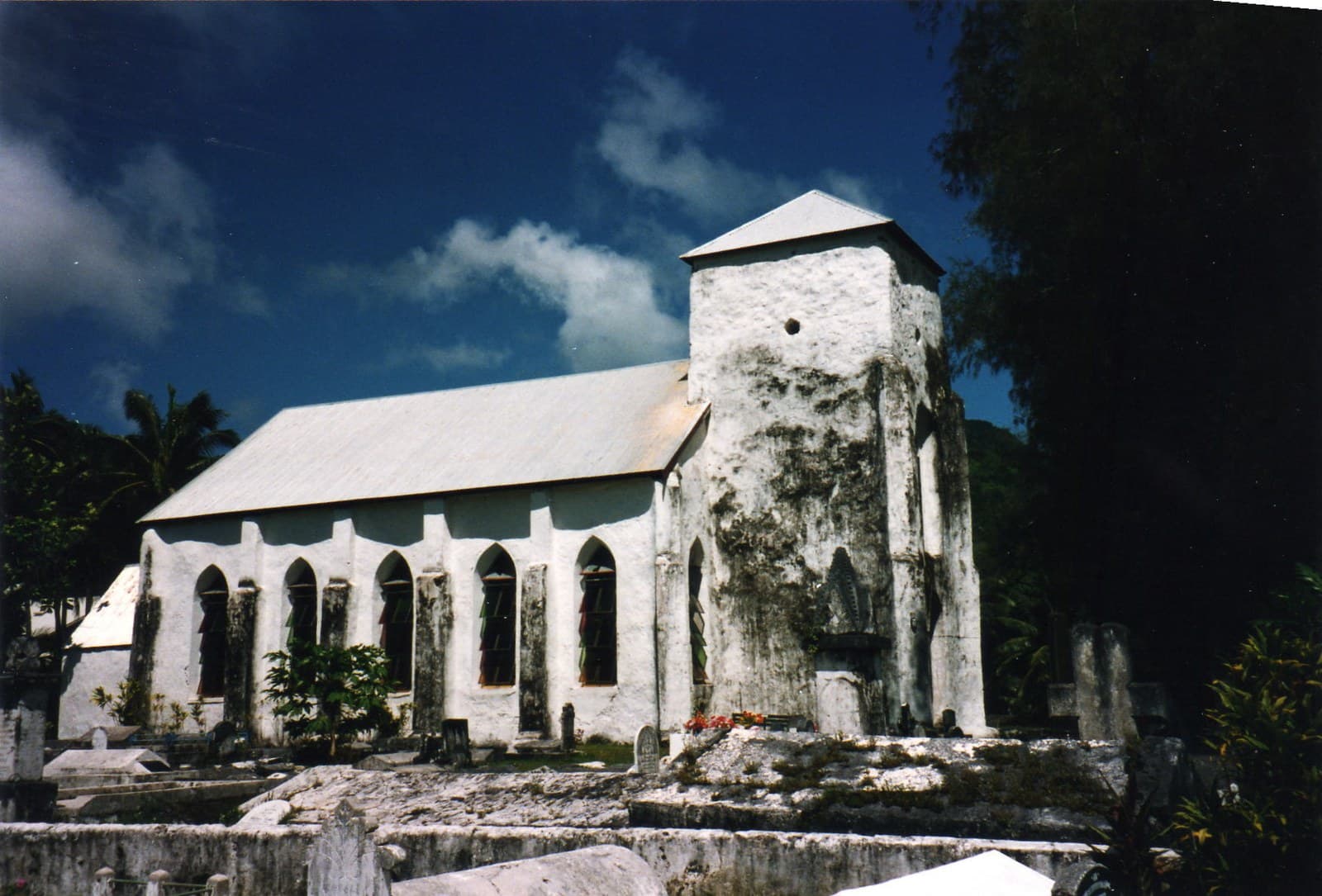
 Cook Islands churches were built of coral lime by congregations who had been Christian for a generation, and the marae they replaced were often quarried for the stone. Photograph by CCsmith, CC0, via Wikimedia Commons.
The older religion has not been reconstructed, and nobody here pretends otherwise; the gods Tangaroa, Rongo and Tāne belong to genealogy and to carving rather than to worship. What survives is a careful attitude toward places. Marae are approached with protocol, sites are not walked over casually, and the tapu attached to certain grounds and certain families is respected by people who would describe themselves as entirely Christian. Tangaroa, in a mild irony that Cook Islanders enjoy, appears on the one-dollar coin.
The dead stay at the house. Cook Islands families bury their people on family land, in a tomb in the garden a few steps from the door, and the tombs are substantial: concrete and tile, often roofed, sometimes built as a small house with a veranda where relatives sit. On Rarotonga the ring road runs past hundreds of them. The custom rests on land tenure, since Cook Islands land is held by family right and cannot be sold, only leased, so the ground a person is buried in is ground their descendants will keep.
A death brings the family together fast and expensively. The body is usually kept at home, watched through the night with hymns and stories; relatives arrive from the outer islands and from overseas; and the funeral is followed by feasting the family provides. Gifts move throughout, in the tuku'anga, the formal handing over of tivaevae, mats, cloth and money to the bereaved household, which then redistributes much of it. The best quilt in the house is used to cover the coffin and is buried with it. Months or a year later the family gathers again to unveil the finished headstone, a second occasion with its own catering and its own travel.
Two things make this distinctive. First, the strength of the pull home: Cook Islanders who have lived their whole adult lives in Auckland or Sydney are commonly flown back to be buried on family land, and community fundraising to pay for repatriation is a standard feature of diaspora church life. Second, the graves are decorated rather than merely maintained, with painted concrete, tiling, artificial flowers, photographs and lights, and a tomb built to be sat beside says plainly that the household has not finished with the person inside it.
Cook Islands genealogy is land law, and the Land Court wrote it down.
Descent determines rights to land here, and from the early twentieth century the Native Land Court, later the Land Court, required claimants to prove theirs. Families gave evidence, reciting genealogies back to founding ancestors, and the court clerks recorded it. The minute books that resulted hold generations of Cook Islands whakapapa as sworn testimony, and they are the primary written genealogical source for the country. As in New Zealand, the process that created them was designed to convert collective land into individual shares, and the record is valuable partly because the process was invasive.
Before that, and alongside it, genealogy was recited. The ariki titles and the tapere, the land divisions of each island, are held through lines that families know.
Mission registers are the vital records. The London Missionary Society arrived in 1821 and the Cook Islands Christian Church that grew from it kept baptisms, marriages and burials from early in the nineteenth century.
New Zealand administered the islands from 1901, so the twentieth-century administrative record is a New Zealand one, and Archives New Zealand holds a substantial part of it.
The population question dominates the present. Far more Cook Islanders live in New Zealand and Australia than in the islands, and Cook Islanders are New Zealand citizens, so the recent record of most families is in Auckland. The land, and the entitlement to it, stays behind.
The Cook Islands Library and Museum Society in Avarua, formed in 1963 and open the following year, is the oldest heritage institution in the country: a members' library with a Pacific collection of rare books, and a museum of carving, weaving, shell and fishing gear, ceramics and canoe material, run largely by volunteers (Cook Islands Library and Museum). The National Museum, under the Ministry of Cultural Development, holds the state collection, including tivaevae, and the Ministry also administers the national archives, the arts programme and Te Maeva Nui.
The physical heritage is mostly marae, and the work on it is slow and local. Arai-te-Tonga is maintained by the families whose titles are bound to it; other sites on Rarotonga, Atiu, Mauke and Mangaia have been cleared and recorded by community groups, sometimes with New Zealand or regional funding. Much of the finest older material culture is abroad, in the British Museum, in Auckland and in Cambridge, collected in the missionary period, and the question of what should come back is asked politely and persistently rather than loudly.
The heaviest pressure on all of it is depopulation. Islands like Mitiaro and Mauke have a few hundred residents each, the schools are small, and the people who know how to build a vaka, plant a taro pond or recite a genealogy are ageing. Marae Moana protects the ocean around them, and the tivaevae, the ura and the language have institutional support, but the underlying problem is arithmetic, and no ministry can legislate people back into a village.
For a country of 15,000 residents the Cook Islands are well served online. The Cook Islands Māori Dictionary, built on the work of Jasper Buse and Raututi Taringa, is free and searchable and has become the standard reference for teachers, students and the diaspora (Cook Islands Māori Dictionary). The Ministry of Cultural Development and New Zealand's education agencies publish language material for schools on both sides of the ocean, and Cook Islands News, the national daily, keeps an online archive that works as a running record of village life.
Collections held elsewhere have been opened up too: Auckland Museum, Te Papa and the British Museum publish Cook Islands objects with images and provenance, which allows a family in Rarotonga to see a staff-god or a Mangaian adze without leaving the island. Diaspora communities do their own archiving, streaming Te Maeva Nui performances, church anniversaries and funerals so that the people who could not travel can still be present.
Cook Islands culture is now produced in two places at once. Auckland has its own Te Maeva Nui celebrations, its own dance troupes and drumming schools, and a generation of artists including Ani O'Neill, who works with crochet and tivaevae forms, and Mahiriki Tangaroa, who paints from the island's plants and histories. Cook Islanders are prominent in New Zealand rugby league and rugby, in music and in television, and the two-way traffic keeps the language and the dance in front of young people who may never live in the islands.
The politics of association keeps returning to the question of identity. In 2024 the government proposed a separate Cook Islands passport as recognition of nationhood; New Zealand replied that a distinct passport, citizenship and UN membership belong to fully independent states, and the proposal was dropped in early 2025 (Wikipedia). Deep-sea mining licensing in the manganese-nodule fields of the exclusive economic zone raises a related argument, between the revenue that might keep people at home and the ocean that Marae Moana was declared to protect. Both debates come back to the same thing: how a country of 15,000 people keeps being a country.
A language with a legal home. Te Reo Māori Kūki 'Āirani has been official since 2003, taught in schools on both sides of the Tasman, and its dictionary is free online, including for the Pukapukan community whose speech is counted in.
Tivaevae taken seriously. A domestic craft made by women and given away at funerals is now collected by national galleries, exhibited internationally and taught to a younger generation in both the islands and New Zealand.
Te Maeva Nui. The festival of self-government has become the country's main mechanism for transmitting dance, drumming and island-specific song, and it is now staged in Auckland as well as Avarua.
An ocean declared whole. Marae Moana placed the entire exclusive economic zone, close to two million square kilometres, under a single management framework in 2017.
Cook Islands churches were built of coral lime by congregations who had been Christian for a generation, and the marae they replaced were often quarried for the stone. Photograph by CCsmith, CC0, via Wikimedia Commons.
The older religion has not been reconstructed, and nobody here pretends otherwise; the gods Tangaroa, Rongo and Tāne belong to genealogy and to carving rather than to worship. What survives is a careful attitude toward places. Marae are approached with protocol, sites are not walked over casually, and the tapu attached to certain grounds and certain families is respected by people who would describe themselves as entirely Christian. Tangaroa, in a mild irony that Cook Islanders enjoy, appears on the one-dollar coin.
The dead stay at the house. Cook Islands families bury their people on family land, in a tomb in the garden a few steps from the door, and the tombs are substantial: concrete and tile, often roofed, sometimes built as a small house with a veranda where relatives sit. On Rarotonga the ring road runs past hundreds of them. The custom rests on land tenure, since Cook Islands land is held by family right and cannot be sold, only leased, so the ground a person is buried in is ground their descendants will keep.
A death brings the family together fast and expensively. The body is usually kept at home, watched through the night with hymns and stories; relatives arrive from the outer islands and from overseas; and the funeral is followed by feasting the family provides. Gifts move throughout, in the tuku'anga, the formal handing over of tivaevae, mats, cloth and money to the bereaved household, which then redistributes much of it. The best quilt in the house is used to cover the coffin and is buried with it. Months or a year later the family gathers again to unveil the finished headstone, a second occasion with its own catering and its own travel.
Two things make this distinctive. First, the strength of the pull home: Cook Islanders who have lived their whole adult lives in Auckland or Sydney are commonly flown back to be buried on family land, and community fundraising to pay for repatriation is a standard feature of diaspora church life. Second, the graves are decorated rather than merely maintained, with painted concrete, tiling, artificial flowers, photographs and lights, and a tomb built to be sat beside says plainly that the household has not finished with the person inside it.
Cook Islands genealogy is land law, and the Land Court wrote it down.
Descent determines rights to land here, and from the early twentieth century the Native Land Court, later the Land Court, required claimants to prove theirs. Families gave evidence, reciting genealogies back to founding ancestors, and the court clerks recorded it. The minute books that resulted hold generations of Cook Islands whakapapa as sworn testimony, and they are the primary written genealogical source for the country. As in New Zealand, the process that created them was designed to convert collective land into individual shares, and the record is valuable partly because the process was invasive.
Before that, and alongside it, genealogy was recited. The ariki titles and the tapere, the land divisions of each island, are held through lines that families know.
Mission registers are the vital records. The London Missionary Society arrived in 1821 and the Cook Islands Christian Church that grew from it kept baptisms, marriages and burials from early in the nineteenth century.
New Zealand administered the islands from 1901, so the twentieth-century administrative record is a New Zealand one, and Archives New Zealand holds a substantial part of it.
The population question dominates the present. Far more Cook Islanders live in New Zealand and Australia than in the islands, and Cook Islanders are New Zealand citizens, so the recent record of most families is in Auckland. The land, and the entitlement to it, stays behind.
The Cook Islands Library and Museum Society in Avarua, formed in 1963 and open the following year, is the oldest heritage institution in the country: a members' library with a Pacific collection of rare books, and a museum of carving, weaving, shell and fishing gear, ceramics and canoe material, run largely by volunteers (Cook Islands Library and Museum). The National Museum, under the Ministry of Cultural Development, holds the state collection, including tivaevae, and the Ministry also administers the national archives, the arts programme and Te Maeva Nui.
The physical heritage is mostly marae, and the work on it is slow and local. Arai-te-Tonga is maintained by the families whose titles are bound to it; other sites on Rarotonga, Atiu, Mauke and Mangaia have been cleared and recorded by community groups, sometimes with New Zealand or regional funding. Much of the finest older material culture is abroad, in the British Museum, in Auckland and in Cambridge, collected in the missionary period, and the question of what should come back is asked politely and persistently rather than loudly.
The heaviest pressure on all of it is depopulation. Islands like Mitiaro and Mauke have a few hundred residents each, the schools are small, and the people who know how to build a vaka, plant a taro pond or recite a genealogy are ageing. Marae Moana protects the ocean around them, and the tivaevae, the ura and the language have institutional support, but the underlying problem is arithmetic, and no ministry can legislate people back into a village.
For a country of 15,000 residents the Cook Islands are well served online. The Cook Islands Māori Dictionary, built on the work of Jasper Buse and Raututi Taringa, is free and searchable and has become the standard reference for teachers, students and the diaspora (Cook Islands Māori Dictionary). The Ministry of Cultural Development and New Zealand's education agencies publish language material for schools on both sides of the ocean, and Cook Islands News, the national daily, keeps an online archive that works as a running record of village life.
Collections held elsewhere have been opened up too: Auckland Museum, Te Papa and the British Museum publish Cook Islands objects with images and provenance, which allows a family in Rarotonga to see a staff-god or a Mangaian adze without leaving the island. Diaspora communities do their own archiving, streaming Te Maeva Nui performances, church anniversaries and funerals so that the people who could not travel can still be present.
Cook Islands culture is now produced in two places at once. Auckland has its own Te Maeva Nui celebrations, its own dance troupes and drumming schools, and a generation of artists including Ani O'Neill, who works with crochet and tivaevae forms, and Mahiriki Tangaroa, who paints from the island's plants and histories. Cook Islanders are prominent in New Zealand rugby league and rugby, in music and in television, and the two-way traffic keeps the language and the dance in front of young people who may never live in the islands.
The politics of association keeps returning to the question of identity. In 2024 the government proposed a separate Cook Islands passport as recognition of nationhood; New Zealand replied that a distinct passport, citizenship and UN membership belong to fully independent states, and the proposal was dropped in early 2025 (Wikipedia). Deep-sea mining licensing in the manganese-nodule fields of the exclusive economic zone raises a related argument, between the revenue that might keep people at home and the ocean that Marae Moana was declared to protect. Both debates come back to the same thing: how a country of 15,000 people keeps being a country.
A language with a legal home. Te Reo Māori Kūki 'Āirani has been official since 2003, taught in schools on both sides of the Tasman, and its dictionary is free online, including for the Pukapukan community whose speech is counted in.
Tivaevae taken seriously. A domestic craft made by women and given away at funerals is now collected by national galleries, exhibited internationally and taught to a younger generation in both the islands and New Zealand.
Te Maeva Nui. The festival of self-government has become the country's main mechanism for transmitting dance, drumming and island-specific song, and it is now staged in Auckland as well as Avarua.
An ocean declared whole. Marae Moana placed the entire exclusive economic zone, close to two million square kilometres, under a single management framework in 2017.
National Overview
Notable Cities
Historical Foundations
Linguistic and Etymological Roots
Cultural Identity
Religion and Spirituality
Remembrance and Mourning Traditions
Tracing a Family in Cook Islands
Heritage Preservation Efforts
Digital Heritage
Contemporary Cultural Influences
Success Stories
References and resources
- Encyclopaedia Britannica, Cook Islands: geography, the two island groups, history and government.
- Cook Islands, Wikipedia: population, free association and the constitutional arrangement of 1965.
- Te Ara, Cook Islanders in New Zealand: migration, the diaspora and the voyaging connection to Aotearoa.
- Papeiha, Wikipedia: the Raiatean teacher who carried Christianity to Aitutaki and Rarotonga.
- Cook Islands Tourism, Arai-te-Tonga: the koutu marae and its investiture role.
- Cook Islands Māori, Wikipedia: dialects, official status and speaker numbers.
- Pukapukan language, Wikipedia: the distinct Samoic speech of the northwestern atoll.
- Cook Islands Māori Dictionary: the free searchable dictionary built on Buse and Taringa.
- Tivaevae, Wikipedia: forms, the vainetini who make them and their ceremonial use.
- Culture of the Cook Islands, Wikipedia: dance, drumming and the Te Maeva Nui competitions.
- Cook Islands Christian Church, Wikipedia: the LMS inheritance and the largest denomination.
- Cook Islands Library and Museum: the 1963 society, its Pacific library and collections.
- Marae Moana, Wikipedia: the marine park declared over the whole exclusive economic zone.