Heritage · Country
Bahrain Culture and Heritage
Bahrain rose from Dilmun, the island paradise of Sumerian myth where the ancients believed a person might escape death and where the Gulf's finest pearls were fished. This guide follows four thousand years of that memory, from the burial mounds of A'ali to the pearling houses of Muharraq and the Islamic customs that still gather families in mourning.Written to last.
By Confinity Heritage Editorial · Updated 2026-07-31 · 8-minute readQuiet tools, kept out of the way.
Long before it was a country, Bahrain was a promise. In the clay tablets of Sumer the island appears as Dilmun, a pure and radiant land where predators do not kill, where sickness and old age do not come, and where a chosen survivor of the Flood was granted the immortality that eludes everyone else. The Epic of Gilgamesh sends its hero across the waters of death to find that man in Dilmun, and Sumerian hymns place the sunrise there. That an ancient people looked at this low limestone island, ringed by shallow seas and fed by sweet springs rising through salt water, and saw the nearest thing to paradise tells us something about how memory attaches itself to a place.
The Bahrain that grew on that foundation kept the habit of remembering. Its northern plain holds one of the largest ancient cemeteries on earth; its coast built an entire economy, and a whole musical tradition, around men who dived for pearls and often did not come back; and its mosques, both Sunni and Shia, mark a calendar of mourning that reaches from the seventh century into the present day. This profile traces that inheritance, from the Dilmun harbour beneath the Portuguese fort to the digital archives now preserving it.
Bahrain is an archipelago in the Persian Gulf, a cluster of some thirty-three natural islands and a growing number of reclaimed ones, lying off the eastern coast of Saudi Arabia to which it has been joined since 1986 by the 25-kilometre King Fahd Causeway (Britannica). The largest island, also called Bahrain, carries the capital, Manama, and most of the population of roughly 1.6 million (Wikipedia). It is one of the smallest states in the Arab world and one of the flattest, its interior a desert broken by date gardens and by the modest rise of Jebel Dukhan, the "mountain of smoke". Not far from that hill grows the Tree of Life, a solitary mesquite roughly four centuries old and nearly ten metres tall, thriving in near-total absence of rain for reasons long debated, and drawing on the old association of the island with a lost garden (Wikipedia).
The island's fortune was set by geography. Fresh-water springs welling up beneath the sea made it habitable and, in ancient eyes, miraculous, while its position at the centre of the Gulf made it a natural warehouse for trade between Mesopotamia, Arabia and the lands beyond. Arabic is the official language, and the population is overwhelmingly Muslim, divided between Shia and Sunni communities, alongside long-settled minorities and a large expatriate workforce. Bahrain was the first place in the Gulf to strike oil, in 1932, and its comparatively modest reserves pushed it early towards banking, refining and trade, so that its identity has never rested on petroleum alone.
Manama. The capital, whose name is often read as "the place of rest" or "of dreams", first appears in Islamic-era records and grew into the island's chief port and market. Its old quarter keeps the Bab al-Bahrain gateway and the covered lanes of the souq, while the Bahrain National Museum on the corniche presents the Dilmun past to visitors. Manama became the seat of government in the nineteenth century and remains the commercial heart of the country.
Muharraq. Bahrain's former capital, holding that role until 1932, sits on its own island across the water from Manama and was the centre of the pearling trade at its height (Wikipedia). Its close-knit lanes preserve the coral-stone houses of pearl merchants and captains, among them the Shaikh Isa bin Ali House, and the town anchors the UNESCO-listed Pearling Path. UNESCO has since named Muharraq a Creative City of Design.
Riffa. Set on the higher ground of the island's centre, Riffa was long a seat of the ruling family and of government until 1869 (Wikipedia). Above the valley rises the Shaikh Salman bin Ahmed Al Fateh Fort, rebuilt in 1812 on older foundations, where the ruler Isa bin Ali Al Khalifa was born. Restored by the Ministry of Culture, the fort now narrates the family's history to the public.
Bahrain's recorded story begins with the Dilmun civilisation, which flourished from the late fourth millennium BCE and reached its height in the early second, controlling the sea lanes between Sumerian Mesopotamia and the Indus Valley (Wikipedia). Dilmun traded copper from Oman, timber, and above all pearls, and its merchants used standardised weights matched to those of distant Indus cities. The faith of that world survives at the Barbar Temple, a sequence of three shrines built one atop another from around 3000 BCE and dedicated to Enki, the god of wisdom and fresh water, and his consort Ninhursag (Wikipedia). The dead of Dilmun were laid beneath tens of thousands of earthen mounds that still ridge the northern plain.
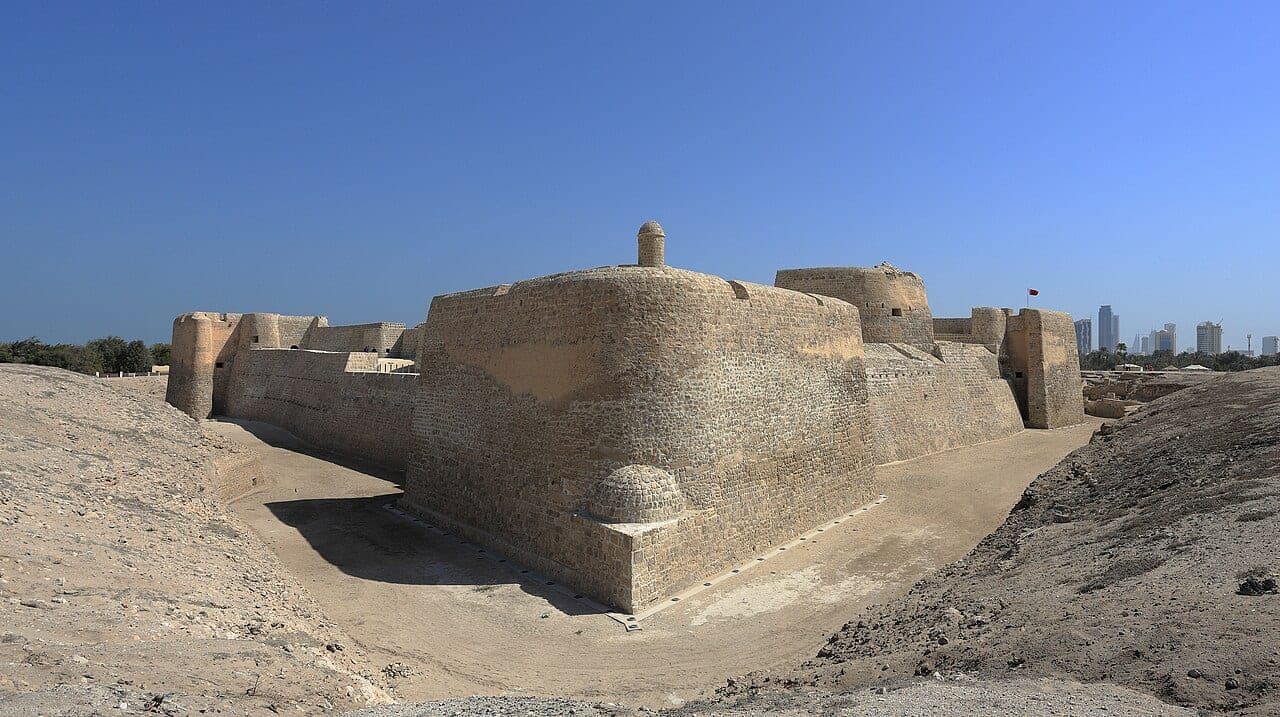
 Qalat al-Bahrain is a mound built from four thousand years of settlement, with the Portuguese fort on top being only the most recent layer. Photograph by Martin Falbisoner, CC BY-SA 4.0, via Wikimedia Commons.
The island's principal settlement lay at what is now Qal'at al-Bahrain, an artificial mound twelve metres high built up from about 2300 BCE by successive cities, and serving as Dilmun's capital and harbour (UNESCO). Its layers record Kassite administration and cuneiform tablets, then the Hellenistic age, when Greek writers knew the island as Tylos and the admiral Nearchus, sailing for Alexander the Great, reported its pearls; Tylos later passed into the Parthian sphere of Gulf trade (Britannica). Bahrain embraced Islam within the Prophet Muhammad's own lifetime, around 628 CE, through his envoy Al-Ala'a Al-Hadhrami, making it one of the earliest regions to convert.
Portuguese forces seized the island in 1521 and held it until 1602, crowning the ancient mound with the fort that gives Qal'at al-Bahrain its modern name. Safavid Persia governed for much of the following century, a period in which Bahrain became a noted centre of Shia scholarship. In 1783 the Bani Utbah under Ahmed bin Muhammad Al Khalifa, remembered as Al Fateh, "the Conqueror", took the island and founded the dynasty that rules today (Wikipedia). A series of treaties with Britain, from 1820 through 1861, 1868 and 1892, drew Bahrain into a protective relationship that lasted until independence. The economy turned on pearling until oil was discovered in 1932, the first such find on the Arab side of the Gulf, and full independence from Britain came in 1971.
Arabic is the language of Bahrain, spoken in a distinctive Gulf dialect and written, in its formal register, as the language of the Qur'an, administration and letters. The name of the country is itself a small geography lesson: al-Bahrayn is the dual form of the Arabic word bahr, "sea", and so means "the two seas" (Wikipedia). Scholars have offered several readings of which two seas are meant, the waters east and west of the island, or the sea above and the sweet springs below, that ancient union of salt and fresh water which made the place habitable and which lay at the heart of the Dilmun idea of it.
The name once ranged more widely. In medieval Arabic geography "Bahrayn" described the whole eastern coast of Arabia, from Basra to the Omani border, and only later contracted to the islands alone, a reminder that Bahrain was long the name of a region as much as a place.
For most of its history Bahrain lived by the sea, and its culture carries the shape of that life. Pearling ran on the dhow, the wooden sailing vessel that carried crews to the offshore oyster beds each summer for months at a time, and its rhythms produced fidjeri, a form of a cappella song performed by the divers and sailors themselves (Wikipedia). A lead singer, the nahham, is answered by a chorus of clapping voices over the beat of the mirwas drum and the jahlah, a clay water-pot struck with the hands; the songs speak of the sea, of longing and of the danger of the dive, and in 2021 UNESCO inscribed fidjeri on its list of intangible cultural heritage.
The crafts of that world are being revived alongside the music, among them Kurar, a gold-thread embroidery once worked by women in the pearling households. The table, too, remembers the sea and the caravan. The national dish, machboos, layers basmati rice with fish or meat and a warming mixture of spices sharpened by loomi, the dried black lime of the Gulf (Remitly). Muhammar, sweet rice cooked with date syrup and served against grilled fish, traces its origin to the pearl divers, who sweetened their rice with dibs pressed from the island's dates; harees, a slow-cooked porridge of wheat and meat, appears at Ramadan and on days of gathering.
Islam has shaped Bahrain since the seventh century, and the island is home to both Sunni and Shia communities, whose long coexistence is written into its landscape of mosques and shrines. Among the oldest is the Al-Khamis Mosque near Manama, whose foundation is traditionally dated to the Umayyad period and whose twin minarets, raised under the later Uyunid and Usfurid rulers, made it a landmark for centuries (Wikipedia). It is counted among the earliest mosques in the region, and archaeologists have recovered from it an inscribed limestone mihrab.
Older layers of belief survive nearby. The Barbar Temple preserves the worship of Enki and the sanctity of fresh water that defined Dilmun, and the springs and wells around the island long carried a sacred character. Modern Bahrain has kept a reputation for accommodating other faiths as well: Manama holds one of the oldest churches on the Arabian side of the Gulf and a small historic synagogue, remnants of communities of traders who settled around the port. The result is a religious geography in which the mosque, the church and the ancient temple mound sit within a short drive of one another.
Islamic funerary custom governs how Bahrainis mourn, and its emphasis falls on swiftness, simplicity and community. The body is washed, wrapped in a plain white shroud and buried, usually within a day, in a grave aligned so that the deceased faces Mecca; the funeral prayer, salat al-janazah, is offered by the gathered community, and elaborate display is discouraged. Mourning is measured in custom rather than ostentation, with a defined period during which the family receives condolences and, for a widow, a longer term of withdrawal prescribed by religious law. Both the Sunni and Shia communities of the island share these fundamentals while observing them in their own ways.
The tenth day of the month of Muharram, Ashura, carries particular weight. For Shia Muslims it commemorates the martyrdom of Husayn ibn Ali, grandson of the Prophet, killed with his companions at Karbala in 680 CE (Wikipedia). In Bahrain the occasion brings majalis, gatherings in the ma'tam or community house where the events of Karbala are narrated and elegies recited, and processions of mourners through the older quarters, black banners raised in the streets. For many Sunni Muslims the same day is marked instead by voluntary fasting, a practice linked in tradition to the deliverance of Moses. Observed differently by each community, Ashura is one of the most visible expressions of remembrance in the Bahraini year.
Remembrance also reaches back into deep antiquity through the burial mounds themselves. The tens of thousands of tumuli that Dilmun raised over its dead, each a stone chamber ringed by a wall and heaped with earth, amount to one of the largest funerary landscapes surviving from the ancient world, and their careful, individual form suggests a society that took the marking of the dead seriously (UNESCO). To stand among them is to see remembrance practised on the island for more than four thousand years.
Bahrain's family record runs on pearls, courts and one nationality question.
Before oil the archipelago lived on pearling, and the trade generated paperwork: the tawwash merchants advanced money to nakhoda captains, who advanced it to divers, and the debts were recorded and inherited. Diving debt passed from father to son, so the pearling ledgers are a genealogical series of a particularly grim kind, and the Pearling Path, the UNESCO-listed route through Muharraq, follows the houses of the families who ran it.
Sharia court registers hold marriage, divorce and inheritance and are the principal older record, Sunni and Jaafari courts keeping their own. Because Islamic inheritance requires naming heirs precisely, an estate file is a family tree.
Bahrain's first modern census was taken in the 1940s, and civil registration developed from the mid-century under the personal number system that governs everything now.
The politically live question is who counts as Bahraini. The distinction between Baharna, the Shia population who consider themselves the indigenous inhabitants, Sunni Arab families of tribal origin, and the Ajam of Persian descent, is old and consequential, and naturalisation policy since the 2000s has been contested precisely because it changes the balance. Since 2011 a number of Bahrainis have had their citizenship revoked, some later restored. As in Kuwait, proving a family's residence a century ago is not an antiquarian exercise.
Dilmun's burial mounds, tens of thousands of them, are the oldest record of all.
Bahrain holds three UNESCO World Heritage sites, and each preserves a different chapter of the island's memory. Qal'at al-Bahrain, inscribed in 2005, protects the great tell and the Portuguese fort together with the buried Dilmun capital beneath, of which only about a quarter has been excavated; a purpose-built site museum on the shore displays the finds (UNESCO). The Dilmun Burial Mounds, inscribed in 2019, safeguard twenty-one archaeological components, including fields of many thousands of tumuli and a group of monumental royal tombs at A'ali, after decades in which farming and building had eroded the wider necropolis (UNESCO).
The third site, "Pearling, Testimony of an Island Economy", inscribed in 2012, threads through Muharraq as a 3.5-kilometre path linking seventeen historic buildings, three offshore oyster beds and the Bu Maher fortress from which divers once set out (UNESCO). UNESCO describes it as the last complete surviving example of the pearling tradition, which sustained the Gulf from antiquity until Japanese cultured pearls collapsed the market in the early 1930s, when as many as thirty thousand men still dived from Bahrain. The Bahrain Authority for Culture and Antiquities oversees these sites, and the Pearling Path's restoration won the Aga Khan Award for Architecture in 2019.
The work of preservation increasingly runs through screens as well as stone. The Bahrain Authority for Culture and Antiquities maintains the national inventory of monuments and archaeological finds, and the Qal'at al-Bahrain Site Museum and the Pearling Path visitor centre both use reconstructions, film and interactive displays to make sense of sites that are, on the ground, largely foundations and mounds. Photogrammetry and 3D survey now document the fragile burial mounds and the coral-stone houses of Muharraq, creating a measured record that survives independently of the originals.
The island's ancient story has also travelled through touring exhibitions and online collections drawn from the National Museum, so that the seals, weights and pottery of Dilmun can be studied far from Manama. For a heritage spread across thousands of low mounds and weathered walls, this digital layer helps hold the whole picture together as the physical sites are conserved.
Modern Bahrain has built cultural institutions on top of its old ones. The Shaikh Ebrahim bin Mohammed Al Khalifa Center for Culture and Research has restored a series of historic houses in Muharraq and turned them into small museums and venues, seeding the regeneration that the Pearling Path continued. The annual Spring of Culture festival fills the season with concerts, exhibitions and performances, and the National Theatre of Bahrain, opened in 2012 on the Manama waterfront, gives the country one of the larger auditoriums in the Arab world.
The island's contemporary profile also reaches beyond its heritage. Bahrain has hosted a Formula One Grand Prix since 2004, drawing an international audience to its desert circuit, and its long trading tradition continues in a financial-services sector that grew up as the oil economy diversified. Across these pursuits the older identity persists, in the dhow motifs of public design and the pearl at the centre of the national story.
The pearl trail restored. The regeneration of Muharraq's Pearling Path, which reused and repaired the houses of merchants and captains rather than clearing them, won the 2019 Aga Khan Award for Architecture and revived near-vanished crafts such as Kurar embroidery, showing how a working town can carry its own past forward.
The mounds saved from the plough. The 2019 World Heritage inscription of the Dilmun Burial Mounds gave lasting protection to a necropolis that development had steadily consumed, preserving both the ordinary tumuli and the royal tombs of A'ali as a record of ancient remembrance.
Fidjeri kept singing. The songs of the pearl divers, once at risk of fading with the industry that produced them, were inscribed by UNESCO in 2021 and are now taught and performed anew, so that the voices of the crews still sound over the mirwas and the clay pot.
Qalat al-Bahrain is a mound built from four thousand years of settlement, with the Portuguese fort on top being only the most recent layer. Photograph by Martin Falbisoner, CC BY-SA 4.0, via Wikimedia Commons.
The island's principal settlement lay at what is now Qal'at al-Bahrain, an artificial mound twelve metres high built up from about 2300 BCE by successive cities, and serving as Dilmun's capital and harbour (UNESCO). Its layers record Kassite administration and cuneiform tablets, then the Hellenistic age, when Greek writers knew the island as Tylos and the admiral Nearchus, sailing for Alexander the Great, reported its pearls; Tylos later passed into the Parthian sphere of Gulf trade (Britannica). Bahrain embraced Islam within the Prophet Muhammad's own lifetime, around 628 CE, through his envoy Al-Ala'a Al-Hadhrami, making it one of the earliest regions to convert.
Portuguese forces seized the island in 1521 and held it until 1602, crowning the ancient mound with the fort that gives Qal'at al-Bahrain its modern name. Safavid Persia governed for much of the following century, a period in which Bahrain became a noted centre of Shia scholarship. In 1783 the Bani Utbah under Ahmed bin Muhammad Al Khalifa, remembered as Al Fateh, "the Conqueror", took the island and founded the dynasty that rules today (Wikipedia). A series of treaties with Britain, from 1820 through 1861, 1868 and 1892, drew Bahrain into a protective relationship that lasted until independence. The economy turned on pearling until oil was discovered in 1932, the first such find on the Arab side of the Gulf, and full independence from Britain came in 1971.
Arabic is the language of Bahrain, spoken in a distinctive Gulf dialect and written, in its formal register, as the language of the Qur'an, administration and letters. The name of the country is itself a small geography lesson: al-Bahrayn is the dual form of the Arabic word bahr, "sea", and so means "the two seas" (Wikipedia). Scholars have offered several readings of which two seas are meant, the waters east and west of the island, or the sea above and the sweet springs below, that ancient union of salt and fresh water which made the place habitable and which lay at the heart of the Dilmun idea of it.
The name once ranged more widely. In medieval Arabic geography "Bahrayn" described the whole eastern coast of Arabia, from Basra to the Omani border, and only later contracted to the islands alone, a reminder that Bahrain was long the name of a region as much as a place.
For most of its history Bahrain lived by the sea, and its culture carries the shape of that life. Pearling ran on the dhow, the wooden sailing vessel that carried crews to the offshore oyster beds each summer for months at a time, and its rhythms produced fidjeri, a form of a cappella song performed by the divers and sailors themselves (Wikipedia). A lead singer, the nahham, is answered by a chorus of clapping voices over the beat of the mirwas drum and the jahlah, a clay water-pot struck with the hands; the songs speak of the sea, of longing and of the danger of the dive, and in 2021 UNESCO inscribed fidjeri on its list of intangible cultural heritage.
The crafts of that world are being revived alongside the music, among them Kurar, a gold-thread embroidery once worked by women in the pearling households. The table, too, remembers the sea and the caravan. The national dish, machboos, layers basmati rice with fish or meat and a warming mixture of spices sharpened by loomi, the dried black lime of the Gulf (Remitly). Muhammar, sweet rice cooked with date syrup and served against grilled fish, traces its origin to the pearl divers, who sweetened their rice with dibs pressed from the island's dates; harees, a slow-cooked porridge of wheat and meat, appears at Ramadan and on days of gathering.
Islam has shaped Bahrain since the seventh century, and the island is home to both Sunni and Shia communities, whose long coexistence is written into its landscape of mosques and shrines. Among the oldest is the Al-Khamis Mosque near Manama, whose foundation is traditionally dated to the Umayyad period and whose twin minarets, raised under the later Uyunid and Usfurid rulers, made it a landmark for centuries (Wikipedia). It is counted among the earliest mosques in the region, and archaeologists have recovered from it an inscribed limestone mihrab.
Older layers of belief survive nearby. The Barbar Temple preserves the worship of Enki and the sanctity of fresh water that defined Dilmun, and the springs and wells around the island long carried a sacred character. Modern Bahrain has kept a reputation for accommodating other faiths as well: Manama holds one of the oldest churches on the Arabian side of the Gulf and a small historic synagogue, remnants of communities of traders who settled around the port. The result is a religious geography in which the mosque, the church and the ancient temple mound sit within a short drive of one another.
Islamic funerary custom governs how Bahrainis mourn, and its emphasis falls on swiftness, simplicity and community. The body is washed, wrapped in a plain white shroud and buried, usually within a day, in a grave aligned so that the deceased faces Mecca; the funeral prayer, salat al-janazah, is offered by the gathered community, and elaborate display is discouraged. Mourning is measured in custom rather than ostentation, with a defined period during which the family receives condolences and, for a widow, a longer term of withdrawal prescribed by religious law. Both the Sunni and Shia communities of the island share these fundamentals while observing them in their own ways.
The tenth day of the month of Muharram, Ashura, carries particular weight. For Shia Muslims it commemorates the martyrdom of Husayn ibn Ali, grandson of the Prophet, killed with his companions at Karbala in 680 CE (Wikipedia). In Bahrain the occasion brings majalis, gatherings in the ma'tam or community house where the events of Karbala are narrated and elegies recited, and processions of mourners through the older quarters, black banners raised in the streets. For many Sunni Muslims the same day is marked instead by voluntary fasting, a practice linked in tradition to the deliverance of Moses. Observed differently by each community, Ashura is one of the most visible expressions of remembrance in the Bahraini year.
Remembrance also reaches back into deep antiquity through the burial mounds themselves. The tens of thousands of tumuli that Dilmun raised over its dead, each a stone chamber ringed by a wall and heaped with earth, amount to one of the largest funerary landscapes surviving from the ancient world, and their careful, individual form suggests a society that took the marking of the dead seriously (UNESCO). To stand among them is to see remembrance practised on the island for more than four thousand years.
Bahrain's family record runs on pearls, courts and one nationality question.
Before oil the archipelago lived on pearling, and the trade generated paperwork: the tawwash merchants advanced money to nakhoda captains, who advanced it to divers, and the debts were recorded and inherited. Diving debt passed from father to son, so the pearling ledgers are a genealogical series of a particularly grim kind, and the Pearling Path, the UNESCO-listed route through Muharraq, follows the houses of the families who ran it.
Sharia court registers hold marriage, divorce and inheritance and are the principal older record, Sunni and Jaafari courts keeping their own. Because Islamic inheritance requires naming heirs precisely, an estate file is a family tree.
Bahrain's first modern census was taken in the 1940s, and civil registration developed from the mid-century under the personal number system that governs everything now.
The politically live question is who counts as Bahraini. The distinction between Baharna, the Shia population who consider themselves the indigenous inhabitants, Sunni Arab families of tribal origin, and the Ajam of Persian descent, is old and consequential, and naturalisation policy since the 2000s has been contested precisely because it changes the balance. Since 2011 a number of Bahrainis have had their citizenship revoked, some later restored. As in Kuwait, proving a family's residence a century ago is not an antiquarian exercise.
Dilmun's burial mounds, tens of thousands of them, are the oldest record of all.
Bahrain holds three UNESCO World Heritage sites, and each preserves a different chapter of the island's memory. Qal'at al-Bahrain, inscribed in 2005, protects the great tell and the Portuguese fort together with the buried Dilmun capital beneath, of which only about a quarter has been excavated; a purpose-built site museum on the shore displays the finds (UNESCO). The Dilmun Burial Mounds, inscribed in 2019, safeguard twenty-one archaeological components, including fields of many thousands of tumuli and a group of monumental royal tombs at A'ali, after decades in which farming and building had eroded the wider necropolis (UNESCO).
The third site, "Pearling, Testimony of an Island Economy", inscribed in 2012, threads through Muharraq as a 3.5-kilometre path linking seventeen historic buildings, three offshore oyster beds and the Bu Maher fortress from which divers once set out (UNESCO). UNESCO describes it as the last complete surviving example of the pearling tradition, which sustained the Gulf from antiquity until Japanese cultured pearls collapsed the market in the early 1930s, when as many as thirty thousand men still dived from Bahrain. The Bahrain Authority for Culture and Antiquities oversees these sites, and the Pearling Path's restoration won the Aga Khan Award for Architecture in 2019.
The work of preservation increasingly runs through screens as well as stone. The Bahrain Authority for Culture and Antiquities maintains the national inventory of monuments and archaeological finds, and the Qal'at al-Bahrain Site Museum and the Pearling Path visitor centre both use reconstructions, film and interactive displays to make sense of sites that are, on the ground, largely foundations and mounds. Photogrammetry and 3D survey now document the fragile burial mounds and the coral-stone houses of Muharraq, creating a measured record that survives independently of the originals.
The island's ancient story has also travelled through touring exhibitions and online collections drawn from the National Museum, so that the seals, weights and pottery of Dilmun can be studied far from Manama. For a heritage spread across thousands of low mounds and weathered walls, this digital layer helps hold the whole picture together as the physical sites are conserved.
Modern Bahrain has built cultural institutions on top of its old ones. The Shaikh Ebrahim bin Mohammed Al Khalifa Center for Culture and Research has restored a series of historic houses in Muharraq and turned them into small museums and venues, seeding the regeneration that the Pearling Path continued. The annual Spring of Culture festival fills the season with concerts, exhibitions and performances, and the National Theatre of Bahrain, opened in 2012 on the Manama waterfront, gives the country one of the larger auditoriums in the Arab world.
The island's contemporary profile also reaches beyond its heritage. Bahrain has hosted a Formula One Grand Prix since 2004, drawing an international audience to its desert circuit, and its long trading tradition continues in a financial-services sector that grew up as the oil economy diversified. Across these pursuits the older identity persists, in the dhow motifs of public design and the pearl at the centre of the national story.
The pearl trail restored. The regeneration of Muharraq's Pearling Path, which reused and repaired the houses of merchants and captains rather than clearing them, won the 2019 Aga Khan Award for Architecture and revived near-vanished crafts such as Kurar embroidery, showing how a working town can carry its own past forward.
The mounds saved from the plough. The 2019 World Heritage inscription of the Dilmun Burial Mounds gave lasting protection to a necropolis that development had steadily consumed, preserving both the ordinary tumuli and the royal tombs of A'ali as a record of ancient remembrance.
Fidjeri kept singing. The songs of the pearl divers, once at risk of fading with the industry that produced them, were inscribed by UNESCO in 2021 and are now taught and performed anew, so that the voices of the crews still sound over the mirwas and the clay pot.
National Overview
Notable Cities
Historical Foundations
Linguistic and Etymological Roots
Cultural Identity
Religion and Spirituality
Remembrance and Mourning Traditions
Tracing a Family in Bahrain
Heritage Preservation Efforts
Digital Heritage
Contemporary Cultural Influences
Success Stories
References and resources
- UNESCO World Heritage Centre: Qal'at al-Bahrain, Ancient Harbour and Capital of Dilmun. The 2005 inscription and the site's Dilmun and Portuguese layers.
- UNESCO World Heritage Centre: Dilmun Burial Mounds. The 2019 inscription and the necropolis at A'ali.
- UNESCO World Heritage Centre: Pearling, Testimony of an Island Economy. The Muharraq pearling trail and its history.
- UNESCO Intangible Cultural Heritage: Fjiri. The 2021 inscription of the pearl divers' song.
- Encyclopaedia Britannica: Bahrain. Geography, history and political background.
- Wikipedia: Dilmun. The ancient civilisation, its trade and its myth.
- Wikipedia: History of Bahrain. Tylos, the Islamic period, Portuguese rule and the Al Khalifa dynasty.
- Wikipedia: Al-Khamis Mosque. One of the oldest mosques in the region.
- Wikipedia: Tree of Life (Bahrain). The solitary mesquite of the southern desert.
- Wikipedia: Ashura. Sunni and Shia observance of the tenth of Muharram.