Heritage · Country
Qatar Culture and Heritage
Qatar is a low desert peninsula where pearl divers and Bedouin herders built a way of life long before oil, and where a single generation turned a fishing town into a capital of glass and gardens. This guide follows that inheritance, from the ruined pearling city of Al Zubarah to the museums of Doha, and the remembrance customs that carry it forward.Written to last.
By Confinity Heritage Editorial · Updated 2026-07-31 · 8-minute readQuiet tools, kept out of the way.
Qatar is a low limestone peninsula reaching north into the Gulf, roughly 160 kilometres of desert, salt flats and shallow coast where the sea shaped life for far longer than oil ever has. For most of its recorded past the peninsula lived by the water: fishermen and pearl divers worked the offshore banks each summer, while Bedouin herders moved between wells and grazing with the seasons. From those two economies, the coast and the interior, grew the settlements, tribes and customs that Qataris still recognise as their own.
Within a single lifetime that world was transformed. The discovery of oil at Dukhan, and later of the vast North Field gas reserves, turned a small pearling society into one of the wealthiest states on earth, and the fishing town of Doha into a capital of towers and museums. Qatar has spent much of that wealth holding the two eras together, restoring Souq Waqif and the fort of Al Zubarah, building the Museum of Islamic Art and the National Museum of Qatar, and keeping alive the falconry, seafaring and majlis traditions that pass memory forward.
Qatar occupies a peninsula on the north-eastern edge of Arabia, projecting about 160 kilometres into the Gulf and sharing its only land border with Saudi Arabia to the south (Encyclopaedia Britannica: Qatar). At roughly 11,581 square kilometres it is among the smaller states of the region, its terrain mostly flat desert and coastal salt flats, edged in the south-east by the tidal inlet of Khor Al Adaid, the Inland Sea (Wikipedia: Qatar).
The resident population is close to three million, but the great majority are expatriate workers; Qatari nationals are a minority in their own country, and Doha, the capital, holds more than four fifths of all residents. Arabic is the official language, with English widely used in daily life; Islam is the official religion, most Qatari citizens being Sunni Muslims, and the currency is the Qatari riyal. The Al Thani family has ruled since the mid-nineteenth century; the head of state is the emir, a title held since 2013 by Tamim bin Hamad Al Thani. The foundation of the modern state lies beneath the desert and the sea: substantial oil reserves and, offshore to the north-east, the North Field, one of the largest natural-gas accumulations in the world.
Doha. The capital grew from Al Bidda, a fishing and pearling settlement on a curving bay, into a city of more than two million people. Along its waterfront Corniche stand the landmarks of the new Qatar: the Museum of Islamic Art on its own island, the sail-like towers of West Bay and the restored lanes of Souq Waqif. Doha is the seat of Qatar Museums, Education City and Al Jazeera, and hosted the 2022 football World Cup, the first in the Arab world.
Al Wakrah. About 15 kilometres south of Doha, Al Wakrah began as a fishing and pearl-diving village and grew into one of the peninsula's larger pearling ports (Wikipedia: Al Wakrah). Its heritage quarter and the restored Souq Al Wakrah preserve the old coral-stone architecture, while the nearby Al Janoub Stadium, designed by Zaha Hadid in the form of a dhow's sails, ties the modern city to its seafaring past.
Al Khor. On the north-eastern coast, roughly 50 kilometres from Doha, Al Khor was long associated with the Al Muhannadi tribe and thrived as a centre of pearling and fishing (Wikipedia: Al Khor). Its name means "the bay". Offshore lies Al Khor Island, also called Purple Island, known in antiquity for extracting purple dye from murex sea snails, and the Al Khor Museum, in a former waterfront police station, gathers the town's maritime and archaeological heritage.
Al Zubarah. On the remote north-western shore lies the most important archaeological site in the country. Al Zubarah was founded in the mid-eighteenth century by merchants of the Bani Utbah confederation and grew within decades into one of the leading pearling and trading ports of the Gulf (UNESCO World Heritage Centre: Al Zubarah Archaeological Site). Abandoned in the nineteenth and early twentieth centuries, its buried streets, houses, mosques and harbour were left largely undisturbed beneath the sand. The Al Zubarah Fort, built nearby in 1938 under Sheikh Abdullah bin Jassim Al Thani, now serves as the site's visitor centre (Wikipedia: Al Zubarah).
Human presence on the peninsula reaches deep into prehistory. Stone tools, Ubaid pottery traded from Mesopotamia, and the rock carvings of Jebel Jassassiyeh, where cup marks and images of boats are pecked into the limestone, record settlement across thousands of years (Wikipedia: Qatar). For most of that time life turned on two resources: the pearl banks of the shallow Gulf and the grazing of the interior. Each summer, crews sailed out on wooden dhows for the diving season, the ghaus, diving for oysters from the seabed, while Bedouin families herded camels and goats between wells. Pearls were the peninsula's principal wealth and its main export to India and beyond.
 Al Zubarah was a pearling and trading town abandoned in the nineteenth century and buried by sand, which left the street plan of a Gulf town intact beneath it. Photograph by Richard Mortel, CC BY 2.0, via Wikimedia Commons.
The Al Thani family rose to lead the peninsula in the nineteenth century. In 1868 the British political resident Lewis Pelly negotiated an agreement with Sheikh Mohammed bin Thani that recognised Qatar as distinct from Bahrain, a turning point in the emergence of a separate Qatari polity (Encyclopaedia Britannica: Qatar). His son Jassim bin Mohammed Al Thani, regarded as the founder of the modern state, resisted external control, and in 1893 Qatari forces checked an Ottoman expedition at the Battle of Al Wajbah, still commemorated on Qatar's National Day. An Ottoman garrison held Doha from 1871 until 1913, and in 1916 a treaty made Qatar a British protectorate, with Britain managing its external affairs.
The pearling economy collapsed in the 1930s, undercut by Japanese cultured pearls and the global depression, and the peninsula fell into hardship. Relief came from beneath the ground: oil was discovered at Dukhan in 1939, and after wartime delay exports began in 1949. When Britain announced its withdrawal from the Gulf, Qatar declared full independence on 3 September 1971. Revenue from oil and the North Field gas reserves has since funded rapid modernisation, an expansion into global media and diplomacy, and the cultural building programme that defines Doha today.
Arabic is the official language, and the everyday speech of Qataris is a variety of Gulf Arabic, or Khaleeji, shared in its broad features with neighbouring communities around the Gulf. The large expatriate presence means English, Hindi, Urdu, Malayalam and Persian are heard constantly in Doha, yet Arabic remains the language of government, worship, poetry and family life.
The origin of the name Qatar is debated. Many scholars point to the geographer Ptolemy, whose second-century map of the Arabian coast marks a place read as "Catara" or "Catharrae" in the position of the peninsula, one of the earliest apparent references to the region. Others connect the name to the Arabic root behind muqatarah, a form of trade in which goods were bought in sealed containers at a fixed price without weighing or measuring, said to have been common in the peninsula's markets (Wikipedia: Qatar). Whatever its true source, the name has attached to this stretch of coast for a very long time.
Qatari culture grew from the meeting of the desert and the sea, and its emblems come from both. Falconry, the training of hunting falcons to take game across the open desert, was a practical Bedouin skill before it became a cherished pastime, and it remains close to the heart of national identity; the falcon appears on the state emblem, and the Souq Waqif falcon market and its dedicated falcon hospital draw enthusiasts from across the Gulf.
From the sea comes the dhow, the wooden vessel that carried pearl divers, fishermen and traders; boat-building, the pearling songs and the diving season survive in festivals, museums and the annual dhow gatherings along the Corniche. The majlis, the reception space where men meet to talk, settle disputes, recite poetry and welcome guests, is the social heart of Qatari life, and was inscribed on UNESCO's list of intangible cultural heritage in 2015 as a shared Gulf tradition (UNESCO Intangible Cultural Heritage: Qatar). Poetry, especially the colloquial Nabati verse of the Bedouin, carries genealogy, elegy and praise, and remains a living art.
Craft traditions include Al Sadu, the geometric weaving of camel and sheep wool by Bedouin women, and the making of the bisht, the formal cloak. At the table, Qatari hospitality centres on machboos, spiced rice cooked with meat or fish; harees, a wheat-and-meat porridge served at Ramadan and weddings; and sweets such as luqaimat, fried dumplings in date syrup. Arabic coffee, gahwa, spiced with cardamom and poured in small cups alongside dates, is the standing ritual of welcome, recognised on the UNESCO list as a symbol of generosity.
Islam is the official religion of Qatar and the framework of public and family life. The great majority of Qatari nationals are Sunni Muslims, sharing in the Hanbali legal tradition that shaped the wider Gulf, and Islamic principles inform the country's law and its calendar. The calls to prayer, the fast and communal meals of Ramadan, the two Eids and the giving of zakat all order the year.
Mosques range from small neighbourhood prayer halls to the large Imam Muhammad ibn Abd al-Wahhab Mosque, the state mosque in Doha, and observance shapes dress, hospitality and the working week, which pauses for the Friday congregational prayer. Qatar's migrant population has brought communities of other faiths, chiefly Christians and Hindus; several churches serving them were built at a dedicated religious complex on the edge of Doha in the late 2000s, where worship is permitted for non-Muslim residents.
Death in Qatar is met quickly, simply and communally, in keeping with Islamic practice. The body is washed by close relatives of the same sex, a rite known as ghusl, then wrapped in a plain white shroud, the kafan (Wikipedia: Islamic funeral). The funeral prayer, salat al-janazah, is offered by the gathered community, usually on the day of death or the following morning, and the deceased is laid in the cemetery on the right side facing Mecca in a grave kept deliberately modest, often marked by nothing more than a plain stone. Elaborate tombs are avoided, in the belief that all are equal in death.
What follows is the aza, the condolence gathering, one of the strongest institutions of Qatari social life and a place where Bedouin custom and Islamic practice meet. For three days the bereaved family receives visitors, men and women in separate spaces, most often in the home majlis or a marquee raised outside. Relatives and neighbours take over the household's cooking so that a house in mourning need not light its own stove, verses of the Qur'an are recited, and the refrain of condolence is that the dead belong to God and to Him they return. A widow observes the Qur'anic waiting period, the iddah, of four months and ten days. Bedouin tradition adds the marthiya, the oral elegy in which a poet mourns the dead and recalls their standing and generosity. Beyond the mourning days, families give sadaqah, charity in the name of the deceased, and visit the cemetery on the mornings of the two Eids to greet the dead and tidy their graves. For Qataris, giving each person a known grave and a spoken name completes the work of grief.
Qatari records are tribal, legal and comparatively recent as state documents, and the country has spent the last two decades building an archive to fix that.
Descent is the framework. Qatari families place themselves by tribe and by whether they are hadhar or badu, and the recitation is exact. Sharia court registers hold marriage and inheritance, and the pearling trade before oil left ledgers of advances and debts as it did in Bahrain and Kuwait.
The state's own civil registration developed through the twentieth century and is administered through the identity number system.
The nationality law, like Kuwait's, ties citizenship to residence before a fixed date, in Qatar's case 1930, and families who cannot document it are in a weaker category. The Al Ghufran clan case, in which a large number of people lost citizenship in the mid-2000s, is the sharpest recent example of a genealogy having legal force.
The Qatar Digital Library is the substantial contribution. A partnership with the British Library has digitised and published, free, hundreds of thousands of pages of India Office records relating to the Gulf: the British Residency correspondence, the tribal genealogies British officials compiled, the pearling and slavery reports, and the maps. It is now the best single source for the history of every state on this coast, and Qatar paid for it.
The oral tradition, the nabati poetry that records events and lineages, carries what the documents do not.
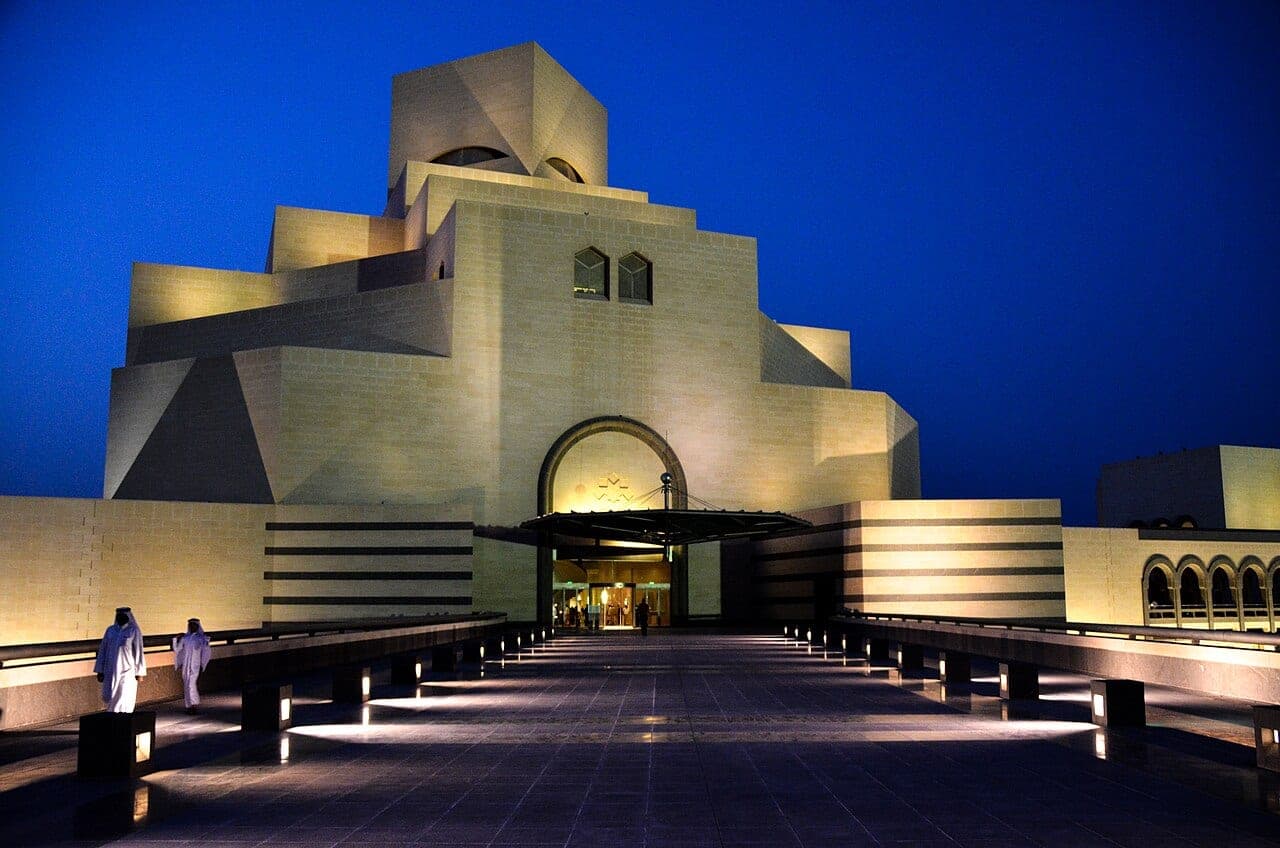
Qatar's heritage work is led by Qatar Museums, established in 2005 to build and connect the country's cultural institutions (Qatar Museums). Its flagship is the Museum of Islamic Art, designed by I. M. Pei and opened in 2008 on a purpose-built island off the Corniche. Drawing on Pei's study of historic Islamic architecture, in particular the ninth-century Ibn Tulun Mosque in Cairo, it houses one of the most comprehensive collections of Islamic art in the world, spanning three continents and some fourteen centuries (Wikipedia: Museum of Islamic Art, Doha).
The National Museum of Qatar, designed by Jean Nouvel and opened in March 2019, tells the country's own story through interlocking discs modelled on the desert rose, the crystal that forms in Qatar's sabkha; its galleries wrap around the restored twentieth-century palace of Sheikh Abdullah bin Jassim Al Thani, the historic seat of government preserved at the museum's heart (Wikipedia: National Museum of Qatar). The old market of Souq Waqif, whose name means "standing market", was restored between 2006 and 2008 after fire and decay, its mud-rendered shops and covered lanes rebuilt in mid-twentieth-century style (Wikipedia: Souq Waqif). Nearby stands Al Koot Fort, completed in 1927 under Sheikh Abdullah bin Jassim Al Thani to police the market and now a heritage museum (Wikipedia: Al Koot Fort). Furthest from the city, the Al Zubarah Archaeological Site joined the UNESCO World Heritage List in 2013 as the best-preserved pearling and trading town of the eighteenth- and nineteenth-century Gulf (UNESCO: Al Zubarah).
Because so much of Qatar's history is recorded in archives held abroad, digitisation has become central to preserving it. The Qatar Digital Library, a partnership between Qatar Foundation, Qatar National Library and the British Library launched in 2014, has placed hundreds of thousands of pages online, drawn from the India Office records and other Gulf collections alongside medieval Arabic scientific manuscripts, all freely available in Arabic and English, and now a primary resource for researching the region's modern history (Qatar Digital Library).
Within the country, the Qatar National Library preserves and digitises manuscripts, maps, photographs and rare printed works relating to Qatar and the Gulf (Qatar National Library). Qatar Museums has opened parts of its collections online, and the excavation of Al Zubarah has been supported by digital survey and three-dimensional recording that document the buried town without disturbing it.
The new Qatar has become a stage for art and ideas. Qatar Museums has commissioned public works, including Richard Serra's steel plates in the interior desert and Damien Hirst's bronzes on human gestation outside a Doha hospital. Mathaf, the Arab Museum of Modern Art, and the Katara Cultural Village add modern art, concerts, exhibitions and an annual dhow festival.
Film and literature have grown alongside the visual arts. The Doha Film Institute supports Arab and international cinema and runs the Ajyal youth film festival, and Qatari authors such as Abdulaziz Al Mahmoud, whose historical novel of Gulf piracy reached a wide readership, have brought local history to new audiences. The media network Al Jazeera, founded in Doha in 1996, gave the country an outsized presence in the Arab public sphere, and the 2022 World Cup served as a showcase for Qatari heritage, from stadium designs based on the dhow and the Bedouin tent to the imagery of falconry and pearling woven through the tournament.
Al Zubarah joins the World Heritage List. In 2013 the buried pearling town became Qatar's first UNESCO World Heritage Site, recognised as an exceptionally complete record of the economy that built the country and protected by ongoing excavation and conservation.
A palace at the centre of a museum. The National Museum of Qatar, opened in 2019, was built around the restored palace of Sheikh Abdullah bin Jassim Al Thani rather than replacing it, keeping the historic seat of the ruling family as the physical and symbolic core of the nation's story.
A century of Gulf records goes online. The Qatar Digital Library has made vast archives of Gulf history and Arabic science freely available worldwide, turning documents once seen only by specialists into a shared resource.
Falconry kept alive. Recognised by UNESCO in 2010 as a living human heritage shared across many nations, falconry in Qatar is sustained by the Souq Waqif falcon market and hospital and passed from parents to children in the desert, keeping a Bedouin skill current (UNESCO decision inscribing falconry, 2010).
Al Zubarah was a pearling and trading town abandoned in the nineteenth century and buried by sand, which left the street plan of a Gulf town intact beneath it. Photograph by Richard Mortel, CC BY 2.0, via Wikimedia Commons.
The Al Thani family rose to lead the peninsula in the nineteenth century. In 1868 the British political resident Lewis Pelly negotiated an agreement with Sheikh Mohammed bin Thani that recognised Qatar as distinct from Bahrain, a turning point in the emergence of a separate Qatari polity (Encyclopaedia Britannica: Qatar). His son Jassim bin Mohammed Al Thani, regarded as the founder of the modern state, resisted external control, and in 1893 Qatari forces checked an Ottoman expedition at the Battle of Al Wajbah, still commemorated on Qatar's National Day. An Ottoman garrison held Doha from 1871 until 1913, and in 1916 a treaty made Qatar a British protectorate, with Britain managing its external affairs.
The pearling economy collapsed in the 1930s, undercut by Japanese cultured pearls and the global depression, and the peninsula fell into hardship. Relief came from beneath the ground: oil was discovered at Dukhan in 1939, and after wartime delay exports began in 1949. When Britain announced its withdrawal from the Gulf, Qatar declared full independence on 3 September 1971. Revenue from oil and the North Field gas reserves has since funded rapid modernisation, an expansion into global media and diplomacy, and the cultural building programme that defines Doha today.
Arabic is the official language, and the everyday speech of Qataris is a variety of Gulf Arabic, or Khaleeji, shared in its broad features with neighbouring communities around the Gulf. The large expatriate presence means English, Hindi, Urdu, Malayalam and Persian are heard constantly in Doha, yet Arabic remains the language of government, worship, poetry and family life.
The origin of the name Qatar is debated. Many scholars point to the geographer Ptolemy, whose second-century map of the Arabian coast marks a place read as "Catara" or "Catharrae" in the position of the peninsula, one of the earliest apparent references to the region. Others connect the name to the Arabic root behind muqatarah, a form of trade in which goods were bought in sealed containers at a fixed price without weighing or measuring, said to have been common in the peninsula's markets (Wikipedia: Qatar). Whatever its true source, the name has attached to this stretch of coast for a very long time.
Qatari culture grew from the meeting of the desert and the sea, and its emblems come from both. Falconry, the training of hunting falcons to take game across the open desert, was a practical Bedouin skill before it became a cherished pastime, and it remains close to the heart of national identity; the falcon appears on the state emblem, and the Souq Waqif falcon market and its dedicated falcon hospital draw enthusiasts from across the Gulf.
From the sea comes the dhow, the wooden vessel that carried pearl divers, fishermen and traders; boat-building, the pearling songs and the diving season survive in festivals, museums and the annual dhow gatherings along the Corniche. The majlis, the reception space where men meet to talk, settle disputes, recite poetry and welcome guests, is the social heart of Qatari life, and was inscribed on UNESCO's list of intangible cultural heritage in 2015 as a shared Gulf tradition (UNESCO Intangible Cultural Heritage: Qatar). Poetry, especially the colloquial Nabati verse of the Bedouin, carries genealogy, elegy and praise, and remains a living art.
Craft traditions include Al Sadu, the geometric weaving of camel and sheep wool by Bedouin women, and the making of the bisht, the formal cloak. At the table, Qatari hospitality centres on machboos, spiced rice cooked with meat or fish; harees, a wheat-and-meat porridge served at Ramadan and weddings; and sweets such as luqaimat, fried dumplings in date syrup. Arabic coffee, gahwa, spiced with cardamom and poured in small cups alongside dates, is the standing ritual of welcome, recognised on the UNESCO list as a symbol of generosity.
Islam is the official religion of Qatar and the framework of public and family life. The great majority of Qatari nationals are Sunni Muslims, sharing in the Hanbali legal tradition that shaped the wider Gulf, and Islamic principles inform the country's law and its calendar. The calls to prayer, the fast and communal meals of Ramadan, the two Eids and the giving of zakat all order the year.
Mosques range from small neighbourhood prayer halls to the large Imam Muhammad ibn Abd al-Wahhab Mosque, the state mosque in Doha, and observance shapes dress, hospitality and the working week, which pauses for the Friday congregational prayer. Qatar's migrant population has brought communities of other faiths, chiefly Christians and Hindus; several churches serving them were built at a dedicated religious complex on the edge of Doha in the late 2000s, where worship is permitted for non-Muslim residents.
Death in Qatar is met quickly, simply and communally, in keeping with Islamic practice. The body is washed by close relatives of the same sex, a rite known as ghusl, then wrapped in a plain white shroud, the kafan (Wikipedia: Islamic funeral). The funeral prayer, salat al-janazah, is offered by the gathered community, usually on the day of death or the following morning, and the deceased is laid in the cemetery on the right side facing Mecca in a grave kept deliberately modest, often marked by nothing more than a plain stone. Elaborate tombs are avoided, in the belief that all are equal in death.
What follows is the aza, the condolence gathering, one of the strongest institutions of Qatari social life and a place where Bedouin custom and Islamic practice meet. For three days the bereaved family receives visitors, men and women in separate spaces, most often in the home majlis or a marquee raised outside. Relatives and neighbours take over the household's cooking so that a house in mourning need not light its own stove, verses of the Qur'an are recited, and the refrain of condolence is that the dead belong to God and to Him they return. A widow observes the Qur'anic waiting period, the iddah, of four months and ten days. Bedouin tradition adds the marthiya, the oral elegy in which a poet mourns the dead and recalls their standing and generosity. Beyond the mourning days, families give sadaqah, charity in the name of the deceased, and visit the cemetery on the mornings of the two Eids to greet the dead and tidy their graves. For Qataris, giving each person a known grave and a spoken name completes the work of grief.
Qatari records are tribal, legal and comparatively recent as state documents, and the country has spent the last two decades building an archive to fix that.
Descent is the framework. Qatari families place themselves by tribe and by whether they are hadhar or badu, and the recitation is exact. Sharia court registers hold marriage and inheritance, and the pearling trade before oil left ledgers of advances and debts as it did in Bahrain and Kuwait.
The state's own civil registration developed through the twentieth century and is administered through the identity number system.
The nationality law, like Kuwait's, ties citizenship to residence before a fixed date, in Qatar's case 1930, and families who cannot document it are in a weaker category. The Al Ghufran clan case, in which a large number of people lost citizenship in the mid-2000s, is the sharpest recent example of a genealogy having legal force.
The Qatar Digital Library is the substantial contribution. A partnership with the British Library has digitised and published, free, hundreds of thousands of pages of India Office records relating to the Gulf: the British Residency correspondence, the tribal genealogies British officials compiled, the pearling and slavery reports, and the maps. It is now the best single source for the history of every state on this coast, and Qatar paid for it.
The oral tradition, the nabati poetry that records events and lineages, carries what the documents do not.
Qatar's heritage work is led by Qatar Museums, established in 2005 to build and connect the country's cultural institutions (Qatar Museums). Its flagship is the Museum of Islamic Art, designed by I. M. Pei and opened in 2008 on a purpose-built island off the Corniche. Drawing on Pei's study of historic Islamic architecture, in particular the ninth-century Ibn Tulun Mosque in Cairo, it houses one of the most comprehensive collections of Islamic art in the world, spanning three continents and some fourteen centuries (Wikipedia: Museum of Islamic Art, Doha).
The National Museum of Qatar, designed by Jean Nouvel and opened in March 2019, tells the country's own story through interlocking discs modelled on the desert rose, the crystal that forms in Qatar's sabkha; its galleries wrap around the restored twentieth-century palace of Sheikh Abdullah bin Jassim Al Thani, the historic seat of government preserved at the museum's heart (Wikipedia: National Museum of Qatar). The old market of Souq Waqif, whose name means "standing market", was restored between 2006 and 2008 after fire and decay, its mud-rendered shops and covered lanes rebuilt in mid-twentieth-century style (Wikipedia: Souq Waqif). Nearby stands Al Koot Fort, completed in 1927 under Sheikh Abdullah bin Jassim Al Thani to police the market and now a heritage museum (Wikipedia: Al Koot Fort). Furthest from the city, the Al Zubarah Archaeological Site joined the UNESCO World Heritage List in 2013 as the best-preserved pearling and trading town of the eighteenth- and nineteenth-century Gulf (UNESCO: Al Zubarah).
Because so much of Qatar's history is recorded in archives held abroad, digitisation has become central to preserving it. The Qatar Digital Library, a partnership between Qatar Foundation, Qatar National Library and the British Library launched in 2014, has placed hundreds of thousands of pages online, drawn from the India Office records and other Gulf collections alongside medieval Arabic scientific manuscripts, all freely available in Arabic and English, and now a primary resource for researching the region's modern history (Qatar Digital Library).
Within the country, the Qatar National Library preserves and digitises manuscripts, maps, photographs and rare printed works relating to Qatar and the Gulf (Qatar National Library). Qatar Museums has opened parts of its collections online, and the excavation of Al Zubarah has been supported by digital survey and three-dimensional recording that document the buried town without disturbing it.
The new Qatar has become a stage for art and ideas. Qatar Museums has commissioned public works, including Richard Serra's steel plates in the interior desert and Damien Hirst's bronzes on human gestation outside a Doha hospital. Mathaf, the Arab Museum of Modern Art, and the Katara Cultural Village add modern art, concerts, exhibitions and an annual dhow festival.
Film and literature have grown alongside the visual arts. The Doha Film Institute supports Arab and international cinema and runs the Ajyal youth film festival, and Qatari authors such as Abdulaziz Al Mahmoud, whose historical novel of Gulf piracy reached a wide readership, have brought local history to new audiences. The media network Al Jazeera, founded in Doha in 1996, gave the country an outsized presence in the Arab public sphere, and the 2022 World Cup served as a showcase for Qatari heritage, from stadium designs based on the dhow and the Bedouin tent to the imagery of falconry and pearling woven through the tournament.
Al Zubarah joins the World Heritage List. In 2013 the buried pearling town became Qatar's first UNESCO World Heritage Site, recognised as an exceptionally complete record of the economy that built the country and protected by ongoing excavation and conservation.
A palace at the centre of a museum. The National Museum of Qatar, opened in 2019, was built around the restored palace of Sheikh Abdullah bin Jassim Al Thani rather than replacing it, keeping the historic seat of the ruling family as the physical and symbolic core of the nation's story.
A century of Gulf records goes online. The Qatar Digital Library has made vast archives of Gulf history and Arabic science freely available worldwide, turning documents once seen only by specialists into a shared resource.
Falconry kept alive. Recognised by UNESCO in 2010 as a living human heritage shared across many nations, falconry in Qatar is sustained by the Souq Waqif falcon market and hospital and passed from parents to children in the desert, keeping a Bedouin skill current (UNESCO decision inscribing falconry, 2010).
National Overview
Notable Cities
Historical Foundations
Linguistic and Etymological Roots
Cultural Identity
Religion and Spirituality
Remembrance and Mourning Traditions
Tracing a Family in Qatar
Heritage Preservation Efforts
Digital Heritage
Contemporary Cultural Influences
Success Stories
References and resources
- UNESCO World Heritage Centre: Al Zubarah Archaeological Site
- UNESCO Intangible Cultural Heritage: Qatar elements
- UNESCO: decision inscribing falconry as a living human heritage (2010)
- Encyclopaedia Britannica: Qatar
- Wikipedia: Qatar
- Wikipedia: Al Zubarah
- Wikipedia: Museum of Islamic Art, Doha
- Wikipedia: National Museum of Qatar
- Wikipedia: Souq Waqif
- Wikipedia: Al Koot Fort
- Qatar Museums
- Qatar Digital Library
- Qatar National Library